Modern European thinkers, renaissance & early modern: Campanella to Riccioli
- 1
 PhilosopherModern European1568 – 1639
Tommaso Campanella
Tommaso Campanella, baptized Giovanni Domenico Campanella, was an Italian Dominican friar, philosopher, theologian, astrologer, and poet. Campanella was prosecuted by the Roman Inquisition for heresy in 1594 and was confined to house arrest for two years.
- ◆Utopia
- ◆political philosophy
Read the full pageTommaso Campanella (Italian: [tomˈmaːzo kampaˈnɛlla]; 5 September 1568 – 21 May 1639), baptized Giovanni Domenico Campanella, was an Italian Dominican friar, philosopher, theologian, astrologer, and poet.
Campanella was prosecuted by the Roman Inquisition for heresy in 1594 and was confined to house arrest for two years. Accused of conspiring against the Spanish rulers of Calabria in 1599, he was tortured and sent to prison, where he spent 27 years. He wrote his most significant works during this time, including The City of the Sun, a utopia describing an egalitarian theocratic society where property is held in common.
- 2
 PhilosopherModern European1570 – 1637
Péter Pázmány
Péter Pázmány de Panasz, S.J., was a Hungarian Jesuit who was a noted philosopher, theologian, cardinal, pulpit orator and statesman. He was an important figure in the Counter-Reformation in Royal Hungary.
Read the full pagePéter Pázmány de Panasz, S.J., was a Hungarian Jesuit who was a noted philosopher, theologian, cardinal, pulpit orator and statesman. He was an important figure in the Counter-Reformation in Royal Hungary.
Pázmány's most important legacy was his creation of the Hungarian literary language. As an orator he was dubbed "the Hungarian Cicero in the purple". In 1867, a street in Vienna, the Pazmanitengasse, was named after him.
- 3
 PhilosopherModern European1571 – 1653
Lucrezia Marinella
Lucrezia Marinella was a poet, writer, philosopher, polemicist, and women's rights advocate from the Republic of Venice. She is best known for her polemical treatise The Nobility and Excellence of Women and the Defects and Vices of Men.
- ◆''Amore innamorato
- ◆et impazzato''
Read the full pageLucrezia Marinella (1571–1653) was a poet, writer, philosopher, polemicist, and women's rights advocate from the Republic of Venice. She is best known for her polemical treatise The Nobility and Excellence of Women and the Defects and Vices of Men (1600). Her works have been noted for bringing women into the philosophical and scientific community during the late Renaissance.
Lucrezia Marinella was the daughter of a physician and natural philosopher, Giovanni Marinelli, who wrote novels, some of which were on women’s well-being, hygiene and beauty. Although her father was not from Venice, Lucrezia and her family were "cittadinaza." Her brother, Curzo Marinella, was also a physician and Lucrezia married the physician Girolamo Vacca. None of her children seem to have been born in Venice. Her father might have been the vital link between her private studies and the writing and the wider world of Venetian literary circles, including the Accademia de’ Desiosi.
- 4
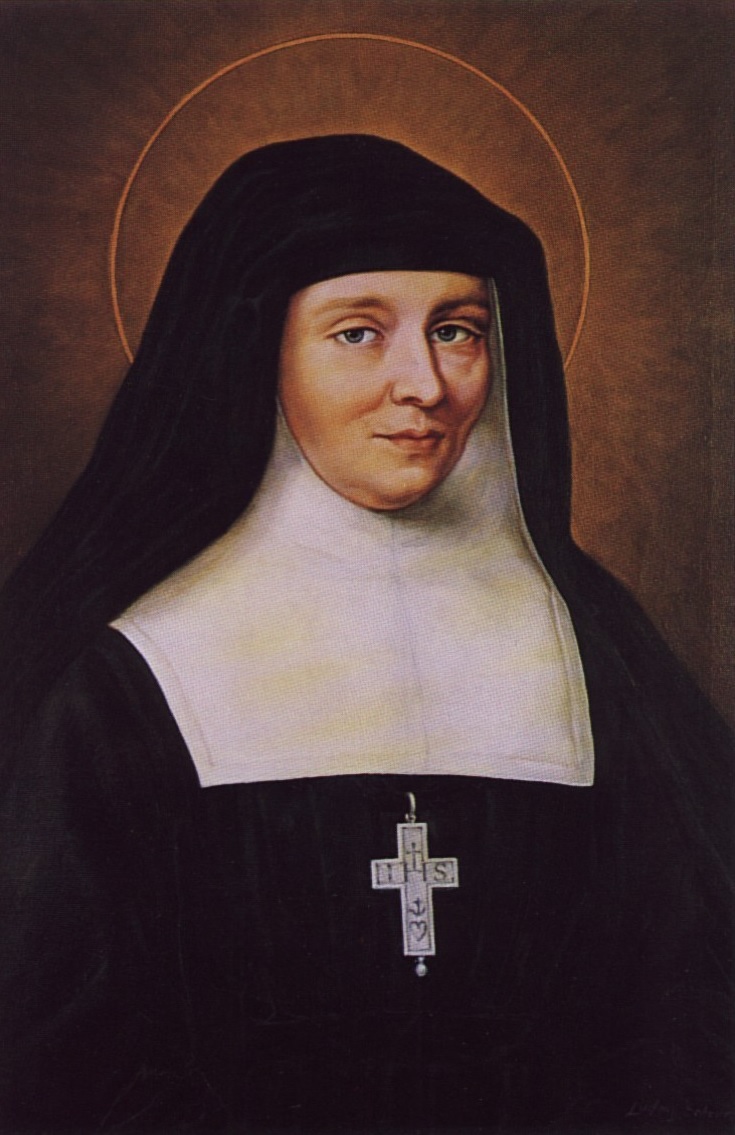 PhilosopherModern European1572 – 1641
Jane Frances de Chantal
Jane Frances de Chantal, born Jeanne-Françoise Frémyot, Baroness of Chantal, was a French Catholic noble widow and nun who was beatified in 1751 and canonized in 1767. She founded the Order of the Visitation of Holy Mary.
Read the full pageJane Frances de Chantal , born Jeanne-Françoise Frémyot, Baroness of Chantal (French: [ʒan fʁɑ̃swaz fʁemjo]; 28 January 1572 – 13 December 1641), was a French Catholic noble widow and nun who was beatified in 1751 and canonized in 1767. She founded the Order of the Visitation of Holy Mary. The religious order accepted women who were rejected by other orders because of poor health or age.
When people criticized her, Chantal famously said, "What do you want me to do? I like sick people myself; I'm on their side." During its first eight years, the new order also was unusual in its public outreach, in contrast to most female religious orders who remained cloistered and adopted strict ascetic practices.
- 5
 PhilosopherModern European1575 – 1624
Jakob Böhme
Jakob Böhme was a German philosopher, Christian mystic, and Lutheran Protestant theologian. He was considered an original thinker by many of his contemporaries within the Lutheran tradition, and his first book, commonly known as Aurora, caused a great scandal.
- ◆Boehmian theosophy
Read the full pageJakob Böhme (; German: [ˈbøːmə]; 24 April 1575 – 17 November 1624) was a German philosopher, Christian mystic, and Lutheran Protestant theologian. He was considered an original thinker by many of his contemporaries within the Lutheran tradition, and his first book, commonly known as Aurora, caused a great scandal. In contemporary English, his name may be spelled Jacob Boehme (retaining the older German spelling); in seventeenth-century England it was also spelled Behmen, approximating the contemporary English pronunciation of the German Böhme.
Böhme had a profound influence on later philosophical movements such as German idealism and German Romanticism. Hegel described Böhme as "the first German philosopher".
- 6
 PhilosopherModern European1585 – 1640
Uriel da Costa
Uriel da Costa was a Portuguese Sephardi philosopher who was born a New Christian but returned to Judaism, whereupon he questioned the Catholic and rabbinic orthodoxies of his time. This led him into conflict with both Christian and Jewish institutions: his books were placed on the Index Librorum Prohibitorum and sever
Read the full pageUriel da Costa (Portuguese: [uɾiˈɛl dɐ ˈkɔʃtɐ]; also Acosta or d'Acosta; c. 1585 – April 1640) was a Portuguese Sephardi philosopher who was born a New Christian but returned to Judaism, whereupon he questioned the Catholic and rabbinic orthodoxies of his time. This led him into conflict with both Christian and Jewish institutions: his books were placed on the Index Librorum Prohibitorum and several Jewish authorities excommunicated him. His iconoclastic life culminated in suicide in c. 1640.
His short autobiography contains many details about his life, but over the past two centuries, documents uncovered in Portugal, Amsterdam, Hamburg, and elsewhere have added much to the picture.
- 7
 PhilosopherModern European1586 – 1617
Rose of Lima
Rose of Lima (Latin: Rosa Limana, Spanish: Rosa de Lima), was a member of the Third Order of Saint Dominic in Lima, Peru, Spanish Empire, who became known for both her life of severe penance and her care of the poverty stricken of the city through her own private efforts. Rose of Lima was born to a noble family and is
Read the full pageRose of Lima (born Isabel Flores de Oliva; 20 April 1586 – 24 August 1617) (Latin: Rosa Limana, Spanish: Rosa de Lima), was a member of the Third Order of Saint Dominic in Lima, Peru, Spanish Empire, who became known for both her life of severe penance and her care of the poverty stricken of the city through her own private efforts.
Rose of Lima was born to a noble family and is the patron saint of embroidery, gardening, and cultivation of blooming flowers. She was the first person born in the Americas to be canonized as a saint.
- 8
 PhilosopherModern European1586 – 1654
Johannes Valentinus Andreae
Johannes Valentinus Andreae, also known as Johannes Valentinus Andreä or Johann Valentin Andreae, was a German theologian and writer. He is generally considered to be the author of the Rosicrucian text known as the Chymische Hochzeit Christiani Rosencreutz anno 1459, based on an earlier unpublished novel of his titled
Read the full pageJohannes Valentinus Andreae (17 August 1586 – 27 June 1654), also known as Johannes Valentinus Andreä or Johann Valentin Andreae, was a German theologian and writer.
He is generally considered to be the author of the Rosicrucian text known as the Chymische Hochzeit Christiani Rosencreutz anno 1459 (published in 1616, Strasbourg; in English Chymical Wedding of Christian Rosenkreutz in 1459), based on an earlier unpublished novel of his titled Chymische Hochzeit (Chemical Wedding) written in 1607. This became one of the three founding works of Rosicrucianism, which was a popular occult Protestant movement founded in Germany.
- 9
 PhilosopherModern European1588 – 1648
Marin Mersenne
Marin Mersenne, OM was a French polymath whose works touched a wide variety of fields. He is perhaps best known today among mathematicians for Mersenne prime numbers, those written in the form Mn = 2n − 1 for some integer n.
- ◆Mersenne primes
- ◆Mersenne's conjecture
- ◆Mersenne's laws
- ◆Acoustics
Read the full pageMarin Mersenne, OM (also known as Marinus Mersennus or le Père Mersenne; French: [maʁɛ̃ mɛʁsɛn]; 8 September 1588 – 1 September 1648) was a French polymath whose works touched a wide variety of fields. He is perhaps best known today among mathematicians for Mersenne prime numbers, those written in the form Mn = 2n − 1 for some integer n. He also developed Mersenne's laws, which describe the harmonics of a vibrating string (such as may be found on guitars and pianos), and his seminal work on music theory, Harmonie universelle, for which he is referred to as the "father of acoustics".
Mersenne, an ordained Catholic priest, had many contacts in the scientific world and has been called "the center of the world of science and mathematics during the first half of the 1600s" and, because of his ability to make connections between people and ideas, "the post-box of Europe". He was also a member of the ascetical Minim religious order and wrote and lectured on theology and philosophy.
- 10
 PhilosopherModern European1588 – 1653
Robert Filmer
Sir Robert Filmer was an English political theorist who defended the divine right of kings. His best known work, Patriarcha, published posthumously in 1680, was the target of numerous Whig rebuttals, including Algernon Sidney's Discourses Concerning Government, James Tyrrell's Patriarcha Non Monarcha and John Locke's T
- ◆Divine right of kings
- ◆Patriarchalism
Read the full pageSir Robert Filmer (c. 1588 – 26 May 1653) was an English political theorist who defended the divine right of kings. His best known work, Patriarcha, published posthumously in 1680, was the target of numerous Whig rebuttals, including Algernon Sidney's Discourses Concerning Government, James Tyrrell's Patriarcha Non Monarcha and John Locke's Two Treatises of Government. Filmer also wrote critiques of Thomas Hobbes, John Milton, Hugo Grotius and Aristotle.
The eldest child of Sir Edward Filmer and Elizabeth Filmer (née Argall) of East Sutton in Kent, he matriculated at Trinity College, Cambridge, in 1604. He did not take a degree and was admitted to Lincoln's Inn on 24 January 1605. He was called to the bar in 1613, but there is no evidence he practised law. He bought the porter's lodge at Westminster Abbey for use as his town house. On 8 August 1618, he married Anne Heton in St Leonard's Church in London, with their first child baptised in February 1620. On 24 January 1619, King James I knighted Filmer at Newmarket.
- 11
 PhilosopherModern European1592 – 1670
John Amos Comenius
John Amos Comenius was a Czech philosopher, pedagogue and theologian who is considered the father of modern education. He served as the last bishop of the Unity of the Brethren (direct predecessor of the Moravian Church) before becoming a religious refugee and one of the earliest champions of universal education, a con
Read the full pageJohn Amos Comenius (; Czech: Jan Amos Komenský; German: Johann Amos Comenius; Polish: Jan Amos Komeński; Latinized: Ioannes Amos Comenius; 28 March 1592 – 15 November 1670) was a Czech philosopher, pedagogue and theologian who is considered the father of modern education. He served as the last bishop of the Unity of the Brethren (direct predecessor of the Moravian Church) before becoming a religious refugee and one of the earliest champions of universal education, a concept eventually set forth in his book Didactica Magna. As an educator and theologian, he led schools and advised governments across Protestant Europe through the middle of the seventeenth century and proposed the pedagogical concept of pansophism.
Comenius introduced a number of educational concepts and innovations including pictorial textbooks written in native languages instead of Latin, teaching based in gradual development from simple to more comprehensive concepts, lifelong learning with a focus on logical thinking over dull memorization, equal opportunity for impoverished children, education for women, and universal and practical instruction. He also believed heavily in the connection between nature, religion, and knowledge, in which he stated that knowledge is born from nature and nature from God.
- 12
 PhilosopherModern European1598 – 1671
Giovanni Battista Riccioli
Giovanni Battista Riccioli was an Italian astronomer and a Catholic priest in the Jesuit order. He is known, among other things, for his experiments with pendulums and with falling bodies, for his discussion of 126 arguments concerning the motion of the Earth, and for introducing the current scheme of lunar nomenclatur
- ◆lunar nomenclature
Read the full pageGiovanni Battista Riccioli (17 April 1598 – 25 June 1671) was an Italian astronomer and a Catholic priest in the Jesuit order. He is known, among other things, for his experiments with pendulums and with falling bodies, for his discussion of 126 arguments concerning the motion of the Earth, and for introducing the current scheme of lunar nomenclature. He is also widely known for discovering the first double star. He argued that the rotation of the Earth should reveal itself because on a rotating Earth, the ground moves at different speeds at different latitudes.
The asteroid 122632 Riccioli is named after him.