Modern European thinkers, 19th century: Whewell to Ruge
- 1
 PhilosopherModern European1794 – 1866
William Whewell
William Whewell was an English polymath. He was Master of Trinity College, Cambridge.
- ◆scientist
- ◆physicist
- ◆anode
- ◆cathode
Read the full pageWilliam Whewell ( HEW-əl; 24 May 1794 – 6 March 1866) was an English polymath. He was Master of Trinity College, Cambridge. In his time as a student there, he achieved distinction in both poetry and mathematics.
The breadth of Whewell's endeavours is his most remarkable feature. In a time of increasing specialisation, Whewell belonged in an earlier era when natural philosophers investigated widely. He published work in mechanics, physics, geology, astronomy, and economics, while also composing poetry, writing a Bridgewater Treatise, translating the works of Goethe, and writing sermons and theological tracts. In mathematics, Whewell introduced what is now called the Whewell equation, defining the shape of a curve without reference to an arbitrarily chosen coordinate system. He also organized thousands of volunteers internationally to study ocean tides, in what is now considered one of the first citizen science projects. He received the Royal Medal for this work in 1837.
- 2
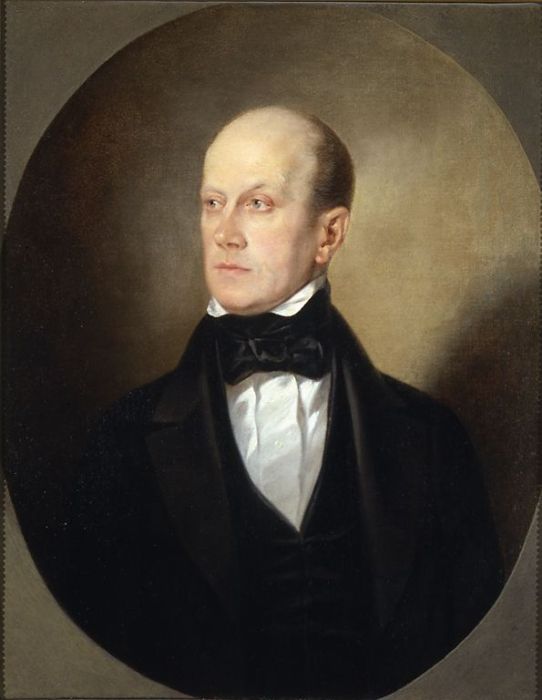 PhilosopherModern European1794 – 1856
Pyotr Chaadayev
Pyotr or Petr Yakovlevich Chaadayev was a Russian philosopher. He was one of the Russian Schellingians.
Read the full pagePyotr or Petr Yakovlevich Chaadayev (Russian: Пётр Я́ковлевич Чаада́ев; also spelled Chaadaev; 7 June [27 May O.S.] 1794 – 26 April [14 April O.S.] 1856) was a Russian philosopher. He was one of the Russian Schellingians.
Chaadayev was born in Moscow into a wealthy noble family. He interrupted his education to join the military and served with distinction in the Napoleonic Wars. Chaadayev wrote eight "Philosophical Letters" about Russia in French between 1826 and 1831, which circulated among intellectuals in Russia in manuscript form for many years. They comprise an indictment of Russian culture for its laggard role far behind the leaders of Western civilization. He cast doubt on the greatness of the Russian past, and ridiculed Orthodoxy for failing to provide a sound spiritual basis for the Russian mind. He extolled the achievements of Europe, especially in rational and logical thought, its progressive spirit, its leadership in science, and its leadership on the path to freedom.
- 3
 PhilosopherModern European1795 – 1881
Thomas Carlyle
Thomas Carlyle was a Scottish essayist, historian and philosopher. Known as the "sage of Chelsea", his writings strongly influenced the intellectual and artistic culture of the Victorian era.
- ◆Carlyleanism
- ◆Natural Supernaturalism
- ◆Meaning of life
- ◆Speech is silver, silence is golden
- ◆Great Man theory
- ◆Condition-of-England question
Read the full pageThomas Carlyle (4 December 1795 – 5 February 1881) was a Scottish essayist, historian and philosopher. Known as the "sage of Chelsea", his writings strongly influenced the intellectual and artistic culture of the Victorian era.
Carlyle was born in Ecclefechan, a village in Dumfriesshire. He attended the University of Edinburgh, where he excelled in mathematics and invented the Carlyle circle. After finishing the arts course he prepared to become a minister in the Burgher Church while working as a schoolmaster. He quit these and several other endeavours before settling on literature, writing for the Edinburgh Encyclopædia and working as a translator. He initially gained prominence in English-language literary circles for his extensive writing on German Romantic literature and philosophy. These themes were explored in his first major work, a semi-autobiographical philosophical novel entitled Sartor Resartus (1833–34).
- 4
 PhilosopherModern European1797 – 1855
Antonio Rosmini
Antonio Francesco Davide Ambrogio Rosmini-Serbati, IC was an Italian Catholic priest and philosopher. He founded the Rosminians, officially the Institute of Charity, and pioneered the concept of social justice and Italian Liberal Catholicism.
Read the full pageAntonio Francesco Davide Ambrogio Rosmini-Serbati, IC (Italian pronunciation: [anˈtɔːnjo roˈzmiːni serˈbaːti]; 25 March 1797 – 1 July 1855) was an Italian Catholic priest and philosopher. He founded the Rosminians, officially the Institute of Charity, and pioneered the concept of social justice and Italian Liberal Catholicism.
Alessandro Manzoni considered Rosmini the only contemporary Italian author worth reading. Rosmini has been beatified in the Catholic Church.
- 5
 PhilosopherModern European1798 – 1857
Auguste Comte
Isidore Auguste Marie François Xavier Comte was a French philosopher and writer who formulated the doctrine of positivism. He is often regarded as the first philosopher of science in the modern sense of the term.
- ◆Altruism
- ◆Hierarchy of the sciences
- ◆Law of three stages
- ◆Positivist calendar
- ◆Religion of Humanity
- ◆Sociological positivism
Read the full pageIsidore Auguste Marie François Xavier Comte (; French: [oɡyst(ə) kɔ̃t] ; 19 January 1798 – 5 September 1857) was a French philosopher and writer who formulated the doctrine of positivism. He is often regarded as the first philosopher of science in the modern sense of the term. Comte's ideas were fundamental to the development of sociology, as he coined the term and treated the discipline as the crowning achievement of the sciences.
Influenced by Henri de Saint-Simon, Comte's work attempted to remedy the social disorder caused by the French Revolution, which he believed indicated an imminent transition to a new form of society. He sought to establish a new social doctrine based on science, which he labeled positivism. He had a major impact on 19th-century thought, influencing the work of social thinkers such as John Stuart Mill and George Eliot. His concept of Sociology and social evolutionism set the tone for early social theorists and anthropologists such as Harriet Martineau and Herbert Spencer, evolving into modern academic sociology presented by Émile Durkheim as practical and objective social research.
- 6
 PhilosopherModern European1798 – 1837
Giacomo Leopardi
Count Giacomo Taldegardo Francesco Salesio Saverio Pietro Leopardi was an Italian philosopher, poet, essayist, and philologist. Regarded as a major figure in 19th-century Italian literature, he is often cited alongside Alessandro Manzoni as a central figure of Italian Romanticism, despite holding distinct and frequentl
- ◆Philosophical pessimism
Read the full pageCount Giacomo Taldegardo Francesco Salesio Saverio Pietro Leopardi (29 June 1798 – 14 June 1837) was an Italian philosopher, poet, essayist, and philologist.
Regarded as a major figure in 19th-century Italian literature, he is often cited alongside Alessandro Manzoni as a central figure of Italian Romanticism, despite holding distinct and frequently opposing views on religion and aesthetics. Raised in Recanati, a secluded town within the conservative Papal States, Leopardi gained access to an extensive library that enabled him to engage with classical literature and Enlightenment philosophy with more depth. His poetic and prose works explore themes of existential pessimism, materialism, human suffering, and the nature of happiness, which earned him recognition as a radical thinker. His development of a distinct lyrical style and his philosophical writing, notably collected in the Zibaldone, established his reputation in international literary and among philosophical scholars.
- 7
 PhilosopherModern European1798 – 1876
František Palacký
František Palacký was a Czech historian and politician. He was the most influential person of the Czech National Revival, called "Father of the Nation".
Read the full pageFrantišek Palacký (Czech pronunciation: [ˈfraɲcɪʃɛk ˈpalatskiː]; 14 June 1798 – 26 May 1876) was a Czech historian and politician. He was the most influential person of the Czech National Revival, called "Father of the Nation".
František Palacký was born on 14 June 1798, at Hodslavice house 108, a northeastern Moravian village now part of the Moravian-Silesian Region of the Czech Republic. His ancestors had been members of the community of the Bohemian Brethren, and had clandestinely maintained their Protestant belief throughout the period of religious persecution, eventually giving their adherence to the Augsburg confession as approximate to their original faith. Palacký's father was a schoolmaster and a man of some learning. The son was sent in 1812 to the Evangelic Lutheran Lyceum at the then-Hungarian city of Bratislava, where he came in contact with the philologist Pavel J. Šafařík and became a zealous student of Slavic languages (he mastered 11 languages and became familiar with a few others).
- 8
 PhilosopherModern European1801 – 1887
Gustav Fechner
Gustav Theodor Fechner was a German physicist, philosopher, and experimental psychologist. A pioneer in experimental psychology and founder of psychophysics (techniques for measuring the mind), he inspired many 20th-century scientists and philosophers.
- ◆Weber–Fechner law
Read the full pageGustav Theodor Fechner (; German: [ˈfɛçnɐ]; 19 April 1801 – 18 November 1887) was a German physicist, philosopher, and experimental psychologist. A pioneer in experimental psychology and founder of psychophysics (techniques for measuring the mind), he inspired many 20th-century scientists and philosophers. He is also credited with demonstrating the non-linear relationship between psychological sensation and the physical intensity of a stimulus via the formula: S=KlnI, which became known as the Weber–Fechner law.
Fechner was born at Groß Särchen, near Muskau, in Lower Lusatia, where his father, a maternal uncle, and his paternal grandfather were pastors. His mother, Johanna Dorothea Fechner (b. 1774), née Fischer, also came from a religious family. Some biographers consider, that despite these religious influences, Fechner became an atheist in later life, while others say that Fechner had his own religious system of belief, a synthesis of Christianity and paganism.
- 9
 PhilosopherModern European1801 – 1881
Émile Littré
Émile Maximilien Paul Littré was a French lexicographer, freemason and philosopher, best known for his Dictionnaire de la langue française, commonly called le Littré.
- ◆''Dictionnaire de la langue française''
Read the full pageÉmile Maximilien Paul Littré (French: [emil maksimiljɛ̃ pɔl litʁe]; 1 February 1801 – 2 June 1881) was a French lexicographer, freemason and philosopher, best known for his Dictionnaire de la langue française, commonly called le Littré.
Littré was born in Paris. His father, Michel-François Littré, had been a gunner and, later, a sergeant-major of marine artillery in the French navy who was deeply imbued with revolutionary ideas of the day. Settling down as a tax collector, he married Sophie Johannot, a free-thinker like himself, and devoted himself to the education of his son Émile. The boy was sent to the Lycée Louis-le-Grand, where Louis Hachette and Eugène Burnouf became his friends. After he completed his studies at the lycée, he was undecided as to what career he should adopt; however, he devoted himself to mastering the English and German languages, classical and Sanskrit literature, and philology.
- 10
 PhilosopherModern European1801 – 1852
Vincenzo Gioberti
Vincenzo Gioberti was an Italian Catholic priest, philosopher, publicist and politician who served as the Prime Minister of Sardinia from 1848 to 1849. He was a prominent spokesman for liberal Catholicism.
Read the full pageVincenzo Gioberti (Italian pronunciation: [vinˈtʃɛntso dʒoˈbɛrti]; 5 April 1801 – 26 October 1852) was an Italian Catholic priest, philosopher, publicist and politician who served as the Prime Minister of Sardinia from 1848 to 1849. He was a prominent spokesman for liberal Catholicism.
Gioberti was born in Turin, Italy. When very young he lost his parents, and at the age of sixteen was admitted among the clerics of the court. He studied theology at the University of Turin, and obtained his doctorate there.
- 11
 PhilosopherModern European1802 – 1872
Ion Heliade Rădulescu
Ion Heliade Rădulescu or Ion Heliade was a Wallachian, later Romanian academic, Romantic and Classicist poet, essayist, memoirist, short story writer, newspaper editor and politician. A prolific translator of foreign literature into Romanian, he was also the author of books on linguistics and history.
Read the full pageIon Heliade Rădulescu or Ion Heliade (also known as Eliade or Eliade Rădulescu; Romanian pronunciation: [ˈi.on (h)eliˈade rəduˈlesku]; 6 January 1802 – 27 April 1872) was a Wallachian, later Romanian academic, Romantic and Classicist poet, essayist, memoirist, short story writer, newspaper editor and politician. A prolific translator of foreign literature into Romanian, he was also the author of books on linguistics and history. For much of his life, Heliade Rădulescu was a teacher at Saint Sava College in Bucharest, which he helped reopen. He was a founding member and first president of the Romanian Academy.
Heliade Rădulescu is considered one of the foremost champions of Romanian culture from the first half of the 19th century, having first risen to prominence through his association with Gheorghe Lazăr and his support of Lazăr's drive for discontinuing education in Greek. Over the following decades, he had a major role in shaping the modern Romanian language, but caused controversy when he advocated the massive introduction of Italian neologisms into the Romanian lexis. A Romantic nationalist landowner siding with moderate liberals, Heliade was among the leaders of the 1848 Wallachian revolution, after which he was forced to spend several years in exile. Adopting an original form of conservatism, which emphasized the role of the aristocratic boyars in Romanian history, he was rewarded for supporting the Ottoman Empire and clashed with the radical wing of the 1848 revolutionaries.
- 12
 PhilosopherModern European1802 – 1880
Arnold Ruge
Arnold Ruge was a German philosopher and political writer. He was the older brother of Ludwig Ruge.
Read the full pageArnold Ruge (German: [ˈʁuːɡə]; 13 September 1802 – 31 December 1880) was a German philosopher and political writer. He was the older brother of Ludwig Ruge.
Born in Bergen auf Rügen, he studied at Halle, Jena and Heidelberg. As an advocate of a free and united Germany, he took part in the student agitations of 1821–1824 and was jailed from 1824 to 1830 in the fortress of Kolberg, where he studied Plato and the Greek poets. Moving to Halle on his release, he published a number of plays (including Schill und die Seinen, a tragedy) and translations of ancient Greek texts (e.g. Oedipus at Colonus). He became a Privatdozent at the University of Halle in 1832.