Chinese thinkers, ancient
- 1
 PhilosopherChinese521 – 481 BCE
Yan Hui
Yan Hui was a Chinese philosopher. He was the favorite disciple of Confucius and one of the most revered figures of Confucianism.
Read the full pageYan Hui (c. 521–481 BC) was a Chinese philosopher. He was the favorite disciple of Confucius and one of the most revered figures of Confucianism. He is venerated in Confucian temples as one of the Four Sages.
Yan Hui is also known by his courtesy name Ziyuan and as Yan Yuan, a combination of his surname and courtesy name. He is also reverently referred to as Master Yan or Yanzi.
- 2
 PhilosopherChinese504 – 435 BCE
Zengzi
Zeng Shen, better known as Zengzi (Master Zeng), courtesy name Ziyu (子輿), was a Chinese philosopher and disciple of Confucius. He later taught Zisi (Kong Ji), the grandson of Confucius, who was in turn the teacher of Mencius, thus beginning a line of transmitters of orthodox Confucian traditions.
Read the full pageZeng Shen (505–435 BC), better known as Zengzi (Master Zeng), courtesy name Ziyu (子輿), was a Chinese philosopher and disciple of Confucius. He later taught Zisi (Kong Ji), the grandson of Confucius, who was in turn the teacher of Mencius, thus beginning a line of transmitters of orthodox Confucian traditions. He is revered as one of the Four Sages of Confucianism.
Zeng Shen was 46 years younger than Confucius. He was a native of South Wu City in the State of Lu, and was the son of Zeng Dian, one of the earliest disciples of Confucius.
- 3
 PhilosopherChinese483 – 402 BCE
Zisi
Zisi, born Kong Ji, was a Chinese philosopher and the grandson of Confucius.
Read the full pageZisi (c. 481 – c. 402 BCE), born Kong Ji, was a Chinese philosopher and the grandson of Confucius.
Zisi was the son of Kong Li (孔鯉) (Boyu (伯鱼)) and the only grandson of Confucius. He is traditionally accredited with transmitting Confucian teaching to Mencius and writing the Doctrine of the Mean, Biaoji 表記, "Ziyi" (The Black Robes") 緇衣, and "Fangji" (The Record of the Dikes) 坊記, presently chapters of the Liji. (Since Zisi's dates of life do not overlap with those of Mengzi, it has been suggested that the intermediary role in the transmission was played by Shi Shuo 世碩.)
- 4PhilosopherChinese369 – 318 BCE
Yang Zhu
Yang Zhu, also known as Yangzi (Master Yang), was a Chinese philosopher during the Warring States period. An early ethical egoist alternative to Mohist and Confucian thought, Yang Zhu's surviving ideas appear primarily in the Chinese texts Huainanzi, Lüshi Chunqiu, Mengzi, and possibly the Liezi and Zhuangzi.
Read the full pageYang Zhu (; simplified Chinese: 杨朱; traditional Chinese: 楊朱; pinyin: Yáng Zhū; Wade–Giles: Yang Chu; 440–c.360 BC), also known as Yangzi (Master Yang), was a Chinese philosopher during the Warring States period. An early ethical egoist alternative to Mohist and Confucian thought, Yang Zhu's surviving ideas appear primarily in the Chinese texts Huainanzi, Lüshi Chunqiu, Mengzi, and possibly the Liezi and Zhuangzi. He founded the philosophical school of Yangism.
The philosophies attributed to Yang Zhu, as presented in the Liezi, clash with the primarily Daoist influence of the rest of the work. Of particular note is his recognition of self-preservation (weiwo 為我), which has led him to be credited with "the discovery of the body". In comparison with other Chinese philosophical giants, Yang Zhu has recently faded into relative obscurity, but his influence in his own time was so widespread that Mencius described his philosophies along with the antithetical ideas of Mozi as "floods and wild animals that ravage the land".
- 5
 PhilosopherChinese179 – 104 BCE
Dong Zhongshu
Dong Zhongshu was a Chinese philosopher, politician, and writer of the Han dynasty. He is traditionally associated with the promotion of Confucianism as the official ideology of the Chinese imperial state, favoring heaven worship over the tradition of cults celebrating the five elements.
Read the full pageDong Zhongshu (Chinese: 董仲舒; Wade–Giles: Tung Chung-shu; 179–104 BC) was a Chinese philosopher, politician, and writer of the Han dynasty. He is traditionally associated with the promotion of Confucianism as the official ideology of the Chinese imperial state, favoring heaven worship over the tradition of cults celebrating the five elements. Enjoying great influence in the court in the last decades of his life, his adversary
Gongsun Hong ultimately
- 6PhilosopherChinese27 – 97
Wang Chong
Wang Chong, courtesy name Zhongren (仲任), was a Chinese astronomer, meteorologist, naturalist, philosopher, and writer active during the Eastern Han dynasty. He developed a rational, secular, naturalistic and mechanistic account of the world and of human beings and gave a materialistic explanation of the origin of the u
- ◆Materialism
- ◆Criticism of superstition
- ◆Scientific explanation of natural phenomena
Read the full pageWang Chong (Chinese: 王充; pinyin: Wáng Chōng; Wade–Giles: Wang Ch'ung; 27 – c. 97 AD), courtesy name Zhongren (仲任), was a Chinese astronomer, meteorologist, naturalist, philosopher, and writer active during the Eastern Han dynasty. He developed a rational, secular, naturalistic and mechanistic account of the world and of human beings and gave a materialistic explanation of the origin of the universe. His main work was the Lunheng (論衡, "Critical Essays"). This book contained many theories involving early sciences of astronomy and meteorology, and Wang Chong was even the first in Chinese history to mention the use of the square-pallet chain pump, which became common in irrigation and public works in China thereafter. Wang also accurately described the process of the water cycle.
Unlike most of the Chinese philosophers of his period, Wang spent much of his life in non-self-inflicted poverty. He was said to have studied by standing at bookstalls, and had a superb memory, which allowed him to become very well-versed in the Chinese classics. He eventually reached the rank of District Secretary, a post he soon lost as a result of his combative and anti-authoritarian nature.
- 7
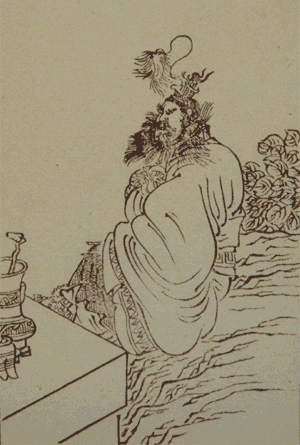 PhilosopherChinese34 – 156
Zhang Daoling
Zhang Daoling, birth name Zhang Ling (張陵), courtesy name Fuhan (輔漢), was a Chinese Taoist religious leader who lived during the Eastern Han dynasty. He founded the Way of the Five Pecks of Rice millenarian movement, and established a theocratic state.
- ◆Way of the Five Pecks of Rice
- ◆Taoism
Read the full pageZhang Daoling (張道陵, traditionally February 22, 34 – October 10, 156), birth name Zhang Ling (張陵), courtesy name Fuhan (輔漢), was a Chinese Taoist religious leader who lived during the Eastern Han dynasty. He founded the Way of the Five Pecks of Rice millenarian movement, and established a theocratic state. The Way of the Celestial Masters grew out of those beginnings, and so Zhang is considered the founder of religious Taoism by scholars and is venerated as such by followers of Zhengyi Dao.
His son Zhang Heng (張衡) and grandson Zhang Lu inherited leadership of the movement and state. Also known as Celestial Master Zhang (張天師), Ancestral Celestial Master (祖天師) or Zhengyi Zhenren (正一真人), Zhang is sometimes pictured riding on a tiger. In some Taoist sects, Zhang, along with Ge Xuan, Xu Xun (許遜) and Sa Shoujian (薩守堅), are called the "Four Celestial Masters" (四大天師).
- 8
 PhilosopherChinese45 – 116
Ban Zhao
Ban Zhao, courtesy name Huiban (Chinese: 惠班), was a Chinese historian, philosopher, and politician. She was the first known female Chinese historian and, along with Pamphile of Epidaurus, one of the first known female historians.
Read the full pageBan Zhao (Chinese: 班昭; 45 or 49 – c. 117/120 CE), courtesy name Huiban (Chinese: 惠班), was a Chinese historian, philosopher, and politician. She was the first known female Chinese historian and, along with Pamphile of Epidaurus, one of the first known female historians. She completed her brother Ban Gu's work on the history of the Western Han, the Book of Han. She also wrote Lessons for Women, an influential work on women's conduct. She also had great interest in astronomy and mathematics and wrote poems, commemorative writings, argumentations, commentaries, essays and several longer works, not all of which survive. She became China's most famous female scholar and an instructor of Taoist sexual practices for the imperial family. Ban Zhao is depicted in the Wu Shuang Pu (無雙譜, Table of Peerless Heroes) by Jin Guliang.
Ban Zhao was born in Anling, near modern Xianyang, Shaanxi province. At age fourteen, she married a local resident named Cao Shishu and was called in the court by the name as Venerable Madame Cao (曹大家). Her husband died when she was still young. She never remarried, instead devoting her life to scholarship. She was the daughter of the famous historian Ban Biao and younger sister of the general Ban Chao and of historian Ban Gu. She was also the granddaughter of Han official Ban Zhi, and the grandniece of the notable scholar and poet Consort Ban.
- 9PhilosopherChinese223 – 262
Ji Kang
Ji Kang, sometimes referred to as Xi Kang, courtesy name Shuye (叔夜), was a Chinese composer, essayist, philosopher, and poet of the Three Kingdoms period. He was one of the Seven Sages of the Bamboo Grove who held aloof from the dangerous politics of third-century China to devote themselves to art and refinement.
Read the full pageJi Kang (Chinese: 嵇康, c.224–c.263), sometimes referred to as Xi Kang, courtesy name Shuye (叔夜), was a Chinese composer, essayist, philosopher, and poet of the Three Kingdoms period. He was one of the Seven Sages of the Bamboo Grove who held aloof from the dangerous politics of third-century China to devote themselves to art and refinement.
Ji Kang is noted as an author and was also a famous composer and guqin-player. He was described as a handsome and tall man (approximately 1.88 metres). Ji Kang had a boyfriend, Ruan Ji, who was also part of the Seven Sages of the Bamboo Grove. Both Ji and Ruan were skilled whistlers, developing a talent in transcendental whistling.
- 10
 PhilosopherChinese284 – 364
Ge Hong
Ge Hong, courtesy name Zhichuan (稚川), was a Chinese linguist, philosopher, physician, politician, and writer during the Eastern Jin dynasty. He was the author of Essays on Chinese Characters, the Baopuzi, the Emergency Formulae at an Elbow's Length, among others.
Read the full pageGe Hong (Chinese: 葛洪; pinyin: Gě Hóng; Wade–Giles: Ko Hung; b. 283 – d. 343 or 364), courtesy name Zhichuan (稚川), was a Chinese linguist, philosopher, physician, politician, and writer during the Eastern Jin dynasty. He was the author of Essays on Chinese Characters, the Baopuzi, the Emergency Formulae at an Elbow's Length, among others. He was the originator of first aid in traditional Chinese medicine and influenced later generations.
He also took on the name Baopuzi (Chinese: 抱朴子), with which translates literally as 'embracing simplicity'—a reflection of his commitment to fundamental virtues, unadorned truth, and detachment from material temptations.