
Zisi
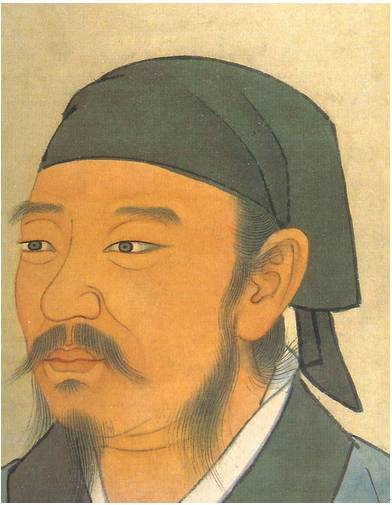
Zisi, born Kong Ji, was a Chinese philosopher and the grandson of Confucius.
Zisi (c. 481 – c. 402 BCE), born Kong Ji, was a Chinese philosopher and the grandson of Confucius.
Intellectual genealogy, teaching, criticism
Zisi was the son of Kong Li (孔鯉) (Boyu (伯鱼)) and the only grandson of Confucius. He is traditionally accredited with transmitting Confucian teaching to Mencius and writing the Doctrine of the Mean, Biaoji 表記, "Ziyi" (The Black Robes") 緇衣, and "Fangji" (The Record of the Dikes) 坊記, presently chapters of the Liji. (Since Zisi's dates of life do not overlap with those of Mengzi, it has been suggested that the intermediary role in the transmission was played by Shi Shuo 世碩.)
Where his grandfather began to distinguish between true and supposed knowledge, Zisi proceeded upon meditations on the relativity in human knowledge of the universe. He attempted to analyse as many types of action as possible, and believed that wise people who are conscious of their moral and intellectual duties can copy the reality of the universe into themselves.
On par with Mencius, Zisi is attacked by Xunzi in his famous "Against Twelve Masters" chapter. The target of Xunzi's attack is the Wuxing teaching. According to Zhang Binglin (1868-1936), Zisi attempted combining Confucian teaching with the principles of numerology. Li Xueqin suggests that it was done under influence of the text presently constituting the "Great Plan" (Hongfan) chapter of the Shangshu.
The extant version of the book of the same name is ascribed to Zisi. It was compiled by Wang Zhuo (汪晫 Wāng Zhuó) of the Song dynasty, but not recognized as authentic. The more reliable edition was made by Huang Yizhou (1828-1899), drawing the references from Shen Yue (441-513). According to Huang Yizhou, some aspects of Zisi's thinking are paralleled by the Huainanzi.
Recent discoveries
Wuxing (text), a recent archeological discovery providing new insight into Zisi's teaching.
Duke Mu of Lu Asks Zisi 《魯穆公問子思》, a Guodian text relating about the concept of the "loyal minister" 忠臣 through the dialogue between Zisi and the young Duke Mu (d. 377 BCE).
Adapted from the Wikipedia article Zisi, available under CC BY-SA 4.0.
Connections


You might also explore
 Confucius★Chinese551 – 479 BCETeacher from Lu whose vision of humaneness, ritual and self-cultivation became the moral foundation of East Asian…
 Zhu Xi★Chinese1130 – 1200Leading Neo-Confucian whose synthesis of principle (li) and qi became orthodoxy for 600 years.
 XunziChinesec. 310 – 235 BCEConfucian who held that human nature is bad and must be reformed by ritual and learning.
 MoziChinesec. 470 – 391 BCECraftsman-philosopher who taught impartial care for all and judged doctrines by their benefits.
 Wang YangmingChinese1472 – 1529Neo-Confucian who taught the unity of knowledge and action and innate moral knowing.
 Ban ZhaoChinese45 – 116Ban Zhao, courtesy name Huiban (Chinese: 惠班), was a Chinese historian, philosopher, and politician. She was the first…