American thinkers, renaissance & early modern
- 1
 PhilosopherAmericas1484 – 1566
Bartolomé de las Casas
Defended the humanity and rights of indigenous Americans in the Valladolid debate.
Read the full pageBartolomé de las Casas, OP (US: lahss KAH-səss; Spanish pronunciation: [baɾtoloˈme ðe las ˈkasas]); 11 November 1484 – 18 July 1566) was a Spanish lawyer, clergyman, writer, and activist best known for his work as a historian and social reformer. He arrived in Hispaniola as a layman, then became a Dominican friar. He was appointed as the first resident Bishop of Chiapas, and the first officially appointed "Protector of the Indians". His extensive writings, the most famous being A Short Account of the Destruction of the Indies and Historia de Las Indias, chronicle the first decades of colonization of the Caribbean islands. He described and railed against the atrocities committed by the conquistadores against the Indigenous peoples.
Arriving as one of the first Spanish settlers in the Americas, De Las Casas initially participated in the colonial economy built on forced Indigenous labor, but eventually felt compelled to oppose the abuses committed by European colonists against the Indigenous population. In 1515 he gave up his Indigenous Caribbean laborers and encomienda. He then advocated, before Charles V, on behalf of rights for the Natives. In his early writings, he advocated the use of African slaves to replace Indigenous labor. He did so without knowing that the Portuguese were carrying out "brutal and unjust wars in the name of spreading the faith". Later in life, he retracted this position, as he regarded both forms of slavery as equally wrong.
- 2
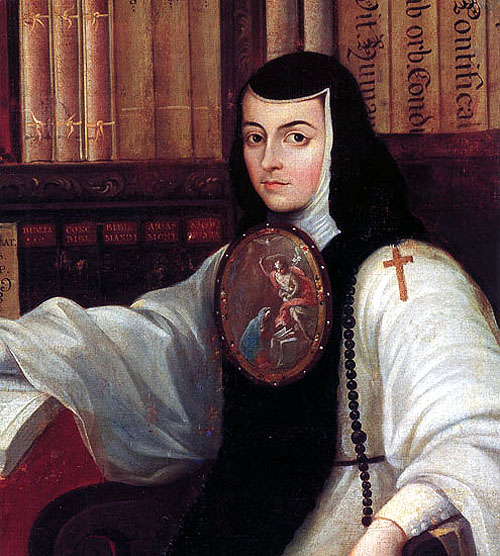 PhilosopherAmericas1651 – 1695
Sor Juana Inés
Juana Inés de Asbaje y Ramírez de Santillana, better known as Sor Juana Inés de la Cruz, was a Hieronymite nun and a Novohispanic writer, philosopher, composer, and poet of the Baroque period, nicknamed "The Tenth Muse", "The Mexican Phoenix", and "The Phoenix of America" by her contemporary critics. She was also a stu
Read the full pageJuana Inés de Asbaje y Ramírez de Santillana, better known as Sor Juana Inés de la Cruz (12 November 1648 – 17 April 1695), was a Hieronymite nun and a Novohispanic writer, philosopher, composer, and poet of the Baroque period, nicknamed "The Tenth Muse", "The Mexican Phoenix", and "The Phoenix of America" by her contemporary critics. She was also a student of science. She was among the main contributors to the Spanish Golden Age, alongside Juan Ruiz de Alarcón and Garcilaso de la Vega "El Inca", and is considered one of the most important female writers in Spanish language literature and Mexican literature.
Sor Juana has been significant to many communities across time, having been presented as a candidate for Catholic sainthood, symbol of Mexican nationalism, and a paragon of freedom of speech, women's rights, and sexual diversity.
- 3
 PhilosopherAmericas1722 – 1803
Samuel Adams
Samuel Adams was an American statesman, political philosopher, and a Founding Father of the United States. He was a politician in colonial Massachusetts, a leader of the movement that became the American Revolution, a signatory of the Declaration of Independence and other founding documents, and one of the architects o
Read the full pageSamuel Adams (September 27 [O.S. September 16], 1722 – October 2, 1803) was an American statesman, political philosopher, and a Founding Father of the United States. He was a politician in colonial Massachusetts, a leader of the movement that became the American Revolution, a signatory of the Declaration of Independence and other founding documents, and one of the architects of the principles of American republicanism that shaped the political culture of the United States. He was a second cousin to his fellow Founding Father, President John Adams. He founded the Sons of Liberty.
Adams was born in Boston, brought up in a religious and politically active family. A graduate of Harvard College, he was an unsuccessful businessman and tax collector before concentrating on politics. He was an influential official of the Massachusetts House of Representatives and the Boston Town Meeting in the 1760s, and he became a part of a movement opposed to the British Parliament's efforts to tax the British American colonies without their consent. His 1768 Massachusetts Circular Letter calling for colonial non-cooperation prompted the occupation of Boston by British troops, eventually resulting in the Boston Massacre of 1770. Adams and his colleagues devised a committee of correspondence system in 1772 to help coordinate resistance to what he saw as the British government's attempts to violate the British Constitution at the expense of the colonies, which linked like-minded Patriots throughout the Thirteen Colonies. Continued resistance to British policy resulted in the 1773 Boston Tea Party and the coming of the American Revolution. Adams was actively involved with colonial newspapers publishing accounts of colonial sentiment over British colonial rule, which were fundamental in uniting the colonies. Adams, the ringleader at the destruction of the East India Company's tea, was also actively involved in bribing British soldiers to desert and provided them with new clothes and the offer of land to cultivate..
- 4
 PhilosopherAmericas1737 – 1809
Thomas Paine
Thomas Paine was an English-born American Founding Father, inventor, political philosopher, and statesman. He authored Common Sense and The American Crisis, two of the most influential pamphlets at the start of the American Revolution, and he helped to inspire the colonial era patriots in 1776 to declare independence f
Read the full pageThomas Paine (born Thomas Pain, February 9, 1737 [O.S. January 29, 1736] – June 8, 1809; ) was an English-born American Founding Father, inventor, political philosopher, and statesman. He authored Common Sense (1776) and The American Crisis (1776–1783), two of the most influential pamphlets at the start of the American Revolution, and he helped to inspire the colonial era patriots in 1776 to declare independence from Great Britain. His ideas reflected Enlightenment-era ideals of human rights.
Paine was born in Thetford, Norfolk, and immigrated to the British American colonies in 1774 with the help of Benjamin Franklin, arriving in time to participate in the American Revolution. Virtually every American Patriot read his 47-page pamphlet Common Sense, which catalyzed the call for independence from Great Britain. He then wrote The American Crisis, a pro-independence pamphlet series. He returned to Great Britain in 1787, where he wrote Rights of Man (1791), in part a defense of the French Revolution against its critics, particularly the Anglo-Irish conservative writer Edmund Burke. His authorship of the tract led to a trial and conviction in absentia in England in 1792 for the crime of seditious libel. Paine was also a staunch critic of fiat currency, arguing in his 1786 essay Dissertations on Government that paper money was a form of state counterfeiting that undermined republican principles and public morality.