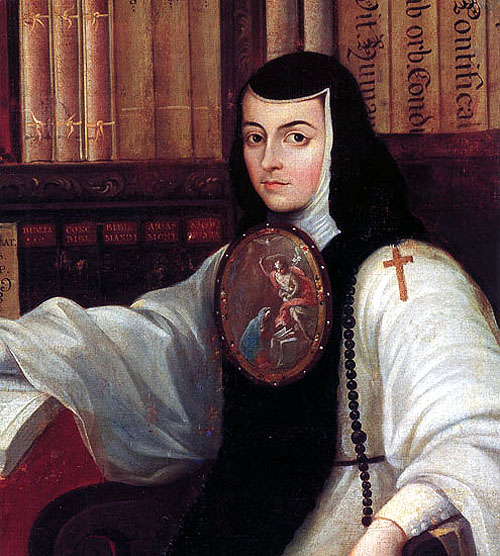
Sor Juana Inés
Juana Inés de Asbaje y Ramírez de Santillana, better known as Sor Juana Inés de la Cruz, was a Hieronymite nun and a Novohispanic writer, philosopher, composer, and poet of the Baroque period, nicknamed "The Tenth Muse", "The Mexican Phoenix", and "The Phoenix of America" by her contemporary critics. She was also a stu
Juana Inés de Asbaje y Ramírez de Santillana, better known as Sor Juana Inés de la Cruz (12 November 1648 – 17 April 1695), was a Hieronymite nun and a Novohispanic writer, philosopher, composer, and poet of the Baroque period, nicknamed "The Tenth Muse", "The Mexican Phoenix", and "The Phoenix of America" by her contemporary critics. She was also a student of science. She was among the main contributors to the Spanish Golden Age, alongside Juan Ruiz de Alarcón and Garcilaso de la Vega "El Inca", and is considered one of the most important female writers in Spanish language literature and Mexican literature.
Sor Juana has been significant to many communities across time, having been presented as a candidate for Catholic sainthood, symbol of Mexican nationalism, and a paragon of freedom of speech, women's rights, and sexual diversity.
Early life
Juana was born in San Miguel Nepantla (presently Nepantla de Sor Juana Inés de la Cruz) near Mexico City as the daughter born outside of marriage to Don Pedro Manuel de Asuaje y Vargas-Machuca (1602-1680), a Spanish navy captain from the Canary Islands involved in colonial transatlantic shipping and trade, and Doña Isabel Ramírez de Santillana y Rendón (1626-1690), a criolla woman, whose father leased the Hacienda de Panoayan, near Mexico City.There are two different baptism registrations that have been attributed to her, one under the name of "Juana" in 1648, and another one under the name of "Inés" in 1651, still a matter of academic research and debate. There is, nevertheless, agreement that she was one of the three children that Doña Isabel Ramírez de Santillana had with Don Pedro de Asuaje. Since Sor Juana's father was absent from her early life and she had limited knowledge of him, Sor Juana's infancy occurred entirely around her mother's family in the hacienda of Panaoyan, in Amecameca, leased by her maternal grandfather, and home to the Ramírez de Santillana family. Among her relatives, several women with the name "Inés" have been noted, including her grandmother Inés de Brenes, her maternal-aunt Inés Ramírez de Santillana, and her first-cousin Inés de Brenes y Mendoza, married to a grandson of Antonio de Saavedra Guzmán, the first published poet in the Americas.
"In 1656, she was sent to Mexico City by her mother to live with her maternal aunt and uncle, María Ramírez Santillana and Juan de Mata. Mexico City had around 50,000 inhabitants at the time and was the bustling heart of New Spain’s colonial life. She began her study of Latin in 1659 under the tutelage of Bachelor Martín de Olivas—it is said that she learned the language in only twenty lessons. If this is true, it is an early manifestation of the literary and linguistic genius that she demonstrated in her later work. In order to give herself motivation to study seriously, she would punish her own laziness or ineptitude by cutting her hair. " (Ford, 1892)(Archive.org)
During her childhood, Inés often hid in the hacienda chapel to read her grandfather's books from the adjoining library, despite restrictions that young girls had on access to education. By the age of three, she had learned how to read and write Latin. By the age of five, she reportedly could do accounts. At age eight, she composed a poem on the Eucharist. By adolescence, Inés had mastered Greek logic, and at age thirteen she was teaching Latin to young children. For many years, scholars believed that Sor Juana learned Nahuatl, an Aztec language, and wrote short poems in it during her childhood. However, more recent research has challenged this belief.
In 1664, at the age of 16, Inés was sent to live in Mexico City. She asked her mother's permission to disguise herself as a male student so that she could enter the university there, her request was not granted. Without the ability to obtain a formal education, Juana continued her studies privately. Through her family's social connections, she was able to obtain the position of lady-in-waiting at the colonial viceroy's court, where she came under the tutelage of the Vicereine Donna Eleonora del Carretto, a member of an Italian noble family, and wife of the Viceroy of New Spain Don Antonio Sebastián de Toledo, Marquis of Mancera. The viceroy Marquis de Mancera, wishing to test the learning and intelligence of the 17-year-old, invited several theologians, jurists, philosophers, and poets to a meeting, during which she had to answer many questions unprepared and explain several difficult points on various scientific and literary subjects. Her ability to answer difficult questions impressed those in attendance and helped establish her reputation as an intellectual. Her literary accomplishments garnered her fame throughout New Spain. She was much admired in the viceregal court, and she received several proposals of marriage, which she declined.
After joining a nunnery in 1667, Sor Juana began writing poetry and prose dealing with such topics as love, women's rights, and religion. She turned her nun's quarters into a salon, visited by New Spain's female intellectual elite, including Doña Eleonora del Carreto, Marchioness of Mancera, and Doña Maria Luisa Gonzaga, Countess of Paredes de Nava, both Vicereines of New Spain, among others. Her criticism of misogyny and the hypocrisy of men led to her condemnation by the Bishop of Puebla, and in 1694 she was forced to sell her collection of books and focus on charity towards the poor. She died the next year, having caught the plague while treating her sisters.
Religious life and name change
In 1667, Inés entered the Monastery of St. Joseph, a community of the Discalced Carmelite nuns, as a postulant, where she remained but a few months. Later, in 1669, she entered the monastery of the Hieronymite nuns, which had more relaxed rules, where she changed her name to Sor Juana Inés de la Cruz, probably in reference to Sor Juana de la Cruz Vázquez Gutiérrez, a Spanish nun whose intellectual accomplishments earned her one of the few dispensations for women to preach the gospel. Another potential namesake was Saint Juan de la Cruz, one of the most accomplished authors of the Spanish Baroque. She chose to become a nun so that she could study as she wished since she wanted "to have no fixed occupation which might curtail my freedom to study."
In the convent and perhaps earlier, Sor Juana became intimate friends with Don Carlos de Sigüenza y Góngora, who visited her in the convent's locutorio. She stayed cloistered in the Convent of Santa Paula of the Hieronymite in Mexico City from 1669 until her death in 1695, and there she studied, wrote, and collected a large library of books. The Viceroy and Vicereine of New Spain became her patrons; they supported her and had her writings published in Spain. She addressed some of her poems to paintings of her friend and patron María Luisa Manrique de Lara y Gonzaga, daughter of Vespasiano Gonzaga, Duca di Guastala, Luzara e Rechiolo, and Inés María Manrique, 9th Countess de Paredes, whom she also addressed as Lísida.
In November 1690, the bishop of Puebla, Manuel Fernández de Santa Cruz published, under the pseudonym of Sor Filotea, and without her permission, Sor Juana's critique of a 40-year-old sermon by Father António Vieira, a Portuguese Jesuit preacher. In Carta Atenagórica, Sor Juana offered a scholastic refutation of Vieira's theology of divine love, arguing instead that Christ's greatest act of love was preserving human free will; many scholars also interpret the treatise as an implicit challenge to male intellectual authority within the Catholic Church. Sor Juana's original philosophical argument regarding God's finezas, where she argues that God's greatest act of love is negative as it refrains from granting favors so as not to burden humanity with un-payable debt, thereby preserving human's free will.
Along with Carta Atenagórica, the bishop also published his own letter in which he said she should focus on religious instead of secular studies. He published his criticisms to use them to his advantage against the priest, and while he agreed with her criticisms, he believed that as a woman, she should devote herself to prayer and give up her writings.
In response to her critics, Sor Juana wrote a letter, La Respuesta a Sor Filotea de la Cruz (Reply to Sister Philotea), in which she defended women's right to formal education. She also advocated for women's right to serve as intellectual authorities, not only through the act of writing, but also through the publication of their writing. By putting women, specifically older women, in positions of authority, Sor Juana argued, women could educate other women. Resultingly, Sor Juana argued, this practice could also avoid potentially dangerous situations involving male teachers in intimate settings with young female students. In 1691, she was reprimanded and ordered to stop writing after the exposure of a private letter in which she wrote of the right of women to education.
In addition to her status as a woman in a self-prescribed position of authority, Sor Juana's radical position made her an increasingly controversial figure. She famously remarked by quoting an Aragonese poet and echoing St. Teresa of Ávila: "One can perfectly well philosophize while cooking supper." In response, Francisco de Aguiar y Seijas, Archbishop of Mexico joined other high-ranking officials in condemning Sor Juana's "waywardness." In addition to opposition she received for challenging the patriarchal structure of the Catholic Church, Sor Juana was repeatedly criticized for believing that her writing could achieve the same philanthropic goals as community work.
By 1693, Sor Juana seemingly ceased writing to avoid risking official censure. Although there is no undisputed evidence of her renouncing her writing, there are documents showing her agreeing to undergo penance. Her name is affixed to such a document in 1694, but the tone of the supposed handwritten penitentials is in rhetorical and autocratic, in contrast to her normally lyrical style. One is signed "Yo, la Peor de Todas" ("I, the worst of all women"). She is said to have sold all her books, then an extensive library of more than 4,000 volumes, as well as her musical and scientific instruments. Other sources report that her defiance toward the Church led to the confiscation of all of her books and instruments, although the bishop himself agreed with the contents of her letters.
Of more than one hundred unpublished works, only a few of Sor Juana's writings have survived, which are known as the Complete Works. According to Octavio Paz, her writings were saved by the vicereine.
On 17 April 1695, Sor Juana died at the age of 46 after ministering to other nuns stricken during a plague. Sigüenza y Góngora delivered the eulogy at her funeral.
Philosophy
Although frequently studied for her Baroque poetry and drama, Sor Juana engaged deeply with 17th-century epistemology, scholasticism, theology, and early modern feminist philosophy.
Epistemology and the limits of reason
In her philosophical poem Primero sueño (First Dream), Sor Juana investigates how the human mind acquires knowledge of the universe. The poem tests two philosophical methods:
Intuitive comprehension: The soul first attempts to grasp all of creation at once through a single act of intuition, but is overwhelmed by the vastness of the cosmos.
Discursive reason: The soul then shifts to Aristotelian logic, analyzing individual objects step by step using the ten categories of Aristotle.
When even this systematic method reaches its limit, Sor Juana concludes not that reason is worthless, but that human knowledge is finite—anticipating early modern epistemic humility and scientific skepticism.
Free will and theological critique
In the Carta Atenagórica (1690), Sor Juana critiques a famous sermon by the Portuguese Jesuit preacher António Vieira regarding what constitutes Christ's greatest act of love (fineza). While Vieira argued that Christ's greatest act was loving humanity without expecting return, Sor Juana drew on Augustine of Hippo, Thomas Aquinas, and John Chrysostom to argue that Christ's greatest act of love was withholding benefits so that human beings could exercise free will. Through this argument, she defended human rational autonomy as the highest divine gift.
Rational equality and empirical observation
Across her prose treatises Autodefensa Espiritual (1682) and La Respuesta a Sor Filotea de la Cruz (1691), Sor Juana constructs a philosophical defense of women's intellectual equality. Her argument rests on three main claims:
Equality of the rational soul: Because women possess rational souls identical to those of men, denying women education violates both reason and divine justice.
Interconnectedness of knowledge: Secular disciplines such as logic, physics, music, and geometry are necessary foundations for understanding theology.
Everyday empiricism: Excluded from universities, women can practice natural philosophy through direct observation of daily life—such as studying geometry in a spinning top or chemical reactions while cooking.
Translations and interpretations
Octavio Paz is credited with re-establishing the importance of the historic Sor Juana in modern times, and other scholars have been instrumental in translating Sor Juana's work to other languages. The only translations of Carta Atenagorica are found in Sor Juana Inés de la Cruz: Selected Writings by Pamela Kirk Rappaport and The Tenth Muse: Sor Juana Inés de la Cruz by Fanchon Royer. Translations of Sor Juana's La Respuesta are credited to Electa Arenal and Amanda Powell, Edith Grossman, Margaret Seyers Peden, and Alan S. Trubeblood. These translations are respectively found in The Answer/La Respuesta, Sor Juana Ines de la Cruz: Selected Works, A Woman of Genius: The Intellectual Biography of Sor Juana Inés de la Cruz and Poems, Protest, and a Dream, and A Sor Juana Anthology.
Since Sor Juana's works were rediscovered after her death, scholarly interpretations and translations are both abundant and contrasting.
Octavio Paz
Octavio Paz was a Mexican Nobel Prize laureate and scholar. In his 1982 book, Sor Juana Inés de la Cruz o las trampas de la fe (translated to English by Margaret Sayers Peden as Sor Juana: Or, The Traps of Faith), Paz examines and contemplates Sor Juana's poetry and life in the context of the history of New Spain, particularly focusing on the difficulties women then faced while trying to thrive in academic and artistic fields. Primarily, Paz aims to explain why Sor Juana chose to become a nun. In Juana Ramírez, Octavio Paz and Diane Marting find that Sor Juana's decision to become a nun stemmed from her refusal to marry; joining the convent, according to Paz and Marting, was a way for Juana to obtain authority and freedom without marrying.
In his analyses of Sor Juana's poetry, Octavio Paz traces some of her influences to the Spanish writers of the Golden Age and the Hermetic tradition, mainly derived from the works of a noted Jesuit scholar of her era, Athanasius Kircher. Paz interprets Sor Juana's most ambitious and extensive poem, Primero Sueño ("The First Dream"), as a representation of the desire of knowledge through a number of hermetic symbols, albeit transformed in her own language and skilled image-making abilities. In conclusion, Paz makes the case that Sor Juana's works were the most important body of poetic work produced in the Americas until the arrival of 19th-century figures such as Emily Dickinson and Walt Whitman.
Tarsicio Herrera Zapién
Tarsicio Herrera Zapién, a classical scholar, has also devoted much of his career to the study of Sor Juana's works. Some of his publications (in Spanish) include Buena fe y humanismo en Sor Juana: diálogos y ensayos: las obras latinas: los sorjuanistas recientes (1984); López Velarde y sor Juana, feministas opuestos: y cuatro ensayos sobre Horacio y Virgilio en México (1984); Poemas mexicanos universales: de Sor Juana a López Velarde (1989) and Tres siglos y cien vidas de Sor Juana (1995).
Feminist analyses and translations
Scholars such as Scout Frewer argue that because Juana's advocacy for religious and intellectual authority would now be associated with feminism, she was a protofeminist. In the twenty-first century, Latin American philosophers and scholars generally interpret Sor Juana as a feminist before the time of feminism.
For instance, scholars like Rachel O'Donnell argue that Sor Juana occupied a special place in between socially acceptable and socially unacceptable roles in seventeenth century Mexico. By examining Sor Juana intersectionally, they prioritize the context of New Spain, specifically the influence of religion, race, and social norms, in understanding Sor Juana as a female theologian and poet.
According to O'Donnell, in colonial Mexico, education was an undertaking reserved for men, especially activities like writing and reading. Consequently, scholars like Octavio Paz argue, religion became a way for women to avoid marriage. Since Sor Juana was opposed to marriage, Paz argues, entering the convent was a socially acceptable way to be a single woman in seventeenth century Mexico. Entering the convent also meant that Sor Juana could read and write about religion despite the barriers to formal education for women. O'Donnell argues that Sor Juana was called a rare bird because although theology was only an acceptable pursuit for men in the Catholic Church, she actively studied religion. Sor Juana likely perceived wisdom and religion as inseparable, so she probably also believed that to follow God was to pursue wisdom. A third perspective suggests that considering the colonial context of New Spain and Sor Juana's background as a criolla, she represented colonial knowledge in a way that defied colonial religious structures.
Luis Felipe Fabre criticized 'Sorjuanista' scholarship as a whole, arguing that the discourse is binary rather than complex and multilayered.
Luis Felipe Fabre
Luis Felipe Fabre, a Mexican writer and scholar, ridicules other scholars, whom he collectively calls Sorjuanistas, who idolize Sor Juana. In his book, Sor Juana and Other Monsters, Fabre argues that the appropriation and recontextualization immanent in scholars' interpretations of Sor Juana construct Sor Juana as either a heretic or a lesbian. Fabre suggests that such representations constitute Sor Juana as a monstrosity or abnormality rather than as a complex woman. He suggests that rather than locating Sor Juana in a fixed identity, scholarship on Sor Juana should be a fluctuating and multilayered conversation.
Margaret Sayers Peden
Margaret Sayers Peden's 1982 A Woman of Genius: The Intellectual Autobiography of Sor Juana Ines de la Cruz, was the first English translation of Sor Juana's work. As well, Peden is credited for her 1989 translation of Sor Juana: Or, the Traps of Faith. Unlike other translations, Peden chose to translate the title of Sor Juana's best known work, First Dream, as "First I Dream" instead. Peden's use of first person instills authority in Sor Juana as an author, as a person with knowledge, in a male-dominated society. Peden also published her English translations of Sor Juana's work in an anthology called Poems, Protest, and a Dream. This work includes her response to authorities censuring her, La Respuesta, and First Dream.
Electa Arenal and Amanda Powell
Adapted from the Wikipedia article Juana Inés de la Cruz, available under CC BY-SA 4.0.
You might also explore
 Alain LeRoy LockeAmericas1885 – 1954Alain LeRoy Locke was an American writer, philosopher, and educator. Distinguished in 1907 as the first African…Alan WattsAmericas1915 – 1973British-American popularizer who interpreted Zen, Daoism and Vedānta for Western audiences with wit and clarity.
 Alasdair MacIntyreAmericas1929 – 2025Alasdair Chalmers MacIntyre was a Scottish-American philosopher who contributed to moral and political philosophy as…
 Alfonso ReyesAmericas1889 – 1959Alfonso Reyes Ochoa was a Mexican writer, philosopher and diplomat. He was nominated for the Nobel Prize in Literature…
 Alfred KorzybskiAmericas1879 – 1950Alfred Habdank Skarbek Korzybski was a Polish-American philosopher and independent scholar who developed a field called…Alfred SchützAmericas1899 – 1959Alfred Schutz was an Austrian philosopher and social phenomenologist whose work bridged sociological and…