Vedānta
"The end of the Vedas": schools interpreting the Upaniṣads on the relation between the self (ātman), the world and ultimate reality (Brahman).
- 1SchoolIndian500 BCE – present
Vedānta
"The end of the Vedas": schools interpreting the Upaniṣads on the relation between the self (ātman), the world and ultimate reality (Brahman).
- ◆Brahman as ultimate reality
- ◆The self (ātman) and its relation to Brahman
- ◆Liberation through knowledge or devotion
Read the full pageVedanta (; Sanskrit: वेदान्त, IAST: Vedānta [ʋeːdɑ́ːntɐ]), also known as Uttara Mīmāṃsā, is one of the six orthodox (āstika) schools of Hindu philosophy and textual exegesis. The word Vedanta means 'conclusion of the Vedas,' and encompasses the ideas that emerged from, or aligned and reinterpreted, the speculations and enumerations contained in the Upanishads, focusing, with varying emphasis, on devotion, knowledge, and liberation. Vedanta developed into many traditions, all of which give their specific interpretations of a common group of texts called the Prasthānatrayī, translated as 'the three sources': the Upanishads, the Brahma Sutras, and the Bhagavad Gita.
All Vedanta traditions place great emphasis on textual exegesis and contain extensive discussions on ontology, soteriology, and epistemology, even though there is much disagreement among the various traditions. Independently considered, they may seem completely disparate due to the pronounced differences in thoughts and reasoning.
- 2
 PhilosopherIndian1836 – 1886
Ramakrishna
Bengali mystic who taught that all religions are paths to the same God; teacher of Vivekananda.
- ◆As many faiths, so many paths
- ◆God-realisation as life's goal
Read the full pageRamakrishna (18 February 1836 – 16 August 1886), also called Ramakrishna Paramahamsa, born Ramakrishna Chattopadhyay (his childhood nickname was Gadadhar), was an Indian Hindu mystic. He was a devotee of the goddess Kali, but adhered to various religious practices from the Hindu traditions of Vaishnavism, Tantric Shaktism, and Advaita Vedanta, as well as Christianity and Sufi Islam. His parable-based teachings advocated the essential unity of religions and proclaimed that world religions are "so many paths to reach one and the same goal". He is regarded by his followers as an avatar (divine incarnation).
Ramakrishna was born in Kamarpukur, Bengal Presidency, India. He described going through religious experiences in childhood. Around the age of twenty, he became a temple priest at the Dakshineshwar Kali Temple in Calcutta. While at the temple, his devotional temperament and intense religious practices led him to experience various spiritual visions. He was assured of the authenticity and sanctity of his visions by several religious teachers.
- 3
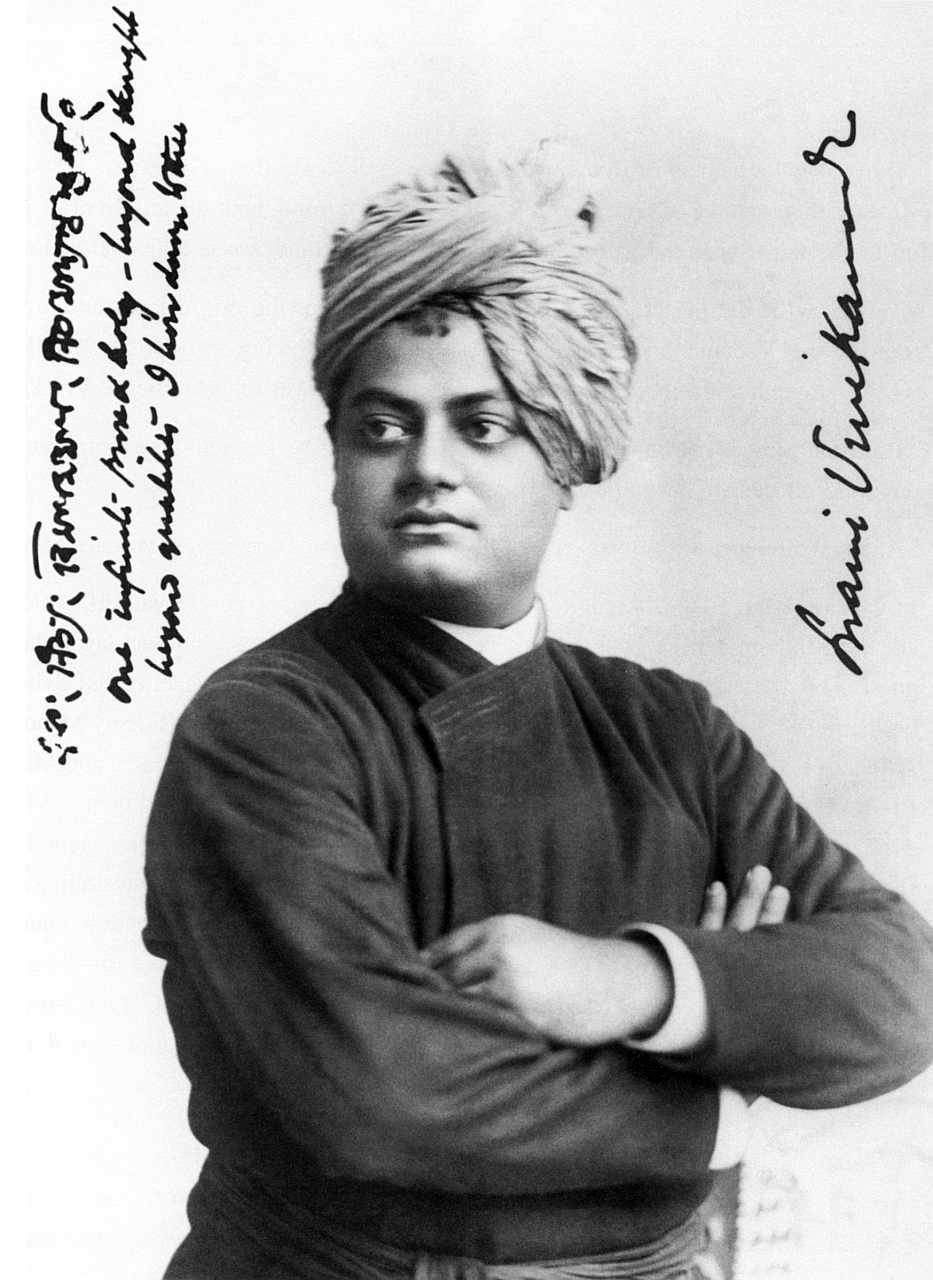 PhilosopherIndian1863 – 1902
Swami Vivekananda
Brought Vedānta and yoga to the West at the 1893 Parliament of Religions.
Read the full pageSwami Vivekananda () (12 January 1863 – 4 July 1902), born Narendranath Datta, was an Indian Hindu monk, philosopher, author, religious teacher, and the chief disciple of the Indian mystic Ramakrishna. Vivekananda was a major figure in the introduction of Vedanta and Yoga to the Western world during the late 19th century, and is credited with raising interfaith awareness and elevating Hinduism to the status of a major world religion.
Vivekananda showed an early inclination towards religion and spirituality. At the age of 18, he met Ramakrishna and became his devoted disciple, and later took up the vows of a sannyasin (renunciate). Following Ramakrishna’s death, Vivekananda travelled extensively across the Indian subcontinent as a wandering monk, gaining first-hand knowledge of the often harsh living conditions endured by the Indian masses under then British India, he sought a way to alleviate their suffering by establishing social services but lacked capital. In 1893, he travelled to the United States to participate in the Parliament of the World's Religions in Chicago, where he delivered a landmark speech beginning with the words "Sisters and brothers of America...". His powerful message introduced Hindu spiritual thought and advocated for both religious tolerance as well as universal acceptance. The speech made a profound impression; an American newspaper described him as "an orator by divine right and undoubtedly the greatest figure at the Parliament".