Stoicism: Posidonius to Lipsius
- 1
 PhilosopherGreek & Roman135 – 51 BCE
Posidonius
Posidonius was a Greek politician, astronomer, astrologer, geographer, historian, mathematician, and teacher native to Apamea, Syria. He was considered the most learned man of his time and, possibly, of the entire Stoic school.
- ◆Cosmic sympathy
Read the full pagePosidonius (; Ancient Greek: Ποσειδώνιος Poseidṓnios; "of Apamea" (ὁ Ἀπαμεύς) or "of Rhodes" (ὁ Ῥόδιος); c. 135 – c. 51 BC) was a Greek politician, astronomer, astrologer, geographer, historian, mathematician, and teacher native to Apamea, Syria. He was considered the most learned man of his time and, possibly, of the entire Stoic school.
After a period learning Stoic philosophy from Panaetius in Athens, he spent many years in travel and scientific researches in Spain, Africa, Italy, Gaul, Liguria, Sicily, and on the eastern shores of the Adriatic. He settled as a teacher in Rhodes, where his fame attracted numerous scholars.
- 2
 PhilosopherJewishc. 20 BCE – 50 CE
Philo of Alexandria
Interpreted the Hebrew Bible through Greek philosophy, pioneering allegorical reading.
Read the full pagePhilo of Alexandria (; Ancient Greek: Φίλων, romanized: Phílōn; Hebrew: יְדִידְיָה, romanized: Yəḏīḏyāh; c. 20 BC – c. 50 AD), also called Philō Judæus, was a Hellenistic Jewish philosopher who lived in Alexandria, in the Roman province of Egypt.
The only event in Philo's life that can be decisively dated is his representation of the Alexandrian Jews in a delegation to the Roman emperor Caligula in 40 CE following civil strife between the Jewish and Greek communities of Alexandria.
- 3
 PhilosopherGreek & Roman4 BCE – 65 CE
Seneca
Stoic statesman and dramatist whose Letters to Lucilius are a handbook for living.
- ◆On the shortness of life
- ◆Anger as temporary madness
- ◆Rehearsing misfortune
Read the full pageLucius Annaeus Seneca the Younger ( SEN-ik-ə; c. 4 BC – AD 65), usually known mononymously as Seneca, was a Stoic philosopher of Ancient Rome, a statesman, a dramatist, and in one work (Apocolocyntosis) a satirist from the post-Augustan age of Latin literature.
Seneca was born in Colonia Patricia Corduba in Hispania, and was trained in rhetoric and philosophy in Greece. His father was Seneca the Elder, his elder brother was Lucius Junius Gallio Annaeanus, and his nephew was the poet Lucan. In AD 41, Seneca was exiled to the island of Corsica under emperor Claudius, but was allowed to return in 49 to become a tutor to Nero. When Nero became emperor in 54, Seneca became his advisor and, together with the praetorian prefect Sextus Afranius Burrus, provided competent government for the first five years of Nero's reign. Seneca's influence over Nero declined with time, and in 65 Seneca was executed by forced suicide for alleged complicity in the Pisonian conspiracy to assassinate Nero, of which he may have been innocent, although there is still no consensus agreement. His stoic and calm suicide has become the subject of numerous paintings.
- 4PhilosopherGreek & Roman25 – 95
Gaius Musonius Rufus
Gaius Musonius Rufus (; Ancient Greek: Μουσώνιος Ῥοῦφος) was a Roman Stoic philosopher of the 1st century AD. He taught philosophy in Rome during the reign of Nero and so was sent into exile in 65 AD, returning to Rome only under Galba.
Read the full pageGaius Musonius Rufus (; Ancient Greek: Μουσώνιος Ῥοῦφος) was a Roman Stoic philosopher of the 1st century AD. He taught philosophy in Rome during the reign of Nero and so was sent into exile in 65 AD, returning to Rome only under Galba. He was allowed to stay in Rome when Vespasian banished all other philosophers from the city in 71 AD although he was eventually banished anyway, returning only after Vespasian's death. A collection of extracts from his lectures still survives. He is also remembered for being the teacher of Epictetus and Dio Chrysostom.
The son of a Roman eques of the name of Capito, Musonius Rufus was born in Volsinii, Etruria about 20–30 AD. By the time of Nero, he was already famous in Rome, where he taught Stoic philosophy. He was associated with the Stoic Opposition against the perceived tyranny of Nero. He followed Rubellius Plautus into exile when Plautus was banished by Nero (60 AD). He returned to Rome after Plautus' death (62 AD), but as a consequence of his practising and teaching Stoicism, he became an object of suspicion and dislike at Nero's court, and was accordingly banished to the island of Gyaros (65 AD) on a trumped-up charge of participation in the Pisonian conspiracy. While Gyaros was "harsh and devoid of human culture", Musonius was able to survive and form a small community of philosophers. He specifically refers to his time in exile in his ninth discourse, pointing out its advantages for a practitioner of Stoicism.
- 5
 PhilosopherGreek & Romanc. 50 – 135
Epictetus
A freed slave whose Stoic teaching starts from one rule: distinguish what is up to us from what is not.
- ◆Dichotomy of control
- ◆It is not things that disturb us, but our judgements about them
- ◆Freedom is inner
Read the full pageEpictetus ( EH-pick-TEE-təss; Ancient Greek: Ἐπίκτητος, Epíktētos; c. 50 – c. 135 AD) was a Greek Stoic philosopher. He was born into slavery at Hierapolis, Phrygia (present-day Pamukkale, in western Turkey) and lived in Rome until his banishment, after which he spent the rest of his life in Nicopolis in northwestern Greece.
Epictetus studied Stoic philosophy under Musonius Rufus and after manumission, his formal emancipation from slavery, he began to teach philosophy. When philosophers were banished from Rome by Emperor Domitian toward the end of the first century, Epictetus founded a school of philosophy in Nicopolis. He taught that philosophy is a way of life and not simply a theoretical discipline. To Epictetus, all external events are beyond our control; he argues that we should accept whatever happens calmly and dispassionately. However, he held that individuals are responsible for their own actions, which they can examine and control through rigorous self-discipline. His teachings were written down and published by his pupil Arrian in his Discourses and Enchiridion. They influenced many later thinkers, including Marcus Aurelius, Rabelais, Pascal, Montesquieu, Diderot, and Samuel Johnson.
- 6
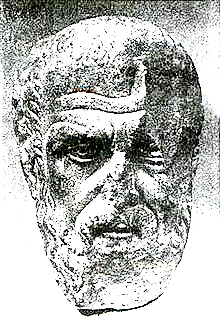 PhilosopherGreek & Roman89 – 175
Arrian
Arrian, also known as Arrian of Nicomedia, was a Greek historian, public servant, military commander, and philosopher of the Roman period. The Anabasis of Alexander by Arrian is considered the best source on the campaigns of Alexander the Great.
Read the full pageArrian, also known as Arrian of Nicomedia, was a Greek historian, public servant, military commander, and philosopher of the Roman period.
The Anabasis of Alexander by Arrian is considered the best source on the campaigns of Alexander the Great. Scholars have generally preferred Arrian to other extant primary sources, though this attitude has changed somewhat in light of modern studies into Arrian's method.
- 7
 PhilosopherGreek & Roman121 – 180
Marcus Aurelius
Roman emperor whose private Stoic notebook, the Meditations, is among the most widely read works of philosophy.
- ◆The obstacle is the way
- ◆Remember you will die
- ◆Do your duty without complaint
- ◆View from above
Read the full pageMarcus Aurelius Antoninus ( or-EE-lee-əs; Latin: [ˈmaːrkʊs au̯ˈreːli.us antoːˈniːnʊs]; 26 April 121 – 17 March 180) was Roman emperor from 161 to 180 and a Stoic philosopher. He was a member of the Nerva–Antonine dynasty, the last of the rulers later known as the Five Good Emperors and the last emperor of the Pax Romana, an age of relative peace, calm, and stability for the Roman Empire lasting from 27 BC to 180 AD. He served as Roman consul in 140, 145, and 161.
Marcus Aurelius was the son of the praetor Marcus Annius Verus and his wife Domitia Calvilla. He was related through marriage to the emperors Trajan and Hadrian. Marcus was three when his father died, and he was raised by his mother and paternal grandfather. After Hadrian's adoptive son, Aelius Caesar, died in 138, Hadrian adopted Marcus's uncle Antoninus Pius as his new heir. In turn, Antoninus adopted Marcus and Lucius, the son of Aelius. Hadrian died that year, and Antoninus became emperor. Now heir to the throne, Marcus studied Greek and Latin under tutors such as Herodes Atticus and Marcus Cornelius Fronto. He married Antoninus's daughter Faustina in 145.
- 8
 PhilosopherGreek & Roman200 – 216
Pantaenus
Pantaenus the Philosopher was a Sicilian theologian and a significant figure in the Catechetical School of Alexandria from around AD 180. This school was the earliest catechetical school, and became influential in the development of Christian theology.
Read the full pagePantaenus the Philosopher (Greek: Πάνταινος; died c. 200) was a Sicilian theologian and a significant figure in the Catechetical School of Alexandria from around AD 180. This school was the earliest catechetical school, and became influential in the development of Christian theology.
Pantaenus was a Stoic philosopher teaching in Alexandria. He was a native of Sicily.
- 9
 PhilosopherModern European1547 – 1606
Justus Lipsius
Justus Lipsius was a Flemish philologist, philosopher, and Christian humanist. Lipsius wrote a series of works designed to revive ancient Stoicism in a form that would be compatible with Christianity.
Read the full pageJustus Lipsius (born Joest Lips; October 18, 1547 – March 23, 1606) was a Flemish philologist, philosopher, and Christian humanist. Lipsius wrote a series of works designed to revive ancient Stoicism in a form that would be compatible with Christianity. The most famous of these is De Constantia (On Constancy). His form of Stoicism influenced a number of contemporary thinkers, creating the intellectual movement of Neostoicism. He taught at the universities in Jena, Leiden, and Leuven.
Lipsius was born in Overijse, Brabant (in modern Belgium). His parents sent him early to the Jesuit college in Cologne, but they feared that he might become a member of the Society of Jesus, so when he was sixteen they removed him to the University of Leuven in Leuven.