Stoicism: Citium to Panaetius
Virtue is the only good; focus on what is in your control and accept the rest as the rational order of nature.
- 1
 SchoolGreek & Roman300 BCE – 250 CE
Stoicism
Virtue is the only good; focus on what is in your control and accept the rest as the rational order of nature.
- ◆The dichotomy of control
- ◆Virtue is sufficient for happiness
- ◆Live according to nature and reason
- ◆Cosmopolitanism: citizens of the world
Read the full pageStoicism was founded by Zeno of Citium, who taught at the Stoa Poikilē — the Painted Porch — in Athens around 300 BCE. The Stoics held that the universe is a rational whole governed by logos, and that human beings flourish by living in agreement with it.
The central practical teaching is that only virtue — wisdom, justice, courage and moderation — is truly good. Health, wealth and reputation are "preferred indifferents": reasonable to pursue, but irrelevant to happiness. As Epictetus put it, some things are up to us (our judgements, intentions and desires) and some are not; misery comes from confusing the two.
- 2PhilosopherGreek & Roman334 – 262 BCE
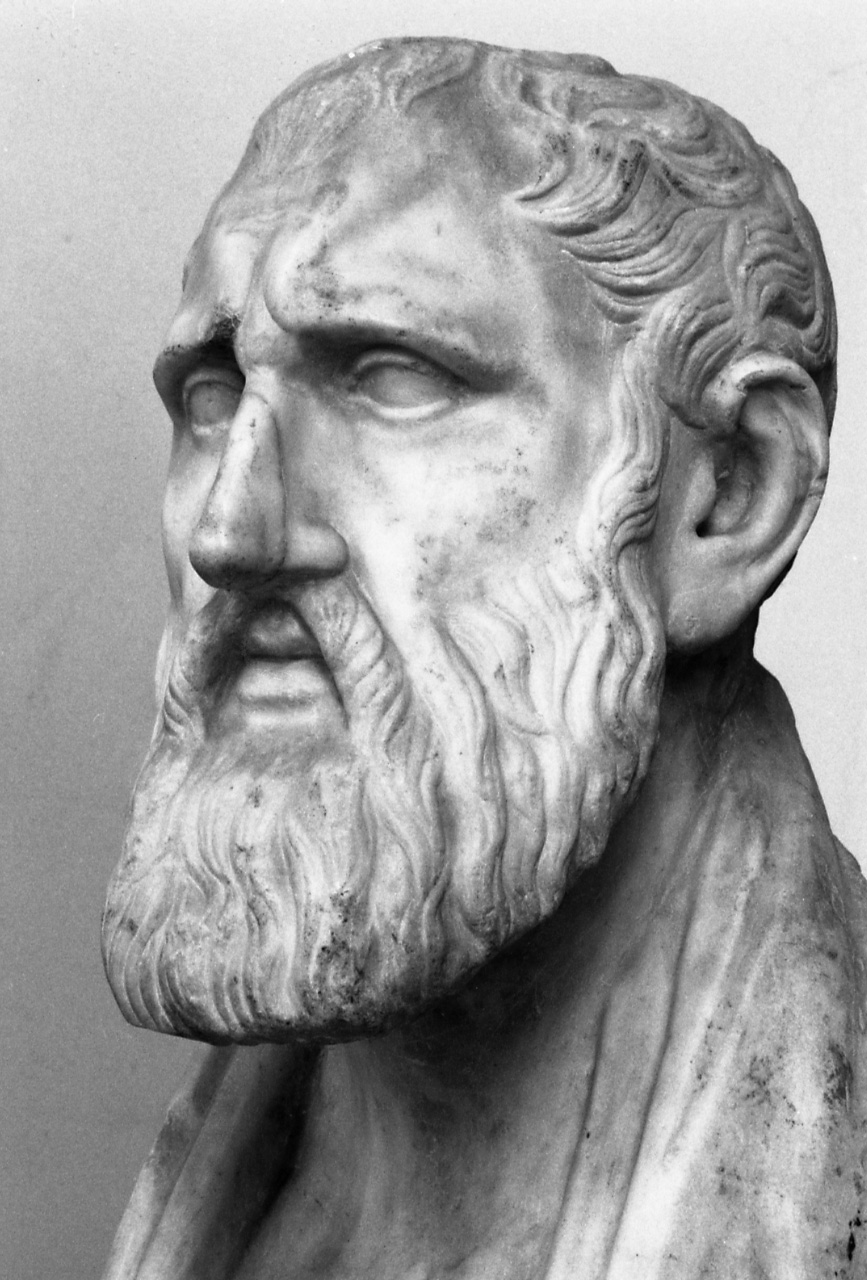
Zeno of Citium
Founder of Stoicism, who taught at the Painted Porch in Athens.
- ◆Stoicism
- ◆three branches of philosophy (physics, ethics, logic)
- ◆Logos
- ◆rationality of human nature
- ◆phantasiai
- ◆katalepsis
Read the full pageZeno of Citium (; Koine Greek: Ζήνων ὁ Κιτιεύς, Zēnōn ho Kitieus; c. 334 – c. 262 BC) was a Hellenistic philosopher from Citium (Κίτιον, Kition), Cyprus. He was the founder of the Stoic school of philosophy, which he taught in Athens from about 300 BC.
Based on the moral ideas of the Cynics, Stoicism laid great emphasis on goodness and peace of mind gained from living a life of virtue in accordance with nature. It proved very popular and flourished as one of the major schools of philosophy from the Hellenistic period through to the Roman era, enjoying revivals in the Renaissance as Neostoicism and in the current era as Modern Stoicism.
- 3PhilosopherGreek & Roman334 – 262 BCE
Zeno of Citium
Founder of Stoicism, who taught at the Painted Porch in Athens.
- ◆Stoicism
- ◆three branches of philosophy (physics, ethics, logic)
- ◆Logos
- ◆rationality of human nature
- ◆phantasiai
- ◆katalepsis
Read the full pageZeno of Citium (; Koine Greek: Ζήνων ὁ Κιτιεύς, Zēnōn ho Kitieus; c. 334 – c. 262 BC) was a Hellenistic philosopher from Citium (Κίτιον, Kition), Cyprus. He was the founder of the Stoic school of philosophy, which he taught in Athens from about 300 BC.
Based on the moral ideas of the Cynics, Stoicism laid great emphasis on goodness and peace of mind gained from living a life of virtue in accordance with nature. It proved very popular and flourished as one of the major schools of philosophy from the Hellenistic period through to the Roman era, enjoying revivals in the Renaissance as Neostoicism and in the current era as Modern Stoicism.
- 4
 PhilosopherGreek & Roman331 – 232 BCE
Cleanthes
Cleanthes, of Assos, was a Greek Stoic philosopher and boxer who was the successor to Zeno of Citium as the second head (scholarch) of the Stoic school in Athens. Originally a boxer, he came to Athens where he took up philosophy, listening to Zeno's lectures.
Read the full pageCleanthes (; Ancient Greek: Κλεάνθης; c. 330 BC – c. 230 BC), of Assos, was a Greek Stoic philosopher and boxer who was the successor to Zeno of Citium as the second head (scholarch) of the Stoic school in Athens. Originally a boxer, he came to Athens where he took up philosophy, listening to Zeno's lectures. He supported himself by working as a water-carrier at night. After the death of Zeno, c. 262 BC, he became the head of the school, a post he held for the next 32 years. Cleanthes successfully preserved and developed Zeno's doctrines. He originated new ideas in Stoic physics, and developed Stoicism in accordance with the principles of materialism and pantheism. Among the fragments of Cleanthes' writings which have come down to us, the largest is a Hymn to Zeus. His pupil was Chrysippus who became one of the most important Stoic thinkers.
Cleanthes was born in Assos in the Troad, about 330 BC. According to Diogenes Laërtius, he was the son of Phanias, and early in life he was a successful boxer. With but four drachmae in his possession he came to Athens, where he took up philosophy, listening first to the lectures of Crates the Cynic, and then to those of Zeno, the Stoic. In order to support himself, he worked all night as water-carrier to a gardener (hence his nickname the Well-Water-Collector, Greek: Φρεάντλης). As he spent the whole day in studying philosophy with no visible means of support, he was summoned before the Areopagus to account for his way of living. The judges were so delighted by the evidence of work which he produced, that they voted him ten minae, though Zeno would not permit him to accept them. His power of patient endurance, or perhaps his slowness, earned him the title of "the Ass" from his fellow students, a name which he was said to have rejoiced in, as it implied that his back was strong enough to bear whatever Zeno put upon it.
- 5PhilosopherGreek & Roman300 – 300 BCE
Ariston of Chios
Aristo of Chios, also spelled Ariston, was a Greek Stoic philosopher and colleague of Zeno of Citium. He outlined a system of Stoic philosophy that was, in many ways, closer to earlier Cynic philosophy.
Read the full pageAristo of Chios (Greek: Ἀρίστων ὁ Χῖος Ariston ho Chios; fl. c. 260 BC), also spelled Ariston, was a Greek Stoic philosopher and colleague of Zeno of Citium. He outlined a system of Stoic philosophy that was, in many ways, closer to earlier Cynic philosophy. He rejected the logical and physical sides of philosophy endorsed by Zeno and emphasized ethics. Although agreeing with Zeno that Virtue was the supreme good, he rejected the idea that morally indifferent things such as health and wealth could be ranked according to whether they are naturally preferred. An important philosopher in his day, his views were eventually marginalized by Zeno's successors.
Aristo, son of Miltiades, was born on the island of Chios sometime around 300 BC. He came to Athens where he attended the lectures of Zeno of Citium, and also, for a time, the lectures of Polemo, (the head of the Academy from 314 to 269). Although he was a member of Zeno's circle he soon departed from Zeno's teachings, largely rejecting the two non-ethical parts of Stoic philosophy – physics and logic – endorsed by Zeno.
- 6
 PhilosopherGreek & Roman279 – 206 BCE
Chrysippus
Third head of the Stoa, who built its logic and physics into a system.
- ◆Pneuma
- ◆Nominalism
- ◆Ekpyrosis
- ◆Palingenesis
Read the full pageChrysippus of Soli (; Ancient Greek: Χρύσιππος ὁ Σολεύς, Chrusippos ho Soleus; c. 279 – c. 206 BC) was a Greek Stoic philosopher. He was a native of Soli, Cilicia, but moved to Athens as a young man, where he became a pupil of the Stoic philosopher Cleanthes. When Cleanthes died, around 230 BC, Chrysippus became the third head of the Stoic school. A prolific writer, Chrysippus expanded the fundamental doctrines of Cleanthes' mentor Zeno of Citium, the founder and first head of the school, which earned him the title of the Second Founder of Stoicism.
Chrysippus excelled in logic, the theory of knowledge, ethics, and physics. He created an original system of propositional logic in order to better understand the workings of the universe and role of humanity within it. He adhered to a fatalistic view of fate, but nevertheless sought a role for personal agency in thought and action. Ethics, he thought, depended on understanding the nature of the universe, and he taught a therapy of extirpating the unruly passions that depress and crush the soul. He initiated the success of Stoicism as one of the most influential philosophical movements for centuries in the Greek and Roman world. The linguistic orientation of Chrysippus' work made it difficult for its students even within the Stoic school.
- 7
 PhilosopherGreek & Roman240 – 150 BCE
Diogenes of Babylon
Diogenes of Babylon was a Stoic philosopher. He was the head of the Stoic school in Athens, and he was one of three philosophers sent to Rome in 155 BC.
Read the full pageDiogenes of Babylon (also known as Diogenes of Seleucia; Ancient Greek: Διογένης Βαβυλώνιος; Latin: Diogenes Babylonius; c. 230 – c. 150/140 BC) was a Stoic philosopher. He was the head of the Stoic school in Athens, and he was one of three philosophers sent to Rome in 155 BC. He wrote many works, but none of his writings survived, except as quotations by later writers.
Born in Seleucia on the Tigris in Babylonia, Diogenes was educated at Athens under the auspices of Chrysippus and succeeded Zeno of Tarsus as head (scholarch) of the Stoic school there in the 2nd century BC. Among his pupils were Panaetius and Antipater of Tarsus who succeeded him as scholarch. He seems to have closely followed the views of Chrysippus, especially on dialectic, in which he is said to have instructed Carneades.
- 8
 PhilosopherGreek & Roman200 – 145 BCE
Crates of Mallus
Crates of Mallus was a Greek grammarian and Stoic philosopher, leader of the literary school and head of the library of Pergamum. He was described as the Crates from Mallus to distinguish him from other philosophers by the same name.
Read the full pageCrates of Mallus (Ancient Greek: Κράτης ὁ Μαλλώτης, Krátēs ho Mallṓtēs; fl. 2nd century BC) was a Greek grammarian and Stoic philosopher, leader of the literary school and head of the library of Pergamum. He was described as the Crates from Mallus to distinguish him from other philosophers by the same name. His chief work was a critical and exegetical commentary on Homer. He is also famous for constructing the earliest known globe of the Earth. Crates Bay, in Antarctica, is named after Crates of Mallus.
He was born in Mallus in Cilicia, and was brought up at Tarsus, and then moved to Pergamon, and there lived under the patronage of Eumenes II, and Attalus II. He was the founder of the Pergamon school of grammar, and seems to have been at one time the head of the library of Pergamon. Among his followers were Hermias (Κρατήτειος Ἑρμείας mentioned in sch. Hom. Il. 16.207a), Zenodotus of Mallus and Herodicus of Babylon.
- 9
 PhilosopherGreek & Roman185 – 110 BCE
Panaetius
Panaetius of Rhodes was an ancient Greek Stoic philosopher. He was a pupil of Diogenes of Babylon and Antipater of Tarsus in Athens, before moving to Rome where he did much to introduce Stoic doctrines to the city, thanks to the patronage of Scipio Aemilianus.
Read the full pagePanaetius (; Ancient Greek: Παναίτιος, romanized: Panaítios; c. 185 – c. 110/109 BC) of Rhodes was an ancient Greek Stoic philosopher. He was a pupil of Diogenes of Babylon and Antipater of Tarsus in Athens, before moving to Rome where he did much to introduce Stoic doctrines to the city, thanks to the patronage of Scipio Aemilianus. After the death of Scipio in 129 BC, he returned to the Stoic school in Athens, and was its last undisputed scholarch. With Panaetius, Stoicism became much more eclectic. His most famous work was his On Duties, the principal source used by Cicero in his own work of the same name.
Panaetius, son of Nicagoras, was born around 185–180 BC, into an old and eminent Rhodian family. He is said to have been a pupil of the linguist Crates of Mallus, who taught in Pergamum, and moved to Athens where he attended the lectures of Critolaus and Carneades, but attached himself principally to the Stoic Diogenes of Babylon and his disciple Antipater of Tarsus. Although it is often thought that he was chosen by the people of Lindos, on Rhodes, to be the priest of Poseidon Hippios, this was actually an honour bestowed upon his grandfather, who was also called Panaetius, son of Nicagoras