Presocratic philosophy: Miletus to Parmenides
The first Greek philosophers, who sought a single principle (archē) behind nature.
- 1
 SchoolGreek & Roman600 – 400 BCE
Presocratic philosophy
The first Greek philosophers, who sought a single principle (archē) behind nature.
- ◆Nature explained by natural causes
- ◆Search for the archē
- ◆Change vs permanence
Read the full pagePre-Socratic philosophy, also known as early Greek philosophy, is ancient Greek philosophy before Socrates. Pre-Socratic philosophers were mostly interested in cosmology, the beginning and the substance of the universe, but the inquiries of these early philosophers spanned the workings of the natural world as well as human society, ethics, and religion. They sought explanations based on natural law rather than the actions of gods. Their work and writing has been almost entirely lost. Knowledge of their views comes from testimonia, i.e. later authors' discussions of the work of pre-Socratics. Philosophy found fertile ground in the ancient Greek world because of the close ties with neighboring civilizations and the rise of autonomous civil entities, poleis.
Pre-Socratic philosophy began in the 6th century BC with the three Milesians: Thales, Anaximander, and Anaximenes. They all attributed the arche (a word that could take the meaning of "origin", "substance" or "principle") of the world to, respectively, water, apeiron (the unlimited), and air. Another three pre-Socratic philosophers came from nearby Ionian towns: Xenophanes, Heraclitus, and Pythagoras. Xenophanes is known for his critique of the anthropomorphism of gods. Heraclitus, who was notoriously difficult to understand, is known for his maxim on impermanence, ta panta rhei, and for attributing fire to be the arche of the world. Pythagoras created a cult-like following that advocated that the universe was made up of numbers. The Eleatic school (Parmenides, Zeno of Elea, and Melissus) followed in the 5th century BC. Parmenides claimed that only one thing exists and nothing can change. Zeno and Melissus mainly defended Parmenides' opinion. Anaxagoras and Empedocles offered a pluralistic account of how the universe was created. Leucippus and Democritus are known for their atomism, and their views that only void and matter exist. The Sophists advanced philosophical relativism. The Pre-Socratics have had significant impact on several concepts of Western philosophy, such as naturalism and rationalism, and paved the way for scientific methodology.
- 2
 PhilosopherGreek & Romanc. 624 – 546 BCE
Thales of Miletus
Often called the first philosopher: he proposed that everything is ultimately water and explained nature without myth.
- ◆Water as the first principle
- ◆Predicted a solar eclipse
- ◆All things are full of gods
Read the full pageThales of Miletus was a pre-Socratic Greek philosopher from Miletus in Ionia, Asia Minor. Thales was one of the Seven Sages, founding figures of Ancient Greece.
Beginning in eighteenth-century historiography, many came to regard him as the first philosopher in the Greek tradition, breaking from the prior use of mythology to explain the world and instead using natural philosophy. He is thus otherwise referred to as the first to have engaged in mathematics, science, and deductive reasoning.
- 3
 PhilosopherGreek & Romanc. 610 – 546 BCE
Anaximander
Proposed the boundless (apeiron) as the source of all things and drew the first Greek world map.
- ◆The apeiron
- ◆Earth floating unsupported
- ◆Early evolution of life
Read the full pageAnaximander ( an-AK-sih-MAN-dər; Ancient Greek: Ἀναξίμανδρος Anaximandros; c. 610 – c. 546 BC) was a pre-Socratic Greek philosopher who lived in Miletus, a city of Ionia (in modern-day Turkey). He belonged to the Milesian school and learned the teachings of his master Thales. He succeeded Thales and became the second master of that school, where he counted Anaximenes and, arguably, Pythagoras amongst his pupils.
Little of his life and work is known today. According to available historical documents, he is the first philosopher known to have written down his studies, although only one fragment of his work remains. Fragmentary testimonies found in documents after his death provide a portrait of the man.
- 4
 PhilosopherGreek & Roman600 – 530 BCE
Bias of Priene
Bias of Priene was a Greek sage. He is widely accepted as one of the Seven Sages of Greece and spent his life working as a legal advocate free of charge for those who had been wronged.
- ◆"Most men are bad"
Read the full pageBias of Priene (; Ancient Greek: Βίας; fl. 6th century BC) was a Greek sage. He is widely accepted as one of the Seven Sages of Greece and spent his life working as a legal advocate free of charge for those who had been wronged. He also served as an envoy for Priene during mediation in a conflict with Samos, but he was unsuccessful.
Bias is known for his belief that most men are bad. He is also reported as saying that it is unfortunate not to be able to bear misfortune, that one should fear the gods and credit them for one's good deeds, and that wealth and material possessions are unimportant. Several tales are associated with Bias, saying that he refused a tripod rewarded to him for being the wisest man alive, that he paid the ransom for kidnapped girls from Messenia, and that he fooled the Lydian king Alyattes into thinking Priene was too well-stocked to besiege. Bias is said to have died while arguing a case before the court in his old age. He was celebrated in his home town of Priene, and he received praise from Heraclitus, who was known for disdaining historical figures.
- 5
 PhilosopherGreek & Roman600 – 500 BCE
Alcmaeon of Croton
Alcmaeon of Croton was an early Greek medical writer and philosopher-scientist. He has been described as one of the most eminent natural philosophers and medical theorists of antiquity and he has also been referred to as "a thinker of considerable originality and one of the greatest philosophers, naturalists, and neuro
- ◆Humorism
Read the full pageAlcmaeon of Croton (; Greek: Ἀλκμαίων ὁ Κροτωνιάτης, Alkmaiōn, gen.: Ἀλκμαίωνος; fl. 5th century BC) was an early Greek medical writer and philosopher-scientist. He has been described as one of the most eminent natural philosophers and medical theorists of antiquity and he has also been referred to as "a thinker of considerable originality and one of the greatest philosophers, naturalists, and neuroscientists of all time." His work in biology has been described as remarkable, and his originality likely made him a pioneer. Because of difficulties dating Alcmaeon's birth, his importance has been neglected.
Alcmaeon was born in Croton, Magna Graecia, and was the son of Peirithous. Alcmaeon is said by some to have been a pupil of Pythagoras, and he is believed to have been born c. 510 BC. Although he wrote primarily about medical topics, there is some suggestion that he was a philosopher of science, not a physician. He also practiced astrology and meteorology. Nothing more is known of the events of his life.
- 6
 PhilosopherGreek & Roman600 – 500 BCE
Hippasus
Hippasus of Metapontum was a Greek philosopher and early follower of Pythagoras. Little is known about his life or his beliefs, but he is sometimes credited with the discovery of the existence of irrational numbers.
Read the full pageHippasus of Metapontum (; Ancient Greek: Ἵππασος ὁ Μεταποντῖνος, Híppasos; c. 530 – c. 450 BC) was a Greek philosopher and early follower of Pythagoras. Little is known about his life or his beliefs, but he is sometimes credited with the discovery of the existence of irrational numbers. The discovery of irrational numbers is said to have been shocking to the Pythagoreans, and Hippasus is supposed to have drowned at sea, apparently as a punishment from the gods for divulging this and crediting it to himself instead of Pythagoras, which was the norm in Pythagorean society. The few ancient sources who describe this story, however, either do not mention Hippasus by name (e.g., Pappus) or alternatively tell that Hippasus drowned because he revealed how to construct a dodecahedron inside a sphere. The discovery of irrationality is not specifically ascribed to Hippasus by any ancient writer.
Not much is known about the life of Hippasus. He may have lived in the late 5th century BC, about a century after the time of Pythagoras. Metapontum in Magna Graecia is usually referred to as his birthplace, although according to Iamblichus (3rd century AD) some claim Metapontum to be his birthplace, while others the nearby city of Croton. Hippasus is recorded under the city of Sybaris in Iamblichus's list of each city's Pythagoreans. He also states that Hippasus was the founder of a sect of the Pythagoreans called the Mathematici (μαθηματικοί) in opposition to the Acusmatici (ἀκουσματικοί); but elsewhere he makes him the founder of the Acusmatici in opposition to the Mathematici.
- 7
 PhilosopherGreek & Roman585 – 525 BCE
Anaximenes of Miletus
Anaximenes of Miletus was a pre-Socratic Greek philosopher from Miletus in Anatolia (modern-day Turkey). He was the last of the three philosophers of the Milesian School, after Thales and Anaximander.
- ◆arche
- ◆rarefaction
- ◆condensation
Read the full pageAnaximenes of Miletus was a pre-Socratic Greek philosopher from Miletus in Anatolia (modern-day Turkey). He was the last of the three philosophers of the Milesian School, after Thales and Anaximander. These three are regarded by historians as the first philosophers of the Western world. Little is known of Anaximenes's life and work, as all of his original texts are lost. Historians and philosophers have reconstructed information about Anaximenes by interpreting texts about him by later writers.
Anaximenes is known for his belief that air is the arche, or the basic element of the universe from which all things are created. All three Milesian philosophers were monists who believed in a single foundational source of everything: Anaximenes believed it to be air, while Thales believed it to be water and Anaximander believed it to be apeiron, an undefined infinity. It is generally accepted that Anaximenes was instructed by Anaximander, and many of their philosophical ideas are similar. While Anaximenes was the preeminent Milesian philosopher in Ancient Greece, he is often given lower importance than the others in the modern day.
- 8
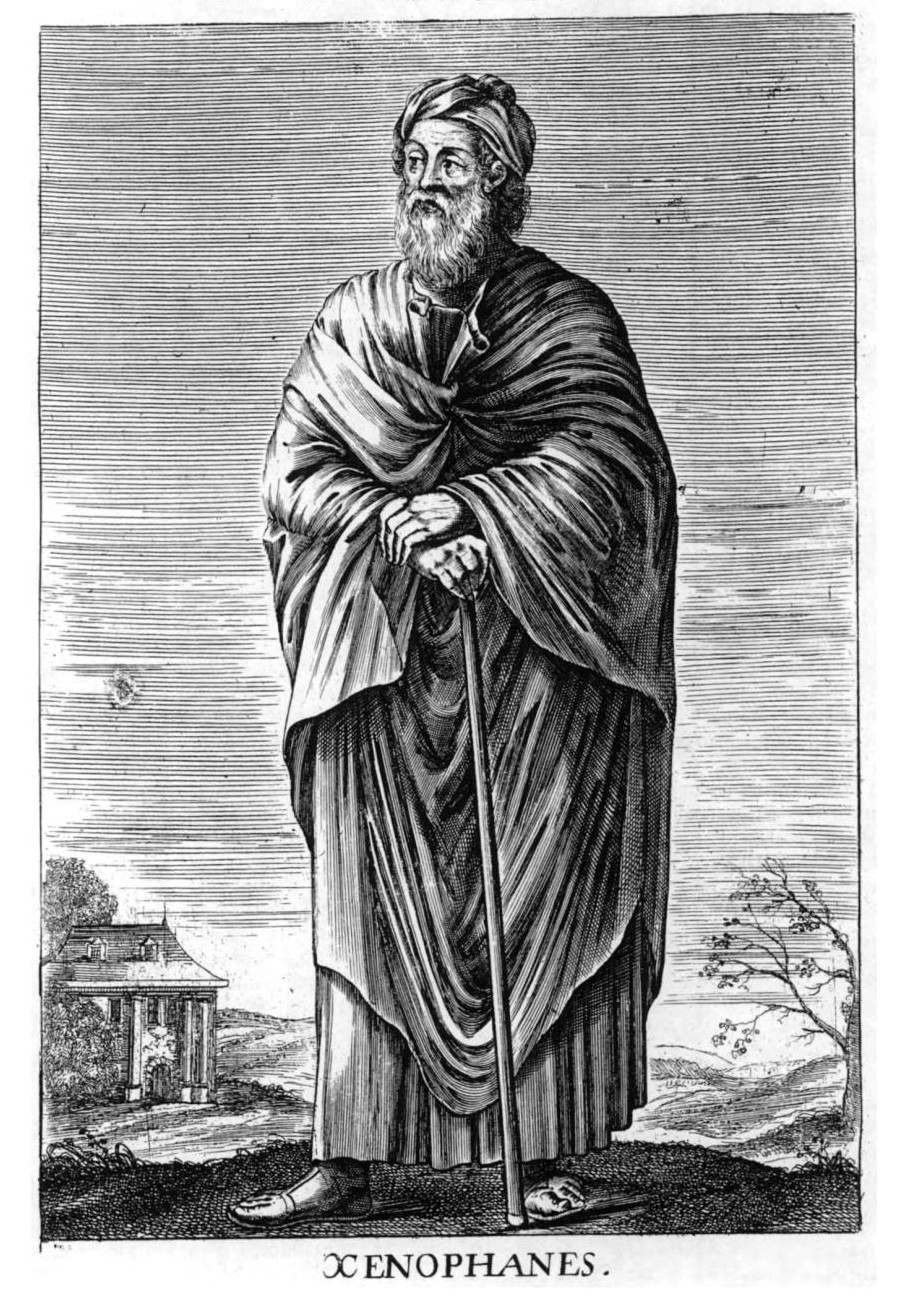 PhilosopherGreek & Roman570 – 478 BCE
Xenophanes
Xenophanes of Colophon was a pre-Socratic Greek philosopher, poet, and critic of Homer. He was born in Ionia and travelled throughout the Greek-speaking world in early classical antiquity.
- ◆projections
- ◆arche
- ◆knowledge
- ◆true belief
Read the full pageXenophanes of Colophon ( zuh-NOF-uh-neez; Ancient Greek: Ξενοφάνης ὁ Κολοφώνιος [ksenopʰánɛːs ho kolopʰɔ̌ːnios]; c. 570 – c. 478 BC) was a pre-Socratic Greek philosopher, poet, and critic of Homer. He was born in Ionia and travelled throughout the Greek-speaking world in early classical antiquity.
As a poet, Xenophanes was known for his critical style, writing poems that are considered among the first satires. He composed elegiac couplets that criticised his society's traditional values of wealth, excesses, and athletic victories. He criticised Homer and the other poets in his works for representing the gods as foolish or morally weak. His poems have not survived intact; only fragments of some of his work survive in quotations by later philosophers and literary critics.
- 9
 PhilosopherGreek & Romanc. 535 – 475 BCE
Heraclitus
Everything flows: reality is constant change held together by the logos and the unity of opposites.
- ◆Panta rhei — everything flows
- ◆You cannot step into the same river twice
- ◆Unity of opposites
- ◆Logos as cosmic order
Read the full pageHeraclitus (; Ancient Greek: Ἡράκλειτος, romanized: Hērákleitos; fl. c. 500 BC) was a pre-Socratic Greek philosopher from the city of Ephesus, which was then part of the Persian Empire. He exerts a wide influence on Western philosophy, both ancient and modern, through the works of such authors as Plato, Aristotle, the Stoics, Georg Wilhelm Friedrich Hegel, Friedrich Nietzsche, and Martin Heidegger.
Little is known of Heraclitus's life. He wrote a single work, of which only fragments survive. Even in ancient times, his paradoxical philosophy, appreciation for wordplay, and cryptic, oracular epigrams earned him the epithets "the dark" and "the obscure". He was considered arrogant and depressed, a misanthrope who was subject to melancholia. Consequently, he became known as "the weeping philosopher" in contrast to the ancient atomist philosopher Democritus, who was known as "the laughing philosopher".
- 10
 PhilosopherGreek & Romanc. 515 – 450 BCE
Parmenides
Argued that what is, is, and cannot not be — so change and plurality are illusions.
- ◆Being is one, eternal, unchanging
- ◆The Way of Truth vs the Way of Opinion
- ◆Reason over the senses
Read the full pageParmenides of Elea (; Ancient Greek: Παρμενίδης ὁ Ἐλεάτης; fl. late sixth or early fifth century BC) was a pre-Socratic Greek philosopher from Elea in Magna Graecia (Southern Italy).
Parmenides was born in the Greek colony of Elea to a wealthy and illustrious family. The exact date of his birth is not known with certainty; on the one hand, according to the doxographer Diogenes Laërtius, Parmenides flourished in the period immediately preceding 500 BC, which would place his year of birth around 540 BC; on the other hand, in the dialogue Parmenides Plato portrays him as visiting Athens at the age of 65, when Socrates was a young man, c. 450 BC, which, if true, suggests a potential year of birth of c. 515 BC. Parmenides is thought to have been in his prime (or "floruit") around 475 BC.