Presocratic philosophy: Anaxagoras to Anaxarchus
- 1
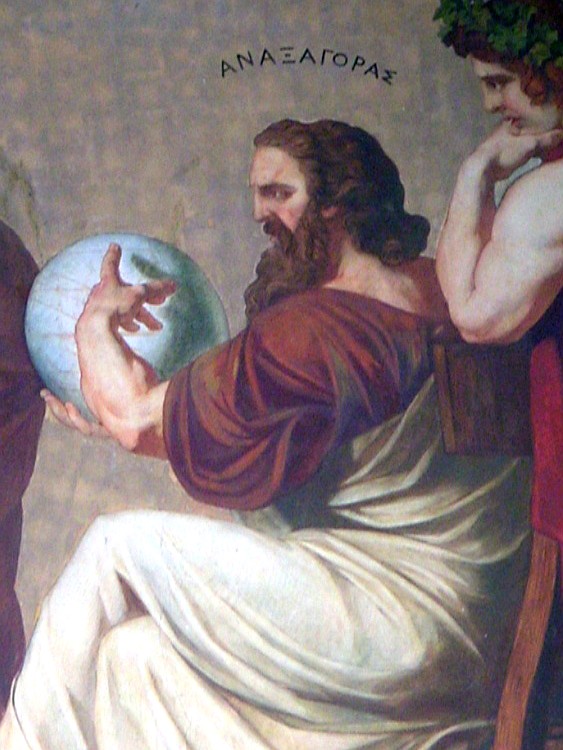 PhilosopherGreek & Roman500 – 428 BCE
Anaxagoras
Anaxagoras was a pre-Socratic Greek philosopher. Born in Clazomenae at a time when Asia Minor was under the control of the Persian Empire, Anaxagoras came to Athens.
- ◆Nous
Read the full pageAnaxagoras (; Ancient Greek: Ἀναξαγόρας, Anaxagóras; c. 500 BC – c. 428 BC) was a pre-Socratic Greek philosopher. Born in Clazomenae at a time when Asia Minor was under the control of the Persian Empire, Anaxagoras came to Athens. In later life he was charged with impiety and went into exile in Lampsacus.
Responding to the claims of Parmenides on the impossibility of change, Anaxagoras introduced the concept of Nous (Cosmic Mind) as an ordering force. He also gave several novel scientific accounts of natural phenomena, including the notion of panspermia, that life exists throughout the universe and could be distributed everywhere. He deduced a correct explanation for eclipses and described the Sun as a fiery mass larger than the Peloponnese, and also attempted to explain rainbows and meteors. He also speculated that the sun might be just another star.
- 2
 PhilosopherGreek & Roman500 – 500 BCE
Leucippus
Leucippus was a pre-Socratic Greek philosopher. He is traditionally credited as the founder of atomism, which he developed with his student Democritus.
- ◆The concept of atoms
Read the full pageLeucippus (; Λεύκιππος, Leúkippos; fl. 5th century BCE) was a pre-Socratic Greek philosopher. He is traditionally credited as the founder of atomism, which he developed with his student Democritus. Leucippus divided the world into two entities: atoms, indivisible particles that make up all things, and the void, the nothingness that exists between the atoms. He developed his philosophy as a response to the Eleatics, who believed that all things are one and the void does not exist. Leucippus's ideas were influential in ancient and Renaissance philosophy. Leucippus was the first Western philosopher to develop the concept of atoms, but his ideas only bear a superficial resemblance to modern atomic theory.
Leucippus's atoms come in infinitely many forms and exist in constant motion, creating a deterministic world in which everything is caused by the collisions of atoms. Leucippus described the beginning of the cosmos as a vortex of atoms that formed the Earth, the Sun, the stars, and other celestial bodies. As Leucippus considered both atoms and the void to be infinite, he presumed that other worlds must exist as cosmoses are formed elsewhere. Leucippus and Democritus described the soul as an arrangement of spherical atoms, which are cycled through the body through respiration and create thought and sensory input.
- 3
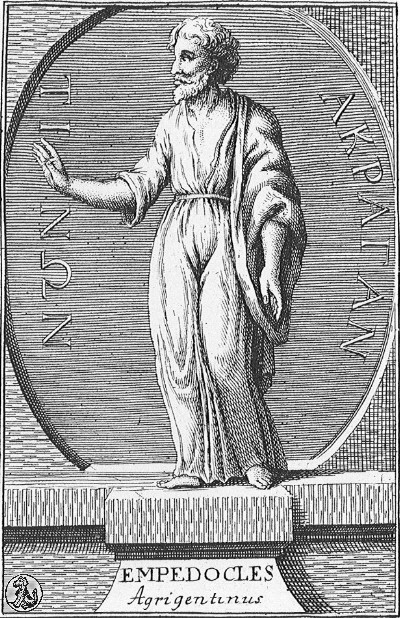 PhilosopherGreek & Romanc. 494 – 434 BCE
Empedocles
Proposed the four elements — earth, water, air and fire — moved by Love and Strife.
- ◆Classical four elements
- ◆fire
- ◆air
- ◆earth
- ◆water
Read the full pageEmpedocles (; Ancient Greek: Ἐμπεδοκλῆς; c. 494 – c. 434 BC, fl. 444–443 BC) was a pre-Socratic Greek philosopher and a native citizen of Akragas, a Greek city in Sicily. Empedocles' philosophy is known best for originating the cosmogonic theory of the four classical elements. He also proposed forces he called Love and Strife which would mix and separate the elements, respectively.
Empedocles challenged the practice of animal sacrifice and killing animals for food. He developed a distinctive doctrine of reincarnation. He is generally considered the last Greek philosopher to have recorded his ideas in verse. Some of his work survives, more than is the case for any other pre-Socratic philosopher. Empedocles' death was mythologized by ancient writers, and has been the subject of a number of literary treatments.
- 4
 PhilosopherGreek & Romanc. 490 – 420 BCE
Protagoras
Leading Sophist famous for "man is the measure of all things".
- ◆Relativism
- ◆Agnosticism about the gods
Read the full pageProtagoras ( proh-TAG-ər-əs, -ass; Greek: Πρωταγόρας; c. 490 BC – c. 420 BC) was a pre-Socratic Greek philosopher and rhetorical theorist. He is numbered as one of the sophists by Plato. In his dialogue Protagoras, Plato credits him with inventing the role of the professional sophist.
Protagoras is also believed to have created a major controversy during ancient times through his statement that "Of all things the measure is Man, of the things that are, that they are, and of the things that are not, that they are not" which was usually rendered simply as "Man is the measure of all things", interpreted by Plato to mean that there is no objective truth; Protagoras seems to have meant that each person's own personal history, experiences and expectations, developed over their lifetime, determine their judgments, opinions, and statements regarding "truth" (which is the title of the book in which Protagoras made this statement). When a person makes a judgment about a certain thing—good or bad or beautiful or unjust—that person will differ from other people's judgments because their experience has been different.
- 5
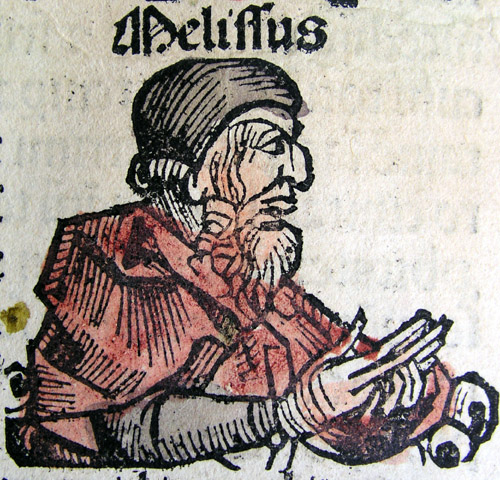 PhilosopherGreek & Roman490 – 430 BCE
Melissus of Samos
Melissus of Samos was the third and last member of the ancient school of Eleatic philosophy, whose other members included Zeno and Parmenides. Little is known about his life, except that he was the commander of the Samian fleet in the Samian War.
- ◆DK
- ◆Nothing comes from nothing
Read the full pageMelissus of Samos (; Ancient Greek: Μέλισσος ὁ Σάμιος; fl. 5th century BC) was the third and last member of the ancient school of Eleatic philosophy, whose other members included Zeno and Parmenides. Little is known about his life, except that he was the commander of the Samian fleet in the Samian War. Melissus’s contribution to philosophy was a treatise of systematic arguments supporting Eleatic philosophy. Like Parmenides, he argued that reality is ungenerated, indestructible, indivisible, changeless, and motionless. In addition, he sought to show that reality is wholly unlimited, and infinitely extended in all directions; and since existence is unlimited, it must also be one.
Not much information remains regarding the life of Melissus. He may have been born around 500 BC; the date of his death is unknown. The little which is known about him is mostly gleaned from a small passage in Plutarch’s Life of Pericles. He was the commander of the Samian fleet in the Samian War, and defeated Pericles and the Athenian fleet in 440 BC. Plutarch claims that Aristotle says that Melissus had also defeated Pericles in an earlier battle. In his Life of Themistocles, Plutarch denies Stesimbrotos’s claim that Melissus was held in high regard by Themistocles, claiming that he is confusing Themistocles and Pericles. Melissus was reputed to have been the pupil of Parmenides, and the teacher of Leucippus, though one must regard such claims with a fair amount of skepticism.
- 6
 PhilosopherGreek & Roman483 – 375 BCE
Gorgias
Gorgias was an ancient Greek sophist, pre-Socratic philosopher, and rhetorician who was a native of Leontinoi in Sicily. Several doxographers report that he was a pupil of Empedocles, although he would only have been a few years younger.
- ◆Paradoxologia
Read the full pageGorgias ( GOR-jee-əs; Ancient Greek: Γοργίας; c. 483 BC – c. 375 BC) was an ancient Greek sophist, pre-Socratic philosopher, and rhetorician who was a native of Leontinoi in Sicily. Several doxographers report that he was a pupil of Empedocles, although he would only have been a few years younger. W. K. C. Guthrie writes that "Like other Sophists, he was an itinerant that practiced in various cities and giving public exhibitions of his skill at the great pan-Hellenic centers of Olympia and Delphi, and charged fees for his instruction and performances. A special feature of his displays was to ask miscellaneous questions from the audience and give impromptu replies." He has been called "Gorgias the Nihilist", although the degree to which this epithet adequately describes his philosophy is controversial.
Prominent among his claims to recognition is that he transplanted rhetoric from his native Sicily to Attica, and contributed to the diffusion of the Attic dialect as the language of literary prose.
- 7
 PhilosopherGreek & Roman460 – 380 BCE
Prodicus
Prodicus of Ceos was a Greek philosopher, and part of the first generation of Sophists. He came to Athens as ambassador from Ceos, and became known as a speaker and a teacher.
Read the full pageProdicus of Ceos (; Ancient Greek: Πρόδικος ὁ Κεῖος, Pródikos ho Keios; c. 465 BC – c. 395 BC) was a Greek philosopher, and part of the first generation of Sophists. He came to Athens as ambassador from Ceos, and became known as a speaker and a teacher. Plato treats him with greater respect than the other sophists, and in several of the Platonic dialogues Socrates appears as the friend of Prodicus. One writer claims Socrates used his method of instruction. Prodicus made linguistics and ethics prominent in his curriculum. The content of one of his speeches is still known, and concerns a fable in which Heracles has to make a choice between Virtue and Vice. He also interpreted religion through the framework of naturalism.
Prodicus was a native of Ioulis on the island of Ceos, the birthplace of Simonides, whom he is described as having imitated. Prodicus came frequently to Athens for the purpose of transacting business on behalf of his native city, and attracted admiration as an orator, although his voice was deep and apt to fall. Plutarch describes him as slender and weak; and Plato also alludes to his weakness, and a degree of effeminacy which thus resulted. Philostratus accuses him of luxury and avarice, but no earlier source mentions this.
- 8PhilosopherGreek & Roman443 – 399 BCE
Hippias
Hippias of Elis was a Greek sophist, and a contemporary of Socrates. With an assurance characteristic of the later sophists, he claimed to be regarded as an authority on all subjects, and lectured on poetry, grammar, history, politics, mathematics, and much else.
Read the full pageHippias of Elis (; Greek: Ἱππίας ὁ Ἠλεῖος; late 5th century BC) was a Greek sophist, and a contemporary of Socrates. With an assurance characteristic of the later sophists, he claimed to be regarded as an authority on all subjects, and lectured on poetry, grammar, history, politics, mathematics, and much else. Most current knowledge of him is derived from Plato, who characterizes him as vain and arrogant.
Hippias was born at Elis in the mid 5th-century BC (c. 460 BC) and was thus a younger contemporary of Protagoras and Socrates. He lived at least as late as Socrates (399 BC). He was a disciple of Hegesidamus. Owing to his talent and skill, his fellow-citizens availed themselves of his services in political matters, and in a diplomatic mission to Sparta. But he was in every respect like the other sophists of the time: he travelled about in various towns and districts of Greece for the purpose of teaching and public speaking. The two dialogues of Plato, the Hippias major and the Hippias minor characterize him as vain and arrogant. The Hippias major (the authorship of this work by Plato is sometimes doubted) concerns the question about the beautiful, and purposely puts the knowledge and presumption of Hippias in a ludicrous light. The Hippias minor discusses the deficiency of human knowledge, and characterizes Hippias as ridiculously vain.
- 9
 PhilosopherGreek & Roman430 – 345 BCE
Archytas
Archytas was an Ancient Greek mathematician, music theorist, statesman, and strategist from the ancient city of Taras (Tarentum) in modern Apulia, Southern Italy. He was a scientist and philosopher affiliated with the Pythagorean school and famous for being the reputed founder of mathematical mechanics and a friend of
- ◆Doubling the cube
- ◆Infinite universe
Read the full pageArchytas was an Ancient Greek mathematician, music theorist, statesman, and strategist from the ancient city of Taras (Tarentum) in modern Apulia, Southern Italy. He was a scientist and philosopher affiliated with the Pythagorean school and famous for being the reputed founder of mathematical mechanics and a friend of Plato.
As a Pythagorean, Archytas believed that arithmetic (logistic), rather than geometry, provided the basis for satisfactory proofs, and developed the most famous argument for the infinity of the universe in antiquity.
- 10PhilosopherGreek & Roman380 – 320 BCE
Anaxarchus
Anaxarchus was a Greek philosopher of the school of Democritus. Together with Pyrrho, he accompanied Alexander the Great into Asia.
Read the full pageAnaxarchus (; Greek: Ἀνάξαρχος; c. 380 – c. 320 BC) was a Greek philosopher of the school of Democritus. Together with Pyrrho, he accompanied Alexander the Great into Asia. The reports of his philosophical views suggest that he was a forerunner of the Greek skeptics.
Anaxarchus was born at Abdera in Thrace. He was the companion and friend of Alexander the Great in his Asiatic campaigns. His relationship with Alexander, however, was ambiguous, owing to contradictory sources. Some paint Anarxchus as a flatterer, among them Plutarch, who tells a story that at Bactra, in 327 BC in a debate with Callisthenes, Anaxarchus advised all to worship Alexander as a god even during his lifetime. In contrast, others paint Anaxarchus as scathingly ironic towards the monarch. According to Diogenes Laertius, in response to Alexander's claim to have been the son of Zeus-Ammon, Anaxarchus pointed to his bleeding wound and remarked, "See the blood of a mortal, not ichor, such as flows from the veins of the immortal gods."