Platonism: Plato to Crantor
The view, from Plato, that abstract, perfect Forms are more real than the changing world of the senses.
- 1
 SchoolGreek & Roman387 BCE – present
Platonism
The view, from Plato, that abstract, perfect Forms are more real than the changing world of the senses.
- ◆Theory of Forms
- ◆Knowledge as recollection
- ◆The soul's immortality
- ◆Philosopher-kings
Read the full pagePlatonism is the philosophy of Plato and philosophical systems closely derived from it, considered the opposite of nominalism, or anti-realism. Platonism has had a profound influence on Western thought. Platonism or Platonic realism affirms the real existence of forms or abstract objects, originally to solve the problem of universals. Abstract objects are asserted to exist in a third realm distinct from both the sensible external world and from the internal world of consciousness. This can apply to properties, types, propositions, meanings, numbers, sets, truth values, and so on (see abstract object theory).
Plato's doctrine originally was an attempt to reconcile the reality which is perceptible but unintelligible, associated with the flux of Heraclitus and studied by the likes of physical science, and the reality which is imperceptible but intelligible, associated with the unchanging being of Parmenides and studied by the likes of mathematics. Geometry was one of Plato's main inspirations, which likely reflects the influence of Pythagoras. The Forms are typically described—in dialogues such as the Phaedo, Symposium and Republic—as perfect archetypes, of which objects in the everyday world are imperfect copies. The so-called "Third Man" argument, first articulated by Plato himself and later recast into the eponymous version by Aristotle, was the theory's most famous criticism in antiquity.
- 2
 PhilosopherGreek & Romanc. 428 – 348 BCE
Plato
Founder of the Academy whose dialogues defined Western philosophy's agenda: Forms, justice, the soul, knowledge and the ideal state.
- ◆Theory of Forms
- ◆Allegory of the Cave
- ◆Tripartite soul: reason, spirit, appetite
- ◆Knowledge as recollection
- ◆Philosopher-kings
Read the full pageAlfred North Whitehead said the European philosophical tradition "consists of a series of footnotes to Plato". The claim is exaggerated but understandable: Plato's dialogues raised nearly every question philosophy still asks, and did so as literature of the highest order.
Plato was an Athenian aristocrat and devoted follower of Socrates, whose execution turned him from politics to philosophy. Around 387 BCE he founded the Academy, which lasted in some form for centuries. His early dialogues portray Socrates questioning his contemporaries; the middle dialogues — the Phaedo, Symposium and Republic — develop Plato's own theory of Forms: perfect, unchanging realities such as Justice, Beauty and the Good, of which the things we perceive are imperfect copies. Knowledge is of the Forms, reached by reason rather than the senses; learning is a kind of recollection of what the soul knew before birth.
- 3PhilosopherGreek & Romanc. 428 – 348 BCE
Plato
Founder of the Academy whose dialogues defined Western philosophy's agenda: Forms, justice, the soul, knowledge and the ideal state.
- ◆Theory of Forms
- ◆Allegory of the Cave
- ◆Tripartite soul: reason, spirit, appetite
- ◆Knowledge as recollection
- ◆Philosopher-kings
Read the full pageAlfred North Whitehead said the European philosophical tradition "consists of a series of footnotes to Plato". The claim is exaggerated but understandable: Plato's dialogues raised nearly every question philosophy still asks, and did so as literature of the highest order.
Plato was an Athenian aristocrat and devoted follower of Socrates, whose execution turned him from politics to philosophy. Around 387 BCE he founded the Academy, which lasted in some form for centuries. His early dialogues portray Socrates questioning his contemporaries; the middle dialogues — the Phaedo, Symposium and Republic — develop Plato's own theory of Forms: perfect, unchanging realities such as Justice, Beauty and the Good, of which the things we perceive are imperfect copies. Knowledge is of the Forms, reached by reason rather than the senses; learning is a kind of recollection of what the soul knew before birth.
- 4
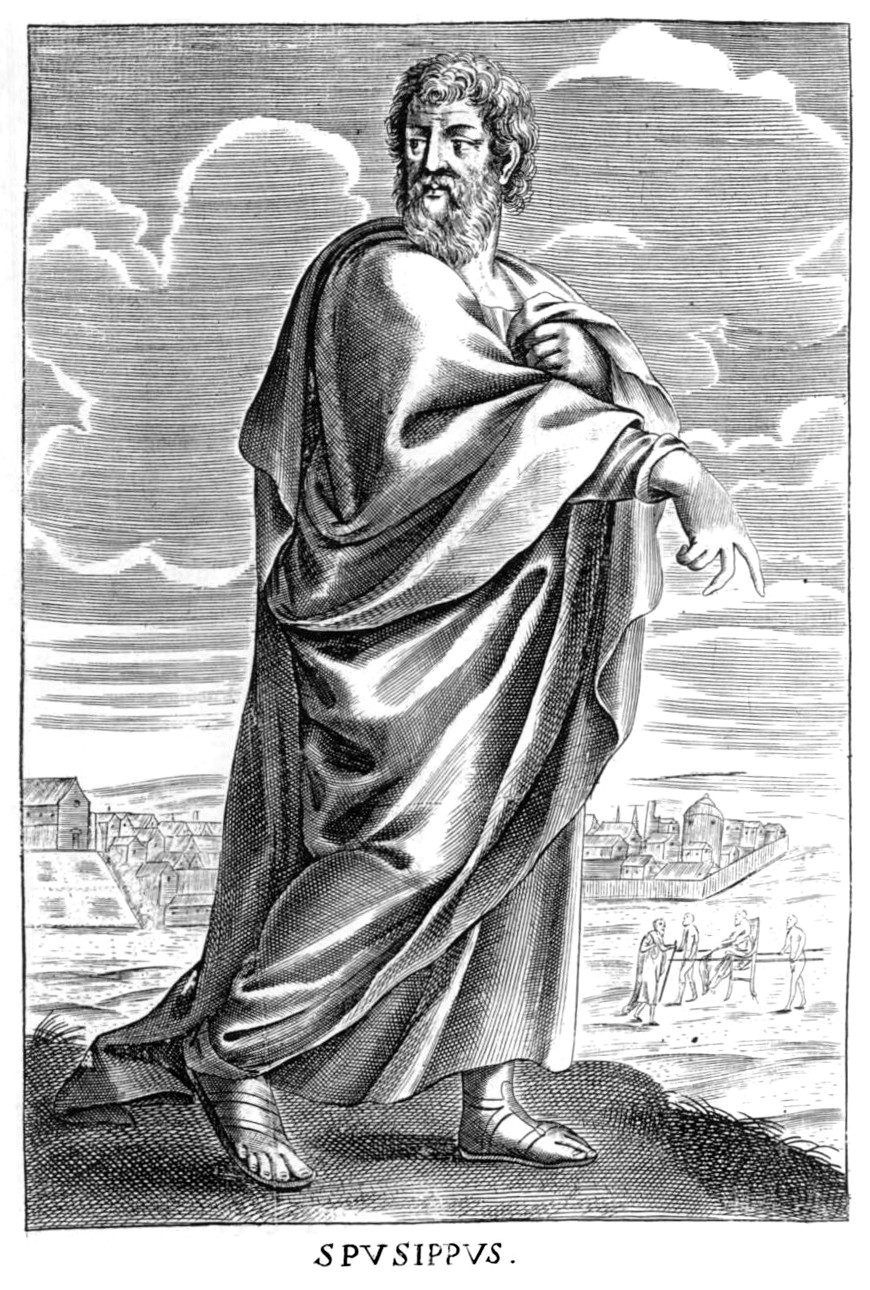 PhilosopherGreek & Roman407 – 339 BCE
Speusippus
Speusippus was an ancient Greek philosopher. Speusippus was Plato's nephew by his sister Potone.
- ◆Theory of Forms
Read the full pageSpeusippus (; Ancient Greek: Σπεύσιππος; c. 408 – 339/8 BC) was an ancient Greek philosopher. Speusippus was Plato's nephew by his sister Potone. After Plato's death, c. 348 BC, Speusippus inherited the Academy, near age 60, and remained its head for the next eight years. However, following a stroke, he passed the chair to Xenocrates. Although the successor to Plato in the Academy, Speusippus frequently diverged from Plato's teachings. He rejected Plato's Theory of Forms, and whereas Plato had identified the Good with the ultimate principle, Speusippus maintained that the Good was merely secondary. He also argued that it is impossible to have satisfactory knowledge of any thing without knowing all the differences by which it is separated from everything else.
The standard edition of the surviving fragments and testimonies is Leonardo Tarán's Speusippus of Athens: A Critical Study with a Collection of the Related Texts and Commentary (1982).
- 5
 PhilosopherGreek & Roman400 – 270 BCE
Polemon
Polemon of Athens was an eminent Greek Platonist philosopher and Plato's third successor as scholarch (i.e., head of the Academy) from 314/313 to 270/269 BC. A pupil of Xenocrates, he believed that philosophy should be practiced rather than just studied, and he placed the highest good in living according to nature.
Read the full pagePolemon of Athens (Ancient Greek: Πολέμων, gen.: Πολέμωνος; d. 270/269 BC) was an eminent Greek Platonist philosopher and Plato's third successor as scholarch (i.e., head of the Academy) from 314/313 to 270/269 BC. A pupil of Xenocrates, he believed that philosophy should be practiced rather than just studied, and he placed the highest good in living according to nature.
Polemon was the son of Philostratus, a man of wealth and political distinction. In his youth, he was relatively irresponsible, but one day, when he was about thirty, on his bursting into the school of Xenocrates, at the head of a band of revelers, his attention was drawn to the sayings of Xenocrates, who continued on calmly in spite of the interruption; it just so happened that Xenocrates was discussing temperance. Polemon immediately tore off his garland and remained an attentive listener, and from that day he adopted a modest and restrained course of life, and continued to frequent the school. On the death of Xenocrates, he became the scholarch, in 315 BC.
- 6
 PhilosopherGreek & Roman396 – 314 BCE
Xenocrates
Xenocrates of Chalcedon was a Greek philosopher, mathematician, and leader (scholarch) of the Platonic Academy from 339/8 to 314/3 BC. His teachings followed those of Plato, which he attempted to define more closely, often with mathematical elements.
- ◆Plato
Read the full pageXenocrates of Chalcedon was a Greek philosopher, mathematician, and leader (scholarch) of the Platonic Academy from 339/8 to 314/3 BC. His teachings followed those of Plato, which he attempted to define more closely, often with mathematical elements. He distinguished three forms of being: the sensible, the intelligible, and a third compounded of the two, to which correspond respectively, sense, intellect and opinion. He considered unity and duality to be gods which rule the universe, and the soul a self-moving number. God pervades all things, and there are daemonical powers, intermediate between the divine and the mortal, which consist in conditions of the soul. He held that mathematical objects and the Platonic Ideas are identical, unlike Plato who distinguished them. In ethics, he taught that virtue produces happiness, but external goods can minister to it and enable it to effect its purpose.
Xenocrates was a native of Chalcedon. By the most probable calculation he was born 396/5 BC, and died 314/3 BC at the age of 82. His father was named Agathon (Ancient Greek: Ἀγάθων) or Agathanor (Ancient Greek: Ἀγαθάνωρ).
- 7PhilosopherGreek & Roman385 – 322 BCE
Heraclides Ponticus
Heraclides Ponticus was a Greek philosopher and astronomer who was born in Heraclea Pontica, now Karadeniz Ereğli, Turkey, and migrated to Athens. He is best remembered for proposing that the Earth rotates on its axis, from west to east, once every 24 hours.
Read the full pageHeraclides Ponticus (Ancient Greek: Ἡρακλείδης ὁ Ποντικός Herakleides; c. 390 BC – c. 310 BC) was a Greek philosopher and astronomer who was born in Heraclea Pontica, now Karadeniz Ereğli, Turkey, and migrated to Athens. He is best remembered for proposing that the Earth rotates on its axis, from west to east, once every 24 hours. He is also hailed as the originator of the heliocentric theory, although this is disputed.
Heraclides' father was Euthyphron, a wealthy nobleman who sent his son to study at the Platonic Academy in Athens under its founder Plato and under his successor Speusippus. According to the Suda, Plato, on his departure for Sicily in 361/360 BC, left the Academy in the charge of Heraclides. Heraclides was nearly elected successor to Speusippus as head of the academy in 339/338 BC, but narrowly lost to Xenocrates. A punning on his name, by Athenian wits, dubbing him Heraclides "Pompicus," suggests he may have been a rather vain and pompous man and the target of much ridicule.
- 8PhilosopherGreek & Roman344 – 275 BCE
Crantor
Crantor of Soli was an Ancient Greek philosopher and member of the Old Academy who was the first philosopher to write commentaries on the works of Plato.
Read the full pageCrantor of Soli (Greek: Κράντωρ, gen.: Κράντορος; died 276/5 BC) was an Ancient Greek philosopher and member of the Old Academy who was the first philosopher to write commentaries on the works of Plato.
Crantor was probably born around the middle of the 4th century BC, at Soli in Cilicia (modern-day Turkey). He moved from Cilicia to Athens in order to study philosophy, where he became a pupil of Xenocrates and a friend of Polemon, and one of the most distinguished supporters of the philosophy of the older Academy. As Xenocrates died 314/3 BC, Crantor must have come to Athens prior to that year, although the date of his birth is not known. He died before both Polemon and Crates, who succeeded Polemon as scholarch. Dropsy was the cause of his death. He left his fortune, which amounted to twelve talents, to Arcesilaus, who had been his pupil and who later succeeded Crates as scholarch of the Academy.
