
Xenocrates
Xenocrates of Chalcedon was a Greek philosopher, mathematician, and leader (scholarch) of the Platonic Academy from 339/8 to 314/3 BC. His teachings followed those of Plato, which he attempted to define more closely, often with mathematical elements.
Xenocrates of Chalcedon was a Greek philosopher, mathematician, and leader (scholarch) of the Platonic Academy from 339/8 to 314/3 BC. His teachings followed those of Plato, which he attempted to define more closely, often with mathematical elements. He distinguished three forms of being: the sensible, the intelligible, and a third compounded of the two, to which correspond respectively, sense, intellect and opinion. He considered unity and duality to be gods which rule the universe, and the soul a self-moving number. God pervades all things, and there are daemonical powers, intermediate between the divine and the mortal, which consist in conditions of the soul. He held that mathematical objects and the Platonic Ideas are identical, unlike Plato who distinguished them. In ethics, he taught that virtue produces happiness, but external goods can minister to it and enable it to effect its purpose.
Life
Xenocrates was a native of Chalcedon. By the most probable calculation he was born 396/5 BC, and died 314/3 BC at the age of 82. His father was named Agathon (Ancient Greek: Ἀγάθων) or Agathanor (Ancient Greek: Ἀγαθάνωρ).
Moving to Athens in early youth, he became the pupil of Aeschines Socraticus, but subsequently joined himself to Plato, whom he accompanied to Sicily in 361. Upon his master's death, he paid a visit with Aristotle to Hermias of Atarneus. In 339/8 BC, Xenocrates succeeded Speusippus in the presidency of the school, defeating his competitors Menedemus of Pyrrha and Heraclides Ponticus by a few votes. On three occasions he was member of an Athenian legation, once to Philip, twice to Antipater.
Xenocrates resented the Macedonian influence then dominant at Athens. Soon after the death of Demosthenes (c. 322 BC), he declined the citizenship offered to him at the insistence of Phocion as a reward for his services in negotiating peace with Antipater after Athens' unsuccessful rebellion. The settlement was reached "at the price of a constitutional change: thousands of poor Athenians were disenfranchised," and Xenocrates said "that he did not want to become a citizen within a constitution he had struggled to prevent". Being unable to pay the tax levied upon resident aliens, he is said to have been saved only by the courage of the orator Lycurgus, or even to have been bought by Demetrius Phalereus, and then emancipated. In 314/3, he died from hitting his head, after tripping over a bronze pot in his house.
Xenocrates was succeeded as scholarch by Polemon, whom he had reclaimed from a life of profligacy. Besides Polemon, the statesman Phocion, Chaeron (tyrant of Pellene), the academic Crantor, the Stoic Zeno and Epicurus are said to have frequented his lectures.
He was described as lacking a natural social grace, he was known for his steady and thorough work habits. His peers in Athens viewed him as a person of high integrity and character, which led people to trust him in public life.
Xenocrates adhered closely to the Platonist doctrine, and he is accounted the typical representative of the Old Academy. In his writings, which were numerous, he seems to have covered nearly the whole of the Academic program; but metaphysics and ethics were the subjects which principally engaged his thoughts. He is said to have made more explicit the division of philosophy into the three parts of Physics, Dialectic and Ethics.
Writings
With a comprehensive work on Dialectic (τῆς περὶ τὸ διαλέγεσθαι πραγματείας βιβλία ιδ΄) there were also separate treatises On Knowledge, On Knowledgibility (περὶ ἐπιστήμης α΄, περὶ ἐπιστημοσύνης α΄), On Divisions (διαιρέσεις η΄), On Genera and Species (περὶ γενῶν καὶ εἰδῶν α΄), On Ideas (περὶ ἰδεῶν), On the Opposite (περὶ τοῦ ἐναντίου), and others, to which probably the work On Mediate Thought (τῶν περὶ τὴν διάνοιαν η΄) also belonged. Two works by Xenocrates on Physics are mentioned (περὶ φύσεως ϛ΄ - φυσικῆς ἀκροάσεως ϛ΄), as are also books On the Gods (περὶ Θεῶν β΄), On the Existent (περὶ τοῦ ὄντος), On the One (περὶ τοῦ ἑνός), On the Indefinite (περὶ τοῦ ἀορίστου), On the Soul (περὶ ψυχῆς), On the Emotions (περὶ τῶν παθῶν α΄) On Memory (περὶ μνήμης), etc. In like manner, with the more general Ethical treatises On Happiness (περὶ εὐδαιμονίας β΄), and On Virtue (περὶ ἀρετῆς) there were connected separate books on individual Virtues, on the Voluntary, etc. His four books on Royalty he had addressed to Alexander (στοιχεῖα πρὸς Ἀλέξανδρον περὶ βασιλείας δ΄). Besides these he had written treatises On the State (περὶ πολιτείας α΄; πολιτικός α΄), On the Power of Law (περὶ δυνάμεως νόμου α΄), etc., as well as upon Geometry, Arithmetic, and Astrology. Besides philosophical treatises, he wrote poetry (epē) and paraenesis.
Epistemology
Xenocrates made a more definite division between the three departments of philosophy, than Speusippus, but at the same time abandoned Plato's heuristic method of conducting through doubts (aporiai), and adopted instead a mode of bringing forward his doctrines in which they were developed dogmatically.
Xenocrates recognized three grades of cognition, each appropriated to a region of its own: knowledge, sensation, and opinion. He referred knowledge (episteme) to that essence which is the object of pure thought, and is not included in the phenomenal world; sensation (aisthesis) to that which passes into the world of phenomena; opinion (doxa) to that essence which is at once the object of sensuous perception, and, mathematically, of pure reason - the essence of heaven or the stars; so that he conceived of doxa in a higher sense, and endeavored, more definitely than Plato, to exhibit mathematics as mediating between knowledge and sensuous perception.
All three modes of apprehension partake of truth; but in what manner scientific perception (epistemonike aisthesis) did so, we unfortunately do not learn. Even here Xenocrates's preference for symbolic modes of sensualising or denoting appears: he connected the above three stages of knowledge with the three Fates: Atropos, Clotho, and Lachesis. We know nothing further about the mode in which Xenocrates carried out his dialectic, as it is probable that what was peculiar to Aristotelian logic did not remain unnoticed in it, for it can hardly be doubted that the division of the existent into the absolutely existent, and the relatively existent, attributed to Xenocrates, was opposed to the Aristotelian table of categories.
Metaphysics
We know from Plutarch that Xenocrates, if he did not explain the Platonic construction of the world-soul as Crantor after him did, nevertheless drew heavily on the Timaeus; and further that he was at the head of those who, regarding the universe as unoriginated and imperishable, looked upon the chronological succession in the Platonic theory as a form in which to denote the relations of conceptual succession. Plutarch unfortunately, does not give us any further details, and contented himself with describing the well-known assumption of Xenocrates, that the soul is a self-moving number. Probably we should connect with this the statement that Xenocrates called unity and duality (monas and duas) deities, and characterised the former as the first male existence, ruling in heaven, as father and Zeus, as uneven number and spirit; the latter as female, as the mother of the gods, and as the soul of the universe which reigns over the mutable world under heaven, or, as others have it, that he named the Zeus who ever remains like himself, governing in the sphere of the immutable, the highest; the one who rules over the mutable, sublunary world, the last, or outermost.
If, like other Platonists, he designated the material principle as undefined duality, the world-soul was probably described by him as the first defined duality, the conditioning or defining principle of every separate definitude in the sphere of the material and changeable, but not extending beyond it. He appears to have called it in the highest sense the individual soul, in a derivative sense a self-moving number, that is, the first number endowed with motion. To this world-soul Zeus, or the world-spirit, has entrusted - in what degree and in what extent, we do not learn - dominion over that which is liable to motion and change. The divine power of the world-soul is then again represented, in the different spheres of the universe, as infusing soul into the planets, Sun and Moon, - in a purer form, in the shape of Olympic gods. As a sublunary daemonical power (as Hera, Poseidon, Demeter), it dwells in the elements, and these daemonical natures, midway between gods and men, are related to them as the isosceles triangle is to the equilateral and the scalene. The divine world-soul which reigns over the whole domain of sublunary changes he appears to have designated as the last Zeus, the last divine activity.
It is not until we get to the sphere of the separate daemonical powers of nature that the opposition between good and evil begins, and the daemonical power is appeased by means of a stubbornness which it finds there congenial to it; the good daemonical power makes happy those in whom it takes up its abode, the bad ruins them; for eudaimonia is the indwelling of a good daemon, the opposite the indwelling of a bad one.
Adapted from the Wikipedia article Xenocrates, available under CC BY-SA 4.0.
Connections
Belongs to
1

Ideas & arguments
1Contributed to
4

You might also explore
 Aristotle★Greek & Roman384 – 322 BCEPlato's student and Alexander's tutor, who systematised logic, ethics, biology, metaphysics and politics — "the master…
 Socrates★Greek & Roman470 – 399 BCEThe Athenian who wrote nothing yet changed philosophy forever by questioning everyone about how to live — and died for…
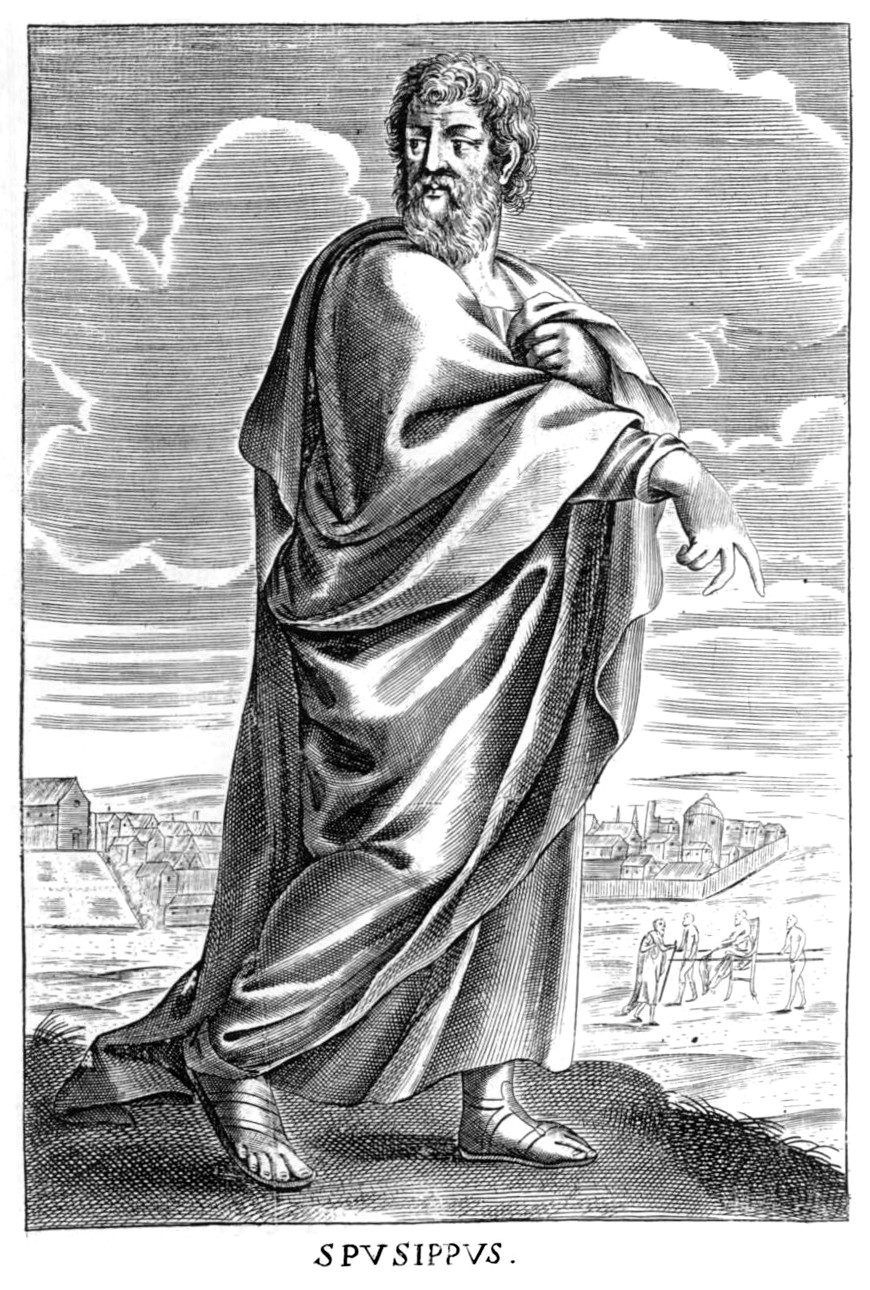 SpeusippusGreek & Roman407 – 339 BCESpeusippus was an ancient Greek philosopher. Speusippus was Plato's nephew by his sister Potone.
 Plato★Greek & Romanc. 428 – 348 BCEFounder of the Academy whose dialogues defined Western philosophy's agenda: Forms, justice, the soul, knowledge and the…
 René Descartes★Modern European1596 – 1650The father of modern philosophy: he doubted everything he could and found certainty in "I think, therefore I am".
 Baruch Spinoza★Jewish1632 – 1677Lens-grinder of Amsterdam who identified God with Nature and wrote an Ethics in geometrical order.