Platonism: Arcesilaus to Guénon
- 1
 PhilosopherGreek & Roman315 – 240 BCE
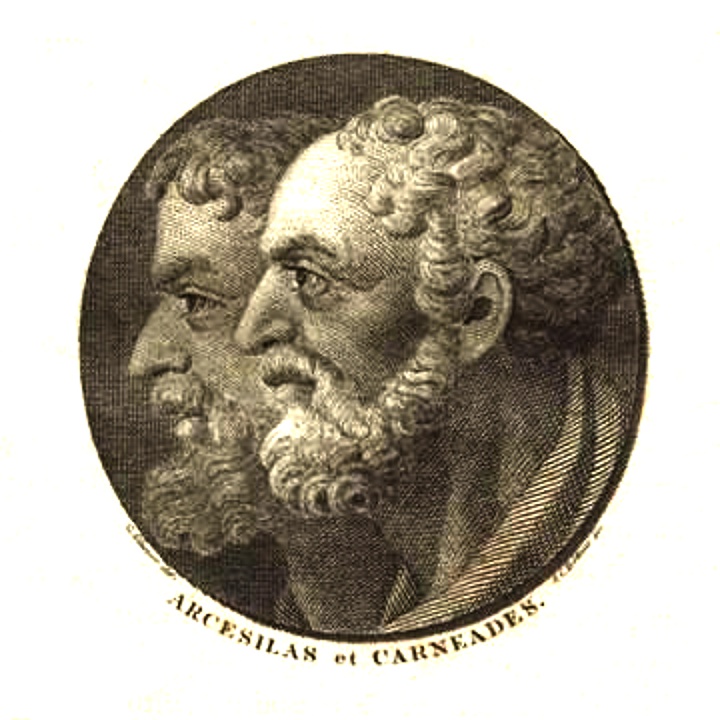
Arcesilaus
Arcesilaus was a Greek Hellenistic philosopher. He was the founder of Academic Skepticism and what is variously called the Second or Middle or New Academy – the phase of the Platonic Academy in which it embraced philosophical skepticism.
- ◆Academic Skepticism
Read the full pageArcesilaus was a Greek Hellenistic philosopher. He was the founder of Academic Skepticism and what is variously called the Second or Middle or New Academy – the phase of the Platonic Academy in which it embraced philosophical skepticism.
Arcesilaus succeeded Crates of Athens as the sixth scholarch of the academy around 264 BC. He did not preserve his thoughts in writing, so his opinions can only be gleaned second-hand from what is preserved by later writers.
- 2
 PhilosopherGreek & Roman213 – 129 BCE
Carneades
Carneades was a Greek philosopher, perhaps the most prominent head of the Skeptical Academy in Ancient Greece. He was born in Cyrene.
- ◆Philosophical skepticism
- ◆probabilism
- ◆Plank of Carneades
Read the full pageCarneades was a Greek philosopher, perhaps the most prominent head of the Skeptical Academy in Ancient Greece. He was born in Cyrene. By the time of his embassy to Rome in 155 BC, he was already a leading critic of dogmatic doctrines, especially those of Stoicism and the Epicureans, continuing the critical engagement that his predecessor Arcesilaus had also directed against both schools.
As scholarch (leader) of the Academy, he was one of three philosophers sent to Rome in 155 BC where his lectures on the uncertainty of justice caused consternation among leading politicians. He left no writings. His ideas were passed on to us through his successor Clitomachus whose own books were lost but relayed to us indirectly in the writings of Cicero and Sextus Empiricus. He seems to have doubted the ability not just of the senses but of reason too in acquiring truth. His skepticism was, however, moderated by the belief that we can, nevertheless, ascertain probabilities (not in the sense of statistical probability, but in the sense of persuasiveness) of truth, to enable us to act.
- 3PhilosopherGreek & Roman187 – 110 BCE
Clitomachus
Clitomachus or Cleitomachus was a Greek philosopher, originally from Carthage, who came to Athens in 163/2 BC and studied philosophy under Carneades. He became head of the Academy around 127/6 BC.
Read the full pageClitomachus or Cleitomachus was a Greek philosopher, originally from Carthage, who came to Athens in 163/2 BC and studied philosophy under Carneades. He became head of the Academy around 127/6 BC. He was an Academic skeptic like his master. Nothing survives of his writings, which were dedicated to making known the views of Carneades, but Cicero made use of them for some of his works.
Clitomachus was born in Carthage in 187/6 BC as Hasdrubal (Ancient Greek: Ἀσδρούβας, Hasdroúbas; Punic: 𐤏𐤆𐤓𐤁𐤏𐤋, ʿAzrubaʿal, "Help of Baal"). He came to Athens in 163/2 BC, when he was about 24 years old. There he became connected with the founder of the New Academy, the philosopher Carneades, under whose guidance he rose to be one of the most distinguished disciples of this school; but he also studied at the same time the philosophy of the Stoics and Peripatetics. In 127/6 BC, two years after the death of Carneades, he became the effective head (scholarch) of the Academy. He continued to teach at Athens till as late as 111 BC, as Crassus heard him in that year. He died in 110/09 BC, and was succeeded as scholarch by Philo of Larissa.
- 4PhilosopherGreek & Roman159 – 84 BCE
Philo of Larissa
Philo of Larissa was a Greek philosopher. It is very probable that his actual name was "Philio." He was a pupil of Clitomachus, whom he succeeded as head of the Academy.
Read the full pagePhilo of Larissa was a Greek philosopher. It is very probable that his actual name was "Philio."
He was a pupil of Clitomachus, whom he succeeded as head of the Academy. During the Mithridatic Wars which would see the destruction of the Academy, he travelled to Rome where Cicero heard him lecture. None of his writings survive. He was an Academic sceptic, like Clitomachus and Carneades before him, but he offered a more moderate view of skepticism than that of his teachers, permitting provisional beliefs without certainty.
- 5PhilosopherGreek & Roman130 – 68 BCE
Antiochus of Ascalon
Antiochus of Ascalon was a 1st-century BC Platonist philosopher. He rejected skepticism, blended Stoic doctrines with Platonism, and was the first philosopher in the tradition of Middle Platonism.
- ◆Katalepsis
- ◆Platonism
- ◆Stoicism
- ◆Peripateticism
Read the full pageAntiochus of Ascalon (; Ancient Greek: Άντίοχος ὁ Ἀσκαλώνιος; c. 135/130 – c. 68 BC) was a 1st-century BC Platonist philosopher. He rejected skepticism, blended Stoic doctrines with Platonism, and was
the first philosopher in the tradition of Middle Platonism.
- 6
 PhilosopherGreek & Roman200
Celsus
Celsus was a 2nd-century Greek philosopher and opponent of early Christianity. His literary work The True Word (also Account, Doctrine or Discourse; Greek: Hellenistic Greek: Λόγος Ἀληθής) survives exclusively via quotations in Contra Celsum, a refutation written in 248 by Origen of Alexandria.
Read the full pageCelsus (; Hellenistic Greek: Κέλσος, Kélsos; fl. AD 175–177) was a 2nd-century Greek philosopher and opponent of early Christianity. His literary work The True Word (also Account, Doctrine or Discourse; Greek: Hellenistic Greek: Λόγος Ἀληθής) survives exclusively via quotations in Contra Celsum, a refutation written in 248 by Origen of Alexandria. The True Word is the earliest known comprehensive criticism of Christianity and Judaism.
Hanegraaff has argued that The True Word was written shortly after the death of Justin Martyr (who was possibly the first Christian apologist), and was probably a response to his work. Origen stated that Celsus was from the first half of the 2nd century AD, although the majority of modern scholars have come to a general consensus that Celsus probably wrote around AD 170 to 180.
- 7
 PhilosopherModern European1886 – 1951
René Guénon
René Jean-Marie-Joseph Guénon, also known as Abdalwahid Yahia (Arabic: عبد الـواحد يحيی; ʿAbd al-Wāḥid Yaḥiā), was a French-Egyptian intellectual who wrote on topics ranging from esotericism, "sacred science" and "traditional studies" to symbolism and initiation. In his writings, Guénon proposes to hand down eastern me
- ◆wisdom tradition
- ◆Western esotericism
- ◆Eastern
Read the full pageRené Jean-Marie-Joseph Guénon (15 November 1886 – 7 January 1951), also known as Abdalwahid Yahia (Arabic: عبد الـواحد يحيی; ʿAbd al-Wāḥid Yaḥiā), was a French-Egyptian intellectual who wrote on topics ranging from esotericism, "sacred science" and "traditional studies" to symbolism and initiation.
In his writings, Guénon proposes to hand down eastern metaphysics and traditions, these doctrines being defined by him as of "universal character", and adapt them to western readers "while keeping strictly faithful to their spirit".