Existentialism
Existence precedes essence: we are thrown into a world without given meaning and must create ourselves through free choices.
- 1SchoolModern European1840 – present
Existentialism
Existence precedes essence: we are thrown into a world without given meaning and must create ourselves through free choices.
- ◆Existence precedes essence
- ◆Radical freedom and responsibility
- ◆Anxiety, absurdity and authenticity
- ◆Bad faith
Read the full pageExistentialism is less a doctrine than a mood and a method. It starts not from abstract questions about knowledge or substance but from the concrete situation of an individual who must live, choose and die.
Kierkegaard insisted that truth worth having must be lived "subjectively"; Nietzsche announced the death of God and asked how we could create values without him. In 20th-century France Jean-Paul Sartre gave the movement its slogan — existence precedes essence: there is no human nature that determines what we are; we make ourselves through our choices, and we are "condemned to be free". Simone de Beauvoir applied the idea to gender ("one is not born, but becomes, a woman"), while Albert Camus explored the absurd clash between our demand for meaning and a silent universe.
- 2
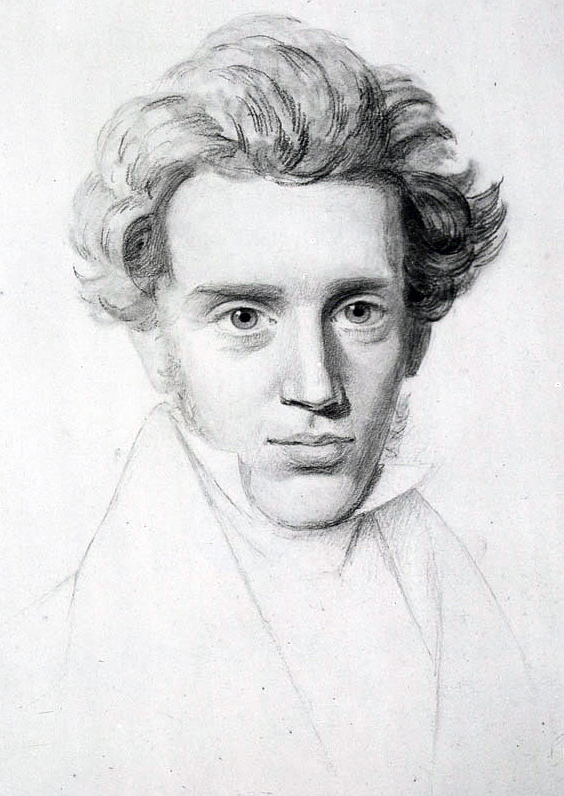 PhilosopherModern European1813 – 1855
Søren Kierkegaard
Danish father of existentialism: truth is subjectivity, and faith a leap beyond reason.
- ◆Leap of faith
- ◆Anxiety as the dizziness of freedom
- ◆Aesthetic, ethical and religious stages
- ◆Truth is subjectivity
Read the full pageSøren Aabye Kierkegaard ( SORR-ən KEER-kə-gard, US also -gor; Danish: [ˈsɶːɐn ˈɔˀˌpyˀ ˈkʰiɐ̯kəˌkɒːˀ] ; 5 May 1813 – 11 November 1855) was a Danish philosopher, Christian theologian, poet, social critic, and religious author who is widely considered to be the first existentialist philosopher. He wrote critical texts on organized religion, Christianity, morality, ethics, psychology, love, and the philosophy of religion, displaying a fondness for metaphor, irony, and parables. Much of his philosophical work deals with the issues around how one lives as a "single individual", highlighting the importance of authenticity, personal choice and commitment, and the duty to love. Kierkegaard prioritized concrete human reality over abstract thinking.
Kierkegaard's theological work focuses on Socratic Christian ethics, the institution of the Church, the differences among purely objective proofs of Christianity, the infinite qualitative distinction between man and God, and the individual's subjective relationship to the God-Man Jesus Christ, which came through faith. Much of his work deals with Christian love. He was extremely critical of the doctrine and practice of Christianity as a state-controlled religion (Caesaropapism), like the Church of Denmark. His psychological work explored the emotions and feelings of individuals when faced with life choices. Unlike Jean-Paul Sartre and the atheistic existentialism paradigm, Kierkegaard focused on Christian existentialism.
- 3
 PhilosopherModern European1844 – 1900
Friedrich Nietzsche
Diagnostician of nihilism who proclaimed the death of God and called for a revaluation of all values.
- ◆God is dead
- ◆Will to power
- ◆Übermensch
- ◆Eternal recurrence
- ◆Master and slave morality
- ◆Perspectivism
Read the full pageFriedrich Nietzsche was a classical philologist who became a professor at twenty-four, left academia because of ill health, and wrote a string of brilliant, aphoristic books in the decade before his collapse into madness in 1889.
His central diagnosis is that "God is dead": modern Europeans no longer really believe in the Christian God, but have not faced the consequences. Without a divine foundation, the values that rested on it — including the moral ideals of pity, humility and equality — are left hanging. The danger is nihilism.
- 4
 PhilosopherModern European1905 – 1980
Jean-Paul Sartre
Existentialist who declared that existence precedes essence and that we are condemned to be free.
- ◆Existence precedes essence
- ◆Condemned to be free
- ◆Bad faith
- ◆Hell is other people
Read the full pageJean-Paul Charles Aymard Sartre (, US also ; French: [saʁtʁ]; 21 June 1905 – 15 April 1980) was a French philosopher, political activist, and writer, considered a leading figure in 20th-century French philosophy and Marxism. Sartre was one of the key figures in the philosophy of existentialism (and phenomenology) and was a proponent of Libertarian Marxism. His work has influenced sociology, critical theory, post-colonial theory, and literary studies including literary history and literary theory. He was awarded the 1964 Nobel Prize in Literature despite attempting to refuse it, saying that he always declined official honors and that "a writer should not allow himself to be turned into an institution".
Sartre had an open relationship with prominent feminist and fellow existentialist philosopher Simone de Beauvoir. Together, Sartre and de Beauvoir challenged the cultural and social assumptions and expectations of their upbringings, which they considered bourgeois, in both lifestyles and thought. The conflict between oppressive, spiritually destructive conformity (mauvaise foi, literally, 'bad faith') and an "authentic" way of "being" became the dominant theme of Sartre's early work, a theme embodied in his principal philosophical work Being and Nothingness (L'Être et le Néant, 1943). Sartre provided an introduction to his philosophy in his work Existentialism Is a Humanism (L'existentialisme est un humanisme, 1946), originally presented as a lecture.
- 5
 PhilosopherAfrican1925 – 1961
Frantz Fanon
Psychiatrist and philosopher of decolonisation and the psychology of racism.
- ◆Double consciousness
- ◆colonial alienation
- ◆to become black
- ◆sociogeny
- ◆total liberation
- ◆by any means necessary
Read the full pageFrantz Omar Fanon (, US: ; French: [fʁɑ̃ts fanɔ̃]; 20 July 1925 – 6 December 1961) was a French psychiatrist and political philosopher from Martinique, who made critical contributions to the fields of post-colonial studies and critical theory. As well as an intellectual, Fanon was a political radical and Pan-Africanist, concerned with the psychopathology of colonization and the human, social, and cultural consequences of decolonization.
In the course of his work as a physician and psychiatrist, Fanon supported the Algerian War of independence (1954–1962) from France and joined the Algerian National Liberation Front. Jansen and Osterhammel characterise Fanon as "the most influential anticolonial thinker of his time". For more than five decades, the life and works of Fanon have inspired national liberation movements and other freedom and political movements in Sri Lanka, South Africa, and the United States.