Islamic ideas, Q–V
- 1
 ConceptIslamic
Quran
The Quran (Arabic: الْقُرْآن, lit. 'the recitation' or 'the lecture'), also romanized Qur'an or Koran, is the central religious text of Islam, and is believed by Muslims to be a revelation directly from God (Allāh). It is organized in 114 chapters (sūrah, pl. suwar) which consist of individual verses (āyah).
Read the full pageThe Quran (Arabic: الْقُرْآن, lit. 'the recitation' or 'the lecture'), also romanized Qur'an or Koran, is the central religious text of Islam, and is believed by Muslims to be a revelation directly from God (Allāh). It is organized in 114 chapters (sūrah, pl. suwar) which consist of individual verses (āyah). Aside from its religious significance, it is widely regarded as the finest work in Arabic literature and has significantly influenced the Arabic language.
Muslims believe the Quran was orally revealed by God to the final Islamic prophet Muhammad through the angel Gabriel incrementally over a period of some 23 years, beginning on the Laylat al-Qadr when Muhammad was 40 and concluding in 11 AH/632 CE, the year of his death. Muslims regard the Quran as Muhammad's most important miracle, a proof of his prophethood, and the culmination of a series of divine messages starting with those revealed to the first Islamic prophet Adam, including the holy books of the Torah, Psalms, and Gospel in Islam. The Quran is believed by Muslims to be God's own divine speech providing a complete code of conduct across all facets of life. This has led Muslim theologians to fiercely debate whether the Quran was "created or uncreated". According to tradition, several of Muhammad's companions served as scribes, recording the revelations. Shortly after Muhammad's death, the Quran was compiled on the order of the first caliph Abu Bakr (r. 632–634) by the companions, who had written down or memorized parts of it. Caliph Uthman (r. 644–656) established a standard version, now known as the Uthmanic codex, which is generally considered the archetype of the Quran known today. There are, however, canonical variant readings (qirāʾāt), transmitted through oral tradition, with minor variations in wording and nuance that may lead to subtle differences in meaning, while preserving the core message of the Quran. It is the subject of a modern field of academic research known as Quranic studies. Some argue that manuscript evidence, textual variants (such as the Sanaa manuscript), and historical sources suggest a more gradual and complex process of compilation and canonization.
- 2ConceptIslamic
Resacralization of knowledge
In traditionalist philosophy, resacralization of knowledge is the reverse of the process of secularization of knowledge. The central premise is that knowledge is intimately connected to its perceived divine source—God or the Ultimate Reality—which has been severed in the modern era.
Read the full pageIn traditionalist philosophy, resacralization of knowledge is the reverse of the process of secularization of knowledge. The central premise is that knowledge is intimately connected to its perceived divine source—God or the Ultimate Reality—which has been severed in the modern era. The process of resacralization of knowledge seeks to reinstate the role of intellect—the divine faculty believed to exist in every human being—above and beyond that of reason, as well as to revive the role of traditional metaphysics in acquiring knowledge—especially knowledge of God—by drawing on sacred traditions and sacred science that uphold divine revelations and the spiritual or gnostic teachings of all revealed religions. It aims to restore the primordial connection between God and humanity, which is believed to have been lost. To accomplish this, it relies on the framework of tawhid, which is developed into a comprehensive metaphysical perspective emphasizing the transcendent unity of all phenomena. Iranian philosopher Seyyed Hossein Nasr elaborated on the process of resacralization of knowledge in his book Knowledge and the Sacred, which was presented as Gifford Lectures in 1981.
The Oxford Encyclopedia of the Modern Islamic World states that Nasr's 1981 Gifford Lectures, which were published under the title Knowledge and the Sacred, reflect "his hope of reviving what he calls the sacred quality of knowledge as opposed to secularized reason". Nasr argues in his Gifford Lectures that the Western intellectual tradition "is in need of a resacralization of knowledge". He contends that Islamic tradition and the "living traditions of the Orient" can aid in revitalizing the Western intellectual tradition because knowledge and the sacred have never been separated in the Orient.
- 3ConceptIslamic
Resacralization of nature
Resacralization of nature is a term used in environmental philosophy to describe the process of restoring the sacred quality of nature. The primary assumption is that nature possesses a sanctified aspect that has been lost in modern times as a result of the secularization of contemporary worldviews.
Read the full pageResacralization of nature is a term used in environmental philosophy to describe the process of restoring the sacred quality of nature. The primary assumption is that nature possesses a sanctified aspect that has been lost in modern times as a result of the secularization of contemporary worldviews. These secular worldviews are considered directly responsible for the spiritual crisis in "modern man", which has ultimately contributed to the current environmental degradation. This perspective emphasizes the significance of changing human perceptions of nature by incorporating religious principles and values that reconnect nature with the divine. The Iranian philosopher Seyyed Hossein Nasr first conceptualized the theme of resacralization of nature in contemporary language, and it was further developed by a number of theologians and philosophers such as Alister McGrath, Sallie McFague and Rosemary Radford Ruether.
According to Tarik M. Quadir, Seyyed Hossein Nasr is "the first person ever to write extensively about the philosophical and religious dimension of the [environmental] crisis." Quadir reaches this conclusion "based on [his] inability to find any comparable scholarly work prior to Nasr's The Encounter of Man and Nature: The Spiritual Crisis of Modern Man (London: George Allen and Unwin, 1968) dealing with the religious and philosophical roots of the contemporary environmental crisis at length." Nasr first presented his insight in a 1965 essay, expanding it in a series of lectures given at the University of Chicago the following year, in May 1966, several months before Lynn White, Jr. gave his famous lecture before the American Academy of Arts and Sciences on December 26, 1966 (published in Science in 1967 as The Historical Roots of Our Ecologic Crisis). Nasr's lectures were later published as The Encounter of Man and Nature: The Spiritual Crisis of Modern Man in 1968 in which he argued, in a detailed manner, "for the revival of a sacred view of the universe in order to combat the contemporary environmental crisis". The theme of resacralization of nature later became an important issue in the writings of many theologians and philosophers.
- 4
 ConceptIslamic
Schools of Islamic theology
Schools of Islamic theology are various Islamic schools and branches in different schools of thought regarding creed. The main schools of Islamic theology include the extant Mu'tazili, Ash'ari, Maturidi, and Athari schools; the extinct ones include the Qadari, Jahmi, Murji', and Batini schools.
Read the full pageSchools of Islamic theology are various Islamic schools and branches in different schools of thought regarding creed. The main schools of Islamic theology include the extant Mu'tazili, Ash'ari, Maturidi, and Athari schools; the extinct ones include the Qadari, Jahmi, Murji', and Batini schools.
The main schism between Sunni, Shia, and Khariji branches of Islam was initially more political than theological, but theological differences have developed over time throughout the history of Islam.
- 5ConceptIslamic
Scientia sacra
In perennial philosophy, scientia sacra or sacred science is a form of spiritual knowledge that lies at the heart of divine revelations and traditional sciences, embodying the essential core of every sacred tradition. It recognizes sources of knowledge beyond those accepted by modern epistemology, such as divine revela
Read the full pageIn perennial philosophy, scientia sacra or sacred science is a form of spiritual knowledge that lies at the heart of divine revelations and traditional sciences, embodying the essential core of every sacred tradition. It recognizes sources of knowledge beyond those accepted by modern epistemology, such as divine revelations and intellectual intuition. Intellectual intuition is believed to allow access to an innate knowledge of God, which is to be reawakened through the use of human intellect. The principles and doctrines of scientia sacra are derived from reason, revelation, and intellectual intuition, with the conviction that these sources of knowledge can be reconciled in a hierarchical order, and applied in the human quest to understand different orders of reality. Its objective is to show how the transmitted, intellectual, and physical sciences are related and unified within the framework of metaphysics, as traditionally defined.
According to this perspective, scientia sacra is synonymous with metaphysics, which is seen not as a branch of philosophy but rather what the Sufis call ma'rifa or gnostic knowledge—the ultimate goal of which is the knowledge of "the Real". It is based on a holistic and hierarchical view of reality that emphasizes the connections between the various levels and states of being. This viewpoint holds that God, the Principle or the One, is the Ultimate Reality—who is absolute, eternal, infinite, and necessary but whose knowledge lies beyond the reach of sense perception and reason. According to the doctrines of scientia sacra, the universe is not a separate reality, but rather only a "manifestation and theophany" of the "Divine Essence", which is essentially the source and center of all other realities.
- 7
 ConceptIslamic
Social cycle theory
Social cycle theories are among the earliest social theories in sociology. Unlike the theory of social evolutionism, which views the evolution of society and human history as progressing in some new, unique direction(s), sociological cycle theory argues that events and stages of society and history generally repeat the
Read the full pageSocial cycle theories are among the earliest social theories in sociology. Unlike the theory of social evolutionism, which views the evolution of society and human history as progressing in some new, unique direction(s), sociological cycle theory argues that events and stages of society and history generally repeat themselves in cycles.
Such a theory does not necessarily imply that there cannot be any social progress. In the early theory of Sima Qian and the more recent theories of long-term ("secular") political-demographic cycles, an explicit accounting is made of social progress.
- 8
 ConceptIslamic
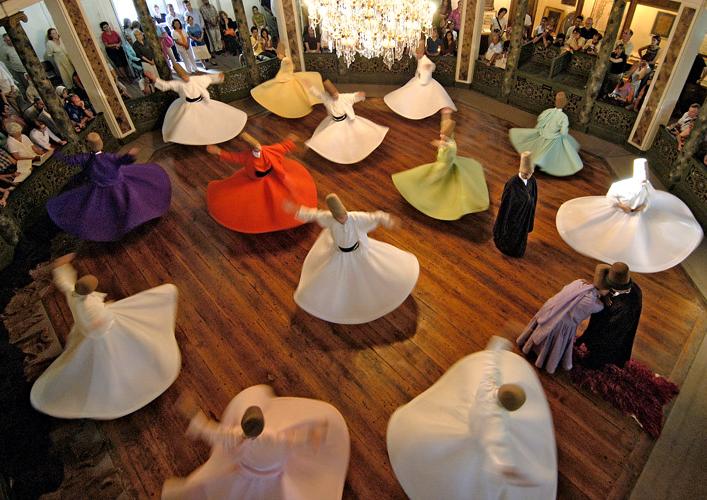
Sufi whirling
Sufi whirling (or Sufi turning) is a form of physically active meditation which originated among certain Sufi groups, and which is still practiced by the Sufi dervishes of the Mevlevi order and other orders such as the Rifa'i-Marufi. It is a customary meditation practice performed within the sema, or worship ceremony,
Read the full pageSufi whirling (or Sufi turning) is a form of physically active meditation which originated among certain Sufi groups, and which is still practiced by the Sufi dervishes of the Mevlevi order and other orders such as the Rifa'i-Marufi. It is a customary meditation practice performed within the sema, or worship ceremony, through which dervishes (from the Persian darvish درویش, also called semazens, from Persian سماعزن) aim to reach greater connection with Allah. This is sought through abandoning one's nafs, ego or personal desires, by listening to the music, focusing on God, and spinning one's body in repetitive circles, which has been seen as a symbolic imitation of planets in the Solar System orbiting the Sun.
The Mevlevi practice gave rise to an Egyptian form, tanoura, distinguished by the use of a multicolored skirt. This has also developed into a performance dance by non-Sufis, including dancers outside the Islamic world.
- 9
 ConceptIslamic
Tafsir al-Mizan
Al-Mizan fi Tafsir al-Quran (Arabic: الميزان في تفسير القرآن, "The balance in Interpretation of Quran"), more commonly known as Tafsir al-Mizan (تفسير الميزان) or simply Al-Mizan (الميزان), is a tafsir (exegesis of the Quran) written by the Shia Muslim scholar and philosopher Muhammad Husayn Tabatabaei. The book consis
Read the full pageAl-Mizan fi Tafsir al-Quran (Arabic: الميزان في تفسير القرآن, "The balance in Interpretation of Quran"), more commonly known as Tafsir al-Mizan (تفسير الميزان) or simply Al-Mizan (الميزان), is a tafsir (exegesis of the Quran) written by the Shia Muslim scholar and philosopher Muhammad Husayn Tabatabaei (1892–1981).
The book consists of 27 volumes originally written in Arabic. Up till now more than three editions have been printed in Iran and Lebanon.
- 10
 ConceptIslamic
Traditionalism (perennialism)
Traditionalism, also known as the Traditionalist School, is a school of thought within perennial philosophy. Originating in the thought of René Guénon in the 20th century, it proposes that a single primordial, metaphysical truth forms the source for, and is shared by, all the major world religions.
Read the full pageTraditionalism, also known as the Traditionalist School, is a school of thought within perennial philosophy. Originating in the thought of René Guénon in the 20th century, it proposes that a single primordial, metaphysical truth forms the source for, and is shared by, all the major world religions. Unlike universalist forms of perennialism based on commonalities in religious experiences across cultures, Traditionalism posits a metaphysical unitary source known as Tradition which forms the basis for the major religions in their "orthodox" forms.
Tradition has exoteric and esoteric dimensions. The exoteric aspects of a tradition are primarily represented by its ceremonies, rituals, and rules, whereas the esoteric aspects are concerned with its spiritual and intellectual qualities. Traditionalists often contrast "tradition" to "modernity". While "tradition" has a transcendent origin, "modernity" takes little or no account of this dimension. Traditionalists defend the transcendent dimension of reality that they see as inherent in traditional religious expressions and worldviews. In contrast, they view liberal and modernist expressions of these traditions with suspicion, seeing their foundations as rationalistic, materialistic and individualistic.
- 11
 ConceptIslamic
Veganism
Veganism is the practice of abstaining from the use of animal products and the consumption of animal source foods, and an associated philosophy that rejects the commodity status of animals. A person who practices veganism is known as a vegan; the word is also used to describe foods and materials that are compatible wit
Read the full pageVeganism is the practice of abstaining from the use of animal products and the consumption of animal source foods, and an associated philosophy that rejects the commodity status of animals. A person who practices veganism is known as a vegan; the word is also used to describe foods and materials that are compatible with veganism.
Ethical veganism excludes all forms of animal use, whether in agriculture for labour or food (e.g., meat, fish and other animal seafood, eggs, honey, and dairy products such as milk or cheese), in clothing and fashion (e.g., leather, wool, fur, and some cosmetics), in entertainment (e.g., rodeos, bullfighting, zoos, circuses, dolphinariums and horse racing), in services (e.g., mounted police, working animals, K9s and animal testing), and in medicine (e.g., bile bear farms, wildlife trade). People who follow a vegan diet for the benefits to the environment, their health, or for religion are regularly also described as vegans.


