Jewish ideas
- 1
 ConceptJewish
Causa sui
Causa sui (Latin: [ˈkau̯.sa ˈsʊ.iː]; transl. cause of itself, self-caused) is a Latin term that denotes something that is generated within itself. Used in relation to the purpose that objects can assign to themselves, the concept was central to the works of Baruch Spinoza, Sigmund Freud, Jean-Paul Sartre, and Ernest Be
Read the full pageCausa sui (Latin: [ˈkau̯.sa ˈsʊ.iː]; transl. cause of itself, self-caused) is a Latin term that denotes something that is generated within itself. Used in relation to the purpose that objects can assign to themselves, the concept was central to the works of Baruch Spinoza, Sigmund Freud, Jean-Paul Sartre, and Ernest Becker.
In Freud and Becker's case, the concept was often used as an immortality vessel, whereby something could create meaning, or continue to create meaning, beyond its own life.
- 2
 ConceptJewish
Conatus
In the philosophy of Baruch Spinoza, conatus (; Latin for "effort; endeavor; impulse, inclination, tendency; undertaking; striving") is an innate inclination of a thing to continue to exist and enhance itself. This thing may be mind, matter, or a combination of both, and is often associated with God's will in a panthei
Read the full pageIn the philosophy of Baruch Spinoza, conatus (; Latin for "effort; endeavor; impulse, inclination, tendency; undertaking; striving") is an innate inclination of a thing to continue to exist and enhance itself. This thing may be mind, matter, or a combination of both, and is often associated with God's will in a pantheist view of nature. The conatus may refer to the instinctive will to live of living organisms or to various metaphysical theories of motion and inertia. Today, conatus is rarely used in the technical sense, since classical mechanics uses concepts such as inertia and conservation of momentum that have superseded it. It has, however, been a notable influence on later thinkers such as Arthur Schopenhauer and Friedrich Nietzsche.
The Latin cōnātus comes from the verb cōnor, which is usually translated into English as, to endeavor; used as an abstract noun, conatus is an innate inclination of a thing to continue to exist and enhance itself. Although the term is most central to Spinoza's philosophy, many other early modern philosophers including René Descartes, Gottfried Leibniz, and Thomas Hobbes made significant contributions, each developing the term differently.
- 3ConceptJewish
Face-to-face (philosophy)
The face-to-face relation (French: rapport de face à face) is a concept in the French philosopher Emmanuel Levinas' thought on human sociality. It means that, ethically, people are responsible to one another in the face-to-face encounter.
Read the full pageThe face-to-face relation (French: rapport de face à face) is a concept in the French philosopher Emmanuel Levinas' thought on human sociality. It means that, ethically, people are responsible to one another in the face-to-face encounter. Specifically, Levinas says that the human face "orders and ordains" us. It calls the subject into "giving and serving" the Other.
Levinas' phenomenological account of the "face-to-face" encounter serves as the basis for his ethics and the rest of his philosophy. For Levinas, "Ethics is the first philosophy." Levinas argues that the encounter of the Other through the face reveals a certain poverty which forbids a reduction to Sameness and, simultaneously, installs a responsibility for the Other in the Self.
- 4ConceptJewish
Golden mean (Judaism)
In Jewish literature, the golden mean (Hebrew: "שביל הזהב", "דרך האמצע", "דרך האמצעית") is primarily associated with the philosopher Rambam, and was influenced by the Greek philosopher Aristotle. In Mishneh Torah, Rambam attributes the method to the first scholars (Chazal) and to Abraham.
Read the full pageIn Jewish literature, the golden mean (Hebrew: "שביל הזהב", "דרך האמצע", "דרך האמצעית") is primarily associated with the philosopher Rambam, and was influenced by the Greek philosopher Aristotle. In Mishneh Torah, Rambam attributes the method to the first scholars (Chazal) and to Abraham. Similar concepts exist in the Rabbinic literature, Tosefta, the Yerushalmi, and Musar literature. Rabbi Yitzhak Arama also finds references in the Bible.
Rambam determined that a person needs to take care of the soul as well as the body, and just as a sick person turns to a doctor, a person with mental illness must turn to the doctor of the soul, which is the philosopher or the sage. Rambam opposed the deterministic approach, arguing that a person has free will and the ability to shape his or her life.
- 5
 ConceptJewish
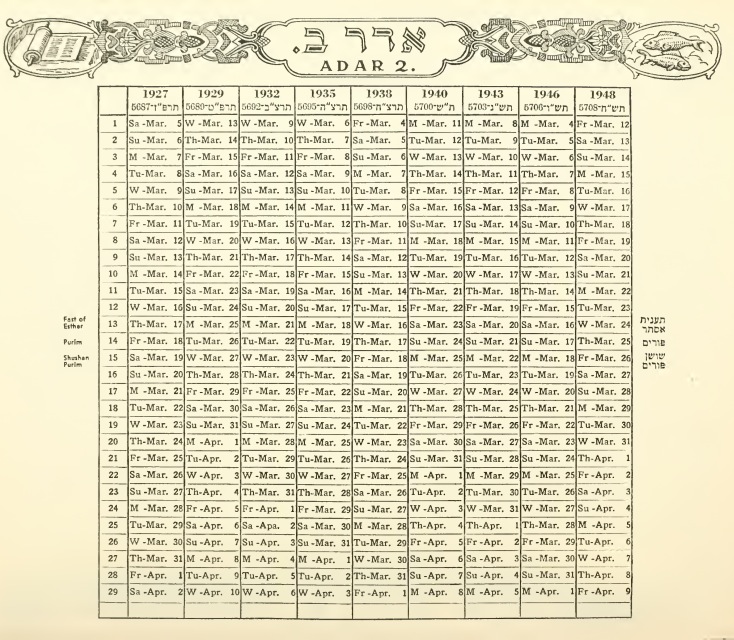
Hebrew calendar
The Hebrew calendar, also called the Jewish calendar, is a lunisolar calendar used today for Jewish religious observance and as an official calendar of Israel. It determines the dates of Jewish holidays and other rituals, such as yahrzeits, and the scheduling of public Torah readings.
Read the full pageThe Hebrew calendar, also called the Jewish calendar, is a lunisolar calendar used today for Jewish religious observance and as an official calendar of Israel. It determines the dates of Jewish holidays and other rituals, such as yahrzeits, and the scheduling of public Torah readings. In Israel, it is used for religious and agriculture purposes, and is also an official calendar for civil holidays alongside the Gregorian calendar.
Like other lunisolar calendars, the Hebrew calendar consists of months of 29 or 30 days that begin and end at approximately the time of the new moon. As 12 such months comprise a total of just 354 days, an extra lunar month is added every 2 or 3 years so that the long-term average year length closely approximates the actual length of the solar year.
- 6
 ConceptJewish
Jewish principles of faith
A universal formulation of principles of faith, recognized across all branches of Judaism, remains undefined. There is no central authority in Judaism in existence today, although the Sanhedrin, the supreme Jewish religious court, could fulfill this role for some if it were re-established.
Read the full pageA universal formulation of principles of faith, recognized across all branches of Judaism, remains undefined. There is no central authority in Judaism in existence today, although the Sanhedrin, the supreme Jewish religious court, could fulfill this role for some if it were re-established. Instead, Jewish principles of faith remain debated by the rabbis based on their understanding of the sacred writings, laws, and traditions, which collectively shape Jewish theological and ethical frameworks.
The most widely recognized existing version is the 13 principles outlined by Maimonides. He stressed the importance of believing that there is one single, omniscient, transcendent, non-corporeal, non-compound God who created the universe and continues to interact with his creation and judge souls' reward or punishment. Other principles include the future emergence of the Messiah, the resurrection of the dead, and the principle that God revealed his laws and 613 mitzvot to the Jewish people in the form of the Written and Oral Torahs.
- 7
 ConceptJewish
Negative liberty
Negative liberty, or negative freedom, is freedom from interference by other people. Negative liberty is primarily concerned with freedom from external restraint and contrasts with positive liberty (the possession of the power and resources to fulfill one's own potential).
Read the full pageNegative liberty, or negative freedom, is freedom from interference by other people. Negative liberty is primarily concerned with freedom from external restraint and contrasts with positive liberty (the possession of the power and resources to fulfill one's own potential). The distinction originated with Bentham, was popularized by T. H. Green and Guido De Ruggiero, and is now best known through Isaiah Berlin's 1958 lecture "Two Concepts of Liberty".
The Stanford Encyclopedia of Philosophy describes negative liberty:
- 8ConceptJewish
Philosophy of dialogue
Philosophy of dialogue is a type of philosophy based on the work of the Austrian-born Jewish philosopher Martin Buber, best known through its classic presentation in his 1923 book I and Thou. For Buber, the fundamental fact of human existence, too readily overlooked by scientific rationalism and abstract philosophical
Read the full pagePhilosophy of dialogue is a type of philosophy based on the work of the Austrian-born Jewish philosopher Martin Buber, best known through its classic presentation in his 1923 book I and Thou.
For Buber, the fundamental fact of human existence, too readily overlooked by scientific rationalism and abstract philosophical thought, is "man with man", a dialogue which takes place in the "sphere of between" (German: das Zwischenmenschliche).
- 9ConceptJewish
Psychophysical parallelism
In the philosophy of mind, psychophysical parallelism (or simply parallelism) is the theory that mental and bodily events are perfectly coordinated, without any causal interaction between them. As such, it affirms the correlation of mental and bodily events (since it accepts that when a mental event occurs, a correspon
Read the full pageIn the philosophy of mind, psychophysical parallelism (or simply parallelism) is the theory that mental and bodily events are perfectly coordinated, without any causal interaction between them. As such, it affirms the correlation of mental and bodily events (since it accepts that when a mental event occurs, a corresponding physical effect occurs as well), but denies a direct cause and effect relation between mind and body. This coordination of mental and bodily events has been postulated to occur either in advance by means of God (as per Gottfried Leibniz's idea of pre-established harmony) or at the time of the event (as in the occasionalism of Nicolas Malebranche) or, finally, according to Baruch Spinoza's Ethics, mind and matter are two of infinite attributes of the only Substance-God, which go as one without interacting with each other. On this view, mental and bodily phenomena are independent yet inseparable, like two sides of a coin.
Psychophysical parallelism is a third possible alternative regarding the relation between mind and body, between interaction (e.g., Mind–body dualism) and one-way body-to-mind causality (e.g., materialism, epiphenomenalism).
- 10ConceptJewish
Religious philosophy
Religious philosophy is philosophical thinking that is influenced and directed as a consequence of teachings from a particular religion. It can be done objectively, but it may also be done as a persuasion tool by believers in that faith.
Read the full pageReligious philosophy is philosophical thinking that is influenced and directed as a consequence of teachings from a particular religion. It can be done objectively, but it may also be done as a persuasion tool by believers in that faith. Religious philosophy is concerned with the nature of religion, theories of salvation, and conceptions of god, gods, and/or the divine.
Due to the historical development of religions, many religions share commonalities concerning their philosophies. These philosophies are often considered to be universal and include beliefs about concepts such as the afterlife, souls, and miracles.


