Greek & Roman ideas, C–G
- 1ConceptGreek & Roman
Criticism of Christianity
Criticism of Christianity has a long history that stretches back to the initial formation of the religion in the Roman Empire. Critics have challenged Christian beliefs and teachings, as well as actions taken in the name of the faith, from the Crusades to modern terrorism.
Read the full pageCriticism of Christianity has a long history that stretches back to the initial formation of the religion in the Roman Empire. Critics have challenged Christian beliefs and teachings, as well as actions taken in the name of the faith, from the Crusades to modern terrorism. The arguments against Christianity include claims that it is a faith of violence, corruption, superstition, polytheism, homophobia, bigotry, pontification, abuses of women's rights, and sectarianism.
In the early years of Christianity, the Neoplatonic philosopher Porphyry emerged as one of the major critics with his book Against the Christians, along with other writers like Celsus and Julian. Porphyry argued that Christianity was based on false prophecies that had not yet materialized. Following the adoption of Christianity by the Roman Empire, dissenting religious voices were gradually suppressed by both governmental and ecclesiastical authorities. Christianity has faced significant theological criticism from thinkers of other Abrahamic religions, particularly including Judaism and Islam. Notably, Maimonides, the renowned rabbi, Jewish philosopher, and Torah scholar of the 12th century, argued that Christian practices and doctrines constituted idolatry and deviated from the strict monotheism (shituf) of Jewish and Muslim theologies. Similarly, Islamic scholars have critiqued Christian beliefs about the Trinity and the divinity of Jesus, viewing these concepts as incompatible with the concept of monotheism. These critiques reflect deep theological disagreements rooted in their shared scriptural traditions and divergent doctrinal interpretations. A millennium later, the Protestant Reformation led to a fundamental split in European Christianity and rekindled critical voices about the Christian faith, both internally and externally. In the 18th century, deist philosophers such as Voltaire and Jean-Jacques Rousseau were critical of Christianity as a revealed religion. With the Age of Enlightenment, Christianity was criticized by major thinkers and philosophers, such as David Hume, Thomas Paine, and the Baron d'Holbach. The central theme of these critiques sought to negate the historical accuracy of the Christian Bible and focused on the perceived corruption of Christian religious authorities. Other thinkers, like Immanuel Kant, offered critiques of traditional arguments for the existence of God, while professing to defend Christian theology on novel grounds.
- 2ConceptGreek & Roman
Definitions of knowledge
Definitions of knowledge aim to identify the essential features of knowledge. Closely related terms are conception of knowledge, theory of knowledge, and analysis of knowledge.
Read the full pageDefinitions of knowledge aim to identify the essential features of knowledge. Closely related terms are conception of knowledge, theory of knowledge, and analysis of knowledge. Some general features of knowledge are widely accepted among philosophers, for example, that it involves cognitive success and epistemic contact with reality. Despite extensive study, disagreements about the nature of knowledge persist, in part because researchers use diverging methodologies, seek definitions for distinct purposes, and have differing intuitions about the standards of knowledge.
An often-discussed definition asserts that knowledge is justified true belief. Justification means that the belief fulfills certain norms like being based on good reasons or being the product of a reliable cognitive process. This approach seeks to distinguish knowledge from mere true beliefs that arise from superstition, lucky guesses, or flawed reasoning. Critics of the justified-true-belief view, like Edmund Gettier, have proposed counterexamples to show that some justified true beliefs do not amount to knowledge if the justification is not genuinely connected to the truth, a condition termed epistemic luck.
- 3
 ConceptGreek & Roman
Demiurge
In the Platonic, Neopythagorean, Middle Platonic, and Neoplatonic schools of philosophy, the Demiurge () is an artisan-like figure responsible for fashioning and maintaining the physical universe. Various schools of Gnostics adopted the term demiurge.
Read the full pageIn the Platonic, Neopythagorean, Middle Platonic, and Neoplatonic schools of philosophy, the Demiurge () is an artisan-like figure responsible for fashioning and maintaining the physical universe. Various schools of Gnostics adopted the term demiurge.
Although a fashioner, the demiurge is not necessarily the same as the creator figure in the monotheistic sense, because the demiurge itself and the material from which the demiurge fashions the universe are both considered consequences of something else. Depending on the system, they may be considered either uncreated and eternal or the product of some other entity. Some of these systems are monotheistic, while others are henotheistic or polytheistic.
- 4
 ConceptGreek & Roman
Discourses of Epictetus
The Discourses of Epictetus (Greek: Ἐπικτήτου διατριβαί, Epiktētou diatribai) are a series of informal lectures by the Stoic philosopher Epictetus written down by his pupil Arrian around 108 AD. Four books out of an original eight are still extant.
Read the full pageThe Discourses of Epictetus (Greek: Ἐπικτήτου διατριβαί, Epiktētou diatribai) are a series of informal lectures by the Stoic philosopher Epictetus written down by his pupil Arrian around 108 AD. Four books out of an original eight are still extant. The philosophy of Epictetus is intensely practical. He directs his students to focus attention on their opinions, anxieties, passions, and desires, so that "they may never fail to get what they desire, nor fall into what they avoid."
The Discourses have been influential since they were written. They are referred to and quoted by Marcus Aurelius. Since the 16th century, they have been translated into multiple languages and reprinted many times.
- 5ConceptGreek & Roman
Eclipse of Thales
The eclipse of Thales was a solar eclipse, which was, according to the ancient Greek historian Herodotus, accurately predicted by the Greek philosopher Thales of Miletus. If Herodotus's account is accurate, this eclipse is the earliest recorded as being known in advance of its occurrence.
Read the full pageThe eclipse of Thales was a solar eclipse, which was, according to the ancient Greek historian Herodotus (writing about 150 years later), accurately predicted by the Greek philosopher Thales of Miletus. If Herodotus's account is accurate, this eclipse is the earliest recorded as being known in advance of its occurrence. According to Herodotus, the change of day into night was interpreted as an omen, and interrupted a battle in a long-standing war between the Medes and the Lydians in Anatolia (present-day Turkey). The only solar eclipse matching the presumed place, era, and conditions of visibility necessary to explain the historical event is the eclipse of 28 May 585 BC. How exactly Thales could have predicted a solar eclipse remains uncertain, however, and modern scholars are sceptical of the story's veracity. Some have argued for different dates, or for other interpretations of Herodotus's account.
Herodotus writes that in the sixth year of the war, the Lydians and the Medes were engaged in an indecisive battle, sometimes called the "Battle of the Eclipse", when suddenly day turned into night, leading to both parties halting the fighting and negotiating a peace agreement. Herodotus also mentions that the loss of daylight had been predicted by Thales of Miletus. He does not, however, mention the location of the battle. Nor, according to the quotation below, does he mention the exact date or even the approximate season of the eclipse, only the year.
- 6
 ConceptGreek & Roman
Emanationism
Emanationism is a theory in the cosmology or cosmogony of certain religious and philosophical systems, that posits the concept of emanation. According to this theory, emanation, from the Latin emanare meaning "to flow from" or "to pour forth or out of", is the mode by which all existing things are derived from a 'first
Read the full pageEmanationism is a theory in the cosmology or cosmogony of certain religious and philosophical systems, that posits the concept of emanation. According to this theory, emanation, from the Latin emanare meaning "to flow from" or "to pour forth or out of", is the mode by which all existing things are derived from a 'first reality', or first principle.
In the emanationist view, all things are derived from this first reality or perfect God, by consecutive steps of degradation, to a lower degree of this first reality or God; at every consecutive step the emanating beings are less pure, less perfect, less divine. Emanationism posits a transcendent principle from which everything is derived, in contrast to both creationism, which considers the universe to be created by a sentient God who is separate from creation, and materialism, which posits no underlying subjective and/or ontological nature behind phenomena, all phenomena being considered immanent.
- 7
 ConceptGreek & Roman
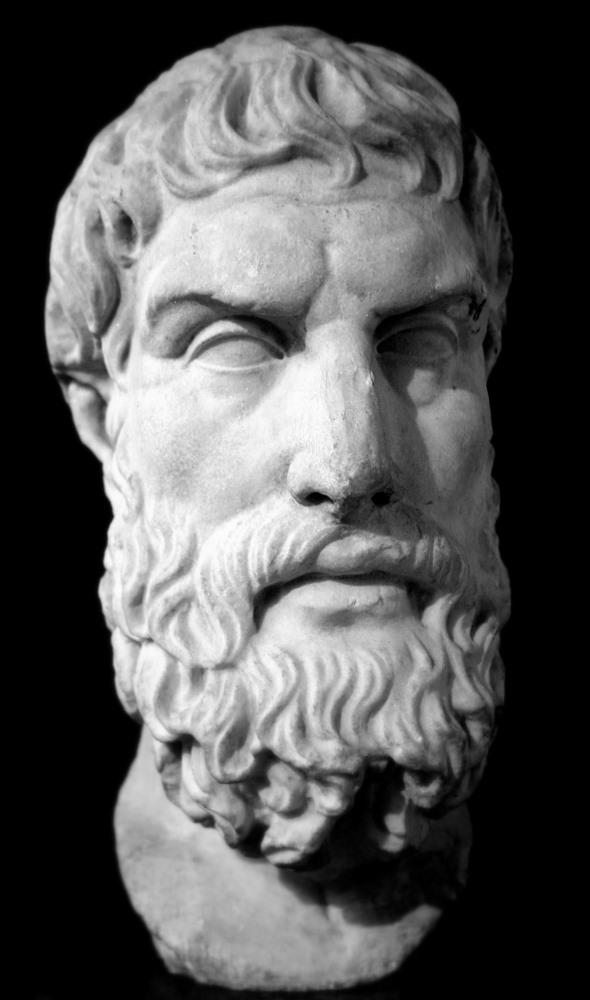
Epicurean paradox
The Epicurean paradox is a logical dilemma about the problem of evil attributed to the Greek philosopher Epicurus, who argued against the existence of a god who is simultaneously omniscient, omnipotent, and omnibenevolent.
Read the full pageThe Epicurean paradox is a logical dilemma about the problem of evil attributed to the Greek philosopher Epicurus, who argued against the existence of a god who is simultaneously omniscient, omnipotent, and omnibenevolent.
The paradox, reported by Lactantius, who attributes it to Epicurus, is based on some questions and proceeds step by step until it purportedly makes the concept of God paradoxical:
- 8ConceptGreek & Roman
Epoché
In Hellenistic philosophy, epoché is suspension of judgment but also "withholding of assent".
Read the full pageIn Hellenistic philosophy, epoché (also
epoche;
- 9
 ConceptGreek & Roman
Eristic
In philosophy and rhetoric, eristic (from Eris, the ancient Greek goddess of chaos, strife, and discord) refers to an argument that aims to successfully dispute another's argument, rather than searching for truth. According to T.H.
Read the full pageIn philosophy and rhetoric, eristic (from Eris, the ancient Greek goddess of chaos, strife, and discord) refers to an argument that aims to successfully dispute another's argument, rather than searching for truth. According to T.H. Irwin, "It is characteristic of the eristic to think of some arguments as a way of defeating the other side, by showing that an opponent must assent to the negation of what he initially took himself to believe." Eristic is defined by Rankin as arguing for the sake of conflict, as opposed to resolving conflict.
Eristic was a type of "question-and-answer" teaching method popularized by the Sophists, such as Euthydemos and Dionysiodoros. Students learned eristic arguments to "refute their opponent, no matter whether he [said] yes or no in answer to their initial question".
- 10ConceptGreek & Roman
Fire (classical element)
Fire is one of the four classical elements along with earth, water and air in ancient Greek philosophy and science. Fire is considered to be both hot and dry and, according to Plato, is associated with the tetrahedron.
Read the full pageFire is one of the four classical elements along with earth, water and air in ancient Greek philosophy and science. Fire is considered to be both hot and dry and, according to Plato, is associated with the tetrahedron.
Fire is one of the four classical elements in ancient Greek philosophy and science. It was commonly associated with energy, assertiveness, and passion. In one Greek myth, Prometheus stole fire from the gods to protect otherwise helpless humans, but was punished for this act of charity. Platos' Protagoras describes how Epimetheus was tasked with equipping all animals in creation with their proper qualities, whereas Prometheus was to inspect the work, but Epimetheus gave all the best attributes to the "brute beasts", leaving humans with nothing, thus causing Prometheus to steal the flames from Hephaestus. Hesiod's Theogony, however, tells a different version of events: Prometheus had sacrificed a great ox and divided the animal in two portions, setting the meat for men and the white bones glazed in fat for Zeus. Enraged, Zeus took away their ability to make fire, causing Prometheus to steal it back from Olympus.
- 11ConceptGreek & Roman
First principle
In philosophy and science, a first principle is a basic proposition or assumption that cannot be deduced from any other proposition or assumption. First principles in philosophy are from first cause attitudes and taught by Aristotelians, and nuanced versions of first principles are referred to as postulates by Kantians
Read the full pageIn philosophy and science, a first principle is a basic proposition or assumption that cannot be deduced from any other proposition or assumption. First principles in philosophy are from first cause attitudes and taught by Aristotelians, and nuanced versions of first principles are referred to as postulates by Kantians.
In mathematics and formal logic, first principles are referred to as axioms or postulates. In physics and other sciences, theoretical work is said to be from first principles, or ab initio, if it starts directly at the level of established science and does not make assumptions such as empirical model and parameter fitting. "First principles thinking" consists of decomposing things down to the fundamental axioms in the given arena, before reasoning up by asking which ones are relevant to the question at hand, then cross-referencing conclusions based on chosen axioms and making sure conclusions do not violate any fundamental laws. Physicists include counterintuitive concepts with reiteration.
- 12ConceptGreek & Roman
Form of the Good
The Form of the Good or simply the Good (Ancient Greek: ἡ τοῦ ἀγαθοῦ ἰδέα), is a concept in the philosophy of Plato. In Plato's Theory of Forms, Forms are abstract ideals that embody the essential qualities of concepts, giving meaning and intelligibility to other objects, such as those in the physical world.
Read the full pageThe Form of the Good or simply the Good (Ancient Greek: ἡ τοῦ ἀγαθοῦ ἰδέα), is a concept in the philosophy of Plato. In Plato's Theory of Forms, Forms are abstract ideals that embody the essential qualities of concepts, giving meaning and intelligibility to other objects, such as those in the physical world.
The Good is the fundamental Form that underpins the system of Forms itself by making them meaningful and intelligible in turn, which Plato explains using the Analogy of the Sun: just as the Sun gives life to the world and natural light for the eye to see it, the Good gives essence to the Forms and a way for the mind to perceive them.
- 13
 ConceptGreek & Roman
Gadfly (philosophy and social science)
A gadfly is a person who interferes with the status quo of a society or community by posing novel, potentially upsetting questions, usually directed at authorities. The term has a modern use but it was originally associated with the ancient Greek philosopher Socrates, as portrayed in Plato's Apology when Socrates was o
Read the full pageA gadfly is a person who interferes with the status quo of a society or community by posing novel, potentially upsetting questions, usually directed at authorities. The term has a modern use but it was originally associated with the ancient Greek philosopher Socrates, as portrayed in Plato's Apology when Socrates was on trial for his life.
The term "gadfly" (Ancient Greek: μύωψ, mýops) was used by Plato in the Apology to describe Socrates' acting as an uncomfortable goad to the Athenian political scene, like a spur or biting fly arousing a sluggish horse.


