Greek & Roman ideas, H–K
- 1
 ConceptGreek & Roman
Henosis
Henosis (Ancient Greek: ἕνωσις) is the classical Greek word for mystical "oneness", "union" or "unity". In Neoplatonism, henosis refers to the unification with what is fundamental in reality: the One (Τὸ Ἕν), the Source, or Monad.
Read the full pageHenosis (Ancient Greek: ἕνωσις) is the classical Greek word for mystical "oneness", "union" or "unity". In Neoplatonism, henosis refers to the unification with what is fundamental in reality: the One (Τὸ Ἕν), the Source, or Monad. The Neoplatonic concept has precedents in the Greek mystery religions as well as parallels in Eastern philosophy. It is further developed in the Corpus Hermeticum, in Christian theology, Islamic Mysticism, soteriology and mysticism. Henosis is also an important factor in the historical development of monotheism during Late Antiquity.
The term is relatively common in classical texts, and has the meaning of "union" or "unity".
- 2
 ConceptGreek & Roman
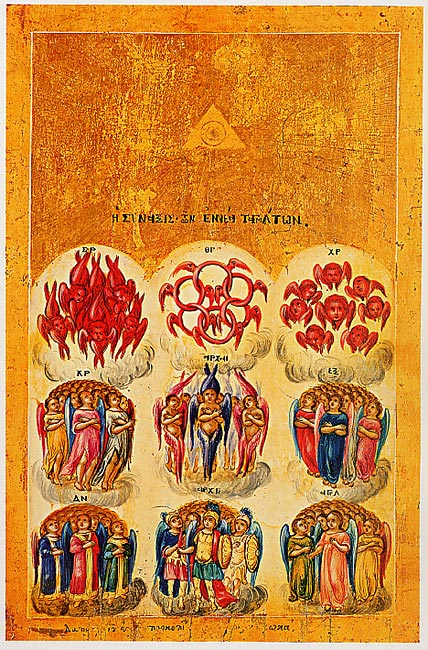
Hierarchy of angels
In the angelology of different religions, a hierarchy of angels is a ranking system of angels. The higher ranking angels have greater power and authority than lower ones, and different ranks have differences in appearance, such as varying numbers of wings or faces.
Read the full pageIn the angelology of different religions, a hierarchy of angels is a ranking system of angels. The higher ranking angels have greater power and authority than lower ones, and different ranks have differences in appearance, such as varying numbers of wings or faces.
The Jewish angelic hierarchy is established in the Hebrew Bible, Talmud, Rabbinic literature, and traditional Jewish liturgy. They are categorized in different hierarchies proposed by various theologians. For example, Maimonides, in his Mishneh Torah or Yad ha-Chazakah: Yesodei ha-Torah, counts ten ranks of angels. The Zohar, in Exodus 43a, also lists ten ranks of angels. Jacob Nazir, in his Maseket Atzilut, also listed ten ranks of angels. Abraham ben Isaac of Granada, in his Berit Menuchah, also listed ten ranks of angels.
- 3ConceptGreek & Roman
Humanitas
Humanitas (from the Latin hūmānus, "human") is a Latin noun meaning human nature, civilization, and kindness. It has uses in the Enlightenment, which are discussed below.
Read the full pageHumanitas (from the Latin hūmānus, "human") is a Latin noun meaning human nature, civilization, and kindness. It has uses in the Enlightenment, which are discussed below.
The Latin word humanitas corresponded to the Greek concepts of philanthrôpía (loving what makes us human) and paideia (education) which were amalgamated with a series of qualities that made up the traditional unwritten Roman code of conduct (mos maiorum). Cicero (106–43 BCE) used humanitas in describing the formation of an ideal speaker (orator) who he believed should be educated to possess a collection of virtues of character suitable both for an active life of public service and a decent and fulfilling private life; these would include a fund of learning acquired from the study of bonae litterae ("good letters", i.e., classical literature, especially poetry), which would also be a source of continuing cultivation and pleasure in leisure and retirement, youth and old age, and good and bad fortune.
- 4
 ConceptGreek & Roman
Humorism
Humorism, the humoral theory, or humoralism, was a system of medicine detailing a supposed makeup and workings of the human body, adopted by Ancient Greek and Roman physicians and philosophers. Humorism began to fall out of favor in the 17th century and it was definitively disproved with the discovery of microbes.
Read the full pageHumorism, the humoral theory, or humoralism, was a system of medicine detailing a supposed makeup and workings of the human body, adopted by Ancient Greek and Roman physicians and philosophers.
Humorism began to fall out of favor in the 17th century and it was definitively disproved with the discovery of microbes.
- 5ConceptGreek & Roman
Hylomorphism
Hylomorphism is a philosophical doctrine developed by the Ancient Greek philosopher Aristotle, which conceives every physical entity or being (ousia) as a compound of matter (potency) and substantial form (act), with the generic form as immanently real within the individual. The word is a 19th-century term formed from
Read the full pageHylomorphism is a philosophical doctrine developed by the Ancient Greek philosopher Aristotle, which conceives every physical entity or being (ousia) as a compound of matter (potency) and substantial form (act), with the generic form as immanently real within the individual. The word is a 19th-century term formed from the Greek words ὕλη (hyle: "wood, matter") and μορφή (morphē: "form"). Hylomorphic theories of physical entities have been undergoing a revival in contemporary philosophy, especially since the 2000s.
The Ancient Greek language originally had no word for matter in general, as opposed to raw material suitable for some specific purpose or other, so Aristotle adapted the word for "wood" to this purpose. The idea that everything physical is made of the same basic substance holds up well under modern science, although it may be thought of more in terms of energy or matter/energy.
- 6ConceptGreek & Roman
Hypokeimenon
Hypokeimenon (Greek: ὑποκείμενον), later often material substratum, is a term in metaphysics which literally means the "underlying thing" (Latin: subiectum). To search for the hypokeimenon is to search for that substance that persists in a thing going through change—its basic essence.
Read the full pageHypokeimenon (Greek: ὑποκείμενον), later often material substratum, is a term in metaphysics which literally means the "underlying thing" (Latin: subiectum).
To search for the hypokeimenon is to search for that substance that persists in a thing going through change—its basic essence.
- 7ConceptGreek & Roman
Hypothetical syllogism
In classical logic, a hypothetical syllogism is a valid argument form, a deductive syllogism with a conditional statement for one or both of its premises. Ancient references point to the works of Theophrastus and Eudemus for the first investigation of this kind of syllogism.
Read the full pageIn classical logic, a hypothetical syllogism is a valid argument form, a deductive syllogism with a conditional statement for one or both of its premises. Ancient references point to the works of Theophrastus and Eudemus for the first investigation of this kind of syllogism.
Hypothetical syllogisms come in two types: mixed and pure. A mixed hypothetical syllogism has two premises: one conditional statement and one statement that either affirms or denies the antecedent or consequent of that conditional statement. For example,
- 8
 ConceptGreek & Roman
I know that I know nothing
"I know that I know nothing" is a saying derived from Plato's account of the Greek philosopher Socrates: "For I was conscious that I knew practically nothing...". It is also sometimes called the Socratic paradox, although this name is often instead used to refer to other seemingly paradoxical claims made by Socrates in
Read the full page"I know that I know nothing" is a saying derived from Plato's account of the Greek philosopher Socrates: "For I was conscious that I knew practically nothing..." (Plato, Apology 22d, translated by Harold North Fowler, 1966). It is also sometimes called the Socratic paradox, although this name is often instead used to refer to other seemingly paradoxical claims made by Socrates in Plato's dialogues (most notably, Socratic intellectualism and the Socratic fallacy).
This saying is also connected or conflated with the answer to a question Socrates (according to Xenophon) or Chaerephon (according to Plato) is said to have posed to the Pythia, the Oracle of Delphi, in which the oracle stated something to the effect of "Socrates is the wisest person in Athens." Socrates, believing the oracle but also completely convinced that he knew nothing, was said to have concluded that nobody knew anything, and that he was only wiser than others because he was the only person who recognized his own ignorance.
- 9ConceptGreek & Roman
Incorporeality
Incorporeality is "the state or quality of being incorporeal or bodiless; immateriality; incorporealism." Incorporeal (Greek: ἀσώματος) means "Not composed of matter; having no material existence." Incorporeality is a quality of souls, spirits, and God in many religions, including the currently major denominations and
Read the full pageIncorporeality is "the state or quality of being incorporeal or bodiless; immateriality; incorporealism." Incorporeal (Greek: ἀσώματος) means "Not composed of matter; having no material existence."
Incorporeality is a quality of souls, spirits, and God in many religions, including the currently major denominations and schools of Judaism, Christianity, Islam, and the Baháʼí Faith. In ancient philosophy, any attenuated "thin" matter such as air, aether, fire or light was considered incorporeal. The ancient Greeks believed air, as opposed to solid earth, to be incorporeal, insofar as it is less resistant to movement; and the ancient Persians believed fire to be incorporeal in that every soul was said to be produced from it. In modern philosophy, a distinction between the incorporeal and immaterial is not necessarily maintained: a body is described as incorporeal if it is not made out of matter.
- 10
 ConceptGreek & Roman
Intentional community
An intentional community or commune is a voluntary residential community designed to foster a high degree of social cohesion and teamwork. Such communities typically promote shared values or beliefs, or pursue a common vision, which may be political, religious, utopian or spiritual, or are simply focused on the practic
Read the full pageAn intentional community or commune is a voluntary residential community designed to foster a high degree of social cohesion and teamwork. Such communities typically promote shared values or beliefs, or pursue a common vision, which may be political, religious, utopian or spiritual, or are simply focused on the practical benefits of cooperation and mutual support. While some groups emphasise shared ideologies, others are centred on enhancing social connections, sharing resources, and creating meaningful relationships.
Some see intentional communities as alternative lifestyles. Others see them as impractical social experiments. Some see them as a natural human response to the isolation and fragmentation of modern housing, offering a return to the social bonds and collaborative spirit found in traditional village life. Others see them as ways to address problems that are seen as plaguing modern cities, such as alcohol abuse, poverty, unemployment and crime, especially when used in conjunction with emigration from industrialized countries and colonization of new lands.
- 11
 ConceptGreek & Roman
Irony
Irony is a juxtaposition of what, on the surface, appears to be the case with what is actually or expected to be the case. Originally a rhetorical device and literary technique, irony has also come to assume a metaphysical significance with implications for one's attitude towards life.
Read the full pageIrony is a juxtaposition of what, on the surface, appears to be the case with what is actually or expected to be the case. Originally a rhetorical device and literary technique, irony has also come to assume a metaphysical significance with implications for one's attitude towards life.
The concept originated in ancient Greece, where it described a dramatic character who pretended to be less intelligent than he actually was in order to outwit boastful opponents. Over time, irony evolved from denoting a form of deception to, more liberally, describing the deliberate use of language to mean the opposite of what it says for a rhetorical effect intended to be recognized by the audience.
- 12ConceptGreek & Roman
Katalepsis
Katalepsis (Greek: κατάληψις, "grasping") is a term in Stoic philosophy for a concept roughly equivalent to modern comprehension. To the Stoic philosophers, katalepsis was an important premise regarding one's state of mind as it relates to grasping fundamental philosophical concepts, which was followed by the assent, o
Read the full pageKatalepsis (Greek: κατάληψις, "grasping") is a term in Stoic philosophy for a concept roughly equivalent to modern comprehension. To the Stoic philosophers, katalepsis was an important premise regarding one's state of mind as it relates to grasping fundamental philosophical concepts, which was followed by the assent, or adherence to the truth thus understood.
According to the Stoics, the mind is constantly being bombarded with impressions (phantasiai). Some of these impressions are true and some false. Impressions are true when they are truly affirmed, false if they are wrongly affirmed. Cicero relates that Zeno would illustrate katalepsis as follows:
- 13ConceptGreek & Roman
Know thyself
"Know thyself" (Greek: Γνῶθι σεαυτόν, gnōthi seauton) is a philosophical Delphic maxim which was inscribed upon the Temple of Apollo in the ancient Greek precinct of Delphi. The best-known of the Delphic maxims, it has been quoted and analyzed by numerous authors throughout history, and has been applied in many ways.
Read the full page"Know thyself" (Greek: Γνῶθι σεαυτόν, gnōthi seauton) is a philosophical Delphic maxim which was inscribed upon the Temple of Apollo in the ancient Greek precinct of Delphi. The best-known of the Delphic maxims, it has been quoted and analyzed by numerous authors throughout history, and has been applied in many ways. Although traditionally attributed to the Seven Sages of Greece, or to the god Apollo himself, the inscription likely had its origin in a popular proverb.
Ion of Chios makes the earliest explicit allusion to the maxim in a fragment dating to the 5th century BC, though the philosopher Heraclitus, active toward the end of the previous century, may also have made reference to the maxim in his works. The principal meaning of the phrase in its original application was "know your limits" – either in the sense of knowing the extent of one's abilities, knowing one's place in the world, or knowing oneself to be mortal. In the 4th century BC, however, the maxim was drastically reinterpreted by Plato, who understood it to mean, broadly speaking, "know your soul".

