Modern European ideas, M
- 1
 ConceptModern European
Modernism
Modernism was an early 20th-century movement in literature, visual arts, performing arts, and music that emphasized experimentation, abstraction, and subjective experience. Philosophy, politics, architecture, and social issues were all aspects of this movement.
Read the full pageModernism was an early 20th-century movement in literature, visual arts, performing arts, and music that emphasized experimentation, abstraction, and subjective experience. Philosophy, politics, architecture, and social issues were all aspects of this movement. Modernism centered around beliefs in a "growing alienation" from prevailing "morality, optimism, and convention" and a desire to change how "human beings in a society interact and live together".
The modernist movement emerged during the late 19th century in response to significant changes in Western culture, including secularization and the growing influence of science. It is characterized by a self-conscious rejection of tradition and the search for newer means of cultural expression. Modernism was influenced by widespread technological innovation, industrialization, and urbanization, as well as the cultural and geopolitical shifts that occurred after World War I. Artistic movements and techniques associated with modernism include abstract art, literary stream-of-consciousness, cinematic montage, musical atonality and twelve-tonality, modern dance, modernist architecture, and urban planning.
- 2ConceptModern European
Modernity
Modernity, a topic in the humanities and social sciences, is both a historical period (the modern era) and the ensemble of particular socio-cultural norms, attitudes, and practices that arose in the wake of the Renaissance—in the Age of Reason of 17th-century thought and the 18th-century Enlightenment. Commentators var
Read the full pageModernity, a topic in the humanities and social sciences, is both a historical period (the modern era) and the ensemble of particular socio-cultural norms, attitudes, and practices that arose in the wake of the Renaissance—in the Age of Reason of 17th-century thought and the 18th-century Enlightenment. Commentators variously consider the era of modernity to have ended by 1930, with World War II in 1945, or as late as the period falling between the 1980s and 1990s; the following era is often referred to as "postmodernity". The term "contemporary history" is also used to refer to the post-1945 timeframe, without assigning it to either the modern or postmodern era. (Thus "modern" may be used as a name of a particular era in the past, as opposed to meaning "the current era".)
Depending on the field, modernity may refer to different time periods or qualities. In historiography, the 16th to 18th centuries are usually described as early modern, while the long 19th century corresponds to modern history proper. While it includes a wide range of interrelated historical processes and cultural phenomena (from fashion to modern warfare), it can also refer to the subjective or existential experience of the conditions they produce, and their ongoing impact on human culture, institutions, and politics.
- 3
 ConceptModern European
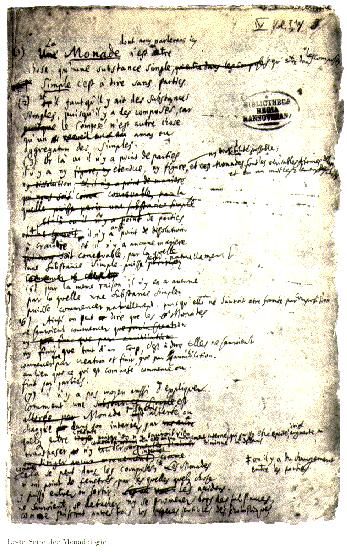
Monadology
The Monadology is one of Gottfried Leibniz's best known works of his later philosophy. It is a short text which presents, in some 90 paragraphs, a metaphysics of simple substances, or monads.
Read the full pageThe Monadology (French: La Monadologie, 1714) is one of Gottfried Leibniz's best known works of his later philosophy. It is a short text which presents, in some 90 paragraphs, a metaphysics of simple substances, or monads.
During his last stay in Vienna from 1712 to September 1714, Leibniz wrote two short texts in French which were meant as concise expositions of his philosophy. After his death, Principes de la nature et de la grâce fondés en raison, which was intended for prince Eugene of Savoy, appeared in French in the Netherlands. Christian Wolff and collaborators published translations in German and Latin of the second text which came to be known as The Monadology. Without having seen the Dutch publication of the Principes they had assumed that it was the French original of the Monadology, which in fact remained unpublished until 1840.
- 4
 ConceptModern European
Monergism
In Christian theology, monergism primarily denotes the belief that God alone is the agent of human salvation. Divine monergism is most commonly associated with Augustinian, Lutheran and Reformed/Calvinist soteriology, the latter of which includes certain strands of Anglicanism.
Read the full pageIn Christian theology, monergism primarily denotes the belief that God alone is the agent of human salvation. Divine monergism is most commonly associated with Augustinian, Lutheran and Reformed/Calvinist soteriology, the latter of which includes certain strands of Anglicanism. It is also a key component of some forms of Christian universalism. Secondarily, monergism can also refer to the belief that humans alone determine their salvation. Human monergism is commonly associated with Pelagianism. Both perspectives contrast with synergism, which asserts that divine and human cooperation is essential for the conversion process.
Monergism derives from the Greek monos (sole) and ergon (work) and refers to a single source acting alone. In Christian theology, it primarily denotes the belief that God is the sole agent in human salvation. This view, known as "divine monergism," is characteristic of Calvinist and Augustinian soteriology. It describes a process in which God alone authors for every step of salvation, without human participation. Monergism can also refer to the belief that humans are the sole agents of their salvation, a view known as "human monergism" and generally associated with Pelagianism. Both perspectives contrast with synergism, which holds that divine and human cooperation is necessary in the conversion process.
- 5
 ConceptModern European
Monism
Monism attributes oneness or singleness (Greek: μόνος) to a concept, such as existence. Primarily used in philosophy, the term sometimes overlaps with nondualism.
Read the full pageMonism attributes oneness or singleness (Greek: μόνος) to a concept, such as existence. Primarily used in philosophy, the term sometimes overlaps with nondualism. Various kinds of monism can be distinguished:
Priority monism states that all existing things go back to a source that is distinct from them; e.g., in Neoplatonism everything is derived from the One. In this view, only the One is ontologically fundamental or prior to everything else.
- 6
 ConceptModern European
Monopoly on violence
In political philosophy, a monopoly on violence or monopoly on the legal use of force is the property of a polity that is the only entity in its jurisdiction to legitimately use force, and thus the supreme authority of that area. While the monopoly on violence as the defining conception of the state was first described
Read the full pageIn political philosophy, a monopoly on violence or monopoly on the legal use of force is the property of a polity that is the only entity in its jurisdiction to legitimately use force, and thus the supreme authority of that area.
While the monopoly on violence as the defining conception of the state was first described in sociology by Max Weber in his essay Politics as a Vocation (1919), the monopoly of the legitimate use of physical force is a core concept of modern public law, which goes back to French jurist and political philosopher Jean Bodin's 1576 work Les Six livres de la République and English philosopher Thomas Hobbes's 1651 book Leviathan. Weber claims that the state is the "only human Gemeinschaft which lays claim to the monopoly on the legitimate use of physical force. As such, states can resort to coercive means such as incarceration, expropriation, humiliation, and death threats to obtain the population's compliance with its rule and thus maintain order. However, this monopoly is limited to a certain geographical area, and in fact this limitation to a particular area is one of the things that defines a state." In other words, Weber describes the state as any organization that succeeds in holding the exclusive right to use, threaten, or authorize physical force against residents of its territory. Such a monopoly, according to Weber, must occur via a process of legitimation.
- 7ConceptModern European
Moore's paradox
Moore's paradox concerns the apparent absurdity involved in asserting a first-person present-tense sentence such as "It is raining, but I do not believe that it is raining" or "It is raining, but I believe that it is not raining." The first author to note this apparent absurdity was G. E.
Read the full pageMoore's paradox concerns the apparent absurdity involved in asserting a first-person present-tense sentence such as "It is raining, but I do not believe that it is raining" or "It is raining, but I believe that it is not raining." The first author to note this apparent absurdity was G. E. Moore. These "Moorean" sentences, as they have become known, are paradoxical in that while they appear absurd, they nevertheless
Can be true;
- 8ConceptModern European
Moral luck
Moral luck describes circumstances whereby a moral agent is assigned moral blame or praise for an action or its consequences, even if it is clear that said agent did not have full control over either the action or its consequences. This term, introduced by Bernard Williams, has been developed, along with its significan
Read the full pageMoral luck describes circumstances whereby a moral agent is assigned moral blame or praise for an action or its consequences, even if it is clear that said agent did not have full control over either the action or its consequences. This term, introduced by Bernard Williams, has been developed, along with its significance to a coherent moral theory, by Williams and Thomas Nagel in their respective essays on the subject.
Broadly speaking, human beings tend to correlate, at least intuitively, responsibility and voluntary action. Thus, the most blame is assigned to persons for their actions and the consequences they entail when we have good cause to believe that both:
- 9ConceptModern European
Moral nihilism
Moral nihilism (also called ethical nihilism) is the metaethical view that nothing is morally right or morally wrong and that morality does not exist. Moral nihilism is distinct from moral relativism, which allows for actions to be wrong relative to a particular culture or individual.
Read the full pageMoral nihilism (also called ethical nihilism) is the metaethical view that nothing is morally right or morally wrong and that morality does not exist.
Moral nihilism is distinct from moral relativism, which allows for actions to be wrong relative to a particular culture or individual. It is also distinct from expressivism, which asserts that moral claims are expressions of emotions, desires, and intents.
- 10ConceptModern European
Moral particularism
Moral particularism is a theory in normative ethics that runs counter to the idea that moral actions can be determined by applying universal moral principles. It states that there is no set of moral principles that can be applied to every situation, making it an idea appealing to the context-dependent nature of morally
Read the full pageMoral particularism is a theory in normative ethics that runs counter to the idea that moral actions can be determined by applying universal moral principles. It states that there is no set of moral principles that can be applied to every situation, making it an idea appealing to the context-dependent nature of morally challenging situations. Moral judgements are said to be determined by factors of relevance with the consideration of a particular context. A moral particularist, for example, would argue that homicide cannot be judged to be morally wrong until all the morally relevant facts are known. While this stands in stark contrast to other prominent moral theories, such as deontology, consequentialism, and virtue ethics, it finds its way into jurisprudence, with the idea of justifiable homicide, for instance. In this case, the morally relevant facts are based on context rather than principle. Critics would argue that even in this case, the principle still informs morally right action.
The term "particularism" was coined to designate this position by R. M. Hare, in 1963 (Freedom and Reason, Oxford: Clarendon, p. 18). Within philosophy, the term is mainly used to denote a favoritism to one's own interests; which goes to say that morality is not universal.
- 11ConceptModern European
Moral sense theory
Moral sense theory (also known as moral sentimentalism) is a theory in moral epistemology and meta-ethics concerning the discovery of moral truths. Moral sense theory typically holds that distinctions between morality and immorality are discovered by emotional responses to experience.
Read the full pageMoral sense theory (also known as moral sentimentalism) is a theory in moral epistemology and meta-ethics concerning the discovery of moral truths. Moral sense theory typically holds that distinctions between morality and immorality are discovered by emotional responses to experience. Some take it to be primarily a view about the nature of moral facts or moral beliefs (a primarily metaphysical view)—this form of the view more often goes by the name "sentimentalism". Others take the view to be primarily about the nature of justifying moral beliefs (a primarily epistemological view)—this form of the view more often goes by the name "moral sense theory". However, some theorists take the view to be one which claims that both moral facts and how one comes to be justified in believing them are necessarily bound up with human emotions.
Popular historical advocates of some version of the moral sense theory or sentimentalism include the 3rd Earl of Shaftesbury (1671–1713), Francis Hutcheson (1694–1746), David Hume (1711–1776), and Adam Smith (1723–1790). Some contemporary advocates include Michael Slote, Justin D'Arms, Daniel Jacobson, Jesse Prinz, Jonathan Haidt, and perhaps John McDowell. Simon Blackburn and Allan Gibbard endorse a non-cognitivist form of sentimentalism.
- 12
 ConceptModern European
Morality
Morality is a quality among social animals, including humans, through which communities and individuals evaluate actions, character, and social arrangements. It often refers to a set of standards, doctrines, or systems of conduct that evaluate actions and character traits using criteria that vary across individuals, so
Read the full pageMorality is a quality among social animals, including humans, through which communities and individuals evaluate actions, character, and social arrangements. It often refers to a set of standards, doctrines, or systems of conduct that evaluate actions and character traits using criteria that vary across individuals, societies, social classes, public opinion, religions, cultures, customs, and traditions. These evaluations often include rightness or wrongness, virtues or vices, honesty or cruelty, honor or disgrace, community harmony, purity, reciprocity, shame, the influence of a person's inner beliefs, and propriety or impropriety of relationships between oneself and others. Morality involves evaluative judgments about agents and actions and assessments of actions as moral or immoral behavior.
Cross-species and cross-cultural research suggests that attention to moral sentiments exists in all human societies, and that moral sentiments are part of cultural universals. Some studies further indicate that behaviors related to morality, such as honesty, helpfulness, tolerance, loyalty, responsibility, social justice, equality, family and national security, stability of social order, gratitude, and the like, are part of universal values. That is, these behaviors may be virtues universally recognized by all societies. The ethical position advocating such principles is called moral universalism. However, the philosophy of moral relativism opposes universal moral principles, holding that no universal morality exists.
- 13
 ConceptModern European
Multitude (philosophy)
In philosophy, multitude often refers to a collective of people defined by common mode of existence, not shared identity. In ancient and medieval philosophy, thinkers explored the nature and role of "the many", typically in social and political contexts (increasingly the latter during the Middle Ages).
Read the full pageIn philosophy, multitude often refers to a collective of people defined by common mode of existence, not shared identity. In ancient and medieval philosophy, thinkers explored the nature and role of "the many", typically in social and political contexts (increasingly the latter during the Middle Ages). The concept gained prominence in the 17th century through the work of Thomas Hobbes and Baruch Spinoza, who developed it as a technical term.
Focusing on mechanism in philosophy amid the Scientific Revolution, Hobbes sought to apply principles of classical mechanics to model human behavior and political organization. He saw the multitude as an unstable pre-political mass and said it benefited from cohesion and unification, which required the force of a social contract with a sovereign authority. At the time, there were disputes over absolute monarchy, which culminated in English Civil War.
- 14
 ConceptModern European
Münchhausen trilemma
The Münchhausen trilemma (also known as Agrippa's trilemma) is an epistemological thought experiment intended to demonstrate the theoretical impossibility of proving any truth, even in the fields of logic and mathematics, without appealing to accepted assumptions. If it is asked how any given proposition is known to be
Read the full pageThe Münchhausen trilemma (also known as Agrippa's trilemma) is an epistemological thought experiment intended to demonstrate the theoretical impossibility of proving any truth, even in the fields of logic and mathematics, without appealing to accepted assumptions. If it is asked how any given proposition is known to be true, proof in support of that proposition may be provided. Yet that same question can be asked of that supporting proof and any subsequent supporting proof. The Münchhausen trilemma states that there are only three ways of completing a proof:
The circular argument, in which the proof of some proposition presupposes the truth of that very proposition


