Modern European ideas, M–N
- 1
 ConceptModern European
Mutual aid
Mutual aid traditionally refers to an organizational model where community members partake in voluntary, collaborative exchanges of resources and services to overcome social, economic, and political barriers and meet common needs while mobilizing to fight injustice. Mutual aid can include physical resources like food,
Read the full pageMutual aid traditionally refers to an organizational model where community members partake in voluntary, collaborative exchanges of resources and services to overcome social, economic, and political barriers and meet common needs while mobilizing to fight injustice. Mutual aid can include physical resources like food, clothing, or medicine, as well as services like breakfast programs or education. These groups are often built for the daily needs of their communities, but mutual aid groups are also found throughout relief efforts, such as in natural disasters or pandemics like the COVID-19 pandemic.
Dean Spade identifies three key elements of mutual aid: (1) addressing material needs while analyzing why these needs aren't already met; (2) building solidarity and strengthening social movements; (3) participatory. In contrast to charity, which often requires benefit recipients to meet certain conditions (e.g., means testing, grant stipulations), mutual aid does not discriminate between those "deserving" and "undeserving" of care. These groups often go beyond material or service exchange and are set up as a form of political participation in which people take responsibility for caring for one another and changing political conditions.
- 2ConceptModern European
Mutualism (economic theory)
Mutualism is an anarchist school of thought and economic theory that advocates for workers' control of the means of production, a free market made up of individual artisans, sole proprietorships and workers' cooperatives, and occupation and use property rights. As proponents of the labour theory of value and labour the
Read the full pageMutualism is an anarchist school of thought and economic theory that advocates for workers' control of the means of production, a free market made up of individual artisans, sole proprietorships and workers' cooperatives, and occupation and use property rights. As proponents of the labour theory of value and labour theory of property, mutualists oppose all forms of economic rent, profit and non-nominal interest, which they see as relying on the exploitation of labour. Mutualists seek to construct an economy without capital accumulation or concentration of land ownership. They also encourage the establishment of workers' self-management, which they propose could be supported through the issuance of mutual credit by mutual banks, with the aim of creating a federal society.
Mutualism has its roots in the utopian socialism of Robert Owen and Charles Fourier. It first developed a practical expression in Josiah Warren's community experiments in the United States, which he established according to the principles of equitable commerce based on a system of labor notes. Mutualism was first formulated into a comprehensive economic theory by the French anarchist Pierre-Joseph Proudhon, who proposed the abolition of unequal exchange and the establishment of a new economic system based on reciprocity. In order to establish such a system, he proposed the creation of a "People's Bank" that could issue mutual credit to workers and eventually replace the state; although his own attempts to establish such a system were foiled by the 1851 French coup d'état.
- 3
 ConceptModern European
Naïve realism
In philosophy of perception and epistemology, naïve realism (often associated with direct (perceptual) realism, itself metaphysically complemented by manifest realism) is the idea that the senses provide us with direct awareness of objects as they really are. When referred to as direct realism, naïve realism is often c
Read the full pageIn philosophy of perception and epistemology, naïve realism (often associated with direct (perceptual) realism, itself metaphysically complemented by manifest realism) is the idea that the senses provide us with direct awareness of objects as they really are. When referred to as direct realism, naïve realism is often contrasted with indirect realism.
According to the naïve realist, the objects of perception are not representations of external objects, but are in fact those external objects themselves. The naïve realist is typically also a metaphysical realist, holding that these objects continue to obey the laws of physics and retain all of their properties regardless of whether or not there is anyone to observe them. They are composed of matter, occupy space, and have properties, such as size, shape, texture, smell, taste and colour, that are usually perceived correctly. The indirect realist, by contrast, holds that the objects of perception are simply representations of reality based on sensory inputs, and thus adheres to the primary/secondary quality distinction in ascribing properties to external objects.
- 4ConceptModern European
Natural language
A natural language or ordinary language is any spoken language or signed language used organically in a human community, first emerging without conscious premeditation, replicating across generations of people in the community, and subject to internal and structural changes across time. The vast majority of languages i
Read the full pageA natural language or ordinary language is any spoken language or signed language used organically in a human community, first emerging without conscious premeditation, replicating across generations of people in the community, and subject to internal and structural changes across time. The vast majority of languages in the world are natural languages. As a category, natural language includes both standard dialects (ones with high social prestige) as well as nonstandard or vernacular dialects.
Even an official language with a regulating academy such as Standard French, overseen by the Académie Française, is still classified as a natural language (e.g. in the field of natural language processing), as its prescriptive aspects do not make it regulated enough to be considered a constructed or controlled natural language. Linguists broadly consider writing to be a static visual representation of a particular natural language, though, in many cases in highly literate modern societies, writing itself is also now subject to the natural processes of widely spoken natural languages.
- 5
 ConceptModern European
Natural science
Natural science or empirical science is a branch of science concerned with the description, understanding, and prediction of natural phenomena, based on empirical evidence from observation and experimentation. Mechanisms such as peer review and reproducibility of findings are used to try to ensure the validity of scien
Read the full pageNatural science or empirical science is a branch of science concerned with the description, understanding, and prediction of natural phenomena, based on empirical evidence from observation and experimentation. Mechanisms such as peer review and reproducibility of findings are used to try to ensure the validity of scientific advances.
Natural science can be divided into two main branches: life science and physical science. Life science is alternatively known as biology. Physical science is subdivided into physics, astronomy, Earth science, and chemistry. These branches of natural science may be further divided into more specialized branches, also known as fields. As empirical sciences, natural sciences use tools from the formal sciences, such as mathematics and logic, converting information about nature into measurements that can be explained as clear statements of the "laws of nature".
- 6
 ConceptModern European
Natural Supernaturalism
Natural Supernaturalism is one of Thomas Carlyle's philosophical concepts. It derives from the name of a chapter in his novel Sartor Resartus in which it is a central tenet of Diogenes Teufelsdröckh's "Philosophy of Clothes".
Read the full pageNatural Supernaturalism is one of Thomas Carlyle's philosophical concepts. It derives from the name of a chapter in his novel Sartor Resartus (1833–34) in which it is a central tenet of Diogenes Teufelsdröckh's "Philosophy of Clothes". Natural Supernaturalism holds that "existence itself is miraculous, that life contains elements of wonder that can never be defined or eradicated by physical science."
Carlyle conceived of Natural Supernaturalism as a "new Mythus" consistent with the discoveries of modern science. Rather than regarding a miracle as "simply a violation of the Laws of Nature", Natural Supernaturalism is based on the idea that nature (and its laws) is itself miraculous, being "of quite infinite depth, of quite infinite expansion". Rodger L. Tarr writes that "According to natural supernaturalism, miracles are an extension of truth, not a corruption of it; mysteries are dimensions of science, not a repudiation of it; and wonder is the foundation of logic, not its antagonist."
- 7ConceptModern European
Natural theology
Natural theology is a type of theology that seeks to provide arguments for theological topics, such as the existence of a deity, based on human reason. It is distinguished from revealed theology, which is based on supernatural sources such as scripture or religious experiences.
Read the full pageNatural theology is a type of theology that seeks to provide arguments for theological topics, such as the existence of a deity, based on human reason. It is distinguished from revealed theology, which is based on supernatural sources such as scripture or religious experiences. It is thus a form of theology open to critical examination, aimed at understanding the divine.
Natural theology does not preclude the concept of divine intervention nor presuppose a clockwork universe; however, it demands that any position be supported through reasoned arguments based on natural reason.
- 8ConceptModern European
Naturalistic fallacy
In metaethics, the naturalistic fallacy is the claim that it is possible to define good in terms of merely described entities, properties, or processes such as pleasant, desirable, or fitness. The term was introduced by British philosopher G.
Read the full pageIn metaethics, the naturalistic fallacy is the claim that it is possible to define good in terms of merely described entities, properties, or processes such as pleasant, desirable, or fitness. The term was introduced by British philosopher G. E. Moore in his 1903 book Principia Ethica.
Moore's naturalistic fallacy is closely related to the is–ought problem, which comes from David Hume's Treatise of Human Nature (1738–40); however, unlike Hume's view of the is–ought problem, Moore (and other proponents of ethical non-naturalism) did not consider the naturalistic fallacy to be at odds with moral realism.
- 9
 ConceptModern European
Naturphilosophie
"Naturphilosophie" (German for "nature-philosophy") is a term used in English-language philosophy to identify a current in the philosophical tradition of German idealism, as applied to the study of nature in the earlier 19th century. German speakers use the clearer term "Romantische Naturphilosophie", the philosophy of
Read the full page"Naturphilosophie" (German for "nature-philosophy") is a term used in English-language philosophy to identify a current in the philosophical tradition of German idealism, as applied to the study of nature in the earlier 19th century. German speakers use the clearer term "Romantische Naturphilosophie", the philosophy of nature developed at the time of the founding of German Romanticism. It is particularly associated with the philosophical work of Friedrich Wilhelm Joseph Schelling and Georg Wilhelm Friedrich Hegel—though it has some clear precursors also. More particularly it is identified with some of the initial works of Schelling during the period 1797–9, in reaction to the views of Johann Gottlieb Fichte, and subsequent developments from Schelling's position. Always controversial, some of Schelling's ideas in this direction are still considered of philosophical interest, even if the subsequent development of experimental natural science had a destructive impact on the credibility of the theories of his followers in Naturphilosophie.
Naturphilosophie attempted to comprehend nature in its totality and to outline its general theoretical structure, thus attempting to lay the foundations for the natural sciences. In developing their theories, the German Naturphilosophen found their inspiration in the natural philosophy of the Ancient Greek Ionian philosophers.
- 10
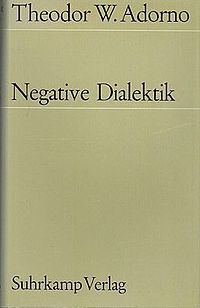 ConceptModern European
Negative Dialectics
Negative Dialectics (German: Negative Dialektik) is a 1966 book by the philosopher Theodor W. Adorno, in which he presents a critique of traditional Western philosophy and dialectical thinking.
Read the full pageNegative Dialectics (German: Negative Dialektik) is a 1966 book by the philosopher Theodor W. Adorno, in which he presents a critique of traditional Western philosophy and dialectical thinking. Adorno argues that the Enlightenment's emphasis on reason and progress has led to the domination of nature and the suppression of human individuality, and he develops the notion of negative dialectics as a critique of the positive, idealistic dialectics of Hegel and the Marxist dialectical materialism that grew out of it.
Negative dialectics rejects the idea of a final synthesis or reconciliation, instead emphasizing the importance of maintaining the tension between contradictory elements and resisting the temptation to subsume particulars under abstract, totalizing concepts.
- 11
 ConceptModern European
Neurath's boat
Neurath's boat (or Neurath's ship) is a simile used in anti-foundational accounts of knowledge, especially in the philosophy of science. It was first formulated by Otto Neurath.
Read the full pageNeurath's boat (or Neurath's ship) is a simile used in anti-foundational accounts of knowledge, especially in the philosophy of science. It was first formulated by Otto Neurath. It is based in part on the Ship of Theseus which, however, is standardly used to illustrate other philosophical questions, to do with problems of identity. It was popularised by Willard Van Orman Quine in Word and Object (1960).
Neurath used the simile in several occasions, first in "Problems in War Economics" (1913). In "Anti-Spengler" (1921), he wrote:
- 12ConceptModern European
New Right
New Right is a label used to refer to various right-wing political groups, policies, ideologies, and viewpoints that emerged in different countries at different points in time. The term New Right has also been used to describe the emergence of certain European parties after the dissolution of the Soviet Union.
Read the full pageNew Right is a label used to refer to various right-wing political groups, policies, ideologies, and viewpoints that emerged in different countries at different points in time. The term New Right has also been used to describe the emergence of certain European parties after the dissolution of the Soviet Union.
Within the US, the term was used to describe a more combative, anti-egalitarian, and uninhibited right following the 1964 presidential campaign of Barry Goldwater. Although this American brand of New Right had little in common with the "European New Right," both used the expression "conservative revolution" (but only the European New Right used it in a way similar to that of the conservative revolutionary Moeller van den Bruck).
- 13ConceptModern European
Nietzschean affirmation
Nietzschean affirmation (German: Bejahung) is a concept that scholars have identified in the philosophy of Friedrich Nietzsche. An example used to describe the concept is a fragment in Nietzsche's The Will to Power: Suppose that we said yes to a single moment, then we have not only said yes to ourselves, but to the wh
Read the full pageNietzschean affirmation (German: Bejahung) is a concept that scholars have identified in the philosophy of Friedrich Nietzsche. An example used to describe the concept is a fragment in Nietzsche's The Will to Power:
Suppose that we said yes to a single moment, then we have not only said yes to ourselves, but to the whole of existence. For nothing stands alone, either in ourselves or in things; and if our soul did but once vibrate and resound with a chord of happiness, then all of eternity was necessary to bring forth this one occurrence—and in this single moment when we said yes, all of eternity was embraced, redeemed, justified and affirmed.Nietzsche’s affirmative philosophy, as expressed in his parable about eternal recurrence, places his conception of amor fati and his instruction towards the positive embrace of the will to power in a cosmically expanded and universally determined context. Only the embrace of what is and will be, according to the will and its position within natural accident, constitutes freedom (or its nameless equivalent) in Nietzsche’s vision. The ethical injunction about what should be is dismissed by this parable.
- 14ConceptModern European
Noema
The word noema (plural: noemata) derives from the Greek word νόημα meaning "mental object". The philosopher Edmund Husserl used noema as a technical term in phenomenology to stand for the object or content of a thought, judgement, or perception, but its precise meaning in his work has remained a matter of controversy.
Read the full pageThe word noema (plural: noemata) derives from the Greek word νόημα meaning "mental object". The philosopher Edmund Husserl used noema as a technical term in phenomenology to stand for the object or content of a thought, judgement, or perception, but its precise meaning in his work has remained a matter of controversy.
In Ideas: General Introduction to Pure Phenomenology (1913), Husserl continued and built on the (ancient to modern Greek to early modern German Idealism philosophies') terms "noema" () and "noesis" () to designate correlated elements of the structure of any intentional act—for example, an act of perceiving, or judging, or remembering:


