Modern European ideas, M
- 1ConceptModern European
Memory wheels
Memory wheels or combinatory wheels are mnemonic, metaphysical, symbolic, and concept-generative devices first developed in 1582 by Renaissance philosopher Giordano Bruno, as part of his system of ars memoriae (art of memory). They consist of rotating concentric discs inscribed with letters, images, or concepts, design
Read the full pageMemory wheels or combinatory wheels are mnemonic, metaphysical, symbolic, and concept-generative devices first developed in 1582 by Renaissance philosopher Giordano Bruno, as part of his system of ars memoriae (art of memory). They consist of rotating concentric discs inscribed with letters, images, or concepts, designed to generate permutations for both mnemonic and metaphysical purposes. Bruno's designs draw on earlier mnemonic and combinatorial systems, particularly those developed by Ramon Llull, whose rotating diagrams served as a model for symbolic generation and divine contemplation. Bruno's wheels reflect a broader Renaissance shift to the development of structured symbolic tools and an intense interest in mnemonic systems.
A typical memory wheel consists of 4–6 concentric circles, each divided into equal segments (varies between 30 and 60 segments). The entire memory system could contain up to 150 symbolic segments in total, distributed across the various wheels. When rotated, these rings form new symbolic combinations. Bruno's systems have been interpreted as not only encoding knowledge but to simulate the structure of the universe itself. By organising symbolic elements into layered, rotating configurations, they reflected the relationships between natural phenomena, celestial influences, and intellectual principles. The memory wheels thus functioned as both mnemonic devices and metaphysical models, designed to reveal the hidden correspondences linking the physical, cosmic, and spiritual realms. Indeed, according to Frances Yates, Bruno's wheels were "not merely [for] mnemonic functions; they were a means of expressing the total structure of reality by rotating and combining symbols from the elemental, celestial, and intellectual realms." According to scholars such as Yates, the goal extended beyond memorisation and included the generation of new meaning through recombination.
- 2ConceptModern European
Mental representation
A mental representation (or cognitive representation), in philosophy of mind, cognitive psychology, neuroscience, and cognitive science, is a hypothetical internal cognitive symbol that represents external reality or its abstractions. Mental representation is the mental imagery of things that are not actually present t
Read the full pageA mental representation (or cognitive representation), in philosophy of mind, cognitive psychology, neuroscience, and cognitive science, is a hypothetical internal cognitive symbol that represents external reality or its abstractions.
Mental representation is the mental imagery of things that are not actually present to the senses. In contemporary philosophy, specifically in fields of metaphysics such as philosophy of mind and ontology, a mental representation is one of the prevailing ways of explaining and describing the nature of ideas and concepts.
- 3ConceptModern European
Mental state
A mental state, or a mental property, is a state of mind of a person. Mental states comprise a diverse class, including perception, pain/pleasure experience, belief, desire, intention, emotion, and memory.
Read the full pageA mental state, or a mental property, is a state of mind of a person. Mental states comprise a diverse class, including perception, pain/pleasure experience, belief, desire, intention, emotion, and memory.
There is controversy concerning the exact definition of the term. According to epistemic approaches, the essential mark of mental states is that their subject has privileged epistemic access while others can only infer their existence from outward signs. Consciousness-based approaches hold that all mental states are either conscious themselves or stand in the right relation to conscious states. Intentionality-based approaches, on the other hand, see the power of minds to refer to objects and represent the world as the mark of the mental. According to functionalist approaches, mental states are defined in terms of their role in the causal network independent of their intrinsic properties. Some philosophers deny all the aforementioned approaches by holding that the term "mental" refers to a cluster of loosely related ideas without an underlying unifying feature shared by all.
- 4ConceptModern European
Meontology
In philosophy, meontology (from Ancient Greek μή, me "non" and ὄν, on "being" (see ontology)) is the concept of non-being, an attempt to cover what may remain outside of ontology. French philosopher Jean-Luc Nancy distinguishes it as nothingness, as opposed to nothing.
Read the full pageIn philosophy, meontology (from Ancient Greek μή, me "non" and ὄν, on "being" (see ontology)) is the concept of non-being, an attempt to cover what may remain outside of ontology. French philosopher Jean-Luc Nancy distinguishes it as nothingness, as opposed to nothing.
For Emmanuel Levinas, meontology was whatever had meaning beyond ontology, the ethical primary demand of the other in a face-to-face encounter. According to Levinas, meontology refers not to another being but to an inability to be that leads to a transcendent realm "other than being". However, Levinas suggested that meontology, as the mirror image of ontology, occupies the same logical space. Levinas' conceptualization is encapsulated in a principle for existence or for humanity that states, "Do not go inside, go outside!". It implies that the authenticity of human existence is ensured not by looking inwards (egocentrism) because one does not see oneself without the aid of others. Levinas supported the notion of a continual reinterpretation of history, that the traditional history which reduces singular persons to members of classes or tribes cannot be used to narrate the coming-to-pass of the Infinite in the ethical relation.
- 5ConceptModern European
Mere addition paradox
The mere addition paradox (also known as the repugnant conclusion) is a problem in population ethics identified by Derek Parfit and discussed in his book Reasons and Persons. The paradox identifies the mutual incompatibility of four intuitively compelling assertions about the relative value of populations.
Read the full pageThe mere addition paradox (also known as the repugnant conclusion) is a problem in population ethics identified by Derek Parfit and discussed in his book Reasons and Persons (1984). The paradox identifies the mutual incompatibility of four intuitively compelling assertions about the relative value of populations. Parfit’s original formulation of the repugnant conclusion is that "for any possible population of at least ten billion people, all with a very high quality of life, there must be some much larger imaginable population whose existence, if other things are equal, would be better, even though its members have lives that are barely worth living."
Parfit considers four populations, as depicted in the following diagram: A, A+, B− and B. Each bar represents a distinct group of people. The bars' width represents group size while the bar's height represents group happiness. Unlike A and B, A+ and B− are complex populations, each comprising two distinct groups of people. It is also stipulated that the lives of the members of each group are good enough that they would rather be alive than not exist.
- 6ConceptModern European
Mereotopology
In formal ontology, a branch of metaphysics, and in ontological computer science, mereotopology is a first-order theory, embodying mereological and topological concepts, of the relations among wholes, parts, parts of parts, and the boundaries between parts. This field is related to spatial-temporal reasoning, region-co
Read the full pageIn formal ontology, a branch of metaphysics, and in ontological computer science, mereotopology is a first-order theory, embodying mereological and topological concepts, of the relations among wholes, parts, parts of parts, and the boundaries between parts. This field is related to spatial-temporal reasoning, region-connection calculus, and mathematical morphology.
Mereotopology begins in philosophy with theories articulated by A. N. Whitehead in several books and articles he published between 1916 and 1929, drawing in part on the mereogeometry of De Laguna (1922). The first to have proposed the idea of a point-free definition of the concept of topological space in mathematics was Karl Menger in his book Dimensionstheorie (1928) -- see also his (1940). The early historical background of mereotopology is documented in Bélanger and Marquis (2013) and Whitehead's early work is discussed in Kneebone (1963: ch. 13.5) and Simons (1987: 2.9.1). The theory of Whitehead's 1929 Process and Reality augmented the part-whole relation with topological notions such as contiguity and connection. Despite Whitehead's acumen as a mathematician, his theories were insufficiently formal, even flawed. By showing how Whitehead's theories could be fully formalized and repaired, Clarke (1981, 1985) founded contemporary mereotopology. The theories of Clarke and Whitehead are discussed in Simons (1987: 2.10.2), and Lucas (2000: ch. 10). The entry Whitehead's point-free geometry includes two contemporary treatments of Whitehead's theories, due to Giangiacomo Gerla, each different from the theory set out in the next section.
- 7ConceptModern European
Metaphysics of presence
Metaphysics of presence (German: Metaphysik der Anwesenheit) is a view held by Martin Heidegger in Being and Time that holds the entire history of Western philosophy is based on privileging presence over absence. Another translation of presence and absence is effectivity and possibility.
Read the full pageMetaphysics of presence (German: Metaphysik der Anwesenheit) is a view held by Martin Heidegger in Being and Time that holds the entire history of Western philosophy is based on privileging presence over absence. Another translation of presence and absence is effectivity and possibility.
- 8ConceptModern European
Metapolitics
Metapolitics (sometimes written meta-politics) describes political attempts to speak in a metalinguistic sense about politics; that is, to have a political dialogue about politics itself. Activists who use the phrase often view metapolitics as a form of "inquiry" in which the discourse of politics, and the political it
Read the full pageMetapolitics (sometimes written meta-politics) describes political attempts to speak in a metalinguistic sense about politics; that is, to have a political dialogue about politics itself. Activists who use the phrase often view metapolitics as a form of "inquiry" in which the discourse of politics, and the political itself, is reimagined and reappropriated. The term was coined by Marxists and is almost always used in the context of ideological discourse among the far-left and far-right, unlike the wider academic field of political philosophy. Those citing the term often do so in an attempt to take a "self-conscious" role in describing their preferred form of political inquiry.
The term "metapolitics" originated with left-wing French academics, being first popularized by Alain Badiou and Jacques Rancière. Discussing Badiou's Metapolitics, Bruno Bosteels asserts that:
- 9ConceptModern European
Methodological individualism
In the social sciences, methodological individualism is a method for explaining social phenomena strictly in terms of the decisions of individuals, each being moved by their own personal motivations. In contrast, explanations of social phenomena which assume that cause and effect acts upon whole classes or groups are d
Read the full pageIn the social sciences, methodological individualism is a method for explaining social phenomena strictly in terms of the decisions of individuals, each being moved by their own personal motivations. In contrast, explanations of social phenomena which assume that cause and effect acts upon whole classes or groups are deemed illusory, and thus rejected according to this approach. Or to put it another way, only group dynamics which can be explained in terms of individual subjective motivations are considered valid. With its bottom-up micro-level approach, methodological individualism is often contrasted with methodological holism, a top-down macro-level approach, and methodological pluralism.
This framework was introduced as a foundational assumption within the social sciences by Max Weber, and discussed in his book Economy and Society. Within later schools of economic thought, such as the Austrian School, strict adherence to methodological individualism is considered a necessary starting principle. It draws heavily upon assumptions of neoclassical economics, where social behavior is explained in terms of rational actors whose choices are constrained by prices and incomes, and where individuals' subjective preferences are treated as a given.
- 10
 ConceptModern European
Micrographia
Micrographia: or Some Physiological Descriptions of Minute Bodies Made by Magnifying Glasses. With Observations and Inquiries Thereupon is a historically significant book by Robert Hooke about his observations through various lenses.
Read the full pageMicrographia: or Some Physiological Descriptions of Minute Bodies Made by Magnifying Glasses. With Observations and Inquiries Thereupon is a historically significant book by Robert Hooke about his observations through various lenses. It was the first book to include illustrations of insects and plants as seen through microscopes.
Published in January 1665, the first major publication of the Royal Society, it became the first scientific best-seller, inspiring a wide public interest in the new science of microscopy. The book originated the biological term "cell".
- 11
 ConceptModern European
Mimetic theory
The mimetic theory of desire, an explanation of human behavior in relation to culture, originated with the French historian, literary critic, and philosopher of social science René Girard. The name of the theory derives from the philosophical concept mimesis, which carries a wide range of meanings.
Read the full pageThe mimetic theory of desire, an explanation of human behavior in relation to culture, originated with the French historian, literary critic, and philosopher of social science René Girard (1923–2015). The name of the theory derives from the philosophical concept mimesis, which carries a wide range of meanings. In mimetic theory, mimesis refers to human desire, which Girard thought was not linear but the product of a mimetic process in which people imitate models who endow objects with value. Girard called this phenomenon "mimetic desire", and described mimetic desire as the foundation of his theory:Man is the creature who does not know what to desire, and he turns to others in order to make up his mind. We desire what others desire because we imitate their desires.
Girard's idea proposes that all desire is merely an imitation of another's desire, and the desire only occurs because others have deemed said object as worthwhile. This means that a desirable object is only desired because of societal ideas, and is not based on personal preference like most believe. The mimetic desire is triangular, based on the subject, model, and object. The subject mimics the model, and both desire the object. Subject and model thus compete for the object(or status) ultimately resulting in conflict. On a societal level, this conflict is resolved by transferring the collective aggression or blame on to an innocent victim or "scapegoat". This collective action unites the community. Yet, this "scapegoat mechanism" also results in continued violence against the victim as the community develops myths that portray the scapegoat as deserving the punishment.
- 12
 ConceptModern European
Mind–body problem
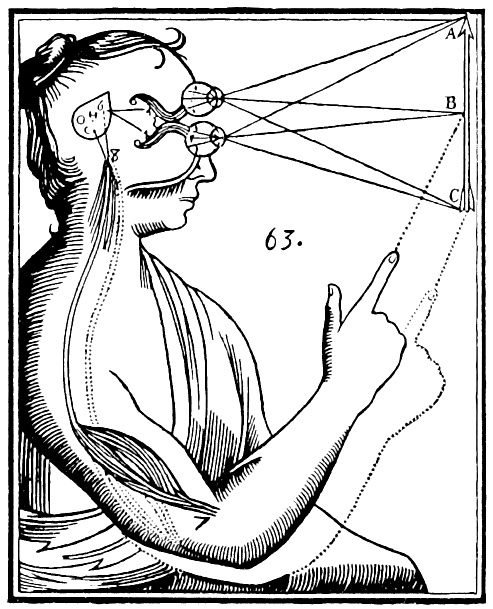
In philosophy of mind, the mind–body problem is a philosophical problem concerning the relationship between thought and consciousness in the human mind and body. It addresses the nature of consciousness, mental states, and their relation to the physical brain and nervous system.
Read the full pageIn philosophy of mind, the mind–body problem is a philosophical problem concerning the relationship between thought and consciousness in the human mind and body. It addresses the nature of consciousness, mental states, and their relation to the physical brain and nervous system. The problem centers on understanding how immaterial thoughts and feelings can interact with the material world, or whether they are ultimately physical phenomena.
This problem has been a central issue in philosophy of mind since the 17th century, particularly following René Descartes' formulation of dualism, which proposes that mind and body are fundamentally distinct substances. Other major philosophical positions include monism, which encompasses physicalism (everything is ultimately physical) and idealism (everything is ultimately mental). More recent approaches include functionalism, property dualism, and various non-reductive theories.
- 13ConceptModern European
Minority (philosophy)
Minority (French: minorité) is a philosophical concept developed by Gilles Deleuze and Félix Guattari in their books Kafka: Towards a Minor Literature, A Thousand Plateaus, and elsewhere. In these texts, they criticize the concept of "majority".
Read the full pageMinority (French: minorité) is a philosophical concept developed by Gilles Deleuze and Félix Guattari in their books Kafka: Towards a Minor Literature (1975), A Thousand Plateaus (1980), and elsewhere. In these texts, they criticize the concept of "majority". For Deleuze and Guattari, "becoming-minor(itarian)" is primarily an ethical action, one of the becomings one is affected by when avoiding "becoming-fascist". They argued further that the concept of a "people", when invoked by subordinate groups or those aligned with them, always refers to a minority, whatever its numerical power might be.
For Deleuze and Guattari the "minor" and "becoming-minority" does not refer to minority groups as described in ordinary language. Minority groups are defined by identities and are thus molar configurations belonging to the majoritarian State machine. (Molar configurations are composed of infinite lines of particles, i.e. lines of becoming.) Deleuze and Guattari's central example here is Franz Kafka. Kafka finds himself at home among neither the Prague Jews nor the dominant German and Austria-Hungarian power structure. For him a "people is missing" and his literature sets out to summon that people. Nonetheless, there is a connection between what are ordinarily referred to as "minorities" and Deleuze and Guattari's conception of the minor and becoming-minor. If becoming-minor often occurs in the context of what are ordinarily called minority groups, then this is because, Deleuze and Guattari argue, becoming-minor is catalyzed by existence in cramped social spaces. The key point not to be missed is that becoming-minor is not related to molar identities, nor is it a politics that seeks representation or recognition of such identities (though Deleuze and Guattari stress that these are worthwhile political ambitions).
- 14
 ConceptModern European
Mirror stage
The mirror stage (French: stade du miroir) is a concept in the psychoanalytic theory of Jacques Lacan. The mirror stage is based on the belief that infants recognize themselves in a mirror (literal) or other symbolic contraption which induces apperception (the turning of oneself into an object that can be viewed by the
Read the full pageThe mirror stage (French: stade du miroir) is a concept in the psychoanalytic theory of Jacques Lacan. The mirror stage is based on the belief that infants recognize themselves in a mirror (literal) or other symbolic contraption which induces apperception (the turning of oneself into an object that can be viewed by the child from outside themselves) from the age of about six months.
Initially, Lacan proposed that the mirror stage was part of an infant's development from 6 to 18 months, as outlined at the Fourteenth International Psychoanalytical Congress at Marienbad in 1936. By the early 1950s, Lacan's concept of the mirror stage had evolved: he no longer considered the mirror stage as a moment in the life of the infant, but as representing a permanent structure of subjectivity, or as the paradigm of "Imaginary order". This evolution in Lacan's thinking becomes clear in his later essay titled "The Subversion of the Subject and the Dialectic of Desire".
