Modern European ideas, L–M
- 1ConceptModern European
Logocentrism
Logocentrism was coined by the German philosopher Ludwig Klages in the early 1900s. It refers to the tradition of Western science and philosophy that regards words and language as a fundamental expression of an external reality.
Read the full pageLogocentrism was coined by the German philosopher Ludwig Klages in the early 1900s. It refers to the tradition of Western science and philosophy that regards words and language as a fundamental expression of an external reality. It holds the logos as epistemologically superior and that there is an original, irreducible object which the logos represent. According to logocentrism, the logos is the ideal representation of the Platonic ideal.
According to Jacques Derrida, with the logos as the site of a representational unity, linguistics dissects the structure of the logos further and establishes the sound of the word, coupled with the sense of the word, as the original and ideal location of metaphysical significance. Logocentric linguistics proposes that "the immediate and privileged unity which founds significance and the acts of language is the articulated unity of sound and sense within the phonic." As the science of language, linguistics is a science by way of this semiotic phonology. It follows, therefore, that speech is the primary form of language and that writing is secondary, representative, and, importantly, outside of speech. Writing is a "sign of a sign" and, therefore, is basically phonetic.
- 2ConceptModern European
Lord–bondsman dialectic
The lord–bondsman dialectic (German: Herrschaft und Knechtschaft; also translated master–servant dialectic) is a famous passage in Georg Wilhelm Friedrich Hegel's The Phenomenology of Spirit. It is widely considered a key element in Hegel's philosophical system, and it has heavily influenced many subsequent philosopher
Read the full pageThe lord–bondsman dialectic (German: Herrschaft und Knechtschaft; also translated master–servant dialectic) is a famous passage in Georg Wilhelm Friedrich Hegel's The Phenomenology of Spirit. It is widely considered a key element in Hegel's philosophical system, and it has heavily influenced many subsequent philosophers.
The passage describes, in narrative form, the development of self-consciousness as such in an encounter between what are thereby (i.e., emerging only from this encounter) two distinct, self-conscious beings. The essence of the dialectic is the movement or motion of recognizing, in which the two self-consciousnesses are constituted in each being recognized as self-conscious by the other. This movement, inexorably taken to its extreme, takes the form of a "struggle to the death" in which one masters [beherrscht] the other, only to find that such lordship makes the very recognition he had sought impossible, since the bondsman, in this state, is not free to offer it.
- 3ConceptModern European
Łukasiewicz logic
In mathematics and philosophy, Łukasiewicz logic ( WUUK-ə-SHEV-itch, Polish: [wukaˈɕɛvitʂ]) is a non-classical, many-valued logic. It was originally defined in the early 20th century by Jan Łukasiewicz as a three-valued modal logic; it was later generalized to n-valued (for all finite integers n) as well as infinitely-
Read the full pageIn mathematics and philosophy, Łukasiewicz logic ( WUUK-ə-SHEV-itch, Polish: [wukaˈɕɛvitʂ]) is a non-classical, many-valued logic. It was originally defined in the early 20th century by Jan Łukasiewicz as a three-valued modal logic; it was later generalized to n-valued (for all finite integers n) as well as infinitely-many-valued (ℵ0-valued) variants, both propositional and first order. The ℵ0-valued version was published in 1930 by Łukasiewicz and Alfred Tarski; consequently it is sometimes called the Łukasiewicz–Tarski logic. It belongs to the classes of t-norm fuzzy logics and substructural logics.
Łukasiewicz logic was motivated by Aristotle's suggestion that bivalent logic was not applicable to future contingents, e.g. the statement "There will be a sea battle tomorrow". In other words, statements about the future were neither true nor false, but an intermediate value could be assigned to them, to represent their possibility of becoming true in the future.
- 4ConceptModern European
Lwów–Warsaw school
The Lwów–Warsaw school (Polish: Szkoła Lwowsko-Warszawska) was an interdisciplinary school (mainly philosophy, logic and psychology) founded by Kazimierz Twardowski in 1895 in Lwów, Austro-Hungary (now Lviv, Ukraine). Though its members represented a variety of disciplines, from mathematics through logic to psychology,
Read the full pageThe Lwów–Warsaw school (Polish: Szkoła Lwowsko-Warszawska) was an interdisciplinary school (mainly philosophy, logic and psychology) founded by Kazimierz Twardowski in 1895 in Lwów, Austro-Hungary (now Lviv, Ukraine).
Though its members represented a variety of disciplines, from mathematics through logic to psychology, the Lwów–Warsaw school is widely considered to have been a philosophical movement. It has produced some of the leading logicians of the twentieth century such as Jan Łukasiewicz, Stanisław Leśniewski, and Alfred Tarski, among others. Its members contributed not just to the techniques of logic but also to various domains that belong to the philosophy of language.
- 5
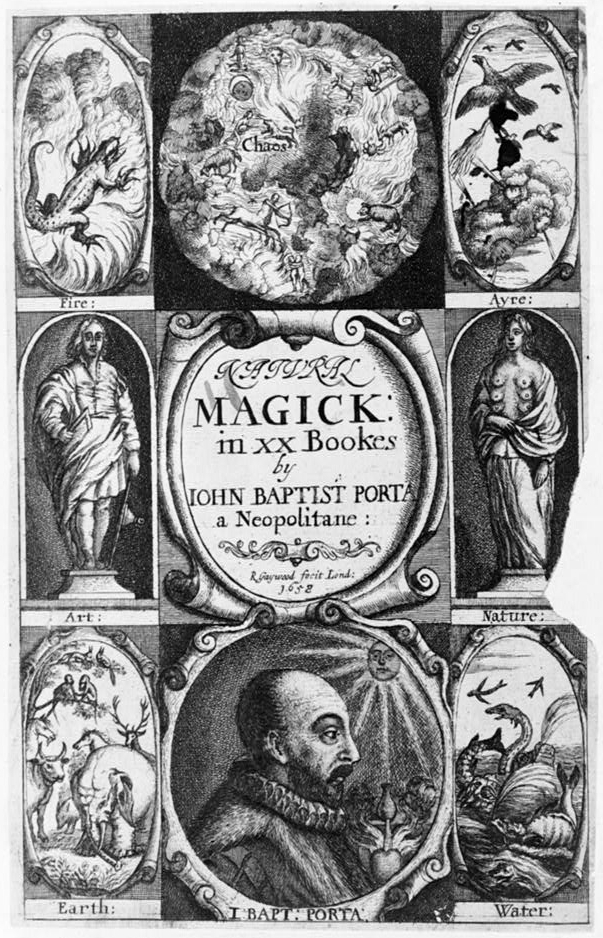 ConceptModern European
Magia Naturalis
Magia Naturalis is a 1558 work of natural magic written by Giambattista della Porta. The first edition consists of four books that draw upon classical sources and craft knowledge, encompassing topics that range from growing plants, transforming metals, and for creating illusions through natural, rather than sorcerous,
Read the full pageMagia Naturalis is a 1558 work of natural magic written by Giambattista della Porta. The first edition consists of four books that draw upon classical sources and craft knowledge, encompassing topics that range from growing plants, transforming metals, and for creating illusions through natural, rather than sorcerous, means. It has been called "one of the great masterpieces of the Renaissance philosophical-scientific tradition".
Giambattista della Porta was born near Naples in 1535 to Leonardo Antonio and his wife, the sister of Adriano Gugliemo Spadafora, who shaped his early education with an extensive museum and library. His elder brother, Giovan Vincenzo, was also a scholar. He died on 14 February 1615.
- 6ConceptModern European
Mapping controversies
Mapping controversies (MC) is an academic course taught in science studies, stemming from the writings of the French sociologist and philosopher Bruno Latour. MC focuses exclusively on the controversies surrounding scientific knowledge rather than the established scientific facts or outcomes.
Read the full pageMapping controversies (MC) is an academic course taught in science studies, stemming from the writings of the French sociologist and philosopher Bruno Latour. MC focuses exclusively on the controversies surrounding scientific knowledge rather than the established scientific facts or outcomes. Thus, it helps sociologists, anthropologists and other social scientists get insights not into scientific knowledge per se, but rather into the process of gaining knowledge. Thus, MC sheds light on those intermediate stages corresponding to the actual research process and pinpoints the connections between scientific work and other types of activities.
The term mapping controversies was first suggested in relation to analysis of scientific and technological controversies, and then lately re-affirmed as a widely applicable methodological approach going beyond the boundaries of science studies. It is usually used for the methodology that identifies and tracks down the polemics or debate surrounding a scientific fact, and utilises various visualisation tools to present the problem in its complexity.
- 7
 ConceptModern European
Master–slave morality
Master–slave morality (German: Herren- und Sklavenmoral) is a central theme of Friedrich Nietzsche's works, particularly in the first essay of his book On the Genealogy of Morality. Nietzsche argues that there are two fundamental types of morality: "master morality" and "slave morality", which correspond, respectively,
Read the full pageMaster–slave morality (German: Herren- und Sklavenmoral) is a central theme of Friedrich Nietzsche's works, particularly in the first essay of his book On the Genealogy of Morality.
Nietzsche argues that there are two fundamental types of morality: "master morality" and "slave morality", which correspond, respectively, to the dichotomies of "good/bad" and "good/evil". In master morality, "good" is a self-designation of the aristocratic classes; it is synonymous with nobility and everything powerful and life-affirming. "Bad" has no condemnatory implication, merely referring to the "common" or the "low" and the qualities and values associated with them, in contradistinction to the warrior ethos of the ruling nobility. In slave morality, the meaning of "good" is made the antithesis of the original aristocratic "good", which itself is relabeled "evil". This inversion of values develops out of the ressentiment the weak feel toward the powerful.
- 8ConceptModern European
Mathematical logic
Mathematical logic is the study of logic within mathematics. This is commonly done by means of formal systems called formal logics that define rules of reasoning and the axioms they satisfy.
Read the full pageMathematical logic is the study of logic within mathematics. This is commonly done by means of formal systems called formal logics that define rules of reasoning and the axioms they satisfy.
Major subareas include model theory, proof theory, set theory, and recursion theory (also known as computability theory). Research in mathematical logic commonly addresses the mathematical properties of formal systems of logic such as their expressive or deductive power. However, it can also include usage of logic to characterize correct mathematical reasoning or to establish foundations of mathematics.
- 9
 ConceptModern European
Mathematical proof
A mathematical proof is a deductive argument for a mathematical statement, showing that the stated assumptions logically guarantee the conclusion. The argument may use other previously established statements, such as theorems; but every proof can, in principle, be constructed using only certain basic or original assump
Read the full pageA mathematical proof is a deductive argument for a mathematical statement, showing that the stated assumptions logically guarantee the conclusion. The argument may use other previously established statements, such as theorems; but every proof can, in principle, be constructed using only certain basic or original assumptions known as axioms, along with the accepted rules of inference. Proofs are examples of exhaustive deductive reasoning that establish logical certainty, to be distinguished from empirical arguments or non-exhaustive inductive reasoning that establish "reasonable expectation". Presenting many cases in which the statement holds is not enough for a proof, which must demonstrate that the statement is true in all possible cases. A proposition that has not been proved but is believed to be true is known as a conjecture, or a hypothesis if frequently used as an assumption for further mathematical work.
Proofs employ logic expressed in mathematical symbols, along with natural language that usually admits some ambiguity. In most mathematical literature, proofs are written in terms of rigorous informal logic. Purely formal proofs, written fully in symbolic language without the involvement of natural language, are considered in proof theory. The distinction between formal and informal proofs has led to much examination of current and historical mathematical practice, quasi-empiricism in mathematics, and so-called folk mathematics, oral traditions in the mainstream mathematical community or in other cultures. The philosophy of mathematics is concerned with the role of language and logic in proofs, and mathematics as a language.
- 10ConceptModern European
Mathematicism
Mathematicism is 'the effort to employ the formal structure and rigorous method of mathematics as a model for the conduct of philosophy', or the metaphysical view that reality is fundamentally mathematical. The term has been applied to a number of philosophers, including Pythagoras and René Descartes although the term
Read the full pageMathematicism is 'the effort to employ the formal structure and rigorous method of mathematics as a model for the conduct of philosophy', or the metaphysical view that reality is fundamentally mathematical. The term has been applied to a number of philosophers, including Pythagoras and René Descartes although the term was not used by themselves.
The role of mathematics in Western philosophy has grown and expanded from Pythagoras onwards. It is clear that numbers held a particular importance for the Pythagorean school, although it is the later work of Plato that attracts the label of mathematicism from modern philosophers. Furthermore it is René Descartes who provides the first mathematical epistemology which he describes as a mathesis universalis, and which is also referred to as mathematicism.
- 11
 ConceptModern European
Mathesis universalis
Mathesis universalis (from Greek: μάθησις, mathesis 'science or learning', and Latin: universalis 'universal') is a hypothetical universal science modelled on mathematics envisaged by Descartes and Leibniz, among a number of other 16th- and 17th-century philosophers and mathematicians. For Leibniz, it would be supporte
Read the full pageMathesis universalis (from Greek: μάθησις, mathesis 'science or learning', and Latin: universalis 'universal') is a hypothetical universal science modelled on mathematics envisaged by Descartes and Leibniz, among a number of other 16th- and 17th-century philosophers and mathematicians. For Leibniz, it would be supported by a calculus ratiocinator. John Wallis invokes the name as title in his Opera Mathematica, a textbook on arithmetic, algebra, and Cartesian geometry.
Descartes' most explicit description of mathesis universalis occurs in Rule Four of the Rules for the Direction of the Mind, written before 1628. Leibniz attempted to work out the possible connections between mathematical logic, algebra, infinitesimal calculus, combinatorics, and universal characteristics in an incomplete treatise titled "Mathesis Universalis" in 1695.
- 12ConceptModern European
Meaning of life
The meaning of life is the concept of an individual's life, human life, or existence in general having an inherent significance or a philosophical point. There is no consensus on the specifics of such a concept, or whether the concept itself even exists in any objective sense.
Read the full pageThe meaning of life is the concept of an individual's life, human life, or existence in general having an inherent significance or a philosophical point. There is no consensus on the specifics of such a concept, or whether the concept itself even exists in any objective sense. Thinking and discourse on the topic is sought in the English language through questions such as—but not limited to—"What is the meaning of life?", "What is the purpose of existence?", and "Why are we here?". There have been many proposed answers to these questions from many different cultural and ideological backgrounds. The search for life's meaning has produced much philosophical, scientific, theological, and metaphysical speculation throughout history. Different people and cultures believe in different answers to this question. Opinions vary on the usefulness of using time and resources in the pursuit of an answer. Excessive pondering can be indicative of, or lead to, an existential crisis.
The meaning of life can be derived from philosophical and religious contemplation of, and scientific inquiries about, existence, social ties, consciousness, and happiness. Many other issues are also involved, such as symbolic meaning, ontology, value, purpose, ethics, good and evil, free will, the existence of one or multiple gods, conceptions of God, the soul, and the afterlife. Scientific contributions focus primarily on describing related empirical facts about the universe, exploring the context and parameters concerning the "how" of life. Science also studies and can provide recommendations for the pursuit of well-being and a related conception of morality. An alternative, humanistic approach poses the question, "What is the meaning of my life?"
- 13
 ConceptModern European
Meaning-making
In psychology, meaning-making is the process of how people (and other living beings) construe, understand, or make sense of life events, relationships, and the self. The term is widely used in constructivist approaches to counseling psychology and psychotherapy, especially during bereavement in which people attribute s
Read the full pageIn psychology, meaning-making is the process of how people (and other living beings) construe, understand, or make sense of life events, relationships, and the self.
The term is widely used in constructivist approaches to counseling psychology and psychotherapy, especially during bereavement in which people attribute some sort of meaning to an experienced death or loss. The term is also used in educational psychology.
- 14ConceptModern European
Mechanism (philosophy)
Mechanism is the belief that natural wholes (principally living things) are similar to complicated machines or artifacts, composed of parts lacking any intrinsic relationship to each other. The doctrine of mechanism in philosophy comes in two different varieties.
Read the full pageMechanism is the belief that natural wholes (principally living things) are similar to complicated machines or artifacts, composed of parts lacking any intrinsic relationship to each other.
The doctrine of mechanism in philosophy comes in two different varieties. They are both doctrines of metaphysics, but they are different in scope and ambitions: the first is a global doctrine about nature; the second is a local doctrine about humans and their minds, which is hotly contested. For clarity, we might distinguish these two doctrines as universal mechanism and mechanism in the philosophy of mind.

