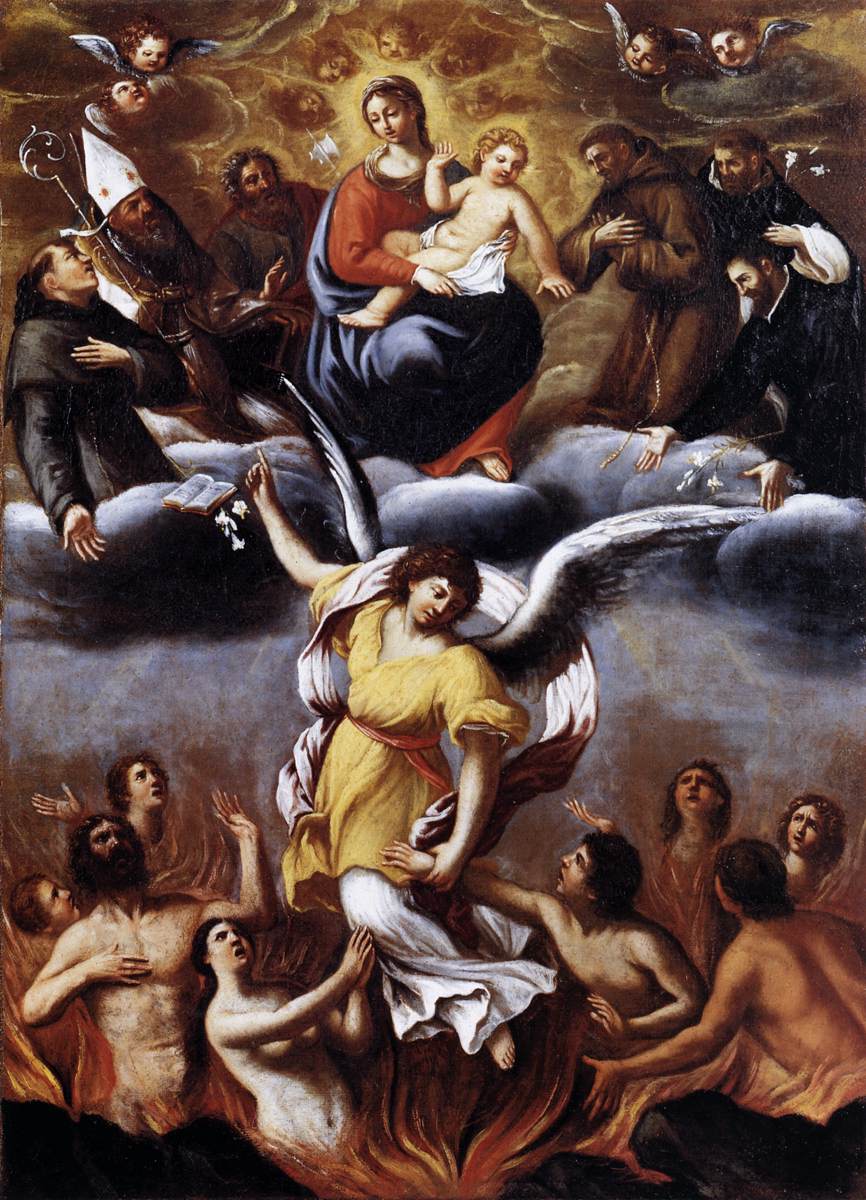
Purgatory
Purgatory (Latin: purgatorium, borrowed into English via Anglo-Norman and Old French) is a belief in Catholic theology. It is a passing intermediate state after physical death for purifying or purging a soul before entering Heaven.
Purgatory (Latin: purgatorium, borrowed into English via Anglo-Norman and Old French) is a belief in Catholic theology. It is a passing intermediate state after physical death for purifying or purging a soul before entering Heaven. A common analogy is dross being removed from gold in a furnace.
In Catholic doctrine, purgatory refers to the final cleansing of those who died in the state of grace, and leaves in them only "the holiness necessary to enter the joy of heaven"; it is entirely different from the punishment of the damned and is not related to the forgiveness of sins for salvation. A forgiven person can be freed from their "unhealthy attachment to creatures" by fervent charity in this world, and otherwise by the non-vindictive "temporal (i.e. non-eternal) punishment" of purgatory.
In late medieval era, metaphors of time, place and fire were frequently adopted. Catherine of Genoa (fl. 1500) re-framed the idea as ultimately joyful. It has been portrayed in art as an unpleasant (voluntary but not optional) "punishment" for unregretted minor sins and imperfect contrition (fiery purgatory) or as a joyful or marvelous final relinquishment of worldly attachments (non-fiery purgatory).
The Eastern Orthodox churches have somewhat different formulations of an intermediate state. Most Protestant denominations do not endorse the Catholic formulation. Several other religions have concepts resembling Purgatory: Gehenna in Judaism, al-A'raf or the upper most layer of hell in Islam, and Naraka in Hinduism.
The word purgatory has come to refer to a wide range of historical and modern conceptions of postmortem suffering short of everlasting damnation. English-speakers also use the word analogously to mean any place or condition of suffering or torment, especially one that is temporary.
History of the belief
The noun purgatory (in Latin purgatorium, a place of cleansing, from the verb purgo, 'to clean, cleanse') appeared perhaps only between 1160 and 1180, which encouraged speaking of Purgatory as a place.
Purgatory pre-dates the specific Catholic tradition of purgatory as a transitional state or condition; it has a history that dates back before Christ, to related beliefs also in Judaism, that prayer for the dead contributes to their afterlife purification. The same practice appears in other traditions, such as the medieval Chinese Buddhist practice of making offerings on behalf of the dead, who are said to suffer numerous trials.
The Catholic Church found specific Old Testament support in after-life purification in 2 Maccabees, which is part of the Catholic, Eastern Orthodox, Oriental Orthodox and Church of the East biblical canons, but regarded as apocryphal by Protestants and major branches of Judaism. According to the Catechism of the Catholic Church, praying for the dead was adopted by Christians from the beginning, a practice that presupposes that the dead are thereby assisted between death and their entry into their final abode. The New American Bible Revised Edition, authorized by the United States Conference of Catholic Bishops, says in a note to the 2 Maccabees passage:
This is the earliest statement of the doctrine that prayers and sacrifices for the dead are efficacious [...] The author [...] uses the story to demonstrate belief in the resurrection of the just, and in the possibility of expiation for the sins of otherwise good people who have died. This belief is similar to, but not quite the same as, the Catholic doctrine of purgatory.
Sacred Tradition, by reference to certain texts of scripture, speaks of the process as involving a cleansing fire. According to Jacques Le Goff, in Western Europe toward the end of the twelfth century Purgatory started to be represented as a physical place, Le Goff states that the concept involves the idea of a purgatorial fire, which he suggests "is expiatory and purifying not punitive like hell fire".
At the Second Council of Lyon in 1274, when the Catholic Church defined, for the first time, its teaching on purgatory, the Eastern Orthodox Church did not adopt the doctrine. The council made no mention of purgatory as a third place or as containing fire, which are absent also in the declarations by the Councils of Florence (1431–1449) and of Trent (1545–1563). Popes John Paul II and Benedict XVI have written that the term does not indicate a place, but a condition of existence.
The Church of England, mother church of the Anglican Communion, officially denounces what it calls "the Romish Doctrine concerning Purgatory", but the Eastern Orthodox Church, Oriental Orthodox Churches, and elements of the Anglican, Lutheran, and Methodist traditions hold that for some there is cleansing after death and pray for the dead, knowing it to be efficacious. The Reformed churches teach that the departed are delivered from their sins through the process of glorification.
Rabbinical Judaism also believes in the possibility of after-death purification and may even use the word "purgatory" to describe the similar rabbinical concept of Gehenna, though Gehenna is also sometimes described as more similar to hell or Hades.
Christianity
Some Christians, typically Roman Catholics, recognize the doctrine of Purgatory. The Eastern Orthodox are less likely to use the term, although they acknowledge an intermediate state after death and before final judgment, and consequentially offer prayers for the dead.
Protestants usually do not recognize Purgatory as such; following their doctrine of sola scriptura, they claim Jesus is not recorded mentioning or otherwise endorsing it, and the deuterocanonical book 2 Maccabees is not accepted by Protestants as scripture.
Catholicism
The Catholic Church holds that "all who die in God's grace and friendship but still imperfectly purified" undergo a process of purification after death, which the church calls Purgatory, "so as to achieve the holiness necessary to enter the joy of heaven".
Though in popular imagination Purgatory is pictured as a place rather than a process of purification, the idea of Purgatory as a physical place is not part of the church's doctrine. However, the church's understanding has typically been that Purgatory has a temporal (temporary, terminating, non-eternal) component with only God being outside of time. Fire, another important element of the Purgatory of popular imagination, is also absent in the Catholic Church's doctrine.
Purgatory and indulgences are defined (i.e. official Catholic) doctrines, unlike limbo. Catholicism bases its teaching also on the practice of praying for the dead, in use within the church ever since the church began, and mentioned in the deuterocanonical book 2 Maccabees 12:46.
In Catholic doctrine
At the Second Council of Lyon in 1274, the Catholic Church defined, for the first time, its teaching on Purgatory, in summary two points:
some saved souls need to be purified after death;
such souls benefit from the prayers and pious duties that the living do for them.
The council declared:
[I]f they die truly repentant in charity before they have made satisfaction by worthy fruits of penance for (sins) committed and omitted, their souls are cleansed after death by purgatorical or purifying punishments [...] And to relieve punishments of this kind, the offerings of the living faithful are of advantage to these, namely, the sacrifices of Masses, prayers, alms, and other duties of piety, which have customarily been performed by the faithful for the other faithful according to the regulations of the Church.
A century and a half later, the Council of Florence repeated the same two points in practically the same words, again excluding certain elements of the purgatory of popular imagination, in particular fire and place, against which representatives of the Eastern Orthodox Church spoke at the council.
The Council of Trent repeated the same two points and moreover in its 4 December 1563 Decree Concerning Purgatory recommended avoidance of speculations and non-essential questions:
Let the more difficult and subtle "questions", however, and those which do not make for "edification" (cf. 1Tm 1,4), and from which there is very often no increase in piety, be excluded from popular discourses to uneducated people. Likewise, let them not permit uncertain matters, or those that have the appearance of falsehood, to be brought out and discussed publicly. Those matters on the contrary, which tend to a certain curiosity or superstition, or that savor of filthy lucre, let them prohibit as scandals and stumbling blocks to the faithful.
Catholic doctrine on purgatory is presented as composed of the same two points in the Compendium of the Catechism of the Catholic Church, first published in 2005, which is a summary in dialogue form of the Catechism of the Catholic Church. It deals with purgatory in the following exchange:
210. What is purgatory?
Purgatory is the state of those who die in God's friendship, assured of their eternal salvation, but who still have need of purification to enter into the happiness of heaven.
211. How can we help the souls being purified in purgatory?
Because of the communion of saints, the faithful who are still pilgrims on earth are able to help the souls in purgatory by offering prayers in suffrage for them, especially the Eucharistic sacrifice. They also help them by almsgiving, indulgences, and works of penance.
These two questions and answers summarize information in sections 1030–1032 and 1054 of the Catechism of the Catholic Church, published in 1992, which also speaks of purgatory in sections 1472−1473.
Role in relation to the church
The prayers of the saints in Heaven and the good deeds, works of mercy, prayers, and indulgences of the living have a twofold effect: they help the souls in Purgatory atone for their sins and they make the souls' own prayers for the living effective, since the merits of the saints in Heaven, on Earth, and in Purgatory are part of the treasury of merit. Whenever the Eucharist is celebrated, souls in Purgatory are purified – i.e., they receive a full remission of sin and punishment – and go to Heaven.
Role in relation to sin
According to the doctrine of the Catholic Church, those who die in God's grace and friendship imperfectly purified, although they are assured of their eternal salvation, undergo a purification after death, so as to achieve the holiness necessary to enter the joy of God.
Unless "redeemed by repentance and God's forgiveness", mortal sin, whose object is grave matter and is also committed with full knowledge and deliberate consent, "causes exclusion from Christ's kingdom and the eternal death of hell, for our freedom has the power to make choices for ever, with no turning back." Such sin "makes us incapable of eternal life, the privation of which is called the 'eternal punishment' of sin".
Venial sin, while not depriving the sinner of friendship with God or the eternal happiness of heaven, "weakens charity, manifests a disordered affection for created goods, and impedes the soul's progress in the exercise of the virtues and the practice of the moral good; it merits temporal punishment", for "every sin, even venial, entails an unhealthy attachment to creatures, which must be purified either here on earth, or after death in the state called purgatory. This purification frees one from what is called the 'temporal punishment' of sin".
These two punishments must not be conceived of as a kind of vengeance inflicted by God from without, but as following from the very nature of sin. A conversion which proceeds from a fervent charity can attain the complete purification of the sinner in such a way that no punishment would remain.
Cardinal Joseph Ratzinger, the future Pope Benedict XVI, paraphrased this as: "Purgatory is not, as Tertullian thought, some kind of supra-worldly concentration camp where man is forced to undergo punishment in a more or less arbitrary fashion. Rather it is the inwardly necessary process of transformation in which a person becomes capable of Christ, capable of God, and thus capable of unity with the whole communion of saints".
This purification from mankind's sinful tendencies has been compared to rehabilitation of someone who needs to be cleansed of any addiction, a gradual and probably painful process. It can be advanced during life by voluntary self-mortification and penance and by deeds of generosity that show love of God rather than of creatures. If not completed before death, it can still be needed for entering the divine presence.
A person seeking purification from sinful tendencies is also considered not to be alone in Catholic teaching, due to be the communion of saints: "the holiness of one profits others, well beyond the harm that the sin of one could cause others. Thus recourse to the communion of saints lets the contrite sinner be more promptly and efficaciously purified of the punishments for sin". The Catholic Church states that, through the granting of indulgences for manifestations of devotion, penance and charity by the living, it opens for individuals "the treasury of the merits of Christ and the saints to obtain from the Father of mercies the remission of the temporal punishments due for their sins".
Catherine of Genoa
On the cusp of the Reformation, Catherine of Genoa (1447–1510) re-framed the theology of purgatory as voluntary, loving and even joyful:
As for paradise, God has placed no doors there. Whoever wishes to enter, does so. An all-merciful God stands there with His arms open, waiting to receive us into His glory. I also see, however, that the divine presence is so pure and light-filled – much more than we can imagine – that the soul that has but the slightest imperfection would rather throw itself into a thousand hells than appear thus before the divine presence.
Therefore, purgatory is a state of both joy and voluntary pain:
Again the soul perceives the grievousness of being held back from seeing the divine light; the soul's instinct too, being drawn by that uniting look, craves to be unhindered
Pope Benedict XVI recommended to theologians the presentation of purgatory by Catherine of Genoa, for whom purgatory is not an external but an inner fire:
In her day it was depicted mainly using images linked to space: a certain space was conceived of in which Purgatory was supposed to be located. Catherine, however, did not see purgatory as a scene in the bowels of the earth: for her it is not an exterior but rather an interior fire. This is purgatory: an inner fire.
He further said that:
'The soul', Catherine says, 'presents itself to God still bound to the desires and suffering that derive from sin and this makes it impossible for it to enjoy the beatific vision of God' [...] The soul is aware of the immense love and perfect justice of God and consequently suffers for having failed to respond in a correct and perfect way to this love; and love for God itself becomes a flame, love itself cleanses it from the residue of sin.
In his 2007 encyclical Spe salvi, Pope Benedict XVI, referring to the words of Paul the Apostle in 1 Corinthians 3:12–15 about a fire that both burns and saves, spoke of the opinion that "the fire which both burns and saves is Christ himself, the Judge and Saviour. The encounter with him is the decisive act of judgement. Before his gaze all falsehood melts away."
This encounter with him, as it burns us, transforms and frees us, allowing us to become truly ourselves. All that we build during our lives can prove to be mere straw, pure bluster, and it collapses. Yet in the pain of this encounter, when the impurity and sickness of our lives become evident to us, there lies salvation. His gaze, the touch of his heart heals us through an undeniably painful transformation 'as through fire'. But it is a blessed pain, in which the holy power of his love sears through us like a flame, enabling us to become totally ourselves and thus totally of God.
The pain of love becomes our salvation and our joy.
Duration
In his 2007 encyclical Spe salvi, Pope Benedict XVI teaches:
It is clear that we cannot calculate the 'duration' of this transforming burning in terms of the chronological measurements of this world. The transforming 'moment' of this encounter eludes earthly time-reckoning – it is the heart's time, it is the time of 'passage' to communion with God in the Body of Christ."
Eastern Catholics
The popular conceptions of Purgatory that, especially in late medieval times, were common among Catholics of the Latin Church have not necessarily found acceptance in the Eastern Catholic Churches, of which there are 23 in full communion with the Pope. Some have explicitly rejected the notions of punishment by fire in a particular place that are prominent in the popular picture of Purgatory.
The representatives of the Eastern Orthodox Church at the Council of Florence (1431–1449) argued against these notions, while declaring that they do hold that there is a cleansing after death of the souls of the saved and that these are assisted by the prayers of the living:
If souls depart from this life in faith and charity but marked with some defilements, whether unrepented minor ones or major ones repented of but without having yet borne the fruits of repentance, we believe that within reason they are purified of those faults, but not by some purifying fire and particular punishments in some place.
The definition of Purgatory adopted by that council excluded the two notions with which the Orthodox disagreed and mentioned only the two points that, they said, were part of their faith also. Accordingly, the agreement, known as the Union of Brest, that formalized the admission of the Ukrainian Greek Catholic Church into the full communion of the Roman Catholic Church stated: "We shall not debate about purgatory, but we entrust ourselves to the teaching of the Holy Church".
Popular notions of Purgatory
Some Catholic saints, theologians and laity have had ideas about purgatory beyond those adopted by the Catholic Church, reflecting or contributing to the popular image, which includes the notions of purification by actual fire, in a determined place and for a precise length of time.
As a place
In his La naissance du Purgatoire (The Birth of Purgatory), Jacques Le Goff attributes the origin of the idea of a third other-world domain, similar to heaven and hell, called Purgatory, to Paris intellectuals and Cistercian monks at some point in the last three decades of the twelfth century, possibly as early as 1170−1180. Previously, the Latin adjective purgatorius, as in purgatorius ignis ('cleansing fire') existed, but only then did the noun purgatorium appear, used as the name of a place called Purgatory. Robert Bellarmine also taught "that Purgatory, at least the ordinary place of expiation, is situated in the interior of the earth, that the souls in Purgatory and the reprobate are in the same subterranean space in the deep abyss which the Scripture calls Hell."
The change happened at about the same time as the composition of the book Tractatus de Purgatorio Sancti Patricii, an account by an English Cistercian of a penitent knight's visit to the land of Purgatory reached through a cave in the island known as Station Island or St Patrick's Purgatory in the lake of Lough Derg, County Donegal, Ireland. Le Goff said this book "occupies an essential place in the history of Purgatory, in whose success it played an important, if not decisive, role".
Adapted from the Wikipedia article Purgatory, available under CC BY-SA 4.0.
Connections
Proposed by
1You might also explore
 Free will★Are our choices genuinely up to us, or determined by prior causes?
 AsceticismGreek & RomanAsceticism is a lifestyle characterized by abstinence from worldly pleasures through self-discipline, self-imposed…Christian theologyModern EuropeanChristian theology is the theology – the systematic study of the divine and religion – of Christian belief and…
 Christian philosophyModern EuropeanChristian philosophy encompasses the philosophical ideas and systems developed by Christians or in direct relation to…Christian apologeticsGreek & RomanChristian apologetics (Ancient Greek: ἀπολογία, "verbal defense, speech in defense") is a branch of Christian theology…ApokatastasisModern EuropeanIn theology, apokatastasis (Greek: ἀποκατάστασις, romanized: apokatástasis, also spelled apocatastasis) is the…