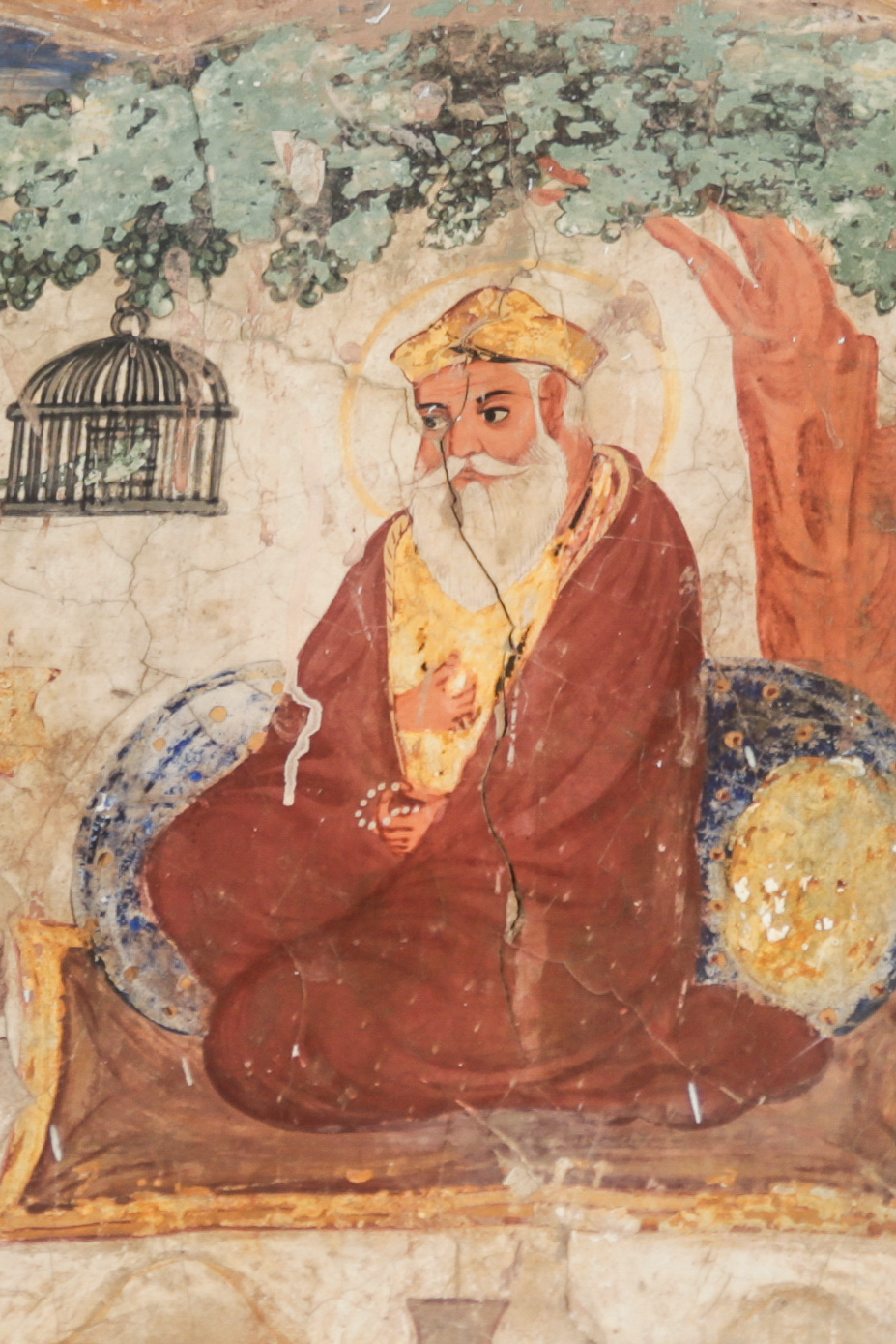
Guru Nanak
Founder of Sikhism, who taught one formless God, honest work, sharing with others and the equality of all.
Key ideas
Gurū Nānak (15 April 1469 – 22 September 1539; Gurmukhi: ਗੁਰੂ ਨਾਨਕ), also known as Bābā Nānak (Father Nanak), was an Indian spiritual teacher, mystic and poet, who is regarded as the founder of Sikhism and is the first of the ten Sikh gurus.
Nanak is said to have travelled far and wide across Asia teaching people the message of Ik Onkar (ੴ, 'One God'), who dwells in every one of his creations and constitutes the eternal Truth. With this concept, he would set up a unique spiritual, social, and political platform based on equality, fraternal love, goodness, and virtue.
Nanak's words are registered in the form of 974 poetic hymns, or shabda, in the holy religious scripture of Sikhism, the Guru Granth Sahib, with some of the major prayers being the Japji Sahib (jap, 'to recite'; ji and sahib are suffixes signifying respect); the Asa di Var ('Ballad of Hope'); and the Sidh Goshti ('Discussion with the Siddhas'). It is part of Sikh religious belief that the spirit of Nanak's sanctity, divinity, and religious authority had descended upon each of the nine subsequent Gurus when the Guruship was devolved onto them. His birthday is celebrated as Guru Nanak Gurpurab, annually across India.
Birth
Nanak was born on 15 April 1469 at Rāi Bhoi Dī Talvaṇḍī village (present-day Nankana Sahib, Punjab, Pakistan) in the Lahore province of the Delhi Sultanate, although according to one tradition, he was born in the Indian month of Kārtik or November, known as Kattak in Punjabi. He was born into the Punjabi Khatri clan like all of the Sikh gurus, specifically, Guru Nanak was a Bedi Khatri. According to Arvind-Pal Singh Mandair, it is more likely that Nanak was born in his mother's home village, known as Nanake, hence why he and his elder sister were named Nanak and Nanaki, respectively, although the Janamsakhis claim he was born in his father's village. Kapur Singh notes that Guru Nanak was born in the Bar Region of Punjab, historically an alluvial barren tract of the Punjab.
There are many supernatural narratives surrounding the birth of Nanak, such as that he was greeted by various Hindu deities after birth. Another tale claims he had the laugh of a full-grown adult, which surprised the Muslim mid-wife Daultan. Furthermore, it is claimed that astrologers predicted the child's future greatness.
Kattak birthdate
Most janamsakhis (ਜਨਮਸਾਖੀ, 'birth stories'), or traditional biographies of Nanak, mention that he was born on the third day of the bright lunar fortnight, in the Baisakh month (April) of Samvat 1526. These include the Puratan janamsakhi (puratan meaning "traditional" or "ancient"), Miharban janamsakhi, Gyan-ratanavali by Bhai Mani Singh, and the Vilayat Vali janamsakhi. Gurbilas Patashahi 6, written 1718, also attributed to Bhai Mani Singh, contradicts Mani Singh's Janamsakhi as it instead says Guru Nanak was born on the full moon of Katak. The Sikh records state that Nanak died on the 10th day of the Asauj month of Samvat 1596 (22 September 1539 CE), at the age of 70 years, 5 months, and 7 days. This further suggests that he was born in the month of Vaisakh (April), not Kattak (November).
As late as 1815, during the reign of Ranjit Singh, the festival commemorating Nanak's birthday was held in April at the place of his birth, known by then as Nankana Sahib. However, the anniversary of Nanak's birth—the Gurpurab (gur + purab, 'celebration')—subsequently came to be celebrated on the full moon day of the Kattak month in November. The earliest record of such a celebration in Nankana Sahib is from 1868 CE.
There may be several reasons for the adoption of the Kattak birthdate by the Sikh community. For one, it may have been the date of Nanak's enlightenment or "spiritual birth" in 1496, as suggested by the Dabestan-e Mazaheb.
Some of the sources that support the Katak birthday incident include:
The Bala Janamasakhi supports the Kattak birth tradition. It is the only Janamsakhi that does. Bhai Bala is said to have obtained Nanak's horoscope from Nanak's uncle Lalu, according to which, Nanak was born on a date corresponding to 20 October 1469 CE. However, this janamsakhi was written by Handalis—a sect of Sikhs who followed a Sikh-convert known as Handal—attempting to depict the founder as superior to Nanak. According to a superstition prevailing in contemporary northern India, a child born in the Kattak month was believed to be weak and unlucky, hence why the work states that Nanak was born in that month.
Bhai Gurdas, having written on a full-moon-day of the Kattak month several decades after Nanak's death, mentions that Nanak had "obtained omniscience" on the same day, and it was now the author's turn to "get divine light."
According to eyewitness Sikh chronicles, known as Bhatt Vahis, Guru Nanak was born on the full moon of Katak.
The Gurbilas Patashahi 6, written in 1718 attributed to Bhai Mani Singh, says Guru Nanak was born on the full moon of Katak.
Meham Parkash written in 1776 also says Guru Nanak was born on the full moon of Katak.
Kesar Singh Chibber’s Bansavalinama Dasan Patashahia Ka, meaning genealogy of the ten emperors, written in 1769, also states that Guru Nanak was born on the full moon of Katak.
Gurpurnali written in 1727 and Guru Tegh Bahadur Malwe da Safar written in 1716 both mention Guru Nanak being born on the full moon of Katak.
Nanak Chandrodaya Sanskrit Janamsakhi from 1797 and Janam Sakhi Baba Nanak by Sant Das Chibber from the 18th century both mention Guru Nanak being born on the full moon of Katak.
Gurpur Parkash Granth, written by Sant Ren Singh based on a granth written by Binod Singh states Guru Nanak was born on the full moon of Katak.
According to Max Arthur Macauliffe (1909), a Hindu festival held in the 19th century on Kartik Purnima in Amritsar attracted a large number of Sikhs. The Sikh community leader Giani Sant Singh did not like this, thus starting a festival at the Sikh shrine of the Golden Temple on the same day, presenting it as the birth anniversary celebration of Guru Nanak.
Macauliffe also notes that Vaisakh (March–April) already saw a number of important festivals—such as Holi, Rama Navami, and Vaisakhi—therefore people would be busy in agricultural activities after the harvest festival of Baisakhi. Therefore, holding Nanak's birth anniversary celebrations immediately after Vaisakhi would have resulted in thin attendance, and therefore, smaller donations for the Sikh shrines. On the other hand, by the Kattak full moon day, the major Hindu festival of Diwali was already over, and the peasants—who had surplus cash from crop sales—were able to donate generously.
Family and early life
Narratives surrounding the birth and early life of Nanak show similarities to those told about Buddha, Jesus, and Krishna, although Nanak's birth was a natural one and not to a virgin. A common theme is Nanak's father wishing for his son to live an ordinary life marked by financial and social success, not understanding that the deeply contemplative young Nanak was more interested in spiritual affairs, which causes conflict between them. Meanwhile, Nanak's mother Tripta differs in her approach and recognizes early on the uniqueness of her son. Two persons are claimed in Sikh lore as recognizing the spiritual qualities of Nanak early on in his life, namely his elder sister Nanaki and the local Muslim landlord, Rai Bullar.
Nanak's parents, father Kalyan Chand Das Bedi (commonly shortened to Mehta Kalu) and mother Mata Tripta, were both Hindus of the Khatri caste who worked as merchants. His father, in particular, was the local patwari (accountant or revenue overseer) for crop revenue in the village of Talwandi. Nanak's father worked for Rai Bullar, who was a recent Bhatti Rajput convert to Islam from Hinduism. Nanak's paternal grandfather was named Shiv Ram Bedi and his great-grandfather was Ram Narayan Bedi. Nanak's mother, Tripta, had a Muslim mid-wife named Daulat who cared for her during her pregnancy, showing an affinity of Nanak's family to Muslims. Nanaki, Nanak's only sister, was four or five years older than him. At Talwandi, Nanak had a childhood friend named Mardana, who was a Muslim rababi.
According to Sikh traditions, the birth and early years of Nanak's life were marked with many events that demonstrated that Nanak had been blessed with divine grace. Daulat, the Muslim mid-wife who helped deliver Nanak, praised the baby as per the Janamsakhis. Commentaries on Nanak's life give details of his blossoming awareness from a young age. For instance, at the age of five, Nanak is said to have voiced interest in divine subjects. His father enrolled him at the village school (a pathsala) under a Brahmin teacher, as per custom. Nanak studied under a teacher named Gopal at the age of five, being an unusually fast-learner, surpassing what the teacher could instruct him in. Nanak learnt the subjects of arithmetic, book-keeping, mnemonic tables of accountancy, and the Devanagari script (known as Sastri script in the northwestern India at the time). Notable lore recounts that, as a child, Nanak astonished his teacher by describing the implicit symbolism of the first letter of the alphabet, resembling the mathematical version of one, as denoting the unity or oneness of God. At age seven, he was sent to study under Brij Nath, where he learnt about the Vedas and the six orthodox schools of Hindu philosophy. On the suggestion of Rai Bullar, Nanak's father sent his son at the age of nine to study at a maktab under a Muslim teacher named Saiyid Hassan, a maulvi, where he learnt Persian, Arabic, and studied Indo-Islamic literature.
Nanak's father hoped his son would take up accounting or mercantile work but Nanak was more interested in religious pursuits, spending much of his time outside, often discussing subjects with sadhus and sufis or roaming the local wilderness. Nanak also spent much time taking care of the family's cattle in the fields, as his father noticed he seemed happier outdoors than indoors. Other stories of his childhood refer to strange and miraculous events about Nanak, such as the one witnessed by Rai Bular, in which the sleeping child's head was shaded from the harsh sunlight, in one account, by the stationary shadow of a tree, or in another, by a venomous cobra. The cobra version is sourced from the Bala janamsakhi tradition. An early miraculous story found in Sikh literature is one where Nanak was watching over his family's buffalos when they rampaged into a neighbouring field, destroying crops. However, when the condition of the crops was checked, they were mysteriously unharmed (the location of the field is now marked by Gurdwara Kiara Sahib in Nankana Sahib).At the age of nine, Nanak began composing his own poetry, being influenced by bhagats and Sufis. Nanak was especially close to his sister. In 1475, Nanak's elder sister, Nanaki, married at the age of 13 and moved to Sultanpur Lodhi. The departure of his elder sister was a source of sorrow for the young Nanak. Two years later, the village priest Hardyal attempted to confer the janaeu thread (a cotton-thread worn on the waist by dvija Hindu boys) on Nanak's body and shave his head to initiate him to the yajnopavitam (upanyana) custom at a local gathering but he rejected it and criticized the impermanence of such an item. This rejection caused controversy in the locality and was the beginning of Nanak's rejection of orthodox Vedic and Hindu traditions. After this event, Nanak became more deeply absorbed into spiritual matters when compared to before, with his father failing to try and find adequate employment to suit his son as Nanak was not interested. An episode of Nanak's early life, known as the sacha sauda, tells of him spending 22 rupees his father entrusted to him to buy goods at a neighbouring town, named Chuharkhana, to feed hungry sadhus, which angered his father and caused him to strike his son.
As Nanak entered adolescence, he became increasingly detached from society, experiencing deep emotional shifts and long periods of silent meditation. His family, viewing his spiritual withdrawal as a lack of ambition, pressured him to take a government job in Sultanpur to re-ground him in reality. Nanak responded with poetic silence and a refusal to eat, leading his family to believe he had been possessed. His family called for the vaid, the village-physician named Hardas, to treat their son's presumed ailment. When receiving treatment, Nanak revealed part of the hymns now found in the Raga Malar section of the Guru Granth Sahib, stating that the doctor did not have the cure for what Nanak was suffering from, which was an ailment that was spiritual in nature, not physical.
Marriage
As a young man, Nanak had an arranged marriage to Sulakhani, daughter of Mūl Chand (aka Mula) and Chando Raṇi. They were married on 24 September 1487, in the town of Batala, and would go on to have two sons, Sri Chand (b. 1494) and Lakhmi Chand (or Lakhmi Das, b. 1496 or 1497). Nanak lived in Sultanpur until c. 1500, which would be a formative time for him, as the puratan janamsakhi suggests, and in his numerous allusions to governmental structure in his hymns, most likely gained at this time. Some sources claim that Nanak married later on at the age of nineteen.
Move to Sultanpur
Jai Ram, Nanaki's husband, was employed at a modikhana (a storehouse for revenues collected in non-cash form), in the service of the Delhi Sultanate's Lahore governor Daulat Khan (who was a Pathan), at which Ram would help Nanak get a job. Nanak moved to Sultanpur, and started working at the modikhana around the age of 16. Nanak began working as the custodian-general at the state's stores. According to Mandair, Nanak began working as an accountant in a local village near Sultanpur. After earning an income, his wife was able to join him, which was around when Nanak was 19 years old. After this, Nanak's life became more stable, with him devoting his efforts to his job during the day and spending his time on spiritual singing (kirtan) at night and early morning-hours, bathing in the Bein river at dawn, and then sleeping, waking-up, working, and repeat, with this cyclical lifestyle continuing for around twelve years. Two sons, Sri Chand and Lakhmi Das, were born to the couple during the Sultanpur chapter.
Also at Sultanpur, Nanak became reacquainted with his childhood musician friend Mardana, who performed spiritual devotional singing with him. In one tale, Nanak criticizes a Qazi who was focused on thinking about his foal at home rather than concentrating on his prayers. Other miracles tied to this period involve claims against Nanak that he was giving away food for free from the granaries but when the stock was checked, nothing out of place was found. When weighing rations, when Nanak reached the number thirteen, pronounced tera in Punjabi, he would repeat the word tera, tera, tera... as it means "yours, yours, yours" in Punjabi as well, a religious expression. As part of his employment, Guru Nanak was exposed to village (Talwandi), district (Sultanpur), and provincial (Lahore) levels of administration.
Spiritual rebirth
According to Sikh belief, a pivotal spiritual event in the form of a revelation happened to Nanak at the age of 33, which is said to have sparked his religious career. According to Kapur Singh, this event occurred in circa 1496 when Nanak was 27 years old, an earlier date and age. One day, Nanak is said to have disappeared into the Bein river while doing his normal morning bathing routine. Searches for Nanak by the locals failed to find him, with his clothes being found near the river it was assumed that Nanak had drowned. The Muslim employer of Nanak had fishermen cast nets in the river in an attempt to recover the assumed corpse of Nanak to no success. On the third or fourth day after his disappearance, Nanak returned but was silent and secluded himself from others, only responding to queries with the phrase: "There is no Hindu, there is no Muslim". The phrase highlights the equality of mankind despite religious differences. According to the Janamsakhi literature, during the time he was gone, Nanak underwent a rite-of-passage at the court of God, he was given amrit (ambrosial-nectar) and a robe-of-honour (sirpao or siropa) by God, elevating him to the status of guru-hood, with a divine voice tasking him to spread the teachings of naam simran (remembrance of the name), dan (charity), isnan (cleansing), and seva (selfless-service). Before returning to the world, Nanak was tested by being asked how one would praise the divine name, with Nanak replying by revealing a song of praise, which is now found in the Japji composition:
There is but one God, True is His Name,The Creator, Fearless, without rancour,Timeless, Unborn, Self-existentBy God's grace he is knownMeditate on HimHe was TrueIn the beginning, in the Primal time,O Nanak, True He is and will be hereafter.
Nanak's expression "there is no Hindu, no Muslim" caused him to be summoned to the court of Sultanpur, as a Qazi protested to Daulat Khan Lodhi. When Nanak later met the Qazi and joined them in their prayers, he criticized the Qazi for not being focused during his prayers. Nanak began teaching about the Divine unity, embodied as Ik Onkar, transcending pre-existing religious identities and divisions of the era. The first person to accept Nanak had achieved a state of enlightenment was his elder sister, Nanaki.
Travels
After this point, Nanak left his government employment at Sultanpur and set aside an ordinary, familial lifestyle and embarked on a spiritual journey. His first followers drew from both Hindu and Muslim backgrounds. The Janamsakhis claim he went on lengthy tours across the Indian subcontinent and beyond, with these voyages being termed udasis (Gurmukhi: ਉਦਾਸੀਆਂ). The exact routes and places visited by Nanak during these extensive tours and the stories' authenticity is debated in academia. Nanak did not author an exact record or account of the places he visited but compositions authored by him reveal some of the conversations he held with others when touring. The locals of places he visited could not decipher if Nanak was a Hindu or Muslim, as he adopted clothing associated with both groups, namely fakirs and sadhus. When visiting a location, Nanak held discourses with local Hindu and Muslim figures of the area, visited mandirs, mosques, viharas, and khanaqahs, and attended fairs and festivals.
The travelling period of Guru Nanak spanned from age 33 to 50. According to Kapur Singh, he first travelled around northern and western Punjab for a while with Mardana, such as to Saidpur and Multan, spreading his teachings of naam japo (remembrance of God), kirat karo (honest work), and vand chhako (sharing), and denouncing the Varnasramadharma aspect of the Indian caste system, staying at the house of the low-caste Bhai Lalo. Bhai Lalo was appointed as the first Sikh missionary by Nanak.
Adapted from the Wikipedia article Guru Nanak, available under CC BY-SA 4.0.
Connections
Founded
1
Belongs to
1
Influenced by
1Ideas & arguments
1You might also explore
 B. R. Ambedkar★Indian1891 – 1956Architect of India's constitution and philosopher of social democracy who reinterpreted Buddhism against caste.
 Ādi ŚaṅkaraIndianc. 700 – 750The great systematiser of Advaita Vedānta: the self is Brahman, and the world of plurality is appearance.
 KabirIndianc. 1398 – 1518Weaver-poet of Varanasi whose sharp, simple verses mocked both Hindu and Muslim ritual and found God within.
 TulsidasIndian1532 – 1623Rambola Dubey, popularly known as Goswami Tulsīdās, was a Ramanandi Vaishnava Hindu saint, devotee, and poet renowned…
 RāmānujaIndian1017 – 1137Founder of Viśiṣṭādvaita: the world and souls are real, forming the "body" of a personal God.
 MirabaiIndianc. 1498 – 1547Rajput princess and poet-saint whose devotion to Krishna defied caste and royal convention.