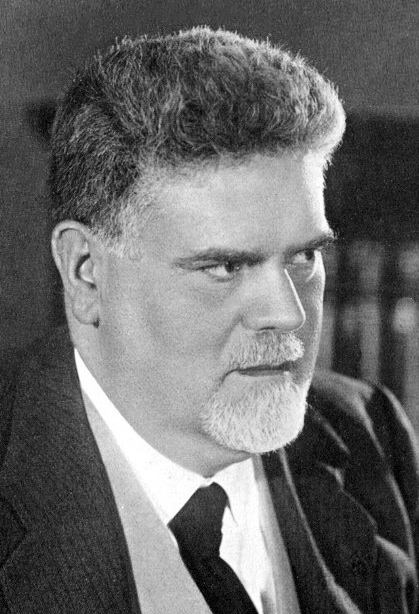
Giovanni Gentile
Giovanni Gentile was an Italian pedagogue, philosopher, and politician. He was one of the primary founders of fascism.
Giovanni Gentile ( jen-TEE-lay; Italian: [dʒoˈvanni dʒenˈtiːle]; 29 May 1875 – 15 April 1944) was an Italian pedagogue, philosopher, and politician. He was one of the primary founders of fascism.
Born in Castelvetrano, Gentile graduated from the Scuola Normale Superiore and the University of Pisa. He, alongside Benedetto Croce, was a major exponent of Italian idealism in Italian philosophy, and also devised his own system of thought, which he called "actual idealism" or "actualism", which has been described as "the subjective extreme of the idealist tradition".
Described by himself and by Benito Mussolini as the "philosopher of fascism", he was influential in providing an intellectual foundation for Italian fascism, notably through writing the 1925 Manifesto of the Fascist Intellectuals, and part of the 1932 "The Doctrine of Fascism" with Mussolini. As Minister for Public Education, he introduced in 1923 the so-called Gentile Reform of the Italian educational system, the first major piece of legislation passed by the Fascist government, which would last in some capacity until 1962. He also helped found the Institute of the Italian Encyclopedia with Giovanni Treccani, and was its first editor.
Though his political influence waned as Mussolini sought the alliance of the Catholic Church in the late 1920s, which conflicted with Gentile's secularism, he remained a faithful Fascist, even after the 1943 armistice with the Allies, and followed Mussolini into the Italian Social Republic. He was assassinated in 1944 by partisans of the Italian resistance.
Early life and career
Gentile was born in Castelvetrano, Italy. He was inspired by Risorgimento-era Italian intellectuals such as Mazzini, Rosmini, Gioberti, and Spaventa from whom he borrowed the idea of autoctisi, "self-construction", but also strongly influenced and mentored by the German idealist and materialist schools of thought—namely Karl Marx, Hegel, and Fichte, with whom he shared the ideal of creating a Wissenschaftslehre (Doctrine of Science), a theory for a structure of knowledge that makes no assumptions. Friedrich Nietzsche, too, influenced him, as seen in an analogy between Nietzsche's Übermensch and Gentile's Uomo Fascista. In religion he presented himself as a Catholic (of sorts), and emphasised actual idealism's Christian heritage; Antonio G. Pesce insists that «there is in fact no doubt that Gentile was a Catholic»; and Gentile once spoke of "his" atheism only in reference to the accusation of atheism leveled against him, although he maintained until the end that he was culturally Catholic. Gentile thought that God is immanent in the act of thinking, not a separate transcendent entity.
Gentile won a fierce competition to become one of four exceptional students of the prestigious Scuola Normale Superiore di Pisa, where he enrolled in the Faculty of Humanities.
In 1898 he graduated in Letters and Philosophy with a dissertation titled Rosmini e Gioberti, that he realised under the supervision of Donato Jaja, a disciple of Bertrando Spaventa.
During his academic career, Gentile served in a number of positions, including:
Professor of the History of Philosophy at the University of Palermo (27 March 1910);
Professor of Theoretical Philosophy at the University of Pisa (9 August 1914);
Professor of the History of Philosophy at the University of Rome (11 November 1917), and later as Professor of Theoretical Philosophy (1926);
Commissioner of the Scuola Normale Superiore di Pisa (1928–32), and later as its Director (1932–43); and
Vice President of Bocconi University in Milan (1934–44).
A long-time collaborator of Benedetto Croce, the two first became friends in 1896 and remained close until 1925, when Croce sided against fascism and Gentile for it with their Manifesto of the Anti-Fascist Intellectuals and Manifesto of the Fascist Intellectuals respectively.
First World War
Gentile was largely uninvolved with politics prior to the outbreak of World War One; he saw himself as a conservative liberal in the vein of Cavour, but mostly concerned himself with writing on the matters of education. Like many Italians, however, the war marked the start of more active involvement in politics, and publicly declared himself for Italy's intervention in the war after the disastrous Battle of Caporetto in 1917, though was privately one from the outbreak of the war. He saw the war as the emergence of a new Italy, which had to fight and destroy the "easy-going, idle Italy", "known for its faint-hearted nature, its individualism, its poor sense of taste and its tendency to withdraw into private egoism"; it was a chance to complete the Risorgimento and uphold its ideals.
Despite his ardent support of the war, he remained staunch in his criticism of the extreme nationalists such as Enrico Corradini and the Italian Nationalist Association for their rejection of liberalism. By the end of the war in 1918, he was attacking much of the Italian political sphere: the Socialists and the Catholics of the future Popular Party for their opposition to the national state; the Vatican as a hostile independent power opposed to the existence of Italy; and the liberal trasformismo of Giovanni Giolitti and the Italian Parliament, marred by endless squabbling, and now an outdated relic in the face of the "new Italy" birthed by the experience of war.
Gentile was indignant at the rejection of Italy's claims, set out in the 1915 Treaty of London, at the Paris Peace Conference. Not only did it fail to respect the hard-fought gains of the "new Italy", but it encouraged fatalism, liberal back-biting, and the questioning of the ideals of intervention in the first place—that is, of the spiritual invigoration that Gentile saw as the most significant consequence of the war. As such, he would support the ultranationalist poet Gabriele D'Annunzio's 1919 occupation of Fiume, which was an important precursor to Fascism. Nonetheless, he continued to believe in liberal democracy and praised the new Prime Minister, Francesco Saverio Nitti, for his commitment to national economic recovery. As the post-war period wore on, Gentile saw no sign of the spiritual revolution within Italian liberal society that he had hoped for, and became increasingly disillusioned; he disengaged with active politics in 1920 and would not return to it until Benito Mussolini's 1922 seizure of power in the March on Rome, by which point fascist doctrine was largely complete.
Minister of Public Education, 1922–1924
In 1922, on the recommendation of Benedetto Croce, who had refused the role himself, Gentile was named Minister for Public Education for the government of Benito Mussolini. The cabinet, though strongly right-wing, was broadly non-partisan; Gentile's inclusion, alongside several other notable non-fascists, was taken as a sign of reconciliation and the promised return to law-and-order. He officially joined the National Fascist Party in 1923.
In his capacity as Minister for Public Education, he instituted the 1923 Gentile Reform, which was the first major reform of the education system since the Unification of Italy and the Casati Law Despite lacking any substantial education policy prior to coming to power, it was the first significant piece of legislation of the Fascist regime; Mussolini described it as the "most Fascist reform".
Based on philosophically idealist and conservative elitist ideas, it was designed to help form the new elite of Fascist society and to reduce the number of intellectual graduates saturating the job market.
An additional purpose of the reform was to improve the regime's relationship with the Catholic Church. It made religious instruction mandatory in junior schools, gave equal distinction to private (notably Catholic) and state schools, and allowed both to sit the same qualification exams for entrance into higher education; these were important elements of the programme of the Catholic Popular Party, and did much to shore up Catholic opinion of the Fascist regime—a long-standing problem for Italian governments due to the Roman Question—as part of a wider programme of concessions by Mussolini to the Vatican. However, it did not go far enough to completely please the Church. Complaints remained over the fact that religious teaching was neither given by priests nor extended beyond the junior schools.
Included in this reform was an attempt to limit the number of women teachers in schools, part of Italian Fascism's wider campaign against feminism, suggesting that: Women do not have, nor will they ever have, either the moral or mental vigor to teach in those schools which formed the ruling class of the country.
The reform also mandated that Italian was the only language to be used in public schools, severely impacting the autonomy of non-Italian speaking minorities—known as allogeni—particularly in the regions of Alto-Adige and the Julian March, recently annexed in the Treaty of Saint-Germain-en-Laye following the First World War.
Under Gentile's reform, the secondary school system was substantially reorganised. The technical schools (scuola technica), relied on by the middle class for educational attainment and in which pupil numbers had increased rapidly since 1900, were abolished. In their place were "complementary schools" (scuola complementare), general education schools which did not allow access to universities or further qualifications. Entry into particular fields, such as science and engineering, were restricted to other specialised secondary schools. The curriculum was also rearranged, emphasising the humanities and especially philosophy; teaching of Latin was also more widely introduced.
Adapted from the Wikipedia article Giovanni Gentile, available under CC BY-SA 4.0.
Connections
Influenced by
1
Influenced
1
You might also explore
 Karl Marx★Modern European1818 – 1883Philosopher of history and critic of capitalism: "philosophers have only interpreted the world; the point is to change…
 Friedrich Engels★Modern European1820 – 1895Friedrich Engels was a German philosopher, social and political theorist, and revolutionary socialist. He is best known…
 Baruch Spinoza★Jewish1632 – 1677Lens-grinder of Amsterdam who identified God with Nature and wrote an Ethics in geometrical order.
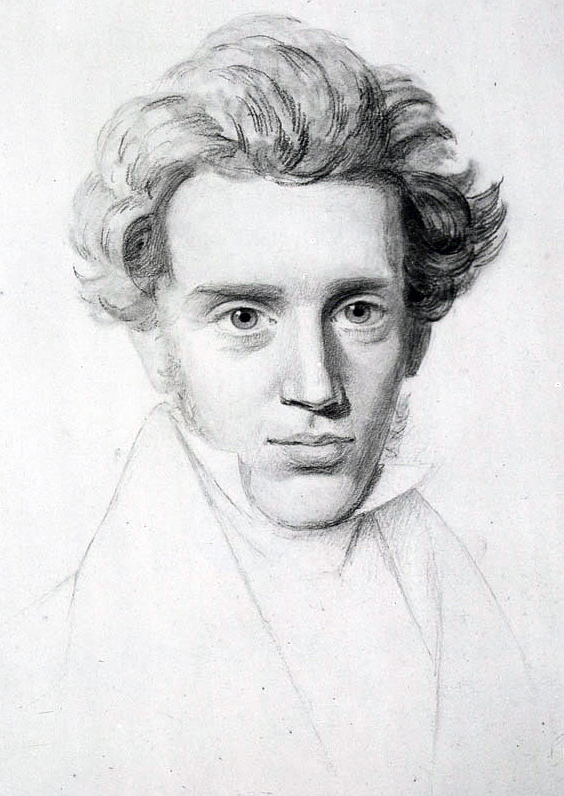 Søren Kierkegaard★Modern European1813 – 1855Danish father of existentialism: truth is subjectivity, and faith a leap beyond reason.
 Max StirnerModern European1806 – 1856Johann Caspar Schmidt, known by the pen name Max Stirner (; German: [ˈʃtɪʁnɐ]), was a German philosopher, dealing…
 Benedetto CroceModern European1866 – 1952Benedetto Croce
was an Italian idealist philosopher, historian, and politician who wrote on numerous topics, including…