Enlightenment and the social contract
Why obey the state? Hobbes answered: to escape a war of all against all. Locke: to protect natural rights. Rousseau: to realise the general will. Voltaire fought for tolerance; Wollstonecraft for women's rights; Zera Yacob in Ethiopia reasoned his way to human equality.
- 1
 Era1680 – 1800
Enlightenment
"Dare to know!" — reason, tolerance, rights and progress against tradition and authority.
Read the full pageThe Age of Enlightenment, also known as the Age of Reason or simply the Enlightenment, was a period of intellectual and cultural flourishing in Europe and Western civilization, emerging in the late 17th century in Western and Central Europe. It reached its peak in the 18th century as its ideas spread more widely across Europe and into the European colonies in the Americas and Oceania. Characterized by an emphasis on reason, empirical evidence, and the scientific method, the Enlightenment promoted ideals of individual liberty, religious tolerance, progress, and natural rights. Its thinkers advocated for constitutional government, the separation of church and state, and the application of rational principles to social and political reform.
The Enlightenment emerged from and built upon the Scientific Revolution of the 16th and 17th centuries, which had established new methods of empirical inquiry through the work of figures such as Galileo Galilei, Johannes Kepler, Francis Bacon, Pierre Gassendi, Christiaan Huygens, and Isaac Newton. Philosophical foundations were laid by thinkers including René Descartes, Thomas Hobbes, Baruch Spinoza, and John Locke, whose ideas about reason, natural rights, and empirical knowledge became central to Enlightenment thought. The dating of the period of the beginning of the Enlightenment can be attributed to the publication of Descartes' Discourse on the Method in 1637, with his method of systematically disbelieving everything unless there was a well-founded reason for accepting it, and featuring his dictum, Cogito, ergo sum ('I think, therefore I am'). Others cite the publication of Newton's Principia Mathematica (1687) as the culmination of the Scientific Revolution and the beginning of the Enlightenment. European historians traditionally dated its beginning with the death of Louis XIV of France in 1715 and its end with the outbreak of the French Revolution in 1789. Many historians now date the end of the Enlightenment as the start of the 19th century, with the latest proposed year being the death of Immanuel Kant in 1804.
The movement was characterized by the widespread circulation of ideas through new institutions: scientific academies, literary salons, coffeehouses, Masonic lodges, and an expanding print culture of books, journals, and pamphlets. The ideas of the Enlightenment undermined the authority of the monarchy and religious officials and paved the way for the political revolutions of the 18th and 19th centuries. A variety of 19th-century movements, including liberalism, socialism, and neoclassicism, trace their intellectual heritage to the Enlightenment. The Enlightenment was marked by an increasing awareness of the relationship between the mind and the everyday media of the world, and by an emphasis on the scientific method and reductionism, along with increased questioning of religious dogma—an attitude captured by Kant's essay Answering the Question: What Is Enlightenment?, where the phrase sapere aude ('dare to know') can be found.
- 2
 PhilosopherModern European1588 – 1679
Thomas Hobbes
Materialist who argued that without government life would be "solitary, poor, nasty, brutish, and short".
- ◆State of nature as war of all against all
- ◆Social contract to an absolute sovereign
- ◆Materialism
Read the full pageThomas Hobbes ( HOBZ; 5 April 1588 – 4 December 1679) was an English philosopher and political theorist, best known for his 1651 book Leviathan, in which he expounds an influential formulation of social contract theory. He is considered to be one of the founders of modern political philosophy.
In his early life, overshadowed by his father's departure following a fight, he was taken under the care of his wealthy uncle. Hobbes's academic journey began in Westport, leading him to the University of Oxford, where he was exposed to classical literature and mathematics. He then graduated from the University of Cambridge in 1608. He became a tutor to the Cavendish family, which connected him to intellectual circles and initiated his extensive travels across Europe. These experiences, including meetings with figures like Galileo, shaped his intellectual development.
After returning to England from France in 1637, Hobbes witnessed the destruction and brutality of the English Civil War from 1642 to 1651 between Parliamentarians and Royalists, which heavily influenced his advocacy for governance by an absolute sovereign in Leviathan, as the solution to human conflict and societal breakdown. Aside from social contract theory, Leviathan also popularised ideas such as the state of nature ("war of all against all") and laws of nature. His other major works include the trilogy De Cive (1642), De Corpore (1655), and De Homine (1658) as well as the posthumous work Behemoth (1681).
- 3ConceptModern European
State of nature
Human life without government — a war of all against all (Hobbes) or a peaceful but insecure condition (Locke).
Read the full pageIn ethics, political philosophy, social contract theory, religion, and international law, the term state of nature describes the way of life that existed before humans organised themselves into societies or civilisations. Philosophers of the state-of-nature theory propose that there was a historical period before societies existed, and seek answers to the questions: "What was life like before civil society?", "How did government emerge from such a primitive start?", and "What are the reasons for entering a state of society by establishing a nation-state?".
In some versions of social contract theory, there are freedoms, but no rights in the state of nature; and, by way of the social contract, people create societal rights and obligations. In other versions of social contract theory, society imposes restrictions (law, custom, tradition, etc.) that limit the natural rights of a person. Societies existing before the political state are investigated and studied as Mesolithic history, as archaeology, and as cultural anthropology, as social anthropology, and as ethnology to determine the particulars of the indigenous society's social structures and power structures.
The early Warring States philosopher Mozi was one of the first thinkers in recorded history to develop the idea of the state of nature. He developed the idea to defend the need for a single overall ruler. According to Mozi, in the state of nature, each person has their own moral rules (yi, 義). As a result, people were unable to reach agreements and resources were wasted. Since Mozi promoted ways of strengthening and unifying the state (li, 利), such natural dis-organisation was rejected:
- 4
 WorkModern European1651
Leviathan
Hobbes's case for an absolute sovereign to escape the war of all against all.
Read the full pageLeviathan or The Matter, Forme and Power of a Commonwealth Ecclesiasticall and Civil, commonly referred to as Leviathan, is a work of social and political theory by the English empiricist philosopher and political theorist Thomas Hobbes (1588–1679), published in 1651 (revised Latin edition 1668). Its name derives from the chaotic Leviathan sea serpent of the Hebrew Bible and earlier mythologies.
The work concerns the structure of society and legitimate government, and is regarded as one of the earliest and most influential examples of social contract theory.
Written during the English Civil War (1642–1651), it argues for a social contract and rule by an absolute sovereign. Hobbes asserts that civil war and the "nasty, brutish and short" state of nature ("the war of all against all") could be avoided only by a strong, undivided government.
- 5
 ConceptModern European
Social contract
Political authority rests on the (real or hypothetical) agreement of the governed.
Read the full pageIn moral and political philosophy, the social contract is a theory of state that conceives of a legitimate state as arising from the agreement of citizens who consent to surrender some of their freedoms and submit to the authority (of the ruler, or to the decision of a majority) in exchange for protection of their remaining rights or maintenance of the social order.
Conceptualized in the Age of Enlightenment, social contractarianism is a core concept of modern theories of constitutionalism. The term takes its name from The Social Contract (French: Du contrat social ou Principes du droit politique), a 1762 book by Jean-Jacques Rousseau that discussed this concept. The starting point for most social contract theories is an examination of the human condition absent any political order, a social position termed the "state of nature" by Thomas Hobbes.
In this condition, individuals' actions are bound only by their personal power and conscience, assuming that 'nature' precludes mutually beneficial social relationships. From this shared premise, social contract theorists aim to demonstrate why rational individuals would voluntarily relinquish their natural freedom in exchange for the benefits of political order.
- 6
 PhilosopherModern European1632 – 1704
John Locke
Founder of British empiricism and liberalism: the mind as blank slate; government by consent to protect life, liberty and property.
- ◆Tabula rasa
- ◆Primary and secondary qualities
- ◆Natural rights
- ◆Government by consent
- ◆Personal identity as memory
Read the full pageJohn Locke (; 29 August 1632 – 28 October 1704) was an English philosopher and physician, widely regarded as one of the most influential of the Enlightenment thinkers and commonly known as the "father of liberalism". His important works include A Letter Concerning Toleration (1689), Two Treatises of Government. His writing on toleration contends that religion is a matter for the individual and that the churches are voluntary associations, ruling out religious coercion and uniformity. The ideas on the separation of church and state originated with Sir Harry Vane in Vane's two pamphlets "Zeal Examined" in 1651 and "A Healing Question" published in 1656. His Two Treatises on Government argues for government based on the consent of the governed and the right to revolt against tyrannous government which has lost consent. The Two Treatises are believed to have influenced the language that Thomas Jefferson chose in his drafting the July 1776 Declaration of Independence during the American War of Independence.
Locke lived through the tumultuous political era of the English Civil War and Commonwealth of England after the execution of Charles I, Restoration of the Stuart monarchy, and the 1688 Glorious Revolution. These experiences affected his political thinking and life choices. During the Interregnum, Locke won a place at Christ Church, Oxford after attending the prestigious Westminster School. He spent 15 years at Oxford, first as a student, then as a tutor, pursuing medical and other scientific interests in a circle of friends. He is also listed as a shareholder with the "Royal Company of Adventures Trading to Africa" founded by the Duke of York and King Charles II who traded in slaves beginning in 1663 per the charter of the company.
In 1666, Locke became an associate of Lord Shaftesbury, a key figure in English political life after the Restoration (1660), and Locke was appointed to governmental posts at Shaftesbury's recommendation. Locke was elected a Fellow of the Royal Society (1668). When Shaftesbury fell from royal favour and died shortly thereafter, Locke went into political exile for five years in the Netherlands (1683–89). There he wrote some of his most important works. During this period, he gained the patronage of Thomas Herbert, 8th Earl of Pembroke. Locke returned to England from exile, accompanying Queen Mary II in 1689. He published three of his most notable works soon after his return. He served as a Commissioner of Trade and Plantations, then retired from public life due to ill health. For the last fourteen years of his life, he lived in the household of Sir Francis Masham and his wife, philosopher Lady Masham, whom Locke had known since she was a young woman.
- 7Read the full page
Some philosophers distinguish two types of rights, natural rights and legal rights.
Natural rights are the subset of moral rights that human beings possess as a result of their nature, independent of the laws or customs of any particular society. Natural law is the law of natural rights.
Legal rights are those bestowed onto a person by a given legal system (they can be modified, repealed, and restrained by human laws). The concept of positive law is related to the concept of legal rights.
- 8
 WorkModern European1689
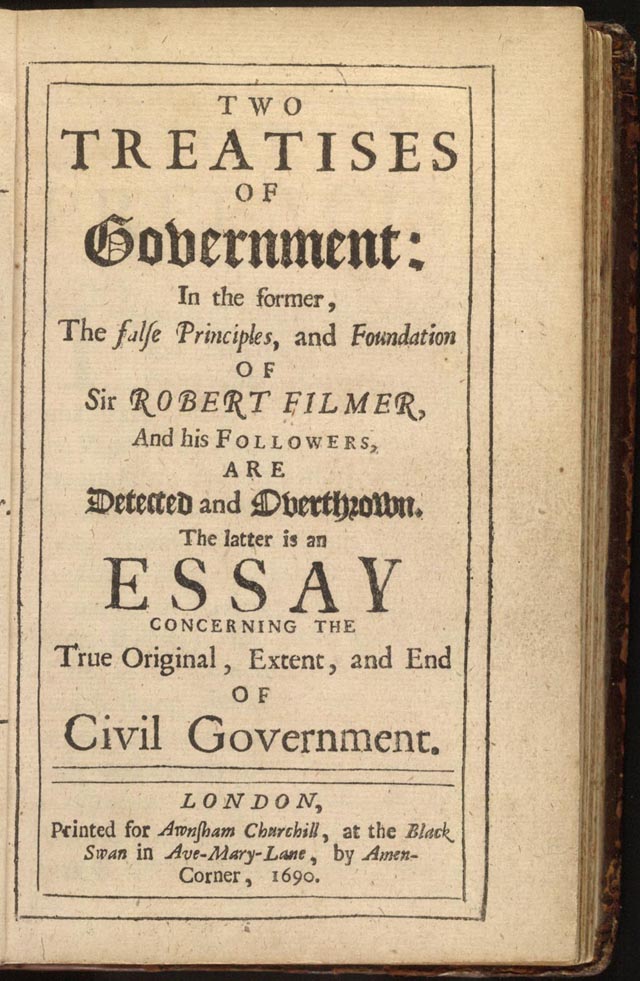
Two Treatises of Government
Locke's theory of natural rights and government by consent.
Read the full pageTwo Treatises of Government (full title: Two Treatises of Government: In the Former, The False Principles, and Foundation of Sir Robert Filmer, and His Followers, Are Detected and Overthrown. The Latter Is an Essay Concerning The True Original, Extent, and End of Civil Government) is English philosopher John Locke's principal work of political philosophy. It was published anonymously in 1689, after the Glorious Revolution, but likely drafted 1680-81 during the Exclusion Crisis (1679–81). The First Treatise attacks patriarchalism in the form of sentence-by-sentence refutation of the late Robert Filmer's (c. 1588–1653) Patriarcha, which argues for a divinely ordained, hereditary, absolute monarchy, ideas which remained current with living defenders. The Second Treatise outlines Locke's ideas for a more civilized society based on natural rights and contract theory, with government requiring the consent of the governed, and, under limited circumstances, the right to overthrow the ruler. "There can be no doubt that the Second Treatise was, in its time and place, a revolutionary work." The book is a key foundational text in the theory of liberalism.
This publication contrasts with earlier political works by Locke himself. In Two Tracts on Government, written in 1660, Locke defends a conservative position; however, Locke never published this earlier work.
Historian Peter Laslett has shown that the bulk of the writing was completed between 1679 and 1680 during the Exclusion Crisis, and subsequently revised after Locke was driven into Dutch exile in 1683. The arguments in First Treatise make sense as a refutation of the divine right of kings. During the Exclusion Crisis, which attempted to prevent James, the Catholic-convert brother of Charles II from ever taking the throne, Lord Shaftesbury, Locke's mentor, patron, and the leader of the Whigs, introduced the Exclusion bill, which was not passed. However, it precipitated Charles II removing Shaftesbury as Lord Chancellor. Richard Ashcraft, following in Laslett's suggestion that the Two Treatises were written before the 1688 Revolution that ousted James II, objected that Shaftesbury's party did not advocate revolution during the Exclusion Crisis. He suggests that they are instead better associated with the revolutionary conspiracies that swirled around what would come to be known as the Rye House Plot. Shaftesbury and Locke and many others were forced into exile in the Netherlands; some, such as Algernon Sidney, were executed for treason in 1683. Locke and Sidney argued along similar lines. James II of England was overthrown in 1688 by a union of Parliamentarians and the Protestant stadtholder of the Dutch Republic William III of Oranje-Nassau (William of Orange). He ascended the English throne as William III of England, ruling jointly with Mary II, as Protestants. Mary was the daughter of James II, and had a strong claim to the English Throne, now known as the Glorious Revolution. Locke claims in the "Preface" to the Two Treatises that its purpose is to justify William III's ascension to the throne, but it is more likely the 1688 Glorious Revolution presented an opportunity to publish the existing manuscript, although anonymously. Locke knew his work was dangerous and did not acknowledge his authorship until the end of his life.
- 9
 PhilosopherModern European1712 – 1778
Jean-Jacques Rousseau
"Man is born free, and everywhere he is in chains": the general will and the corruption of natural goodness by society.
- ◆The general will
- ◆Natural goodness corrupted by society
- ◆Education according to nature
Read the full pageJean-Jacques Rousseau (UK: , US: ; French: [ʒɑ̃ʒak ʁuso]; 28 June 1712 – 2 July 1778) was a Genevan philosophe, writer, and composer. His political philosophy was influential during the Age of Enlightenment, as well as during the French Revolution.
Rousseau wrote Discourse on Inequality, which argues that private property is the source of social inequality, and The Social Contract, which outlines his ideas for what makes a legitimate political order. Rousseau's sentimental novel Julie, or the New Heloise (1761) was an example of his contributions to preromanticism and romanticism in fiction. His Émile, or On Education (1762) is a treatise on the place of the individual in society. Rousseau also wrote some autobiographical writings, such as the posthumously published Confessions (completed in 1770), and the unfinished Reveries of the Solitary Walker (composed 1776–1778)—,which featured an increased focus on subjectivity and introspection. He is thought to be one of the influences on the late 18th-century "Age of Sensibility."
Rousseau was born in the Republic of Geneva, which was at the time a city-state and a Protestant associate of the Swiss Confederacy, now a canton of Switzerland. Since 1536, Geneva had been a Huguenot republic and the seat of Calvinism. Five generations before Rousseau, his ancestor Didier, a bookseller who may have published Protestant tracts, had escaped persecution from French Catholics by fleeing to Geneva in 1549, where he became a wine merchant.
- 10
 ConceptModern European
General will
Rousseau's collective will aimed at the common good, the source of legitimate law.
Read the full pageIn political philosophy, the general will (French: volonté générale) is the will of the people as a whole. The term was made famous by 18th-century Genevan philosopher Jean-Jacques Rousseau.
The phrase "general will", as Rousseau used it, occurs in Article Six of the Declaration of the Rights of Man and of the Citizen (French: Déclaration des droits de l'Homme et du citoyen), composed in 1789 during the French Revolution:The law is the expression of the general will. All citizens have the right to contribute personally, or through their representatives, to its formation. It must be the same for all, whether it protects or punishes. All citizens, being equal in its eyes, are equally admissible to all public dignities, positions, and employments, according to their capacities, and without any other distinction than that of their virtues and their talents.
James Swenson writes: To my knowledge, the only time Rousseau actually uses "expression of the general will" is in a passage of the Discours sur l'économie politique, whose content renders it little susceptible of celebrity. [...] But it is indeed a faithful summary of his doctrine, faithful enough that commentators frequently adopt it without any hesitation. Among Rousseau's definitions of law, the textually closest variant can be found in a passage of the Lettres écrites de la montagne summarizing the argument of Du contrat social, in which law is defined as "a public and solemn declaration of the general will on an object of common interest."
- 11
 PhilosopherModern European1694 – 1778
Voltaire
Satirist of the Enlightenment, champion of tolerance and scourge of the Church; author of Candide.
Read the full pageFrançois-Marie Arouet (French: [fʁɑ̃swa maʁi aʁwɛ]; 21 November 1694 – 30 May 1778), known by his pen name Voltaire (, US also ; French: [vɔltɛːʁ]), was a French Enlightenment writer, philosopher (philosophe), satirist, and historian. Famous for his wit and his criticisms of the Catholic Church and slavery, Voltaire was an advocate of freedom of speech, freedom of religion, and separation of church and state.
Voltaire produced works in almost every literary form, including plays, poems, novels, essays, histories, and scientific expositions. He wrote more than 20,000 letters and 2,000 books and pamphlets. Voltaire was one of the first authors to become renowned and commercially successful internationally. He was an outspoken advocate of civil liberties and was at constant risk from the strict censorship laws of the Catholic French monarchy. His polemics satirized intolerance and religious dogma, as well as the French institutions of his day. His best-known work and magnum opus, Candide, is a novella that comments on, criticizes, and ridicules many events, thinkers and philosophies of his time, most notably Gottfried Leibniz and his belief that our world is of necessity the "best of all possible worlds".
François-Marie Arouet was born in Paris, the youngest of the five children of François Arouet, a lawyer who was a minor treasury official, and his wife, Marie Marguerite Daumard, whose family was on the lowest rank of the French nobility. Some speculation surrounds Voltaire's date of birth, because he claimed he was born on 20 February 1694 as the illegitimate son of a nobleman, Guérin de Rochebrune or Roquebrune. Two of his older brothers—Armand-François and Robert—died in infancy. His surviving brother Armand and sister Marguerite-Catherine were nine and seven years older, respectively.
- 12
 WorkModern European1759
Candide
Voltaire's satire of Leibnizian optimism: "the best of all possible worlds".
Read the full pageCandide, ou l'Optimisme ( kon-DEED or kahn-DEED, French: [kɑ̃did] ) is a French satire written by Voltaire, a philosopher of the Age of Enlightenment, first published in 1759. The novella has been widely translated, with English versions titled Candidus: or, All for the Best (1759); Candide: or, The Optimist (1762); and Candide: Optimism (1947). A young man, Candide, lives a sheltered life in an Edenic paradise, being indoctrinated with Leibnizian optimism by his mentor, Professor Pangloss. This lifestyle is abruptly ended, followed by Candide's slow and painful disillusionment as he witnesses and experiences great hardships in the world. Voltaire concludes Candide with, if not rejecting Leibnizian optimism outright, advocating a deeply practical precept, "we must cultivate our garden", in lieu of the Leibnizian mantra of Pangloss, "all is for the best" in the "best of all possible worlds".
Candide is characterized by its tone as well as its erratic, fantastical, and fast-moving plot. A picaresque novel with a story akin to a serious bildungsroman, it parodies many adventure and romance clichés, in a tone that is bitter and matter-of-fact. The events discussed are often based on historical happenings. As philosophers of Voltaire's day contended with the problem of evil, so does Candide, albeit more directly and humorously. Voltaire ridicules religion, theologians, governments, armies, philosophies, and philosophers. Through Candide, he assaults Leibniz and his optimism.
Candide has enjoyed both great success and great scandal. Immediately after its secretive publication, the book was widely banned on the grounds of blasphemy and sedition. However, the novel has inspired many later authors and artists; today, Candide is considered Voltaire's magnum opus and is often listed as part of the Western canon. It is among the most frequently taught works of French literature. Martin Seymour-Smith listed Candide as one of the 100 most influential books ever written.
- 13
 PhilosopherModern European1723 – 1790
Adam Smith
Moral philosopher of sympathy and the impartial spectator, and father of economics.
- ◆Classical economics
- ◆Free market
- ◆Division of labour
- ◆Absolute advantage
- ◆Invisible hand
Read the full pageAdam Smith (baptised 16 June [O.S. 5 June] 1723 – 17 July 1790) was a Scottish economist and philosopher who was a pioneer in the field of political economy and key figure during the Scottish Enlightenment. Seen by many as the "father of economics", or the "father of capitalism", he is primarily known for two classic works: The Theory of Moral Sentiments (1759) and An Inquiry into the Nature and Causes of the Wealth of Nations (1776). The latter, often abbreviated as The Wealth of Nations, is regarded as his magnum opus, marking the inception of modern economic scholarship as a comprehensive system and an academic discipline. Smith refuses to explain the distribution of wealth and power in terms of divine will and instead appeals to natural, political, social, economic, legal, environmental and technological factors, as well as the interactions among them. The work is notable for its contribution to economic theory, particularly in its exposition of the concept of absolute advantage.
Born in Kirkcaldy, Fife, he studied social philosophy at the University of Glasgow and at the University of Oxford, where he was one of the only students to benefit from scholarships set up by John Snell. Following his graduation, he delivered a successful series of public lectures at the University of Edinburgh, that met with acclaim. This led to a collaboration with David Hume during the Scottish Enlightenment. Smith obtained a professorship at Glasgow, where he taught moral philosophy. During this period, he wrote and published The Theory of Moral Sentiments. Subsequently, he assumed a tutoring position that facilitated travel throughout Europe, where he encountered intellectual figures of his era.
In response to the prevailing policy of safeguarding national markets and merchants through the reduction of imports and the augmentation of exports, a practice that came to be known as mercantilism, Smith laid the foundational principles of classical free-market economic theory. The Wealth of Nations was a precursor to the modern academic discipline of economics. In this and other works, he developed the concept of division of labour and expounded upon how rational self-interest and competition can lead to economic prosperity. Smith was controversial in his day and his general approach and writing style were often satirised by writers such as Horace Walpole.
- 14
 PhilosopherModern European1759 – 1797
Mary Wollstonecraft
Founder of liberal feminism with A Vindication of the Rights of Woman.
Read the full pageMary Wollstonecraft (; 27 April 1759 – 10 September 1797) was an English writer and philosopher best known for her advocacy of women's rights. Until the late twentieth century, Wollstonecraft's life, which encompassed several unconventional (at the time) personal relationships, received more attention than her writing. Wollstonecraft is regarded as one of the founding feminist philosophers, and feminists often cite both her life and her works as important influences.
During her brief career she wrote novels, treatises, a travel narrative, a history of the French Revolution, a conduct book, and a children's book. Wollstonecraft is best known for A Vindication of the Rights of Woman (1792), in which she argues that women are not naturally inferior to men but appeared to be only because they lack education. She suggests that both men and women should be treated as rational beings and imagines a social order founded on reason.
After two ill-fated affairs, with Henry Fuseli and Gilbert Imlay (by whom she had a daughter, Fanny Imlay), Wollstonecraft married the philosopher William Godwin, one of the forefathers of the anarchist movement. Wollstonecraft died at the age of 38, leaving behind several unfinished manuscripts. She died 11 days after giving birth to her second daughter, Mary, who became an accomplished writer and the author of Frankenstein.
- 15PhilosopherAfrican1599 – 1692
Zera Yacob
Ethiopian rationalist whose Hatata argued for the equality of all people by the light of reason.
- ◆belief
Read the full pageZara Yaqob (; Ge'ez: ዘርዐ ያዕቆብ; 28 August 1600 – 1693) was an Ethiopian philosopher best known for his treatise, Hatata ("The Inquiry"), which explores themes of reason, morality, and religious tolerance. Forced into exile, he wrote Hatata while living in a cave, where he reflected on questions of faith, ethics, and the nature of truth. Yacob was educated in the Ethiopian Orthodox Christian tradition but developed a distinct philosophical approach that emphasized rational inquiry over religious dogma.
For centuries, Geʽez texts had been written in Ethiopia. Around 1510, Abba Mikael translated and adapted the Arabic Book of the Wise Philosophers, a collection of sayings from the early Greek pre-Socratics, Plato, and Aristotle via the neo-Platonic dialogues, also influenced by Arab philosophy and the Ethiopian discussions.
Zara Yaqob's Inquiry goes further than these former texts, as he argues for following one's natural reasoning instead of believing what one is told by others. He was a contemporary of the female activist Walatta Petros, whose hagiography was written in 1672.


