
Leviathan
Hobbes's case for an absolute sovereign to escape the war of all against all.
Leviathan or The Matter, Forme and Power of a Commonwealth Ecclesiasticall and Civil, commonly referred to as Leviathan, is a work of social and political theory by the English empiricist philosopher and political theorist Thomas Hobbes (1588–1679), published in 1651 (revised Latin edition 1668). Its name derives from the chaotic Leviathan sea serpent of the Hebrew Bible and earlier mythologies.
The work concerns the structure of society and legitimate government, and is regarded as one of the earliest and most influential examples of social contract theory.
Written during the English Civil War (1642–1651), it argues for a social contract and rule by an absolute sovereign. Hobbes asserts that civil war and the "nasty, brutish and short" state of nature ("the war of all against all") could be avoided only by a strong, undivided government.
Title
The title of Hobbes's treatise alludes to the Leviathan mentioned in the Book of Job. In contrast to the simply informative titles usually given to works of early modern political philosophy, such as John Locke's Two Treatises of Government or Hobbes's own earlier work, The Elements of Law, Hobbes selected a poetic name for this more provocative treatise.
Lexicographers in the early modern period supposed that the term "leviathan" was associated with the Hebrew words lavah, meaning "to couple, connect or join", though in other cases meaning "to borrow", and thannin, believed to mean "a serpent or dragon". In the Westminster Assembly's annotations on the Bible, the interpreters thought that the creature was named using these root words "because by his bignesse he seemes not one single creature, but a coupling of divers together; or because his scales are closed, or straitly compacted together." Samuel Mintz suggests that these connotations lend themselves to Hobbes's understanding of political force since both "Leviathan and Hobbes's sovereign are unities compacted out of separate individuals; they are omnipotent; they cannot be destroyed or divided; they inspire fear in men; they do not make pacts with men; theirs is the dominion of power" on pain of death.
Frontispiece
After lengthy discussion with Thomas Hobbes, the Parisian Abraham Bosse created the etching for the book's famous frontispiece in the géometrique style which Bosse himself had refined. It is similar in organisation to the frontispiece of Hobbes' De Cive (1642), created by Jean Matheus. The frontispiece has two main elements.
In it, a giant crowned figure is seen emerging from the landscape, clutching a sword and a crosier, beneath a quotation from the Book of Job—"Non est potestas Super Terram quae Comparetur ei. Iob. 41.24" ("There is no power on earth to be compared to him. Job 41.24")—further linking the figure to the monster of the book. (Due to disagreements over the precise location of the chapters and verses when they were divided in the Late Middle Ages, the verse Hobbes quotes is usually given as Job 41:33 in modern Christian translations into English, Job 41:25 in the Masoretic Text, Septuagint, and the Luther Bible; it is Job 41:24 in the Vulgate.) The torso and arms of the figure are composed of over three hundred persons, in the style of Giuseppe Arcimboldo; all are facing away from the viewer, with just the giant's head having visible facial features. (A manuscript of Leviathan created for Charles II in 1651 has notable differences – a different main head but significantly the body is also composed of many faces, all looking outwards from the body and with a range of expressions.)
The lower portion is a triptych, framed in a wooden border. The centre form contains the title on an ornate curtain. The two sides reflect the sword and crosier of the main figure – earthly power on the left and the powers of the church on the right. Each side element reflects the equivalent power – castle to church, crown to mitre, cannon to excommunication, weapons to logic, and the battlefield to the religious courts. The giant holds the symbols of both sides, reflecting the union of secular, and spiritual in the sovereign, but the construction of the torso also makes the figure the state.
Introduction
Hobbes opens with a complex extended metaphor involving the automaton, the human body, and the state on the basis of mechanism and corpuscularianism (or corporeal materialism). He presents an image of the bodies of men and states in motion, arguing for a mechanical (scientific) explanation:Nature (the art whereby God hath made and governes the world) is by the art of man, as in many other things, so in this also imitated, that it can make an Artificial Animal. For seeing life is but a motion of Limbs, the begining whereof is in some principall part within; why may we not say, that all Automata (Engines that move themselves by springs and wheeles as doth a watch) have an artificiall life? For what is the Heart, but a Spring; and the Nerves, but so many Strings; and the Joynts, but so many Wheeles, giving motion to the whole Body, such as was intended by the Artificer? Art goes yet further, imitating that Rationall and most excellent worke of Nature, Man. For by Art is created that great LEVIATHAN called a COMMON-WEALTH, or STATE, (in latine CIVITAS) which is but an Artificiall Man; though of greater stature and strength than the Naturall, for whose protection and defence it was intended; and in which, the Soveraignty is an Artificiall Soul, as giving life and motion to the whole body; The Magistrates, and other Officers of Judicature and Execution, artificiall Joynts [&c].
After giving a brief content summary, he also warns:Wisedome is acquired, not by reading of Books, but of Men. Consequently whereunto, those persons, that for the most part can give no other proof of being wise, take great delight to shew what they think they have read in men, by uncharitable censures of one another behind their backs. But there is another saying not of late understood, by which they might learn truly to read one another, if they would take the pains; and that is, Nosce Teipsum, Read Thy Self: ... meant ... to teach us, that for the similitude of the thoughts, and Passions of one man, to the thoughts, and Passions of another, whosoever looketh into himselfe, and considereth what he doth, when he does Think, Opine, Reason, Hope, Feare, &c, and upon what grounds; he shall thereby read and know, what are the thoughts, and Passions of all other men, upon the like occasions. ... But let one man read another by his actions never so perfectly, it serves him onely with his acquaintance, which are but few. He that is to govern a whole Nation, must read in himselfe, not this, or that particular man; but Man-kind; which ... it be hard to do, harder than to learn any Language, or Science ....
Part I: Of Man
In giving an account of sense empiricism and human nature, Hobbes centers words and their definitions ("how necessary it is for any man that aspires to true Knowledge, to examine the Definitions of former Authors"). Initially, he looks for constants and universals. Even good and evil are just the conventional names for an individual's appetites and desires, or the tendency to move toward or away from an object. Hope is nothing more than an appetite for a thing combined with an opinion that it can be had. By contrast, he argues, scholasticism thrives on formulations like incorporeal substance, which (for Hobbes) are contradictions in terms.
He espouses a nominalism ("there being nothing in the world Universall but Names ... imposed on many things, for their similitude in some quality, or other accident"). Though "Nature ... cannot erre", he writes, "men abound in copiousnesse of language; so they become more wise, or more mad than ordinary". He admires geometric axioms and writes that "words are wise mens counters, they do but reckon by them". He warns, however, that "words are the mony [money] of fooles, that value them by the authority of an Aristotle ... or any other Doctor whatsoever, if but a man", because "there can be no certainty of the last Conclusion, without a certainty of all those Affirmations and Negations, on which it was grounded, and inferred", starting from definitions ("men begin at ... Definitions").
Hobbes describes human psychology without any reference to the summum bonum, or greatest good, as previous thought had done. According to Hobbes, not only is the concept of a summum bonum superfluous, but given the variability of human desires, there could be no such thing. Consequently, any political community that sought to provide the greatest good to its members would find itself driven by competing conceptions of that good with no way to decide among them. The result would be civil war.
However, Hobbes states that there is a summum malum, or greatest evil. This is the fear of violent death. A political community can be oriented around this fear.
Since there is no summum bonum, the natural state of man is not to be found in a political community that pursues the greatest good. To be outside of a political community, however, is to be in an anarchic condition. Given human nature, the variability of human desires, and need for scarce resources to fulfill those desires, the "state of nature", as Hobbes calls this anarchic condition, must be a war of all against all. Even when two men are not fighting, neither has a guarantee that the other will not try to kill him for his property or just out of an aggrieved sense of honour, and so they must constantly be on guard against one another. It is even reasonable to preemptively attack one's neighbour.
Adapted from the Wikipedia article Leviathan (Hobbes book), available under CC BY-SA 4.0.
Quotations
“The life of man, solitary, poor, nasty, brutish, and short.”
Connections


You might also explore
 The Social ContractModern European1762"Man is born free, and everywhere he is in chains."
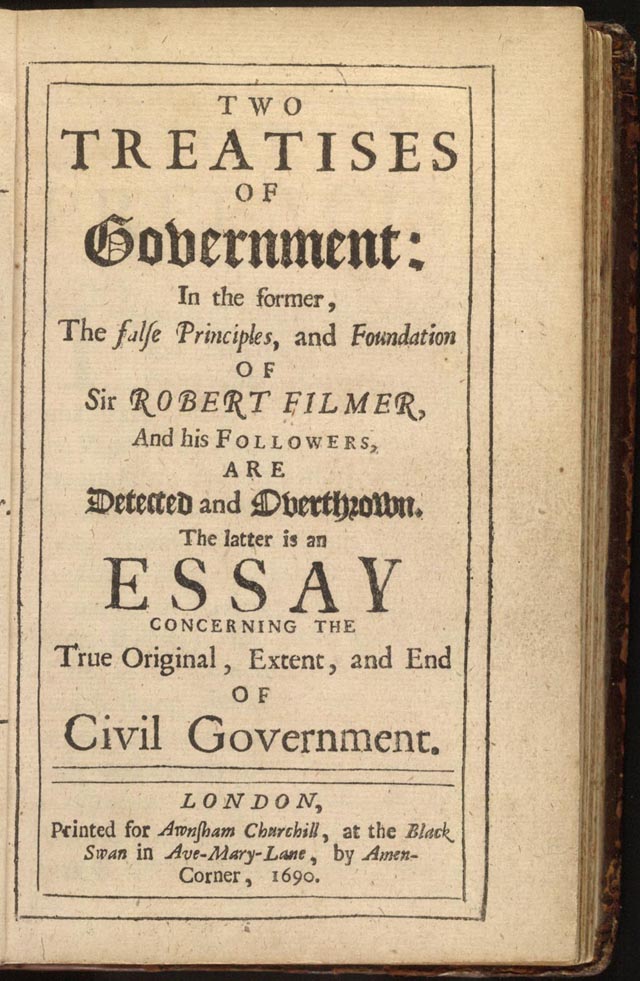 Two Treatises of GovernmentModern European1689Locke's theory of natural rights and government by consent.
 A Treatise of Human NatureModern European1739Hume's youthful masterpiece, which "fell dead-born from the press".
 A Vindication of the Rights of WomanModern European1792Wollstonecraft's case for women's education and rational equality.
 An Enquiry Concerning Human UnderstandingModern European1748Hume's accessible restatement of his epistemology, including the problem of induction.
 An Essay Concerning Human UnderstandingModern European1689Locke's empiricist account of the origin and limits of knowledge.