The Buddha and Mahāvīra
Two ascetics from the Ganges plain rejected the authority of the Vedas. The Buddha taught the Four Noble Truths, no-self and dependent origination — a Middle Way to the end of suffering. Mahāvīra taught radical non-violence and the many-sidedness of truth.
- 1
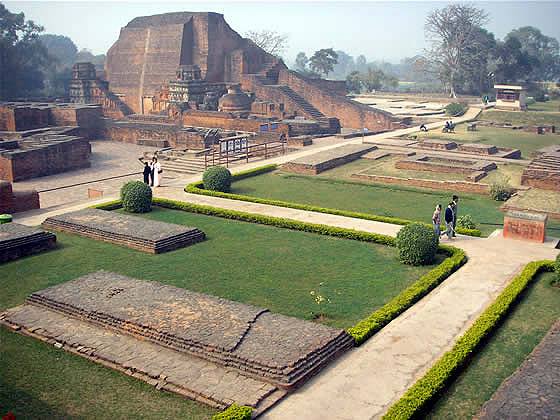 SchoolIndian500 BCE – present
Buddhist philosophy
From the Buddha's Four Noble Truths: suffering arises from craving and ignorance and can end through insight into impermanence, no-self and dependent origination.
- ◆Four Noble Truths
- ◆No-self (anātman)
- ◆Impermanence (anicca)
- ◆Dependent origination
- ◆The Middle Way
Read the full pageBuddhist philosophy begins with a diagnosis. Life as ordinarily lived is marked by duḥkha — unsatisfactoriness, suffering. Its cause is craving rooted in ignorance; it can cease; and there is a path to its cessation. These are the Four Noble Truths of the Buddha's first sermon at Sarnath.
The ignorance in question is philosophical. We take ourselves and things to be permanent, independent substances, when in fact everything arises in dependence on conditions (pratītyasamutpāda), is impermanent, and lacks a fixed self (anātman). The "self" is a convenient label for a changing stream of physical and mental events.
Over two millennia, Buddhist thinkers developed these insights into rich systems: the Abhidharma analysis of reality into momentary events, Nāgārjuna's Madhyamaka philosophy of emptiness, the Yogācāra analysis of consciousness, and the logic of Dignāga and Dharmakīrti. Carried across Asia, Buddhism was reshaped into Tibetan, Chinese, Korean and Japanese forms such as Chan/Zen.
- 2
 PhilosopherIndianc. 563 – 483 BCE
Gautama Buddha
The awakened one: a prince who renounced his life to find the cause of suffering and taught the Middle Way to its end.
- ◆Four Noble Truths
- ◆Noble Eightfold Path
- ◆No-self (anattā)
- ◆Impermanence
- ◆Dependent origination
- ◆The Middle Way between indulgence and asceticism
Read the full pageSiddhārtha Gautama was born into the Śākya clan in the foothills of the Himalayas. According to tradition, he left a sheltered princely life after encountering old age, sickness and death, and spent years as a wandering ascetic before rejecting extreme self-denial. Meditating under a tree at Bodh Gaya he attained awakening (bodhi) and became the Buddha, "the awakened one".
His teaching is famously practical. He refused to answer metaphysical questions — whether the world is eternal, whether an awakened person exists after death — that do not lead to the end of suffering, comparing someone who demands such answers to a man struck by a poisoned arrow who will not have it removed until he knows who shot it.
At its core are the Four Noble Truths and the Eightfold Path of right view, intention, speech, action, livelihood, effort, mindfulness and concentration. Philosophically, his most radical teaching is anattā, no-self: what we call a person is a changing bundle of physical form, feelings, perceptions, mental formations and consciousness, with no permanent owner behind them. Seeing this clearly ends the craving that binds us to suffering. The Buddha taught for some forty-five years across the Ganges plain, and his community (saṅgha) carried his ideas across all of Asia.
- 3
 ConceptIndian
Four Noble Truths
Suffering; its origin in craving; its cessation; and the path leading to its cessation.
- ◆Duḥkha
- ◆Samudaya
- ◆Nirodha
- ◆Mārga — the Eightfold Path
Read the full pageIn Buddhism, the Four Noble Truths (Sanskrit: चत्वार्यार्यसत्यान, romanized: catvāryāryasatyāni; Pali: cattāri ariyasaccāni; "The Four arya satya") are "the truths of the noble one (the Buddha)," which state how things really are when they are seen correctly.
The four truths are:
dukkha (lit. "suffering"; 'unsatisfactoriness', 'not being at ease'; from dush-stha, 'standing unstable'; also translated as "unreliable", "precarity, instability, an unreliable place to stand",). Dukkha is an innate characteristic of transient existence;
- 4ConceptIndian
No-self (Anattā)
There is no permanent, unchanging self — only a stream of physical and mental processes.
Read the full pageIn Buddhism, the term anattā (Pali: 𑀅𑀦𑀢𑁆𑀢𑀸) is the doctrine of "non-self"
– that no unchanging, permanent self exists, and is the absence of essence in any phenomenon. It is sometimes interpreted as a strategy to attain non-attachment by recognizing everything as impermanent, and staying silent on the ultimate existence of an unchanging essence. However, orthodox Theravāda, as presented in the Visuddhimagga, asserts that “This is mere mentality-materiality, there is no being, no person.” It further states: “The mental and material are really here, but here there is no human being to be found, for it is void and merely fashioned like a doll—just suffering piled up like grass and sticks.”
In contrast, dominant schools of Hinduism assert the existence of Ātman as pure awareness or witness-consciousness, "reify[ing] consciousness as an eternal self".
- Read the full page
Impermanence, also known as the philosophical problem of change, is a philosophical concept addressed in a variety of religions and philosophies. In Eastern philosophy it is notable for its role in the Buddhist three marks of existence. It is also an important element of Hinduism. In Western philosophy it is most famously known through its first appearance in Greek philosophy in the writings of Heraclitus and in his doctrine of panta rhei (everything flows). In Western philosophy, the concept is also referred to as becoming.
The Pali word for impermanence, anicca, is a compound word consisting of "a" meaning non-, and "nicca" meaning "constant, continuous, permanent". While 'nicca' is the concept of continuity and permanence, 'anicca' refers to its exact opposite: the absence of permanence and continuity. The term is synonymous with the Sanskrit term anitya (a + nitya). The concept of impermanence is prominent in Buddhism, and it is also found in various schools of Hinduism and Jainism. The term also appears in the Rigveda.
Impermanence, called anicca (Pāli) or anitya (Sanskrit), appears extensively in the Pali Canon as one of the essential doctrines of Buddhism. The doctrine asserts that all of conditioned existence, without exception, is "transient, evanescent, inconstant". All temporal things, whether material or mental, are compounded objects in a continuous change of condition, subject to decline and destruction. All physical and mental events are not metaphysically real. They are not constant or permanent; they come into being and dissolve.
- 6
 ConceptIndian
Dependent origination
Everything arises in dependence on conditions: "when this exists, that comes to be".
Read the full pagePratītyasamutpāda (Sanskrit: प्रतीत्यसमुत्पाद, Pāli: paṭiccasamuppāda), commonly translated as dependent origination, or dependent arising, is a key doctrine in Buddhism shared by all schools of Buddhism. It states that all conditioned dharmas (phenomena) arise in dependence upon other dharmas: "if this exists, that exists; if this ceases to exist, that also ceases to exist". The basic principle is that all conditioned things (saṅkhata dharmas, conditioned phenomena, conditioned principles) arise in dependence upon other things.
The doctrine includes depictions of the arising of suffering (anuloma-paṭiccasamuppāda, "with the grain", forward conditionality) and depictions of how the chain can be reversed (paṭiloma-paṭiccasamuppāda, "against the grain", reverse conditionality). These processes are expressed in various lists of dependently originated phenomena, the most well-known of which is the twelve links or nidānas (Pāli: dvādasanidānāni, Sanskrit: dvādaśanidānāni). The traditional interpretation of these lists is that they describe the process of a sentient being's rebirth in saṃsāra, and the resultant duḥkha (suffering, pain, unsatisfactoriness), and they provide an analysis of rebirth and suffering that avoids positing an atman (unchanging self or eternal soul). The reversal of the causal chain is explained as leading to the cessation of rebirth (and thus, the cessation of suffering).
Another interpretation regards the lists as describing the arising of mental processes and the resultant notion of "I" and "mine" that leads to grasping and suffering. Several modern western scholars argue that there are inconsistencies in the list of twelve links, and regard it to be a later synthesis of several older lists and elements, some of which can be traced to the Vedas.
- 7ConceptIndian
The Middle Way
The path between sensual indulgence and harsh asceticism — and between eternalism and nihilism.
Read the full pageThe Middle Way or Middle Path (Pali: Majjhimāpaṭipadā; Sanskrit: Madhyamāpratipada) as well as "teaching the Dharma by the middle" (majjhena dhammaṃ deseti) are common Buddhist terms used to refer to two major aspects of the Dharma, that is, the teaching of the Buddha. The first phrasing, the Middle Way, refers to a spiritual practice that steers clear of both extreme asceticism and sensual indulgence. This spiritual path is defined as the Noble Eightfold Path that leads to awakening. The second formulation, "teaching the Dharma by the middle," refers to how the Buddha's Dharma (Teaching) approaches ontological issues of existence and personal identity by avoiding eternalism (or absolutism) and annihilationism (or nihilism).
In the early Buddhist texts, there are two aspects of the Middle Way taught by the Buddha. Scholar David Kalupahana describes these as the "philosophical" Middle Way and the "practical" Middle Way. He associates these with the teachings found in the Kaccānagotta-sutta and the Dhammacakkappavattana Sutta respectively.
In the Early Buddhist Texts, the term "Middle Path" (Majjhimāpaṭipadā) was used in the Dhammacakkappavattana Sutta (SN 56.11, and its numerous parallel texts), which the Buddhist tradition regards to be the first teaching that the Buddha delivered after his awakening. In this sutta, the Buddha describes the Noble Eightfold Path as the Middle Way which steers clear of the extremes of sensual indulgence and self-mortification:
- 8Read the full page
Nirvana, in the Indian religions (Jainism, Hinduism, Buddhism, and Sikhism), is the concept of an individual's passions being extinguished as the ultimate state of salvation, release, or liberation from suffering (duḥkha) and from the cycle of birth and rebirth (saṃsāra).
In Indian religions, nirvana is sometimes used as a synonym of moksha and mukti. All Indian religions assert it to be a state of perfect quietude, freedom, and highest happiness; liberation from attachment and worldly suffering; and the ending of samsara, the cycle of existence. However, non-Buddhist and Buddhist traditions describe these terms for liberation differently. In Hindu philosophy, it is the union of or the realization of the identity of Atman with Brahman, depending on the Hindu tradition. In Jainism, nirvana is also the soteriological goal, representing the release of a soul from karmic bondage and samsara. The Buddhist concept of nirvana is the abandonment of the 10 fetters, marking the end of rebirth by stilling the "fires" that keep the process of rebirth going.
The ideas of spiritual liberation, with the concept of soul and Brahman, appear in Vedic texts and Upanishads, such as in verse 4.4.6 of the Brihadaranyaka Upanishad.
- Read the full page
The Dhammapada (Pali: धम्मपद; Sanskrit: धर्मपद, romanized: Dharmapada) is a collection of sayings of the Buddha in verse form and one of the most widely read and best known Buddhist scriptures. The original version of the Dhammapada is in the Khuddaka Nikāya, a division of the Pāli Canon of Theravāda Buddhism.
The Buddhist scholar and commentator Buddhaghosa explains that each saying recorded in the collection was made on a different occasion in response to a unique situation that had arisen in the life of the Buddha and his monastic community. His translation of the commentary, the Dhammapada Aṭṭhakatha, presents the details of these events and is a rich source of legend for the life and times of the Buddha.
The title "Dhammapada" is a compound term composed of dhamma and pada, each word having a number of denotations and connotations. Generally, dhamma can refer to the Buddha's "doctrine" or an "eternal truth" or "righteousness" or all "phenomena"; at its root, pada means "foot" and thus by extension, especially in this context, means either "path" or "verse" (cf. prosodic foot) or both. English translations of this text's title have used various combinations of these and related words.
- 10SchoolIndian500 BCE – present
Jain philosophy
Non-violence, many-sidedness of truth (anekāntavāda) and the liberation of the soul from karmic matter.
- ◆Ahiṃsā
- ◆Anekāntavāda
- ◆Syādvāda — "in some respect"
Read the full pageJain philosophy or Jaina philosophy refers to the ancient Indian philosophical system of the Jain religion. It comprises all the philosophical investigations and systems of inquiry that developed among the early branches of Jainism in ancient India following the nirvana of the 24th Tirthankar, Mahāvīra (c. 6th century BCE). One of the main features of Jain philosophy is its dualistic metaphysics, which holds that there are two distinct categories of existence: the living, conscious, or sentient entities (jīva) and the non-living or material entities (ajīva).
Jain texts discuss numerous philosophical topics such as cosmology, epistemology, ethics, metaphysics, ontology, the philosophy of time, and soteriology. Jain thought is primarily concerned with understanding the nature of living beings, how these beings are bound by the processes of karma (which are seen as fine material particles) and how living beings may be liberated (moksha) from the cycle of death and rebirth (saṃsāra). A peculiarity of Jainism is to essentially associate several renunciatory liberating practices with the imperative of non-violence (ahiṃsā). Jainism and its philosophical system are also notable for the belief in a beginning-less and cyclical universe, which posits a non-theistic understanding of the world and the complete rejection of a hypothetical creator deity. Jain philosophy is also noted for its "realist epistemology" of anekāntavāda ("many-sidedness"), a rejection of all simplistic and one-sided views of truth and reality.
From the Jain point of view, Jain philosophy is eternal and has been taught numerous times in the remote past by the great enlightened tirthankaras ("ford-makers"). Historians trace the developments of Jain thought to a few key historically verifiable figures in ancient India, Parshvanatha (c. 9th or 8th century BCE) and Mahāvīra (c. 6th century BCE, older contemporary of Gautama Buddha). According to Paul Dundas, Jain metaphysical doctrine has remained relatively stable throughout its long history and no major radical doctrinal shift has taken place at least since the 4th or 5th century CE. This is mainly because of the influence of Umaswati's Tattvārthasūtra, which has remained the central authoritative philosophical text among all Jains.
- 11
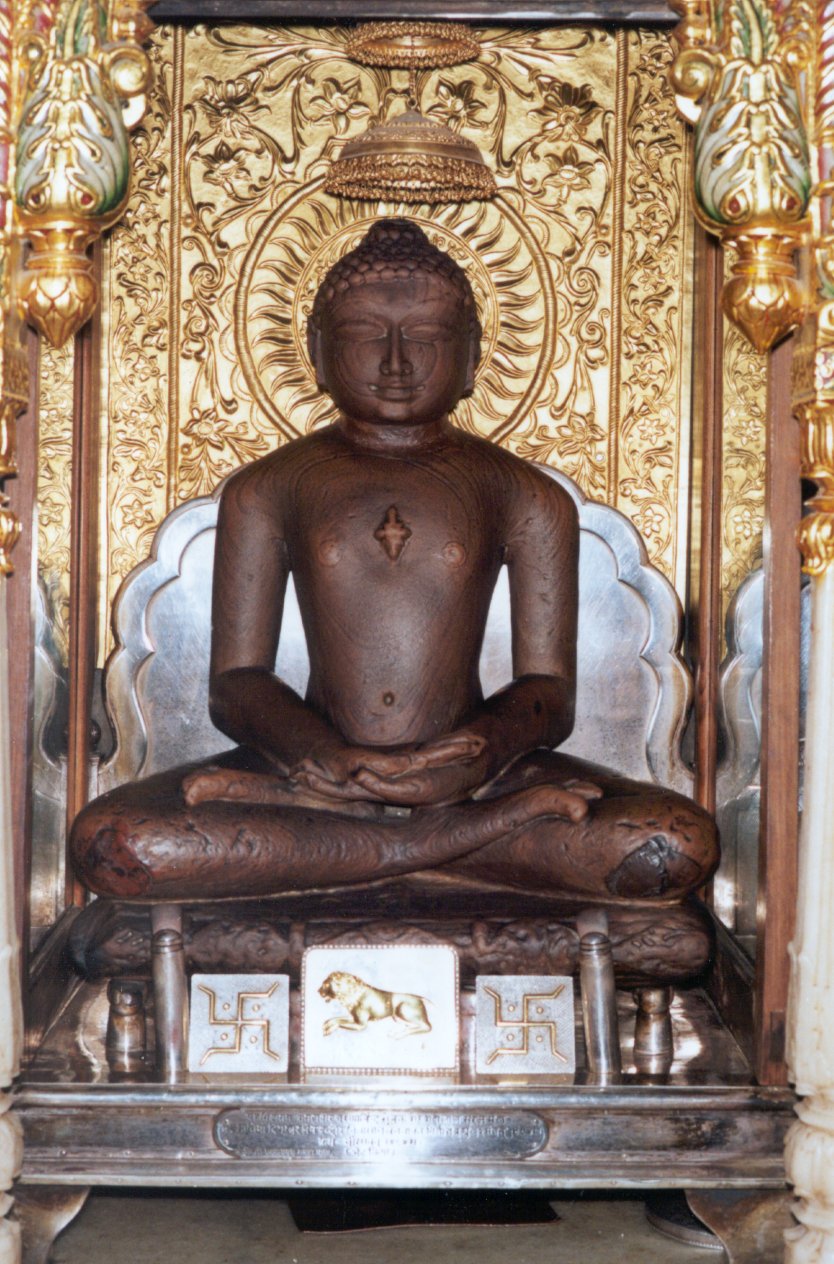 PhilosopherIndianc. 599 – 527 BCE
Mahāvīra
The 24th Jain tīrthaṅkara, who taught radical non-violence and the many-sidedness of truth.
- ◆Ahiṃsā
- ◆Anekāntavāda
- ◆Asceticism
Read the full pageMahavira (Mahāvīra), also known by his birth name Vardhamana (Vardhamāna), was an Indian religious reformer and spiritual leader, considered by Jains to be the 24th and final Tirthankara (Supreme Preacher) in the current time cycle of Jain cosmology. He is believed by historians to have lived in the 6th or 5th century BCE, reviving and reforming an earlier Jain or proto-Jain community which had likely been led by Pārśvanātha, whom Jains consider to be Mahavira's predecessor. Although the dates of Mahavira's life are uncertain and historically reliable information is scarce, and traditional accounts vary by sectarian traditions, the historicity of Mahavira is well-established and not in dispute among scholars.
According to traditional legends and hagiographies, Mahavira was born in 599 BCE to a ruling royal kshatriya Jain family of the Nāya tribe in what is now Bihar in India. According to traditional sources like the Ācārāṅga Sūtra, the Nāyas were followers of Parshvanatha, Mahavira's predecessor. Mahavira abandoned all worldly possessions at the age of about 30 and left home in pursuit of spiritual awakening, becoming an ascetic. Mahavira practiced intense meditation and severe austerities for twelve and a half years, after which he attained Kevala Jnana (omniscience). He preached for 30 years and attained moksha (liberation) when he died.
Mahavira taught attainment of samyaka darshana or self realization (atma-anubhuti) through the practice of bhedvijnāna. This practice involves positioning oneself as a pure soul, separate from the body, mind, and emotions; being aware of the soul's true nature; and remaining grounded and steadfast in soul's unchanging essence during varying auspicious or inauspicious external circumstances. He also preached that the observance of the vows of ahimsa (non-violence), satya (truth), asteya (non-stealing), brahmacharya (chastity), and aparigraha (non-attachment) is necessary for spiritual liberation. He taught the principles of Anekantavada (many-sided reality): syadvada and nayavada. Mahavira's teachings were compiled by Indrabhuti Gautama (his chief disciple) as the Jain Agamas. The texts, transmitted orally by Jain monks, are believed to have been largely lost by about the 1st century CE.
- Read the full page
Ahimsa is the ancient Indian principle of nonviolence that applies to actions toward all living beings. It is a key virtue in Jainism, Buddhism, and Hinduism.
Ahimsa (also spelled Ahinsa) is one of the cardinal virtues of Jainism, where it is the first of the Pancha Mahavrata. It is also one of the central precepts of Hinduism and the first of the five precepts of Buddhism. Ahimsa is inspired by the premise that all living beings have the spark of the divine spiritual energy; therefore, to hurt another being is to hurt oneself. Ahimsa is also related to the notion that all acts of violence have karmic consequences. Ancient scholars of Brahmanism investigated and refined the principles of ahimsa, but the concept reached an extraordinary development in the ethical philosophy of Jainism. Mahavira, the 24th and the last tirthankara of Jainism, further strengthened the idea in the 6th century BCE. About the 5th century CE, Valluvar emphasized ahimsa and moral vegetarianism as virtues for an individual, which formed the core of his teachings in the Kural. Perhaps the most popular advocate of ahimsa in modern times was the leader of the Indian independence movement Mahatma Gandhi.
Ahimsa's precept that humans should "cause no injury" to another living being includes one's deeds, words, and thoughts. Classical Hindu texts such as the Mahabharata and the Ramayana, as well as modern scholars, disagree about what the principle of Ahimsa dictates when one is faced with war and other situations that require self-defence. In this way, historical Indian literature has contributed to just war theory and self-defence.
- 13ConceptIndian
Anekāntavāda
Jain doctrine that reality is many-sided, so every claim is true only from some standpoint — like the blind men and the elephant.
Read the full pageAnekāntavāda (Sanskrit: अनेकान्तवाद, "many-sidedness") is the Jain doctrine about metaphysical truths that emerged in ancient India. It states that the ultimate truth and reality is complex and has multiple aspects and viewpoints.
According to Jainism, no single, specific statement can describe the nature of existence and the absolute truth. This knowledge (Kevala Jnana), it adds, is comprehended only by the Arihants. Other beings and their statements about absolute truth are incomplete, and at best a partial truth. All knowledge claims, according to the anekāntavāda doctrine must be qualified in many ways, including being affirmed and denied. Anekāntavāda is a fundamental doctrine of Jainism.
The origins of anekāntavāda can be traced back to the teachings of Mahāvīra (599–527 BCE), the 24th Jain Tīrthankara, and the predecessor Tirthankars. The dialectical concepts of syādvāda "conditioned viewpoints" and nayavāda "partial viewpoints" were expounded and illustrated from anekāntavāda in the medieval era, providing Jainism with more detailed logical structure and expression. The details of the doctrine emerged in Jainism in the 1st millennium CE, from debates between scholars of Jain, Buddhist and Vedic schools of philosophies.
- 14
 ArgumentIndian
Blind men and the elephant
Each man touches one part and describes the whole differently — the Jain parable for many-sided truth.
Read the full pageThe parable of the blind men and an elephant is a story of a group of blind men who have never come across an elephant before and who learn and imagine what the elephant is like by touching it. Each blind man feels a different part of the animal's body, but only one part, such as the side or the tusk. They then describe the animal based on their limited experience and their descriptions of the elephant are different from each other. In some versions, they come to suspect that the other person is dishonest and they come to blows. Only in a handful of versions do the men find out the truth. Regardless, the moral of the parable is that humans have a tendency to claim absolute truth based on their limited, subjective experience as they ignore other people's limited, subjective experiences which may be equally true. The parable originated in the ancient Indian subcontinent, from where it has been widely disseminated.
This parable is found in the most ancient Jain agams before 5th century BCE.
The Buddhist text Tittha Sutta, Udāna 6.4, Khuddaka Nikaya, contains one of the versions of the story. The Tittha Sutta is dated to around c. 500 BCE, during the lifetime of the Buddha. Other versions of the parable describe sighted men encountering a large statue on a dark night, or some other large object while blindfolded.


