Where philosophy began
Philosophy did not begin in one place. Between roughly 800 and 200 BCE — the period the philosopher Karl Jaspers called the Axial Age — critical reflection on life and the world appeared, apparently independently, in several civilisations.
India
The Upaniṣads (c. 800–200 BCE) turned from ritual to inner inquiry: what is the self (ātman), and how does it relate to ultimate reality (Brahman)? Around 500 BCE the Buddha and Mahāvīra challenged the Vedic tradition with new paths to liberation. Indian philosophy went on to develop rigorous logic, epistemology and metaphysics in a culture of public debate.
China
In a time of war and political chaos, Confucius (551–479 BCE) taught that order begins with personal virtue, ritual and family. Laozi and Zhuangzi answered with the Dao, the nameless Way of nature. Mozi, the Legalists and the Logicians joined the "Hundred Schools of Thought".
Greece
On the coast of Asia Minor, Thales of Miletus (c. 600 BCE) asked what everything is made of and answered without appeal to the gods. A line of thinkers led to Socrates, Plato and Aristotle in Athens, whose questions still organise Western philosophy.
Persia, the Levant and beyond
Zoroaster's dualism of good and evil, the Hebrew prophets' ethical monotheism, and Egyptian wisdom literature such as the Instructions of Ptahhotep belong to the same broad story.
Why then?
Historians point to growing cities, writing, trade, and the collapse of old political orders, which left people asking what to live by. Whatever the cause, the result was the same: in each place, myth gave way to argument, and universal ethics appeared.
Go deeper
- 1Era800 – 200 BCE
Axial Age
The remarkable centuries when Confucius, the Buddha, the Upaniṣadic sages, the Hebrew prophets and the Greek philosophers transformed human thought at almost the same time.
Read the full pageThe German philosopher Karl Jaspers coined the term Axial Age for the period roughly between 800 and 200 BCE, when — independently, in China, India, Persia, the Levant and Greece — thinkers began to reflect critically on the human condition. Confucius and Laozi, the Buddha and Mahāvīra, the authors of the Upaniṣads, Zoroaster, the Hebrew prophets and the Greek philosophers all belong to it.
Whether the age is a real historical pattern or a convenient story is still debated, but the coincidence is striking: in each place, myth gave way to argument, personal ethics became central, and ideas of a universal moral order emerged.
- 2
 WorkIndianc. 800 – 200 BCE
Upaniṣads
Dialogues on the self and ultimate reality that close the Vedas and found Vedānta: "you are that".
Read the full pageThe Upanishads are Sanskrit texts of the late Vedic and post-Vedic periods that "document the transition from the archaic ritualism of the Veda into new religious ideas and institutions" and the emergence of the central religious concepts of Hinduism. They are the most recent addition to the Vedas, the oldest scriptures of Hinduism, and deal with meditation, philosophy, consciousness, and ontological knowledge. Earlier parts of the Vedas dealt with mantras, benedictions, rituals, ceremonies, and sacrifices.
While among the most important literature in the history of Indian religions and culture, the Upanishads document a wide variety of "rites, incantations, and esoteric knowledge" departing from Vedic ritualism and interpreted in various ways in the later commentarial traditions. The Upanishads are widely known, and their diverse ideas, interpreted in various ways, informed later traditions of Hinduism. The central concern of all Upanishads is to discover the relations between ritual, cosmic realities (including gods), and the human body/person, postulating Ātman and Brahman as the "summit of the hierarchically arranged and interconnected universe", but various ideas about the relation between Atman and Brahman can be found.
108 Upanishads are known, of which the first dozen or so are the oldest and most important and are referred to as the principal or main (mukhya) Upanishads. The mukhya Upanishads are found mostly in the concluding part of the Brahmanas and Aranyakas and were, for centuries, memorized by each generation and passed down orally. The mukhya Upanishads predate the Common Era, but there is no scholarly consensus on their date, or even on which ones are pre- or post-Buddhist. The Brihadaranyaka is seen as particularly ancient by modern scholars. Of the remainder, 95 Upanishads are part of the Muktikā canon, composed from about the last centuries of 1st-millennium BCE through about 15th-century CE. New Upanishads, beyond the 108 in the Muktika canon, continued to be composed through the early modern and modern era, though often dealing with subjects that are unconnected to the Vedas. The mukhya Upanishads, along with the Bhagavad Gita and the Brahmasutra (known collectively as the Prasthanatrayi), are interpreted in divergent ways in the several later schools of Vedanta.
- 3
 PhilosopherIndianc. 563 – 483 BCE
Gautama Buddha
The awakened one: a prince who renounced his life to find the cause of suffering and taught the Middle Way to its end.
- ◆Four Noble Truths
- ◆Noble Eightfold Path
- ◆No-self (anattā)
- ◆Impermanence
- ◆Dependent origination
- ◆The Middle Way between indulgence and asceticism
Read the full pageSiddhārtha Gautama was born into the Śākya clan in the foothills of the Himalayas. According to tradition, he left a sheltered princely life after encountering old age, sickness and death, and spent years as a wandering ascetic before rejecting extreme self-denial. Meditating under a tree at Bodh Gaya he attained awakening (bodhi) and became the Buddha, "the awakened one".
His teaching is famously practical. He refused to answer metaphysical questions — whether the world is eternal, whether an awakened person exists after death — that do not lead to the end of suffering, comparing someone who demands such answers to a man struck by a poisoned arrow who will not have it removed until he knows who shot it.
At its core are the Four Noble Truths and the Eightfold Path of right view, intention, speech, action, livelihood, effort, mindfulness and concentration. Philosophically, his most radical teaching is anattā, no-self: what we call a person is a changing bundle of physical form, feelings, perceptions, mental formations and consciousness, with no permanent owner behind them. Seeing this clearly ends the craving that binds us to suffering. The Buddha taught for some forty-five years across the Ganges plain, and his community (saṅgha) carried his ideas across all of Asia.
- 4
 PhilosopherChinese551 – 479 BCE
Confucius
Teacher from Lu whose vision of humaneness, ritual and self-cultivation became the moral foundation of East Asian civilisation.
- ◆Ren — humaneness
- ◆Li — ritual propriety
- ◆The junzi, or exemplary person
- ◆Filial piety (xiao)
- ◆Rectification of names
- ◆Do not impose on others what you do not desire
Read the full pageKong Qiu, honoured as Kongzi ("Master Kong") and Latinised as Confucius, was born in the small state of Lu during a time of political chaos. He served briefly in government, then spent years travelling between states seeking a ruler who would put his ideas into practice. He never found one, and returned home to teach.
His sayings, collected by disciples in the Analects, centre on the cultivation of character. The key virtue is ren, humaneness — caring for others in the way appropriate to one's relationships. It is expressed and trained through li, ritual propriety, from ceremonies of state to everyday courtesies. Through study and practice anyone can become a junzi, an exemplary person, whose influence works like wind on grass.
Confucius saw the family as the root of social order, and filial piety as the root of virtue. Good government depends on rulers who lead by moral example and on "rectifying names" so that a ruler truly acts as a ruler, a father as a father. His Golden Rule — "do not impose on others what you yourself do not desire" — is one of the earliest on record.
- 5
 PhilosopherChinesec. 571 – 471 BCE
Laozi
Legendary sage and reputed author of the Daodejing, the founding text of Daoism.
- ◆The Dao that can be named is not the eternal Dao
- ◆Wu wei
- ◆The soft overcomes the hard
- ◆Return to simplicity
Read the full pageLaozi (variously spelled; , low-TSUH; Chinese: 老子; pinyin: Lǎozǐ) was a legendary Chinese philosopher considered to be the author of the Tao Te Ching (Pinyin: Dào Dé Jīng), one of the foundational texts of Taoism. Modern scholarship generally regards his biographical details as later inventions and his opus a collaboration of various writers, with the name Laozi, literally meaning 'Old Master', likely intended to portray an archaic anonymity that could converse with Confucianism. Traditional accounts addend him as Li Er, born in the 6th-century BC state of Chu during China's Spring and Autumn period (c. 770 – c. 481 BC). Serving as the royal archivist for the Zhou court at Wangcheng (modern Luoyang), he met and impressed Confucius (c. 551 – c. 479 BC).
A central figure in Chinese culture, Laozi is generally considered the founder of Taoism. He was claimed and revered as the ancestor of the Tang dynasty (618–907) and is similarly honored in modern China as the progenitor of the popular surname Li. In some sects of Taoism, Chinese Buddhism, Confucianism, and Chinese folk religion, it is held that he then became an immortal hermit. Certain Taoist devotees held that the Dào Dé Jīng was the avatar – embodied as a book – of the god Laojun, one of the Three Pure Ones of the Taoist pantheon, though few philosophers believe this.
The Dào Dé Jīng had a profound influence on Chinese religious movements and on subsequent Chinese philosophers, who annotated, commended, and criticized the texts extensively. In the 20th century, textual criticism by historians led to theories questioning Laozi's timing or even existence, positing that the received text of the Dào Dé Jīng was not composed until the Warring States period (c. 475 – 221 BC), and was the product of multiple authors.
- 6
 PhilosopherGreek & Romanc. 624 – 546 BCE
Thales of Miletus
Often called the first philosopher: he proposed that everything is ultimately water and explained nature without myth.
- ◆Water as the first principle
- ◆Predicted a solar eclipse
- ◆All things are full of gods
Read the full pageThales of Miletus was a pre-Socratic Greek philosopher from Miletus in Ionia, Asia Minor. Thales was one of the Seven Sages, founding figures of Ancient Greece.
Beginning in eighteenth-century historiography, many came to regard him as the first philosopher in the Greek tradition, breaking from the prior use of mythology to explain the world and instead using natural philosophy. He is thus otherwise referred to as the first to have engaged in mathematics, science, and deductive reasoning.
Thales's view that all of nature is based on the existence of a single ultimate substance, which he theorized to be water, was widely influential among the philosophers of his time. Thales thought the Earth floated on water.
- 7
 PhilosopherGreek & Roman470 – 399 BCE
Socrates
The Athenian who wrote nothing yet changed philosophy forever by questioning everyone about how to live — and died for it.
- ◆The unexamined life is not worth living
- ◆Socratic method: question, define, refute
- ◆Virtue is knowledge; no one does wrong willingly
- ◆Wisdom begins in knowing that you do not know
Read the full pageSocrates was a stonemason's son who spent his life in the marketplace of Athens asking people questions. What is courage? What is justice? What is piety? Those who thought they knew — generals, politicians, poets — found under his cross-examination (elenchus) that their definitions collapsed into contradiction.
He claimed no wisdom of his own except awareness of his ignorance. When the Delphic oracle declared no one wiser than Socrates, he concluded it meant that he alone knew he knew nothing. His real subject was the care of the soul: how to live a good life. He held that virtue is a kind of knowledge, so that no one does wrong knowingly, and that it is worse to do injustice than to suffer it.
In 399 BCE Athens tried him for impiety and corrupting the young. He refused to flee and drank hemlock. Because he wrote nothing, we know him mainly through Plato's dialogues, along with accounts by Xenophon and the satire of Aristophanes — the "Socratic problem" of separating the real man from Plato's character remains open. Almost every later Greek school, from the Cynics to the Stoics, claimed him as its model.
- 8
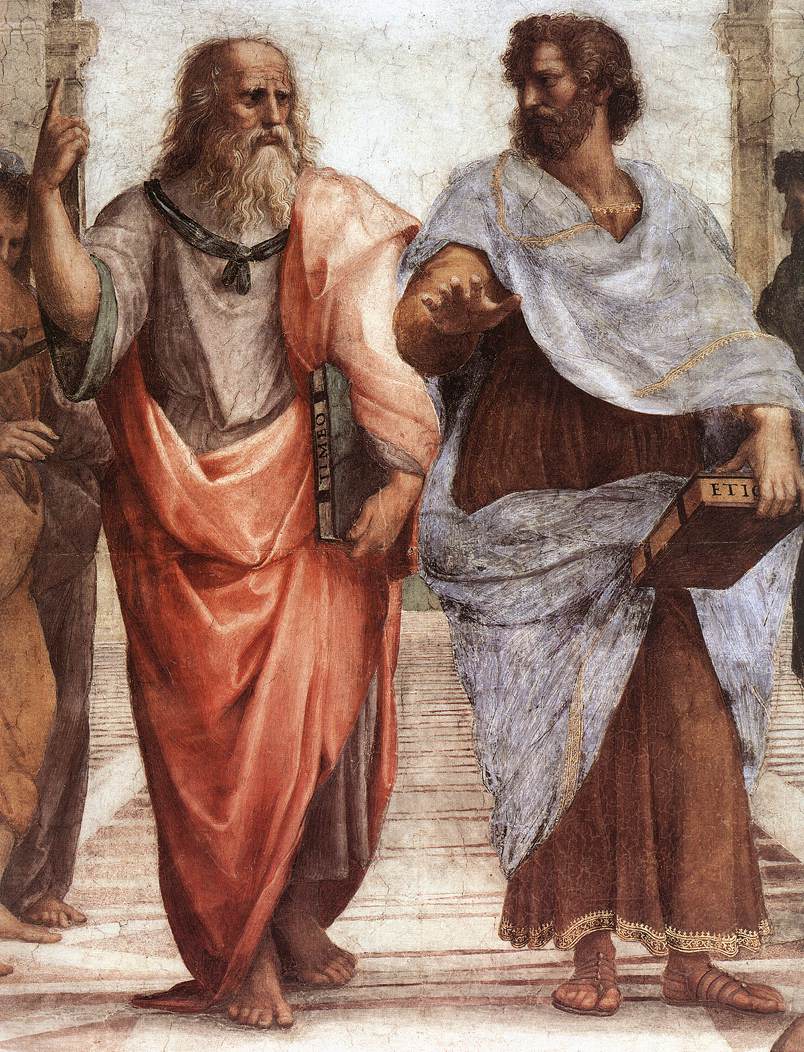 TraditionGreek & Roman600 BCE – 529 CE
Ancient Greek philosophy
The tradition that began with the Presocratics on the Ionian coast and ran through Socrates, Plato, Aristotle and the Hellenistic schools until the closing of the Athenian Academy.
- ◆Reason (logos) can explain nature without appeal to myth
- ◆The examined life as the good life
- ◆Virtue as excellence of character
- ◆Systematic logic, ethics, metaphysics and politics
Read the full pageGreek philosophy began with a question that sounds simple: what is everything made of? Thales answered water, Anaximenes air, Heraclitus fire — but what mattered was the move itself, the attempt to explain the world through principles anyone could inspect and argue about rather than through the will of the gods.
Within two centuries the questions had turned inward. Socrates, who wrote nothing, made philosophy a practice of cross-examination aimed at living well. His student Plato built the first great system around unchanging Forms, and Plato's student Aristotle mapped nearly every field of knowledge — logic, biology, ethics, politics, poetics — with a thoroughness no single thinker has matched since.
After Alexander, the Hellenistic schools — Stoics, Epicureans and Skeptics — narrowed the focus to a practical goal: tranquillity in a world one cannot control. Neoplatonism, the last great pagan school, fed directly into Christian, Jewish and Islamic thought, which is why nearly every later Western and Middle Eastern philosophy carries Greek DNA.
- 9
 TraditionIndian1200 BCE – present
Indian philosophy
A family of rigorous systems (darśanas) — Hindu, Buddhist and Jain — united by questions about the self, liberation (mokṣa) and the sources of valid knowledge (pramāṇa).
- ◆Philosophy as a path to liberation, not only theory
- ◆Detailed epistemology of valid means of knowing (pramāṇa)
- ◆Debate between affirmers (āstika) and deniers (nāstika) of Vedic authority
- ◆Karma, rebirth and the nature of the self
Read the full pageIndian philosophy is usually called darśana — "a way of seeing". Its schools share a striking assumption: knowing the truth about reality is not idle curiosity but the means of release from suffering and the cycle of rebirth.
Classical Indian thought is traditionally divided into āstika schools that accept the authority of the Vedas — Nyāya, Vaiśeṣika, Sāṃkhya, Yoga, Mīmāṃsā and Vedānta — and nāstika schools that reject it, chiefly Buddhism, Jainism and the materialist Cārvāka. They argued with one another for over two thousand years in a culture of formal public debate, and each developed sharp tools to do it: logic, theories of perception and inference, philosophy of language and some of the most sophisticated metaphysics of the self (and of no-self) ever written.
The result is a tradition that anticipated many problems Western philosophy reached much later — the nature of consciousness, the reliability of testimony, the reality of the external world — while framing them inside a practical quest for freedom.
- 10
 TraditionChinese600 BCE – present
Chinese philosophy
Born in the "Hundred Schools of Thought" era, Chinese philosophy focuses on how to live and govern well — harmony, ritual, virtue and the Way (Dao).
- ◆Ethics and politics as cultivating harmony
- ◆The Dao — the Way things and people ought to go
- ◆Self-cultivation through ritual, learning and practice
- ◆Correlative thinking: yin–yang and the five phases
Read the full pageChinese philosophy took shape during the Warring States period, when rival states patronised thinkers who could tell rulers how to bring order to a fractured world. The resulting "Hundred Schools" — Confucians, Mohists, Daoists, Legalists, Logicians and more — framed philosophy as a question of the Way (dao): how a person, a family and a state should move through the world.
Confucianism stressed ritual, family relationships and moral cultivation; Daoism urged spontaneity and returning to the uncarved simplicity of nature; Mohism argued for impartial care and utility; Legalism for strict laws and state power. Buddhism arrived from India in the first centuries CE and was transformed into distinctly Chinese schools like Chan (Zen). Neo-Confucianism, from Zhu Xi to Wang Yangming, then wove these strands into a metaphysics of principle (li) and vital energy (qi) that shaped East Asia for a millennium.

