How philosophers think
Philosophy has no laboratory, but it has methods. Learning them is the fastest way to start doing philosophy rather than just reading about it.
Arguments
An argument is a set of reasons (premises) offered in support of a claim (conclusion). On Rhea, many arguments are laid out as numbered premises P1, P2… and a conclusion ∴ C. Two questions test any argument:
- Is it valid? Would the conclusion have to be true if the premises were true?
- Is it sound? Is it valid and are the premises actually true?
To criticise an argument you must either show it is invalid or deny a premise — and say which one.
Definitions and distinctions
Much philosophical progress comes from noticing that one word hides two ideas. "Free" can mean uncaused or uncoerced; "knowledge" can mean acquaintance or justified true belief. Socrates spent his life asking for definitions; Indian logicians catalogued the valid sources of knowledge (pramāṇa) with great precision.
Thought experiments
Philosophers imagine carefully constructed scenarios to test ideas: Plato's Ring of Gyges, Zhuangzi's butterfly dream, Ibn Sīnā's Floating Man, Descartes's evil demon, the Ship of Theseus, Mary's Room. A good thought experiment isolates one variable — remove all consequences, and is justice still worth it?
Dialectic and debate
Ideas improve under attack. Socrates questioned; the Nyāya school formalised public debate with rules for victory and defeat; medieval universities held disputations in which every thesis met its strongest objection. Rhea's argument pages always list objections and replies for this reason.
Reflective equilibrium
Modern ethics often works by moving back and forth between general principles and judgements about particular cases, adjusting each until they fit. If a principle implies you should push the man off the footbridge and you are sure you should not, something has to give.
Charity
Finally: read others charitably. Reconstruct their view in its strongest form before you criticise it. Most of the great quarrels in this course — Plato and Aristotle, Mencius and Xunzi, al-Ghazālī and Ibn Rushd, Hume and Kant — are worth studying precisely because both sides were brilliant.
Go deeper
- 1
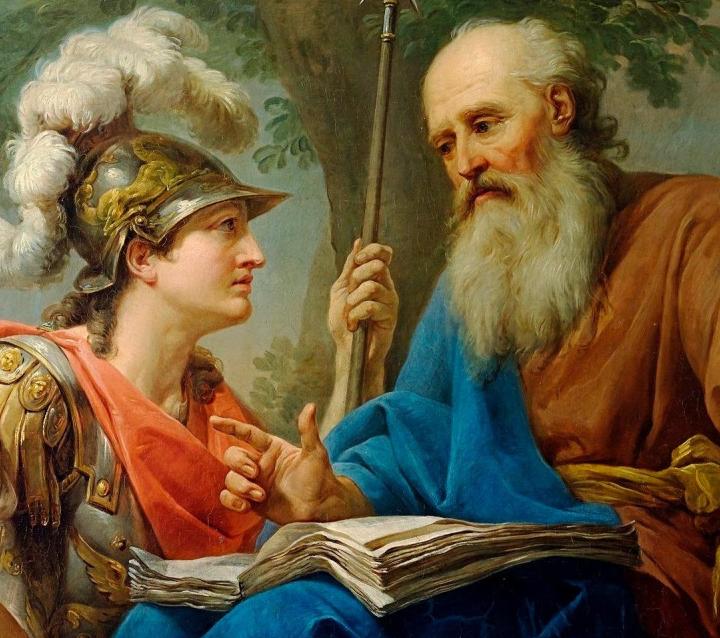 ConceptGreek & Roman
Socratic method
Cooperative questioning that exposes contradictions in our beliefs to reach clearer understanding.
Read the full pageThe Socratic method is a form of argumentative dialogue in which an individual probes a conversation partner on a topic, using questions and clarifications, until the partner is pressed to come to a conclusion on their own, or else their reasoning breaks down and they are forced to admit ignorance. The method is also known as Socratic debate, the maieutic method, or the Socratic dialectic, and sometimes equated with the Greek term elenchus. Socratic dialogues between characters employing this method feature in many of the works of the ancient Greek philosopher Plato, where a fictionalized version of his real-life teacher Socrates debates or expounds upon various philosophical issues with a partner.
In Plato's dialogue Theaetetus, Socrates describes his method as a form of "midwifery" (maieutikós; source of the English adjective maieutic) because it is employed to help his interlocutors develop their understanding and lead it out of them in a way analogous to a child developing in the womb until it is ready for birth. The Socratic method begins with commonly held beliefs and scrutinizes them by way of questioning to determine their internal consistency and their coherence with other beliefs and so to bring everyone closer to the truth.
In modified forms, it is employed today in a variety of pedagogical contexts.
- ◆Validity and soundness
- ◆Deduction, induction and abduction
- ◆Formal systems and proof
- ◆Fallacies
Read the full pageLogic studies the difference between good and bad reasoning. Aristotle invented the first formal system, the syllogism; the Stoics developed propositional logic; Indian Nyāya philosophers built an elaborate theory of inference; and Gottlob Frege's 1879 Begriffsschrift created modern predicate logic, the foundation of computer science.
Today logic includes classical and non-classical systems (modal, intuitionistic, many-valued, paraconsistent), proof theory, model theory and the study of informal fallacies.
- 3Concept
Dialectic
Reasoning through opposition: from Socratic dialogue to Hegel's movement of contradiction and resolution.
Read the full pageDialectic or dialectics, also known as the dialectical method, is a method of reasoning and philosophical argument that emphasizes the progression of thought through a process of resolving contradictions. The term, rooted in the Ancient Greek dialegesthai ('to converse'), was popularized by Plato's Socratic dialogues, which presented dialectic as a discourse between two or more people holding different points of view about a subject but wishing to establish the truth through reasoned argumentation. In modern philosophy, dialectic has evolved into a distinct practice, often a systematic method of reasoning which seeks to establish a comprehensive framework for understanding development, change, and the interconnectedness of reality.
Throughout its history, the concept of dialectic has undergone significant transformations. In antiquity, it was developed as a form of "objective dialectic" by pre-Socratic philosophers like Heraclitus, who focused on the cosmic principles of change and the unity of opposites. This was followed by a "subjective dialectic" pioneered by the Sophists and Socrates, which shifted the focus to human consciousness and the art of argumentation. Plato elevated dialectic to the supreme method of philosophical inquiry, viewing it as the path to understanding the transcendent Forms. His student, Aristotle, redefined it as a method for critically examining reputable opinions (endoxa).
In the modern era, particularly within German idealism, dialectic was revived and systematized. Immanuel Kant conceptualized it as a "logic of illusion", identifying the inherent contradictions (antinomies) that arise when human reason ventures beyond the limits of possible experience. Building on Kant's work and the contributions of Romantic thinkers like Friedrich Wilhelm Joseph Schelling, Georg Wilhelm Friedrich Hegel developed a system of dialecticals, seeing contradiction not as a flaw but as the driving force of all movement and development. For Hegel, dialectic is both a method of argument and an ontology—the immanent process through which Spirit (Geist) unfolds and achieves self-consciousness.
- 4
 ArgumentGreek & Roman
Ring of Gyges
If a ring made you invisible, would you still be just? Glaucon's challenge in Plato's Republic.
P1A ring makes its wearer invisible, removing all risk of being caught
P2Anyone, just or unjust, who had it would act unjustly
∴People are just only because they fear the consequences of injustice.
Read the full pageThe Ring of Gyges (Ancient Greek: Γύγου δακτύλιος, Gúgou daktúlios, Attic Greek pronunciation: [ˈɡyːˌɡuː dakˈtylios]) is a hypothetical magic ring mentioned by the philosopher Plato in Book 2 of his Republic (2:359a–2:360d). It grants its owner the power to become invisible at will. Using the ring as an example, this section of the Republic considers whether a rational, intelligent person who has no need to fear negative consequences for committing an injustice would nevertheless act justly.
Gyges of Lydia was a historical king, the founder of the Mermnad dynasty of Lydian kings. Various ancient works—the most well-known being The Histories of Herodotus—gave different accounts of the circumstances of his acquisition of power. All, however, agree in asserting that he was originally a subordinate of King Candaules of Lydia, that he killed Candaules and seized the throne, and that he had either seduced Candaules' Queen before killing him, married her afterwards, or both.
In the recounting of the myth by Glaucon (Plato's older brother, as a character of the Republic), an unnamed ancestor of Gyges was a shepherd in the service of the king of Lydia. After an earthquake, a chasm was revealed in a mountainside where he was feeding his flock. Entering the chasm, he discovered that it was in fact a tomb with a bronze horse containing a corpse, larger than that of a man, who wore a golden ring, which he then pocketed. He discovered that by adjusting the ring, he gained the power of invisibility. He then arranged to become one of the king's messengers as to the status of the flocks. Arriving at the palace, he used his new power of invisibility to seduce the queen, and with her help, murder the king, and become king of Lydia himself.
- 5ArgumentIslamic
The Floating Man
Ibn Sīnā's person created in mid-air, without senses, who would still know that he exists.
P1Imagine a person created fully formed, suspended in air, with no sensation even of his own body
P2He would still affirm his own existence
∴Self-awareness does not depend on awareness of the body — the soul is distinct from it.
Read the full pageThe floating man, flying man, or man suspended in air argument is a thought experiment by the Persian philosopher Ibn Sina (Avicenna) that argues for the existence of the soul. This thought experiment is used to argue in favor of knowledge by presence.
Ibn Sina wrote the argument while imprisoned in the castle of Fardajan in Hamadan Province, Iran. He concluded that the soul is immaterial and substantial. He also claimed that no human could deny their own consciousness. According to Ibn Sina, the floating man could attain the concept of being without any sense experience.
Ibn Sina saved one of the Iranian rulers, Shams al-Dawla, from death, which caused envy among the courtiers. Following Shams al-Dawla death, Ibn Sina was arrested and imprisoned in a castle between the Iranian provinces of Hamadan and Isfahan, where he supposedly wrote the floating man argument. The name of that castle is recorded in the old books as "Fardjan," "Mazdjan," or "Mazdavan."
- 6
 ArgumentGreek & Roman
Ship of Theseus
If every plank of a ship is replaced, is it the same ship? And what if the old planks are rebuilt into another?
P1Theseus's ship has every plank replaced one at a time
P2The old planks are assembled into a second ship
∴Both ships seem to have a claim to be the original — so what makes an object the same over time?
Read the full pageThe Ship of Theseus, also known as Theseus's Paradox, is a paradox and common thought experiment questioning whether an object (in the most common stating of the paradox, a ship) remains the same when all of its original components are gradually replaced over time, with no single part being designated as essential to its original identity.
Greek biographer Plutarch described the paradox in his Life of Theseus, recounting how the Athenians preserved the ship on which the mythical king Theseus had sailed after slaying the Minotaur and rescuing the children of Athens from King Minos. They maintained the ship by removing and replacing rotted timbers, raising philosophical debates on whether or not it remained the same ship. English philosopher Thomas Hobbes, in De Corpore (1655), further questioned how to consider a second ship that had been built entirely from pieces removed from the original.
In contemporary philosophy, the thought experiment has applications to the philosophical study of identity over time. Within the contemporary philosophy of mind, it has inspired a variety of proposed solutions and concepts regarding the persistence of personal identity.
- 7ConceptIndian
Pramāṇa
Valid means of knowledge — perception, inference, comparison, testimony and more.
Read the full pagePramana (Sanskrit: प्रमाणम्; IAST: Pramāṇam) literally means "proof" and "means of knowledge". One of the core concepts in Indian epistemology, pramanas are one or more reliable and valid means by which human beings gain accurate, true knowledge. The focus of pramana is how correct knowledge can be acquired, how one knows, how one does not know, and to what extent knowledge pertinent about someone or something can be acquired.
While the number of pramanas varies widely from system to system, many ancient and medieval Indian texts identify six pramanas as correct means of accurate knowledge and attaining to the truth. Three of these are almost universally accepted: perception (pratyakṣa), inference (anumāna), and "word" (śabda), meaning the testimony of past or present reliable experts. The other three pramanas are more contentious: comparison and analogy (upamāna); postulation or derivation from circumstances (arthāpatti); and non-perception, or proof from absence (anupalabdhi). Each of these are further categorized in terms of conditionality, completeness, confidence, and possibility of error.
The various schools of Indian philosophies vary on how many of these six pramanas are epistemically reliable and valid means to knowledge. For example, the Charvaka school of the Śramaṇa tradition holds that only one (perception) is a reliable source of knowledge, Buddhism holds that two (perception, inference) are valid means, Jainism holds three (perception, inference and testimony) as valid, and the Mimamsa and Advaita Vedanta schools of Hinduism hold that all six pramanas are useful and can be reliable means to knowledge. The various schools of Indian philosophy have debated whether one of the six forms of pramana can be derived from another and the relative uniqueness of each. For example, Buddhism considers Buddha and other "valid persons", "valid scriptures" and "valid minds" as indisputable, but that such testimony is a form of perception and inference pramanas.


