Medieval Latin thinkers: Norwich to Prague
- 1
 PhilosopherMedieval Latin1342 – 1500
Julian of Norwich
Julian of Norwich, also known as Juliana of Norwich, the Lady Julian, Dame Julian or Mother Julian, was a medieval English Catholic anchoress. Her writings, now known as Revelations of Divine Love, are the earliest surviving English-language works attributed to a woman.
Read the full pageJulian of Norwich (c. 1343 – after 1416), also known as Juliana of Norwich, the Lady Julian, Dame Julian or Mother Julian, was a medieval English Catholic anchoress. Her writings, now known as Revelations of Divine Love, are the earliest surviving English-language works attributed to a woman. They are also the only surviving English-language works by an anchoress.
Julian lived in the English city of Norwich in Norfolk, an important centre for commerce that also had a vibrant religious life. During her lifetime, the city suffered the devastating effects of the Black Death of 1348–1350, the Peasants' Revolt (which affected large parts of England in 1381), and the suppression of the Lollards. In 1373, aged 30 and so seriously ill she thought she was on her deathbed, Julian received a series of visions or shewings of the Passion of Christ. She recovered from her illness and wrote two versions of her experiences, the earlier one being completed soon after her recovery—a much longer version, today known as the Long Text, was written many years later.
- 2
 PhilosopherMedieval Latin1347 – 1380
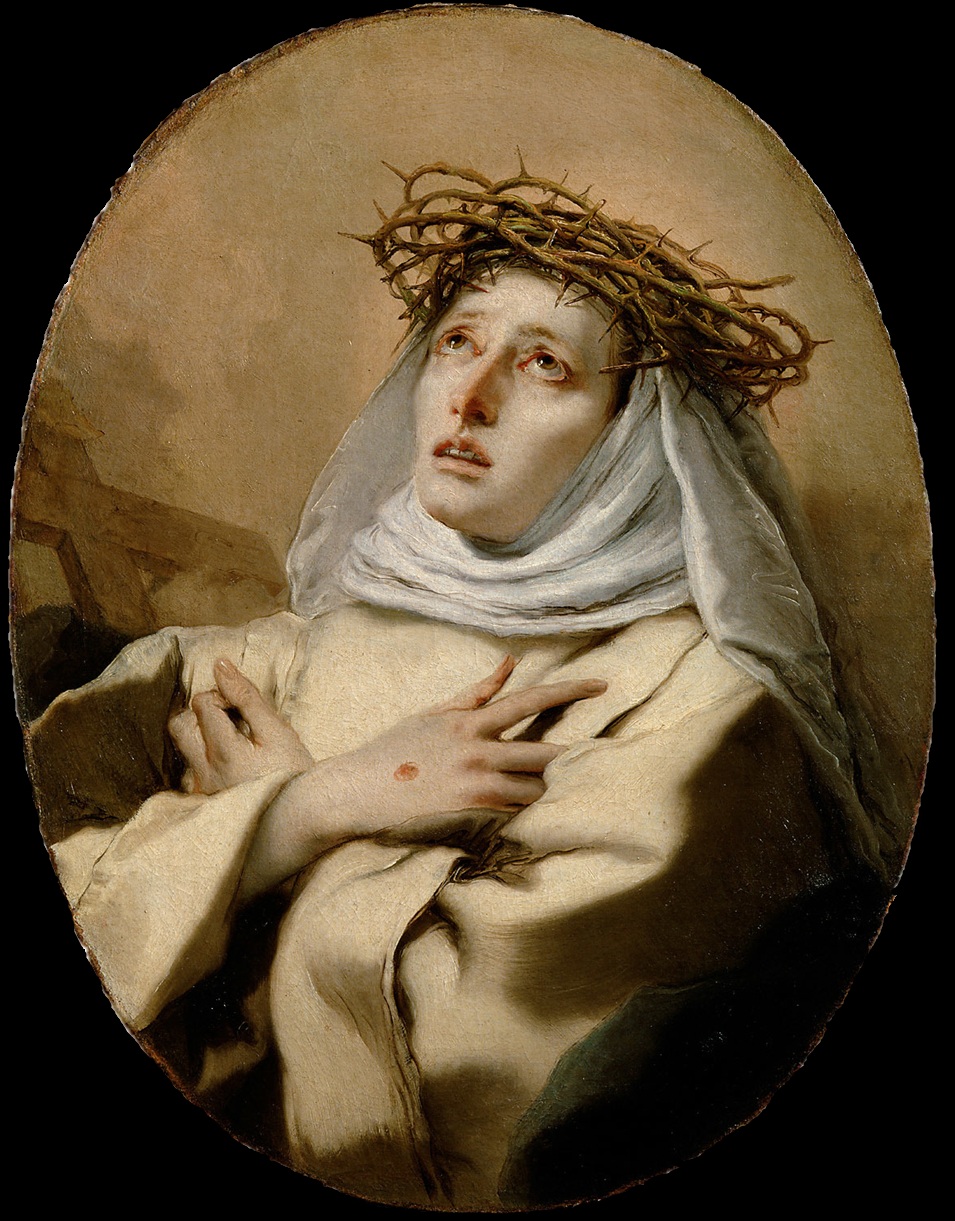
Catherine of Siena
Caterina di Jacopo di Benincasa, TOSD, known as Catherine of Siena, was an Italian Catholic mystic and diplomat who engaged in papal and Italian politics through extensive letter-writing and advocacy. Canonised in 1461, she is revered as a saint and as a Doctor of the Church due to her extensive theological authorship.
Read the full pageCaterina di Jacopo di Benincasa, TOSD (25 March 1347 – 29 April 1380), known as Catherine of Siena, was an Italian Catholic mystic and diplomat who engaged in papal and Italian politics through extensive letter-writing and advocacy. Canonised in 1461, she is revered as a saint and as a Doctor of the Church due to her extensive theological authorship. She is also considered to have influenced Italian literature.
Born and raised in Siena, Catherine wanted from an early age to devote herself to God, against the will of her parents. She joined the mantellates, a group of pious women, primarily widows, informally devoted to Dominican spirituality; later these types of urban pious groups would be formalised as the Third Order Dominicans, but not until after Catherine's death. Her influence with Pope Gregory XI played a role in his 1376 decision to leave Avignon for Rome. The Pope then sent Catherine to negotiate peace with the Florentine Republic. After Gregory XI's death (March 1378) and the conclusion of peace (July 1378), she returned to Siena.
- 3
 PhilosopherMedieval Latin1350 – 1419
Pierre d'Ailly
Pierre d'Ailly was a French theologian, astrologer and cardinal of the Catholic Church.
Read the full pagePierre d'Ailly (French: [d‿aji]; Latin: Petrus Aliacensis, Petrus de Alliaco; 1351 – 9 August 1420) was a French theologian, astrologer and cardinal of the Catholic Church.
D'Ailly was born in Compiègne in 1350 or 1351 of a prosperous bourgeois family. He studied in Paris at the Collège de Navarre, receiving the licentiate in arts in 1367 and the master's a year later, and was active in university affairs by 1372. D'Ailly taught the Bible in 1375 and the Sentences of Peter Lombard in 1376–1377, and received the licentiate and doctorate in theology in 1381. He was affiliated with the university, serving as rector in 1384; among his pupils were Jean Gerson and Nicholas of Clémanges.
- 4PhilosopherMedieval Latin1355 – 1398
Robert Alyngton
Robert Alyngton was an English philosopher who developed new logical, semantic, metaphysical, and ontological theories in 14th century thought. Alyngton is credited with creating the ideological foundation for the Oxford realists by substituting reference to objective reality with reference to mental and linguistic rea
Read the full pageRobert Alyngton (died September 1398) was an English philosopher who developed new logical, semantic, metaphysical, and ontological theories in 14th century thought. Alyngton is credited with creating the ideological foundation for the Oxford realists by substituting reference to objective reality with reference to mental and linguistic reality.
Alyngton was a Fellow of The Queen's College, Oxford from 1379 until 1386. He was deeply influenced by the metaphysics of John Wyclif who began his theological studies at Queen's College in 1363. Alyngton was Chancellor of Oxford University in 1394–5. He later became Rector of Long Whatton, Leicestershire, until his death 1398.
- 5
 PhilosopherMedieval Latin1369 – 1415
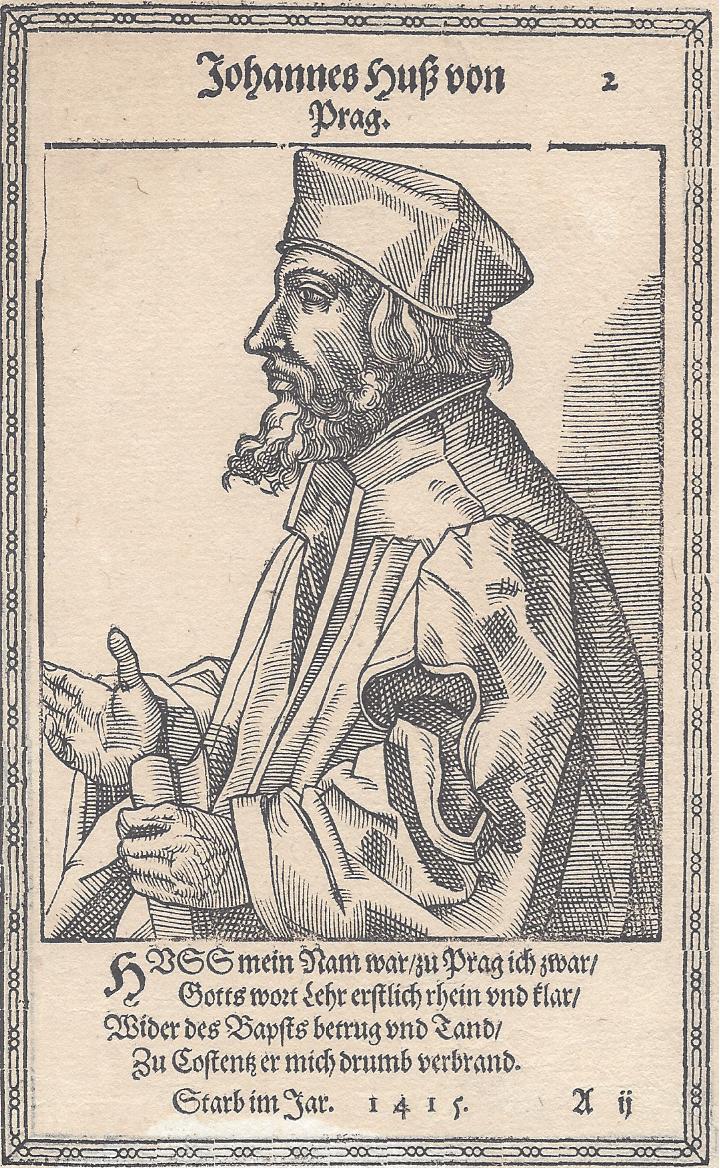
Jan Hus
Jan Hus, sometimes anglicized as John Hus or John Huss, and referred to in historical texts as Johannes Hus or Johannes Huss, was a Czech Christian theologian and philosopher who became a Church reformer and the inspiration of Hussitism, a key predecessor to Protestantism, and a seminal figure in the Bohemian Reformati
Read the full pageJan Hus (; Czech: [ˈjan ˈɦus] ; c. 1369 – 6 July 1415), sometimes anglicized as John Hus or John Huss, and referred to in historical texts as Johannes Hus or Johannes Huss, was a Czech Christian theologian and philosopher who became a Church reformer and the inspiration of Hussitism, a key predecessor to Protestantism, and a seminal figure in the Bohemian Reformation. Hus is considered to be the first Church reformer, even though some designate the theorist John Wycliffe. His teachings had a strong influence, most immediately in the rise of the Hussite reformed Bohemian religious denomination and, over a century later, on Martin Luther.
After being ordained as a Catholic priest, Hus began to preach in Prague. He opposed many doctrines and practices of the Catholic Church in Bohemia, such those concerning ecclesiology, simony, and the Eucharist. Hus was a master, dean, and rector at the Charles University in Prague between 1409 and 1410.
- 6
 PhilosopherMedieval Latin1380 – 1416
Jerome of Prague
Jerome of Prague was a Czech scholastic philosopher and theologian. Jerome was one of the chief followers of Jan Hus and was burned for heresy at the Council of Constance.
Read the full pageJerome of Prague (Czech: Jeroným Pražský; Latin: Hieronymus Pragensis; 1379 – 30 May 1416) was a Czech scholastic philosopher and theologian. Jerome was one of the chief followers of Jan Hus and was burned for heresy at the Council of Constance.
Jerome was born in Prague, Kingdom of Bohemia (now the Czech Republic), in 1379 and graduated from the Charles University of Prague in 1398. He later studied at Oxford University where he first became familiar with the reformist teachings of John Wycliffe. He was a philosopher, theologian, university professor, and church reformer who dedicated his life to eradicate those church doctrines and dogmas he found to be corrupt. He was constantly in and out of jail. His radical ideas eventually brought about his death by execution as a heretic to the church, but made him a martyr for the Protestant Reformation and followers of Jan Hus (known as Hussites).