Islamic thinkers, medieval: al-Farid to Khaldūn
- 1
 PhilosopherIslamic1181 – 1234
Ibn al-Farid
Ibn al-Farid or Ibn Farid; (Arabic: عمر بن علي بن الفارض, ʿUmar ibn ʿAlī ibn al-Fāriḍ) was an Arab poet as well as a Sufi waliullah. His name is Arabic for "son of the obligator" (the one who divides the inheritance between the inheritors), as his father was well regarded for his work in the legal sphere.
Read the full pageIbn al-Farid or Ibn Farid; (Arabic: عمر بن علي بن الفارض, ʿUmar ibn ʿAlī ibn al-Fāriḍ) (22 March 1181 – 1234) was an Arab poet as well as a Sufi waliullah. His name is Arabic for "son of the obligator" (the one who divides the inheritance between the inheritors), as his father was well regarded for his work in the legal sphere. He was born in Cairo to parents from Hama in modern Syria, lived for some time in Mecca, and died in Cairo. His poetry is full of Sufi inspiration and imagery, and he was esteemed as the greatest mystic poet of the Arabs. Some of his poems are said to have been written in ecstasies.
Ibn al-Fāriḍ was arguably the most celebrated Sufi poet in the pre-modern Islamic world, with his poetry admired across both Arabic and Persian speaking regions. The Persian poet Jami is known to have written a commentary on Ibn al-Fāriḍ's poems, and Sa'id al-Din Farghani also authored a Persian commentary on his work
- 2
 PhilosopherIslamic1185 – 1248
Shams Tabrizi
Shams Tabrīzī was an Iranian dervish and poet, best known for his companionship with Rumi. He is referenced with great reverence and grief in Rumi's poetic collection, in particular Divan-i Shams-i Tabrīzī.
Read the full pageShams Tabrīzī (1185–1248) was an Iranian dervish and poet, best known for his companionship with Rumi.
He is referenced with great reverence and grief in Rumi's poetic collection, in particular Divan-i Shams-i Tabrīzī. Tradition holds that Shams taught Rumi in seclusion in Konya for a period of forty days, before fleeing for Damascus. The tomb of Shams-i Tabrīzī was recently nominated to be a UNESCO World Heritage Site.
- 3PhilosopherIslamic1194 – 1264
Athīr al-Dīn al-Abharī
Athīr al-Dīn al-Mufaḍḍal ibn ʿUmar ibn al-Mufaḍḍal al-Samarqandī al-Abharī (Persian): اثیرالدین مُفَضَّل بن عمر بن مَفَضَّل سمرقندی ابهری; d. 1262 or 1265 also known as Athīr al-Dīn al-Munajjim (اثیرالدین منجم) was an Iranian Muslim polymath, philosopher, astronomer, astrologer and mathematician. Other than his influen
Read the full pageAthīr al-Dīn al-Mufaḍḍal ibn ʿUmar ibn al-Mufaḍḍal al-Samarqandī al-Abharī (Persian): اثیرالدین مُفَضَّل بن عمر بن مَفَضَّل سمرقندی ابهری; d. 1262 or 1265 also known as Athīr al-Dīn al-Munajjim (اثیرالدین منجم) was an Iranian Muslim polymath, philosopher, astronomer, astrologer and mathematician. Other than his influential writings, he had many disciples.
His birthplace is contested among sources. According to the Encyclopaedia of Islam and the Encyclopaedia Islamica, he was born in Abhar, a small town between Qazvin and Zanjan in the North-West of Iran. The claim of G.C. Anawati making him a native of Mosul in Iraq, taken from the fact that al-Abharī was educated by a scientist from Mosul, Kamāl al-Dīn ibn Yūnus al-Mawṣilī, must also been dismissed. None of his oldest biographers mentioned Mosul as his birthplace, and al-Abharī himself indicated that he had gone to Mosul for this purpose. Beside the city of Abhar, the epithet al-Abharī could suggest that he or his ancestors originally stem from the Abhar tribe.
- 4
 PhilosopherIslamic1215 – 1288
Ibn al-Nafis
ʿAlāʾ al-Dīn Abū al-Ḥasan ʿAlī ibn Abī Ḥazm al-Qarashī, known as Ibn al-Nafīs (Arabic: ابن النفيس), was an Arab polymath whose areas of work included medicine, surgery, physiology, anatomy, biology, Islamic studies, jurisprudence, and philosophy. He is known for being the first to describe the pulmonary circulation of
Read the full pageʿAlāʾ al-Dīn Abū al-Ḥasan ʿAlī ibn Abī Ḥazm al-Qarashī, known as Ibn al-Nafīs (Arabic: ابن النفيس), was an Arab polymath whose areas of work included medicine, surgery, physiology, anatomy, biology, Islamic studies, jurisprudence, and philosophy. He is known for being the first to describe the pulmonary circulation of the blood. The work of Ibn al-Nafis regarding the right sided (pulmonary) circulation pre-dates the later work (1628) of William Harvey's De motu cordis. Both theories attempt to explain circulation. The 2nd century Greek physician Galen's theory about the physiology of the circulatory system remained unchallenged until the works of Ibn al-Nafis, who has therefore been described as "the father of circulatory physiology".
As an early anatomist, Ibn al-Nafis also performed several human dissections during the course of his work, making several important discoveries in the fields of physiology and anatomy. Besides his famous discovery of the pulmonary circulation, he also gave an early insight of the coronary and capillary circulations. He was also appointed as the chief physician at al-Naseri Hospital founded by Sultan Saladin. Due to his discoveries, he has been described by some as “the second Avicenna”.
- Read the full page
Qotb al-Din Mahmoud b. Zia al-Din Mas'ud b. Mosleh Shirazi (Persian: قطبالدینْ محمود بن ضیاءالدینْ مسعود بن مصلح شیرازی; 1236–1311) was a 13th-century Persian polymath and poet who made contributions to astronomy, mathematics, medicine, physics, music theory, philosophy and Sufism.
Qutb al-Din was born on October 1236 in the city of Shiraz, which at the time served as the capital of the Salghurid atabegate. He belonged to the Kazeruni family, which was distinguished for its physicians. Zia' Al-Din received his Kherqa (Sufi robe) from Shahab al-Din Omar Suhrawardi. Qutb al-Din was garbed by the Kherqa (Sufi robe) as blessing by his father, aged ten. Later on, he also received his own robe from the hands of Najib al-Din Bozgush Shirazni, a famous Sufi of the time. Quṭb al-Din began studying medicine under his father. His father practiced and taught medicine at the Mozaffari hospital in Shiraz. After his father's death (when Qutb al-Din was 14), his uncle and other masters of the period trained him in medicine. He also studied the Qanun (the Canon) of the famous Muslim scholar Avicenna and its commentaries. In particular he read the commentary of Fakhr al-Din Razi on the Canon of Medicine and Qutb al-Din raised many issues of his own. This led to his decision to write his own commentary, where he resolved many of the issues with Nasir al-Din al-Tusi.
- 6
 PhilosopherIslamic1241 – 1321
Yunus Emre
Yunus Emre (Turkish pronunciation: [juːˈnus emˈɾe]), also known as Derviş Yûnus, was a Turkish folk poet and Sufi who greatly influenced Turkish culture. The UNESCO General Conference unanimously passed a resolution declaring 1991, the 750th anniversary of the poet's birth, International Yunus Emre Year.
- ◆Sufism
- ◆Diwan
- ◆Old Anatolian Turkish
Read the full pageYunus Emre (Turkish pronunciation: [juːˈnus emˈɾe]), also known as Derviş Yûnus (Yûnus the Dervish; 1238–1320; Old Anatolian Turkish: يونس امره), was a Turkish folk poet and Sufi who greatly influenced Turkish culture. The UNESCO General Conference unanimously passed a resolution declaring 1991, the 750th anniversary of the poet's birth, International Yunus Emre Year.
Yunus Emre has exercised immense influence on Turkish literature, because Yunus Emre is, after Ahmed Yesevi and Sultan Walad, one of the first known poets to have composed works in the spoken Old Anatolian Turkish. His diction remains very close to the popular speech of the people in Central and Western Anatolia. This is also the language of a number of anonymous folk-poets, folk-songs, fairy tales, riddles (Hayran), and proverbs.
- 7
 PhilosopherIslamic1252 – 1334
Safi-ad-din Ardabili
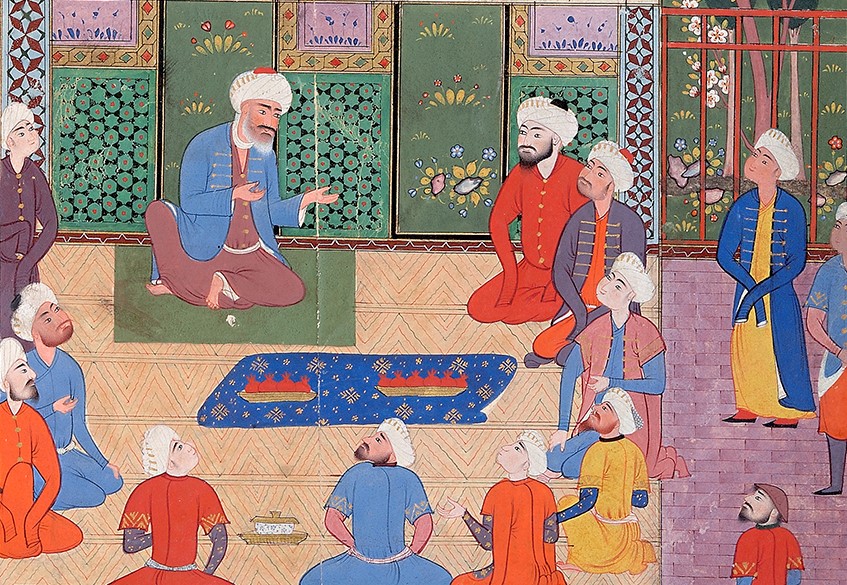
Safi-ad-Din Esḥāq Ardabili was a poet, mystic, teacher and Sufi master of Kurdish origin. He was the son-in-law and spiritual heir of the Sufi master Zahed Gilani, whose order—the Zahediyeh—he reformed and renamed the Safaviyya, which he led from 1301 to 1334.
Read the full pageSafi-ad-Din Esḥāq Ardabili (Persian: صفیالدین اسحاق اردبیلی, romanized: Ṣafī ad-Dīn Isḥāq Ardabīlī; 1252/3 – 1334) was a poet, mystic, teacher and Sufi master of Kurdish origin. He was the son-in-law and spiritual heir of the Sufi master Zahed Gilani, whose order—the Zahediyeh—he reformed and renamed the Safaviyya, which he led from 1301 to 1334. The oldest extant book on the genealogy of the Safavid family and the only one that is pre-1501 is titled Safwat as-Safa and was written by Ibn Bazzaz, a disciple of Sheikh Sadr-al-Din Ardabili, the son of the Sheikh Safi-ad-din Ardabili. Safi was the eponymous ancestor of the Safavid dynasty, which ruled Iran from 1501 to 1736.
Safi was born in 1252/3 in the town of Ardabil, located in Azerbaijan—a region corresponding to the northwestern part of Iran—then under Mongol rule. The town—a commercial centre during this period—was situated in a mountainous area, near the Caspian Sea. Safi's father was Amin al-Din Jibrail, while his mother was named Dawlati. His oldest paternal ancestor was of Kurdish origin, and spoke Persian as their primary language. The life of Safi's father is obscure; Ibn Bazzaz, whose report is distorted, states that Amin al-Din Jibrail died when Safi was six, while Hayati Tabrizi reports that he was born in 1216 and died in 1287.
- 8
 PhilosopherIslamic1313 – 1374
Ibn al-Khatib
Lisan ad-Din Ibn al-Khatib was an Arab Andalusi polymath who was active as a poet, writer, historian, philosopher, physician and politician from Emirate of Granada. Being one of the most notable poets from Granada, his poems decorate the walls of the palace of Alhambra.
Read the full pageLisan ad-Din Ibn al-Khatib (Arabic: لسان الدين ابن الخطيب; 16 November 1313 – 1374) was an Arab Andalusi polymath who was active as a poet, writer, historian, philosopher, physician and politician from Emirate of Granada. Being one of the most notable poets from Granada, his poems decorate the walls of the palace of Alhambra. He is known for composing the muwashshaḥāt "Jadaka al-Ghaithu" and possibly "Lamma Bada Yatathanna."
Ibn Al-Khatib is highly esteemed both as a historian and as a poet. He was a contemporary and acquaintance of Ibn Khaldun.
- 9
 PhilosopherIslamic1332 – 1406
Ibn Khaldūn
Historian-philosopher whose Muqaddimah theorised the rise and fall of civilisations through group solidarity (ʿaṣabiyya).
- ◆Asabiyyah
- ◆Conquest theory of state formation
- ◆Cyclical theory of empires
- ◆Supply and demand theory
- ◆Supply-side economics
Read the full pageIbn Khaldūn (27 May 1332 – 17 March 1406, 732–808 AH) was an Arab Tunisian scholar, historian, philosopher, and sociologist. He is widely acknowledged to be one of the greatest social scientists of the Middle Ages, and is considered by a number of scholars to be the father of historiography, sociology, economics, and demography studies.
His best-known book is the Muqaddimah or Prolegomena ("Introduction"), which he wrote in six months as he states in his autobiography. It later influenced 17th-century and 19th-century Ottoman historians such as Kâtip Çelebi, Mustafa Naima and Ahmed Cevdet Pasha, who used its theories to analyze the growth and decline of the Ottoman Empire. Ibn Khaldun interacted with Tamerlane, the founder of the Timurid Empire.