Modern European thinkers, medieval
- 1
 PhilosopherModern European1395 – 1472
George of Trebizond
George of Trebizond was a Byzantine Greek philosopher, scholar, and humanist.
Read the full pageGeorge of Trebizond (Greek: Γεώργιος Τραπεζούντιος; 1395–1486) was a Byzantine Greek philosopher, scholar, and humanist.
He was born on the Greek island of Crete (then a Venetian colony known as the Kingdom of Candia), and derived his surname Trapezuntius (Τραπεζούντιος) from the fact that his ancestors were from the Byzantine Greek Trapezuntine Empire.
- 2
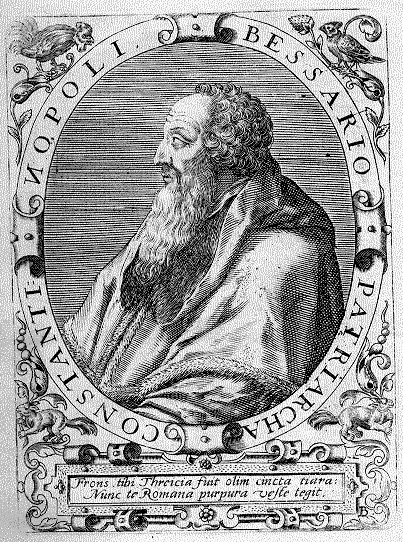 PhilosopherModern European1403 – 1472
Basilios Bessarion
Bessarion was a Byzantine Greek Renaissance humanist, theologian, Catholic cardinal and one of the famed Greek scholars who contributed to the revival of letters in the 15th century. He was educated by Gemistus Pletho in Neoplatonic philosophy and later served as the titular Latin Patriarch of Constantinople.
Read the full pageBessarion (Greek: Βησσαρίων; 2 January 1403 – 18 November 1472) was a Byzantine Greek Renaissance humanist, theologian, Catholic cardinal and one of the famed Greek scholars who contributed to the revival of letters in the 15th century. He was educated by Gemistus Pletho in Neoplatonic philosophy and later served as the titular Latin Patriarch of Constantinople. He eventually was named a cardinal and was twice considered for the papacy.
His baptismal name was Basil (Greek: Βασίλειος, Basileios or Basilios). He took the name Bessarion upon entering the monastery. He has been mistakenly known also as Johannes Bessarion (Italian: Giovanni Bessarione) due to an erroneous interpretation of Gregory III Mammas.
- 3
 PhilosopherModern European1413 – 1463
Catherine of Bologna
Catherine of Bologna was an Italian Poor Clare, writer, teacher, mystic, artist, and saint. The patron saint of artists and against temptations, she was venerated for nearly three centuries in her native Bologna before being formally canonized in 1712 by Pope Clement XI.
Read the full pageCatherine of Bologna (Bolognese: Caterina de' Vigri; 8 September 1413 – 9 March 1463) was an Italian Poor Clare, writer, teacher, mystic, artist, and saint. The patron saint of artists and against temptations, she was venerated for nearly three centuries in her native Bologna before being formally canonized in 1712 by Pope Clement XI. Her feast day is 9 March.
Catherine came from an upper-class family, the daughter of Benvenuta Mammolini of Bologna and Giovanni Vigri, a Ferrarese notary who worked for Niccolò III d'Este, Marquis of Ferrara. She was raised at Niccolo III's court as a lady-in-waiting to his wife Parisina Malatesta (d. 1425) and became lifelong friends with his natural daughter Margherita d'Este (d. 1478). During this time, she received some education in reading, writing, music, playing the viola, and had access to illuminated manuscripts in the d'Este Court library. The viola which she played is in the glass case and is thought to date from slightly earlier than her lifetime. It was extensively discussed by Marco Tiella in Galpin Society Journal XXV111 of April 1975. This information would be of interest to music scholars. A reconstruction has also been made.
- 4
 PhilosopherModern European1418 – 1495
Gabriel Biel
Gabriel Biel was a German scholastic philosopher and member of the Canons Regular of the Congregation of Windesheim, who were the clerical counterpart to the Brethren of the Common Life. Because of his reliance on the scholastic tradition, as well as nominalist views, he is credited an "articulate spokesman of the via
Read the full pageGabriel Biel (German: [biːl]; 1420 to 1425 – 7 December 1495) was a German scholastic philosopher and member of the Canons Regular of the Congregation of Windesheim, who were the clerical counterpart to the Brethren of the Common Life. Because of his reliance on the scholastic tradition, as well as nominalist views, he is credited an "articulate spokesman of the via moderna and … a discerning user of the thought of via antiqua" (Oberman, 11). He has been called ultimus scholasticorum, the last of the schoolmen.
Biel was born in Speyer. In 1432 he was ordained to the priesthood and entered Heidelberg University to obtain a baccalaureate. He succeeded academically and became an instructor in the faculty of the arts for three years, until he pursued a higher degree at the University of Erfurt. His first stay was brief, lasting only until he transferred to the University of Cologne. He did not complete his degree there either, and would return to Erfurt in 1451 to finish. The curriculum at these two universities varied greatly, with Cologne stressing Thomas Aquinas and overall scholastic curricula heavily, and Erfurt emphasizing William of Ockham. During the early 1460s, he became a preacher in the Cathedral of Mainz, of which he was vicar.