Modern European thinkers, early 20th century: Bonnefoy to Sollers
- 1
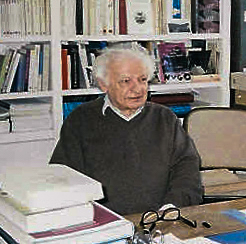 PhilosopherModern European1923 – 2016
Yves Bonnefoy
Yves Jean Bonnefoy was a French poet and art historian. He also published a number of translations, most notably the plays of William Shakespeare which are considered among the best in French.
Read the full pageYves Jean Bonnefoy (24 June 1923, Tours – 1 July 2016, Paris) was a French poet and art historian. He also published a number of translations, most notably the plays of William Shakespeare which are considered among the best in French. He was a professor at the Collège de France from 1981 to 1993 and is the author of several works on art, art history, and artists including Miró and Giacometti, and a monograph on Paris-based Iranian artist Farhad Ostovani. The Encyclopædia Britannica states that Bonnefoy was ″perhaps the most important French poet of the latter half of the 20th century.″
Bonnefoy was born in Tours, Indre-et-Loire, the son of Marius Elie Bonnefoy, a railroad worker, and Hélène Maury, a teacher. He studied mathematics and philosophy at the Universities of Poitiers and the Sorbonne in Paris. After the Second World War he travelled in Europe and the United States and studied art history. From 1945 to 1947 he was associated with the Surrealists in Paris (a short-lived influence that is at its strongest in his first published work, Traité du pianiste (1946)). But it was with the highly personal Du mouvement et de l'immobilité de Douve (On the Motion and Immobility of Douve, 1953) that Bonnefoy found his voice and that his name first came to public notice. Bonnefoy's style is remarkable for the deceptive simplicity of its vocabulary.
- 2PhilosopherModern European1923 – 2016
Ernst Nolte
Ernst Nolte was a German historian and philosopher. Nolte's major interest was the comparative studies of fascism and communism (cf.
- ◆Historikerstreit
Read the full pageErnst Nolte (11 January 1923 – 18 August 2016) was a German historian and philosopher. Nolte's major interest was the comparative studies of fascism and communism (cf. Comparison of Nazism and Stalinism). Originally trained in philosophy, he was professor emeritus of modern history at the Free University of Berlin, where he taught from 1973 until his 1991 retirement. He was previously a professor at the University of Marburg from 1965 to 1973. He was best known for his seminal work Fascism in Its Epoch, which received widespread acclaim when it was published in 1963. Nolte was a prominent academic from the early 1960s and was involved in many controversies related to the interpretation of the history of fascism and communism, including the Historikerstreit in the late 1980s. In later years, Nolte focused on Islamism and "Islamic fascism".
Nolte received several awards, including the Hanns Martin Schleyer Prize and the Konrad Adenauer Prize. He was the father of the legal scholar and judge of the International Court of Justice Georg Nolte.
- 3
 PhilosopherModern European1923 – 1995
Ernest Mandel
Ernest Ezra Mandel, also known by various pseudonyms such as Ernest Germain, Pierre Gousset, Henri Vallin, Walter, was a Belgian Marxian economist, Trotskyist activist and theorist, and Holocaust survivor. He fought in the underground resistance against the Nazis during the occupation of Belgium.
Read the full pageErnest Ezra Mandel (Dutch: [ˈɛrnəst mɑnˈdɛl]; 5 April 1923 – 20 July 1995), also known by various pseudonyms such as Ernest Germain, Pierre Gousset, Henri Vallin, Walter, was a Belgian Marxian economist, Trotskyist activist and theorist, and Holocaust survivor. He fought in the underground resistance against the Nazis during the occupation of Belgium.
Born in Frankfurt, Mandel was recruited to the Belgian section of the international Trotskyist movement, the Fourth International, in his youth in Antwerp. His parents, Henri and Rosa Mandel, were Jewish emigres from Poland, the former a member of Rosa Luxemburg's and Karl Liebknecht's Spartacist League. The beginning of Mandel's period at university was interrupted when the German occupying forces closed the university.
- 4
 PhilosopherModern European1925 – 2003
Alija Izetbegović
Alija Izetbegović was a Bosnian politician, Islamic philosopher and author who served as the president of the presidency of the Republic of Bosnia and Herzegovina from 1990 to 1996. He later served as the first chairman of the presidency of Bosnia and Herzegovina from 1996 to 1998, and then briefly in 2000.
Read the full pageAlija Izetbegović (8 August 1925 – 19 October 2003) was a Bosnian politician, Islamic philosopher and author who served as the president of the presidency of the Republic of Bosnia and Herzegovina from 1990 to 1996. He later served as the first chairman of the presidency of Bosnia and Herzegovina from 1996 to 1998, and then briefly in 2000. He was also the founder and first president of the Party of Democratic Action.
Shortly after his term began, the country's Serb community under the leadership of the Serb Democratic Party created the Republika Srpska and attempted to prevent the secession of Bosnia and Herzegovina from Yugoslavia. This would lead to the outbreak of the Bosnian War.
- 5
 PhilosopherModern European1926 – 2002
Ivan Illich
Ivan Dominic Illich was an Austrian Catholic priest, theologian, philosopher, and social critic. His 1971 book Deschooling Society criticises modern society's institutional approach to education, an approach that he argued demotivates and alienates individuals from the process of learning.
Read the full pageIvan Dominic Illich ( iv-AHN IL-itch, Austrian German: [ˈiːvan ˈɪlɪtʃ]; 4 September 1926 – 2 December 2002) was an Austrian Catholic priest, theologian, philosopher, and social critic. His 1971 book Deschooling Society criticises modern society's institutional approach to education, an approach that he argued demotivates and alienates individuals from the process of learning. His 1975 book Medical Nemesis, importing to the sociology of medicine the concept of medical harm, in which he argues that industrialised society impairs quality of life through processes such as overmedicalisation, the pathologisation of normal conditions, and increased dependency on medical institutions. Illich called himself "an errant pilgrim."
Ivan Dominic Illich was born on 4 September 1926 in Vienna, Austria, to Ivan Peter and Ellen Rose (née Regenstreif-Ortlieb) Illich. His father was a civil engineer and a diplomat from a landed Catholic family of Dalmatia, with property in the city of Split and wine and olive oil estates on the island of Brač. His mother came from a Sephardic Jewish family that had converted to Christianity from Germany and Austria-Hungary (Czernowitz, Bukowina). Ellen Illich was baptized Lutheran but converted to Catholicism upon marriage. Her father, Friedrich "Fritz" Regenstreif, was an industrialist who made his money in the lumber trade in Bosnia, later settling in Vienna, where he built an art nouveau villa.
- 6
 PhilosopherModern European1928 – 2021
Hans Küng
Hans Küng was a Swiss Catholic priest, theologian, and author. He was a leading and often controversial figure in modern Catholic thought, known for his critique of papal infallibility and his advocacy of a re-examination of Catholic doctrine.
Read the full pageHans Küng (German: [ˈhans ˈkʏŋ]; 19 March 1928 – 6 April 2021) was a Swiss Catholic priest, theologian, and author. He was a leading and often controversial figure in modern Catholic thought, known for his critique of papal infallibility and his advocacy of a re-examination of Catholic doctrine. He served as a theological adviser (peritus) at the Second Vatican Council (1962–1965) and was Professor of Ecumenical Theology at the University of Tübingen from 1960 until his retirement in 1996.
His views led to prolonged conflict with Church authorities, and in 1979 the Vatican revoked his authorization to teach Catholic theology. Küng later focused on interreligious dialogue and global ethics, serving as president of the Foundation for a Global Ethic from 1995. He remained a Catholic priest throughout his life and received numerous honors, including the Otto Hahn Peace Medal in 2008.
- 7
 PhilosopherModern European1928 – 2014
Wolfhart Pannenberg
Wolfhart Pannenberg was a German Lutheran theologian. He made a number of significant contributions to modern theology, including his concept of history as a form of revelation centered on the resurrection of Christ, which has been widely debated in both Protestant and Catholic theology, as well as by non-Christian thi
Read the full pageWolfhart Pannenberg (2 October 1928 – 4 September 2014) was a German Lutheran theologian. He made a number of significant contributions to modern theology, including his concept of history as a form of revelation centered on the resurrection of Christ, which has been widely debated in both Protestant and Catholic theology, as well as by non-Christian thinkers.
Pannenberg was born on 2 October 1928 in Stettin, Germany, now Szczecin, Poland. He was baptized as an infant into the Evangelical (Lutheran) Church, but otherwise had virtually no contact with the church in his early years. At about the age of sixteen, however, he had an intensely religious experience he later called his "light experience". Seeking to understand this experience, he began to search through the works of great philosophers and religious thinkers. A high school literature teacher who had been a part of the Confessing Church during the Second World War encouraged him to take a hard look at Christianity, which resulted in Pannenberg's "intellectual conversion", in which he concluded that Christianity was the best available religious option. This propelled him into his vocation as a theologian.
- 8
 PhilosopherModern European1930 – 2002
Pierre Bourdieu
Pierre Bourdieu was a French sociologist and public intellectual. Bourdieu's contributions to the sociology of education, the theory of sociology, and sociology of aesthetics have achieved wide influence in several related academic fields (e.g. anthropology, media and cultural studies, education, popular culture, and t
- ◆Cultural capital
- ◆field
- ◆habitus
- ◆doxa
- ◆reflexivity
- ◆social capital
Read the full pagePierre Bourdieu (UK: , US: ; French: [pjɛʁ buʁdjø]; Gascon: Pèir Bordièu; 1 August 1930 – 23 January 2002) was a French sociologist and public intellectual. Bourdieu's contributions to the sociology of education, the theory of sociology, and sociology of aesthetics have achieved wide influence in several related academic fields (e.g. anthropology, media and cultural studies, education, popular culture, and the arts). During his academic career he was primarily associated with the School for Advanced Studies in the Social Sciences in Paris and the Collège de France.
Bourdieu's work was primarily concerned with the dynamics of power in society, especially the diverse and subtle ways in which power is transferred and social order is maintained within and across generations. In conscious opposition to the idealist tradition of much of Western philosophy, his work often emphasized the corporeal nature of social life and stressed the role of practice and embodiment in social dynamics. Building upon and criticizing the theories of Karl Marx, Sigmund Freud, Max Weber, Émile Durkheim, Claude Lévi-Strauss, Erwin Panofsky and Marcel Mauss among others, his research pioneered novel investigative frameworks and methods, and introduced such influential concepts as cultural reproduction, habitus, field or location, and symbolic violence, as well as cultural capital, social capital, and symbolic capital (as distinct from traditionally recognized economic forms of capital). Another notable influence on Bourdieu was Blaise Pascal, after whom Bourdieu titled his Pascalian Meditations.
- 9
 PhilosopherModern Europeanborn 1931
Roger Penrose
Sir Roger Penrose is an English mathematician, mathematical physicist and philosopher of science. He is Emeritus Rouse Ball Professor of Mathematics at the University of Oxford, an emeritus fellow of Wadham College, Oxford, and an honorary fellow of St John's College, Cambridge, and University College London.
- ◆Moore–Penrose inverse
- ◆Twistor theory
- ◆Spin network
- ◆Abstract index notation
- ◆Black hole bomb
- ◆Geometry of spacetime
Read the full pageSir Roger Penrose (born 8 August 1931) is an English mathematician, mathematical physicist and philosopher of science. He is Emeritus Rouse Ball Professor of Mathematics at the University of Oxford, an emeritus fellow of Wadham College, Oxford, and an honorary fellow of St John's College, Cambridge, and University College London. He shared the 1988 Wolf Prize in Physics with Stephen Hawking for the Penrose–Hawking singularity theorems, and the 2020 Nobel Prize in Physics "for the discovery that black hole formation is a robust prediction of the general theory of relativity". He proposed the Penrose triangle and corresponded with M. C. Escher, influencing his Waterfall and Ascending and Descending. Penrose's eponymous aperiodic tiling presaged Dan Shechtman's discovery of quasicrystals.
Penrose won the Royal Society Science Book Prize for The Emperor's New Mind (1989), which outlines his views on physics and consciousness. He expanded on these ideas in Shadows of the Mind (1994) and The Large, the Small and the Human Mind (1997), the latter written with Stuart Hameroff. His The Road to Reality, (2004), billed as "A Complete Guide to the Laws of the Universe", is an overview of mathematical physics.
- 10
 PhilosopherModern European1931 – 2013
Colin Wilson
Colin Henry Wilson was an English existentialist philosopher-novelist. He also wrote widely on true crime, mysticism and the paranormal, eventually writing more than a hundred books.
Read the full pageColin Henry Wilson (26 June 1931 – 5 December 2013) was an English existentialist philosopher-novelist. He also wrote widely on true crime, mysticism and the paranormal, eventually writing more than a hundred books. Wilson called his philosophy "new existentialism" or "phenomenological existentialism", and maintained his life work was "that of a philosopher, and (his) purpose to create a new and optimistic existentialism".
Wilson was born on 26 June 1931 in Leicester, the first child of Arthur and Annetta Wilson. His father worked in a shoe factory. At the age of eleven he attended Gateway Secondary Technical School, where his interest in science began to blossom. By the age of 14 he had compiled a multi-volume work of essays covering many aspects of science entitled A Manual of General Science. But by the time he left school at sixteen, his interests were already switching to literature. His discovery of George Bernard Shaw's work, particularly Man and Superman, was a landmark. He started to write stories, plays, and essays in earnest – a long "sequel" to Man and Superman made him consider himself to be 'Shaw's natural successor.' After two unfulfilling jobs – one as a laboratory assistant at his old school – he drifted into the Civil Service, but found little to occupy his time.
- 11
 PhilosopherModern European1932 – 2026
Ervin Laszlo
Ervin László was a Hungarian-American philosopher of science, systems theorist, integral theorist and classical pianist. He was an advocate of the theory of quantum consciousness.
- ◆Quantum consciousness
- ◆Akashic field
- ◆Evolutionary Systems Theory
Read the full pageErvin László (Hungarian: [ˈɛrvin ˈlaːsloː]; 12 June 1932 – 29 June 2026) was a Hungarian-American philosopher of science, systems theorist, integral theorist and classical pianist. He was an advocate of the theory of quantum consciousness.
László was born in Budapest, Hungary on 12 June 1932. His father was a shoe manufacturer, and his mother played the piano.
- 12
 PhilosopherModern European1936 – 2023
Philippe Sollers
Philippe Sollers was a French writer, critic and editor.
Read the full pagePhilippe Sollers (French: [sɔlɛʁs]; born Philippe Joyaux; 28 November 1936 – 5 May 2023) was a French writer, critic and editor.
Sollers was born as Philippe Joyaux on 28 November 1936, in Talence, France. His family ran the local Société Joyaux Frères, the iron factory Recalt producing material for kitchens, metal constructions and machines for the aircraft manufacturer SNCASO under the German military administration in occupied France during World War II. His parents were Octave Joyaux and Marcelle Molinié. He moved to Paris in 1955 and studied at the Lycée privé Sainte-Geneviève of Versailles and at the ESSEC Business School.