Jain philosophy
Non-violence, many-sidedness of truth (anekāntavāda) and the liberation of the soul from karmic matter.
- 1SchoolIndian500 BCE – present
Jain philosophy
Non-violence, many-sidedness of truth (anekāntavāda) and the liberation of the soul from karmic matter.
- ◆Ahiṃsā
- ◆Anekāntavāda
- ◆Syādvāda — "in some respect"
Read the full pageJain philosophy or Jaina philosophy refers to the ancient Indian philosophical system of the Jain religion. It comprises all the philosophical investigations and systems of inquiry that developed among the early branches of Jainism in ancient India following the nirvana of the 24th Tirthankar, Mahāvīra (c. 6th century BCE). One of the main features of Jain philosophy is its dualistic metaphysics, which holds that there are two distinct categories of existence: the living, conscious, or sentient entities (jīva) and the non-living or material entities (ajīva).
Jain texts discuss numerous philosophical topics such as cosmology, epistemology, ethics, metaphysics, ontology, the philosophy of time, and soteriology. Jain thought is primarily concerned with understanding the nature of living beings, how these beings are bound by the processes of karma (which are seen as fine material particles) and how living beings may be liberated (moksha) from the cycle of death and rebirth (saṃsāra). A peculiarity of Jainism is to essentially associate several renunciatory liberating practices with the imperative of non-violence (ahiṃsā). Jainism and its philosophical system are also notable for the belief in a beginning-less and cyclical universe, which posits a non-theistic understanding of the world and the complete rejection of a hypothetical creator deity. Jain philosophy is also noted for its "realist epistemology" of anekāntavāda ("many-sidedness"), a rejection of all simplistic and one-sided views of truth and reality.
- 2
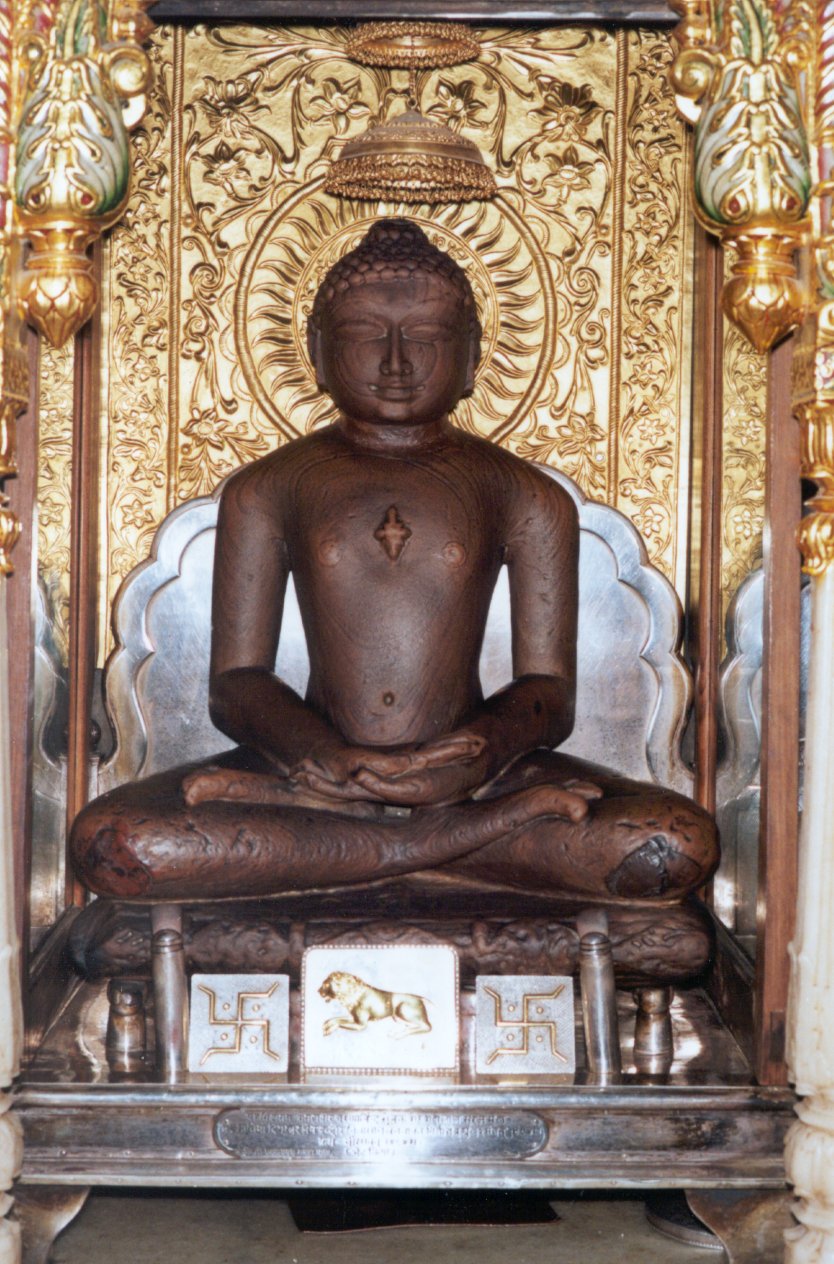 PhilosopherIndianc. 599 – 527 BCE
Mahāvīra
The 24th Jain tīrthaṅkara, who taught radical non-violence and the many-sidedness of truth.
- ◆Ahiṃsā
- ◆Anekāntavāda
- ◆Asceticism
Read the full pageMahavira (Mahāvīra), also known by his birth name Vardhamana (Vardhamāna), was an Indian religious reformer and spiritual leader, considered by Jains to be the 24th and final Tirthankara (Supreme Preacher) in the current time cycle of Jain cosmology. He is believed by historians to have lived in the 6th or 5th century BCE, reviving and reforming an earlier Jain or proto-Jain community which had likely been led by Pārśvanātha, whom Jains consider to be Mahavira's predecessor. Although the dates of Mahavira's life are uncertain and historically reliable information is scarce, and traditional accounts vary by sectarian traditions, the historicity of Mahavira is well-established and not in dispute among scholars.
According to traditional legends and hagiographies, Mahavira was born in 599 BCE to a ruling royal kshatriya Jain family of the Nāya tribe in what is now Bihar in India. According to traditional sources like the Ācārāṅga Sūtra, the Nāyas were followers of Parshvanatha, Mahavira's predecessor. Mahavira abandoned all worldly possessions at the age of about 30 and left home in pursuit of spiritual awakening, becoming an ascetic. Mahavira practiced intense meditation and severe austerities for twelve and a half years, after which he attained Kevala Jnana (omniscience). He preached for 30 years and attained moksha (liberation) when he died.