Eleatic school
Parmenides and Zeno argued that change and plurality are illusions; being is one and unchanging.
- 1
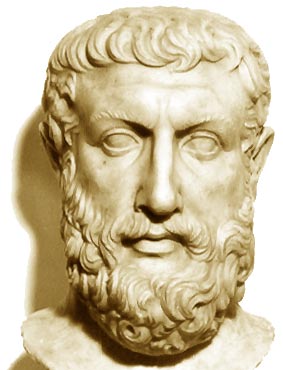 SchoolGreek & Roman500 – 400 BCE
Eleatic school
Parmenides and Zeno argued that change and plurality are illusions; being is one and unchanging.
Read the full pageThe Eleatics were a group of pre-Socratic philosophers and school of thought in the 5th century BC centered around the ancient Greek colony of Elea (Ancient Greek: Ἐλέα), located around 80 miles south-east of Naples in southern Italy, then known as Magna Graecia.
The primary philosophers who are associated with the Eleatic doctrines are Parmenides, Zeno of Elea, and Melissus of Samos, although other Italian philosophers such as Xenophanes of Colophon and Empedocles have also sometimes been classified as members of this movement. The Eleatics have traditionally been seen as advocating a strict metaphysical view of monism in response to the materialist monism advocated by their predecessors, the Ionian school.
- 2
 PhilosopherGreek & Romanc. 490 – 430 BCE
Zeno of Elea
Defended Parmenides with paradoxes showing motion and plurality lead to absurdity.
- ◆Achilles and the tortoise
- ◆The dichotomy
- ◆The arrow
Read the full pageZeno of Elea (; Ancient Greek: Ζήνων ὁ Ἐλεάτης; c. 490 – c. 430 BC) was a pre-Socratic Greek philosopher from Elea, in what is now Southern Italy (Magna Graecia). He was a student of Parmenides and one of the Eleatics. Zeno defended his instructor's belief in monism, the idea that only one single entity exists that makes up all of reality. He rejected the existence of space, time, and motion. To disprove these concepts, he developed a series of paradoxes to demonstrate why they are impossible. Though his original writings are lost, subsequent descriptions by Plato, Aristotle, Diogenes Laertius, and Simplicius of Cilicia have allowed study of his ideas.
Zeno's arguments are divided into two different types: his arguments against plurality, or the existence of multiple objects, and his arguments against motion. Those against plurality suggest that for anything to exist, it must be divisible infinitely, meaning it would necessarily have both infinite mass and no mass simultaneously. Those against motion invoke the idea that distance must be divisible infinitely, meaning infinite steps would be required to cross any distance.