Atomism
Everything is made of indivisible particles moving in the void.
- 1SchoolGreek & Roman460 BCE – present
Atomism
Everything is made of indivisible particles moving in the void.
- ◆Atoms and void
- ◆Mechanism without purpose
Read the full pageAtomism (from Ancient Greek ἄτομον (atomon) 'uncuttable, indivisible') is a natural philosophy proposing that the physical universe is composed of fundamental indivisible components known as atoms.
The concept of atomism appeared in both ancient Greek and ancient Indian philosophical traditions. Atomism in multiple different forms originated in ancient Greece. The word atom is derived from the term atomos ("uncuttable") used by the Greek philosophers Leucippus and his pupil Democritus, who developed this idea in the 5th century BC. Leucippus, Democritus, and other ancient Greek atomists argued that nature consists of two fundamental principles: atoms and void. Clusters of different shapes, arrangements, and positions give rise to the various macroscopic substances in the world.A similar idea was developed by Kanāda of the Vaiśeṣika school, who proposed indivisible particles (paramāṇu). Indian Buddhists, such as Dharmakirti (fl. c. 6th or 7th century) and others, developed distinctive theories of atomism, for example, involving momentary (instantaneous) atoms (kalapas) that flash in and out of existence.
- 2
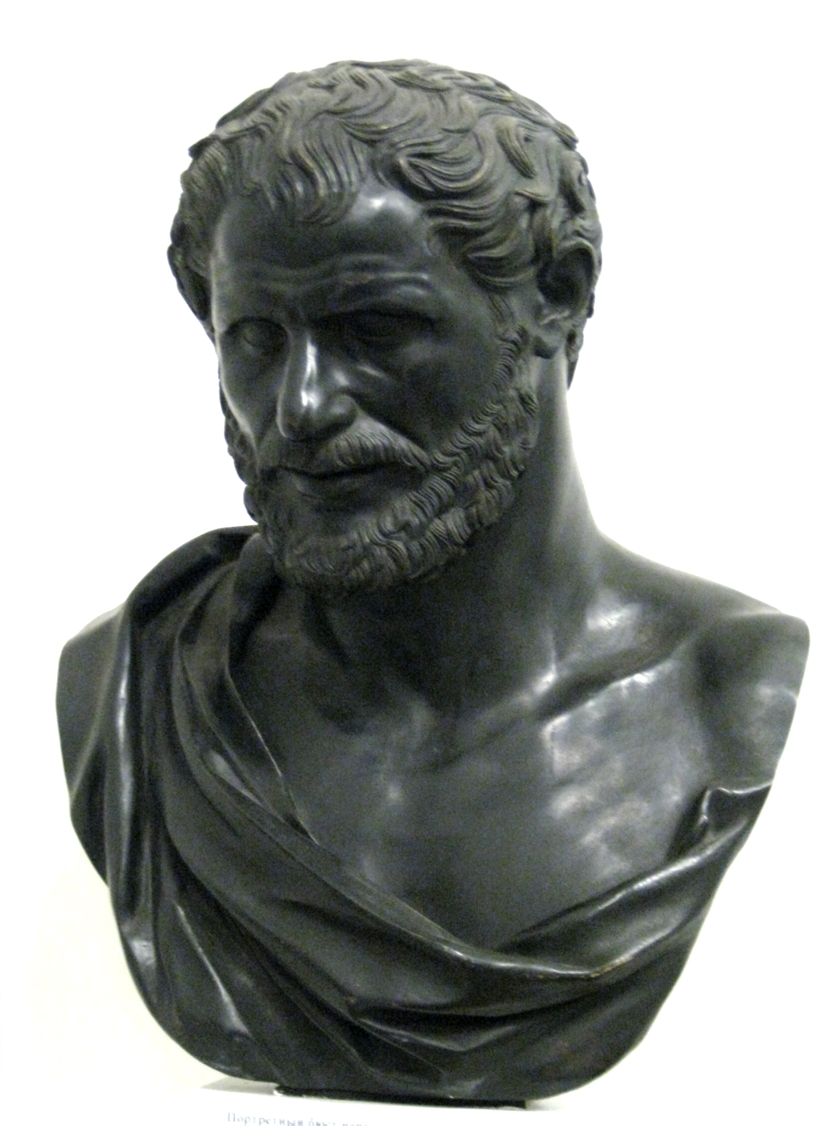 PhilosopherGreek & Romanc. 460 – 370 BCE
Democritus
The "laughing philosopher" who held that the world consists of atoms moving in the void.
- ◆Atoms and void
- ◆Secondary qualities exist only by convention
- ◆Cheerfulness as the goal
Read the full pageDemocritus ( dih-MOK-rih-təs; Greek: Δημόκριτος, Dēmókritos; c. 460 – c. 370 BC) was a pre-Socratic Greek philosopher from Abdera, primarily remembered today for his formulation of an atomic theory of the universe. Democritus wrote extensively on a wide variety of topics.
None of Democritus' original work has survived, except through second-hand references. Many of these references come from Aristotle, who viewed him as an important rival in the field of natural philosophy. He was known in antiquity as the 'laughing philosopher' because of his emphasis on the value of cheerfulness.
- 3PhilosopherGreek & Romanc. 460 – 370 BCE
Democritus
The "laughing philosopher" who held that the world consists of atoms moving in the void.
- ◆Atoms and void
- ◆Secondary qualities exist only by convention
- ◆Cheerfulness as the goal
Read the full pageDemocritus ( dih-MOK-rih-təs; Greek: Δημόκριτος, Dēmókritos; c. 460 – c. 370 BC) was a pre-Socratic Greek philosopher from Abdera, primarily remembered today for his formulation of an atomic theory of the universe. Democritus wrote extensively on a wide variety of topics.
None of Democritus' original work has survived, except through second-hand references. Many of these references come from Aristotle, who viewed him as an important rival in the field of natural philosophy. He was known in antiquity as the 'laughing philosopher' because of his emphasis on the value of cheerfulness.
- 4
 PhilosopherGreek & Roman99 – 55 BCE
Lucretius
Roman poet whose De Rerum Natura set out Epicurean atomism in magnificent verse.
- ◆Naturalistic
Read the full pageTitus Lucretius Carus ( TY-tuhs loo-KREE-shuhs; Latin: [ˈtitʊs lʊˈkreːtɪ.ʊs ˈkaːrʊs]; c. 99 – October 15, 55 BC) was a Roman poet and philosopher. His only known work is the philosophical poem De rerum natura, a didactic work about the tenets and philosophy of Epicureanism, which usually is translated into English as On the Nature of Things—and somewhat less often as On the Nature of the Universe.
Very little is known about Lucretius's life; the only certainty is that he was either a friend or client of Gaius Memmius, to whom the poem was addressed and dedicated. De rerum natura was a considerable influence on the Augustan poets, particularly Virgil (in his Aeneid and Georgics, and to a lesser extent on the Eclogues) and Horace. The work was almost lost during the Middle Ages, but was rediscovered in 1417 in a monastery in Germany by Poggio Bracciolini. It played an important role both in the development of atomism (Lucretius was an important influence on Pierre Gassendi) and the efforts of various figures of the Enlightenment era to construct a new Christian humanism.
- 5
 PhilosopherModern European1592 – 1655
Pierre Gassendi
Pierre Gassendi was a French philosopher, Catholic priest, astronomer, and mathematician. While he held a church position in south-east France, he also spent much time in Paris, where he was a leader of a group of free-thinking intellectuals.
- ◆''Calor vitalis'' (vital heat)
Read the full pagePierre Gassendi (French: [pjɛʁ gasɛ̃di]; born Pierre Gassend, Latinized Petrus Gassendus; 22 January 1592 – 24 October 1655) was a French philosopher, Catholic priest, astronomer, and mathematician. While he held a church position in south-east France, he also spent much time in Paris, where he was a leader of a group of free-thinking intellectuals. He was also an active observational scientist, publishing the first data on the transit of Mercury in 1631. The lunar crater Gassendi is named after him.
He wrote numerous philosophical works, and some of the positions he worked out are considered significant, finding a way between skepticism and dogmatism. Richard Popkin indicates that Gassendi was one of the first thinkers to formulate the modern "scientific outlook", of moderated skepticism and empiricism. He clashed with his contemporary Descartes on the possibility of certain knowledge. His best known intellectual project attempted to reconcile Epicurean atomism with Christianity.