Philosophy of mind
What is the mind, and how does it relate to the body and brain?
- 1
- ◆The mind–body problem
- ◆Consciousness and qualia
- ◆Mental causation
- ◆Artificial minds
Read the full pagePhilosophy of mind is a branch of philosophy that deals with the nature of the mind and its relation to the body and the external world.
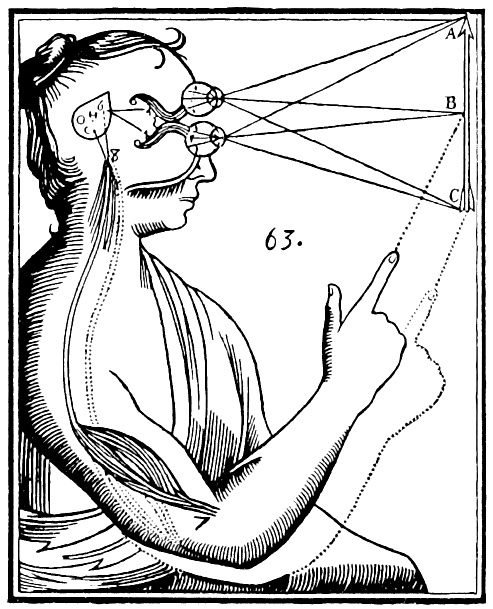
The mind–body problem is a paradigmatic issue in philosophy of mind, although a number of other issues are addressed; these include the hard problem of consciousness and the nature of particular mental states. Aspects of the mind that are studied include mental events, mental functions, mental properties, consciousness and its neural correlates, the ontology of the mind, the nature of cognition and of thought, and the relationship of the mind to the body.
- 2ConceptModern European
Bundle theory of the self
Hume's view that the self is nothing but a bundle of perceptions — strikingly close to Buddhist no-self.
Read the full pageBundle theory, originated by the 18th century Scottish philosopher David Hume, is the ontological theory about objecthood in which an object comprises a collection (bundle) of properties, relations or tropes.
According to bundle theory, an object consists of its properties and nothing more; thus, there cannot be an object without properties and one cannot conceive of such an object. For example, the thought of an apple brings to mind its properties: redness, roundness, being a type of fruit, etc. There is nothing above and beyond these properties; the apple is nothing more than the collection of its properties. In particular, there is no substance in which the properties are inherent.
- Read the full page
Consciousness is being aware of something internal to one's self, or of states or objects in one's external environment. It has been the topic of extensive explanations, analyses, and debate among philosophers, scientists, and theologians for millennia. There is no consensus on what exactly needs to be studied, or whether consciousness can be considered a scientific concept. In some explanations it is synonymous with mind, while in others it is considered an aspect of it.
In the past, consciousness meant one's "inner life": the world of introspection, private thought, imagination, and volition. Today, it often includes various forms of cognition, experience, feeling, or perception. It may be awareness, awareness of awareness, metacognition, or self-awareness, either continuously changing or not. There is also a medical definition that helps, for example, to discern "coma" from other states. The disparate range of research, notions, and speculations raises some curiosity about whether the right questions are being asked.
- 4
 ConceptAmericas
Hard problem of consciousness
Why is there something it is like to have a brain at all — why does physical processing feel like anything?
Read the full pageIn philosophy of mind, the hard problem of consciousness (or simply the hard problem) is to explain how and why organisms have qualia, phenomenal consciousness, or subjective experience. It is contrasted with the "easy problems" of explaining why and how physical systems give rise to the ability to discriminate, to integrate information, and to perform behavioural functions such as watching, listening, speaking (including generating an utterance that appears to refer to personal behaviour or belief), and so forth. The easy problems are amenable to functional explanation—that is, explanations that are mechanistic or behavioural—since each physical system can be explained purely by reference to the "structure and dynamics" that underpin the phenomenon.
Proponents of the hard problem hold that it is categorically different from the easy problems since no mechanistic or behavioural explanation could explain the character of an experience, not even in principle. Even after all the relevant functional facts are explicated, they argue, there will still remain a further question: "Why is the performance of these functions accompanied by experience?" To bolster their case, proponents of the hard problem frequently turn to various philosophical thought experiments, involving philosophical zombies, or inverted qualia, or the ineffability of colour experiences, or the unknowability of foreign states of consciousness, such as the experience of being a bat.
- 5Read the full page
Intentionality is the mental ability to refer to or represent something. Sometimes regarded as the mark of the mental, it is found in mental states like perceptions, beliefs or desires. For example, the perception of a tree has intentionality because it represents a tree to the perceiver. A central issue for theories of intentionality has been the problem of intentional inexistence: to determine the ontological status of the entities which are the objects of intentional states.
An early theory of intentionality is associated with Anselm of Canterbury's ontological argument for the existence of God, and with his tenets distinguishing between objects that exist in the understanding and objects that exist in reality. The idea fell out of discussion with the end of the medieval scholastic period, but in recent times was resurrected by empirical psychologist Franz Brentano and later adopted by contemporary phenomenological philosopher Edmund Husserl. Today, intentionality is a live concern among philosophers of mind and language. A common dispute is between naturalism, the view that intentional properties are reducible to natural properties as studied by the natural sciences, and the phenomenal intentionality theory, the view that intentionality is grounded in consciousness.
- Read the full page
In philosophy of mind, mind–body dualism denotes either that mental phenomena are non-physical, or that the mind and body are distinct and separable. Thus, it encompasses a set of views about the relationship between mind and matter, as well as between subject and object, and is contrasted with other positions, such as physicalism and enactivism, in the mind–body problem.
Aristotle shared Plato's view of multiple souls and further elaborated a hierarchical arrangement, corresponding to the distinctive functions of plants, animals, and humans: a nutritive soul of growth and metabolism that all three share; a perceptive soul of pain, pleasure, and desire that only humans and other animals share; and the faculty of reason that is unique to humans only. In this view, a soul is the hylomorphic form of a viable organism, wherein each level of the hierarchy formally supervenes upon the substance of the preceding level. For Aristotle, the first two souls, based on the body, perish when the living organism dies, whereas there remains an immortal and perpetual intellective part of mind. For Plato, however, the soul was not dependent on the physical body; he believed in metempsychosis, the migration of the soul to a new physical body. It has been considered a form of reductionism by some philosophers, since it enables the tendency to ignore very big groups of variables by its assumed association with the mind or the body, and not for its real value when it comes to explaining or predicting a studied phenomenon.
- Read the full page
In philosophy of mind, qualia (; singular: quale ) are defined as instances of subjective experience. The term qualia derives from the Latin neuter plural form (qualia) of the Latin adjective quālis (Latin pronunciation: [ˈkʷaːlɪs]) meaning "of what sort" or "of what kind" in relation to a specific instance, such as "what it is like to taste a specific apple — this particular apple now".
Examples of qualia include the perceived sensation of pain of a headache, the taste of wine, and the redness of an evening sky. As qualitative characteristics of sensations, qualia stand in contrast to propositional attitudes, where the focus is on beliefs about experience rather than what it is directly like to be experiencing.