The ages of philosophy
- 1Era800 – 200 BCE
Axial Age
The remarkable centuries when Confucius, the Buddha, the Upaniṣadic sages, the Hebrew prophets and the Greek philosophers transformed human thought at almost the same time.
Read the full pageThe German philosopher Karl Jaspers coined the term Axial Age for the period roughly between 800 and 200 BCE, when — independently, in China, India, Persia, the Levant and Greece — thinkers began to reflect critically on the human condition. Confucius and Laozi, the Buddha and Mahāvīra, the authors of the Upaniṣads, Zoroaster, the Hebrew prophets and the Greek philosophers all belong to it.
Whether the age is a real historical pattern or a convenient story is still debated, but the coincidence is striking: in each place, myth gave way to argument, personal ethics became central, and ideas of a universal moral order emerged.
- 2
 Era600 BCE – 476 CE
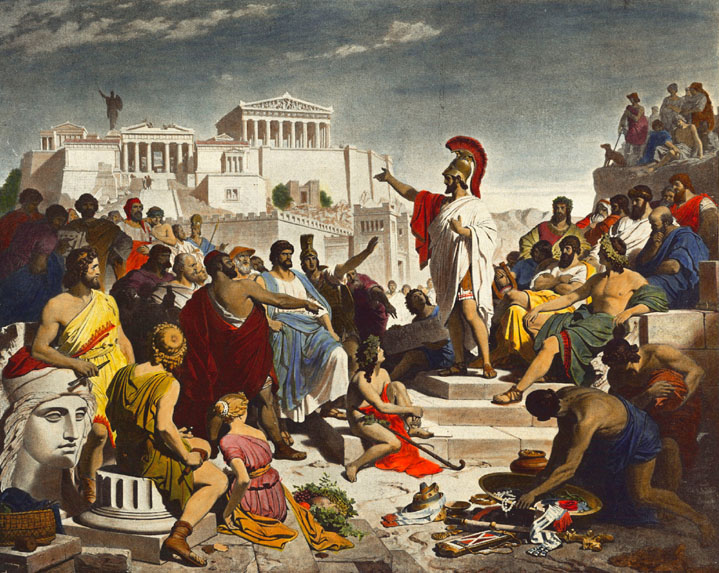
Classical antiquity
The Greek and Roman world from the Presocratics to the fall of the Western Roman Empire.
Read the full pageClassical antiquity, also known as the classical era, classical period, classical age, or simply antiquity, is the period of cultural European history between the 8th century BC and the 5th century AD, following the Greek Dark Ages and being succeeded by late antiquity. It comprises the interwoven civilizations of ancient Greece and Rome, known together as the Greco-Roman world, which played a major role in shaping the culture of the Mediterranean basin. It is the period during which ancient Greece and Rome flourished and had major influence throughout much of Europe, North Africa, and West Asia.
Conventionally, it is often considered to begin with the earliest recorded Epic Greek poetry of Homer (8th–7th centuries BC) and end with the fall of the Western Roman Empire in 476 AD. Such a wide span of history and territory covers many disparate cultures and periods. Classical antiquity may also refer to an idealized vision among later people of what was, in Edgar Allan Poe's words, "the glory that was Greece, and the grandeur that was Rome".
- 3
 Era323 – 31 BCE
Hellenistic period
After Alexander: Stoics, Epicureans and Skeptics turned philosophy into an art of living.
Read the full pageIn classical antiquity, the Hellenistic period covers the time in Greek, Eastern Mediterranean and West Asian history following Classical Greece, between the death of Alexander the Great in 323 BC and the death of Cleopatra VII in 30 BC, in which all these regions were under the influence of Greek leadership, culture, and language as a result of Alexander's conquests.
After the military campaigns of Alexander the Great, the subsequent conquest of the Achaemenid Empire in 330 BC, its disintegration shortly thereafter in the Partition of Babylon and subsequent Wars of the Diadochi, Greek kingdoms were established throughout West Asia (Seleucid Empire, Kingdom of Pergamon), Northeast Africa (Ptolemaic Kingdom) and South Asia (Greco–Bactrian Kingdom, Indo-Greek Kingdom). This resulted in an influx of Greek colonists and the export of Greek culture and language to these new realms, a breadth spanning as far as modern-day India. These new Greek kingdoms were also influenced by regional indigenous cultures, adopting local practices which were deemed beneficial, necessary, or convenient. Hellenistic culture thus represents a fusion of the ancient Greek world with that of the Western Asian, Northeastern African, and Southwestern Asian worlds. The consequence of this mixture gave rise to an Attic-Ionic based Greek dialect, known as Koine Greek, which became the lingua franca throughout the ancient world.
- 4
 Era476 – 1450
Middle Ages
From the fall of Rome to the Renaissance — the age of scholasticism, monasteries and universities.
Read the full pageIn the history of Europe, the Middle Ages or medieval period lasted approximately from the 5th to late 15th centuries, comparable with the post-classical period of global history. The medieval period is the middle epoch of the three traditional divisions of Western history: classical antiquity, the medieval period, and the modern period. The medieval period is itself subdivided into the Early, High, and Late Middle Ages.
The Middle Ages began with the fall of the Western Roman Empire and transitioned into the Modern age during the Renaissance, the Reformation, the European wars of religion, and the Age of Discovery. Early Modernity is a single term adopted to describe this end-stage of the period, during which medieval Europe shades into the modern period.
- 5
 Era750 – 1258
Islamic Golden Age
Baghdad, Cordoba and Bukhara became centres of philosophy, science and translation.
Read the full pageThe Islamic Golden Age was a period of cultural flourishing in the history of Islam, dated from the 8th century CE to the 14th century. The period is understood to have begun during the reign of the Abbasid caliph Harun al-Rashid (786–809), with the establishment of the House of Wisdom in Baghdad, one of the world's largest cities at the time. The institution attracted scholars from across the Muslim world to translate the classical knowledge of the known world into Arabic. In addition to Baghdad, the intellectual and cultural activity also flourished in other urban centers of the medieval Islamic world, including Cairo, and Umayyad Córdoba (capital of Al-Andalus), as well as Damascus, Nishapur, Samarkand, Ghazni, Kairouan, and Fez, and in later centuries, Nasrid Granada.
The period is said to have ended with the collapse of the Abbasid caliphate following the Mongol invasions and the Siege of Baghdad in 1258. Select scholars extend the end of the golden age to around 1350, thereby including the Timurid Renaissance. Others extend it to the 15th century, including the Nasrid Kingdom of Granada, whose court remained an important centre of scholarship, culture and literature, or even to the 16th century, incorporating the rise of the Islamic gunpowder empires.
- 6
 Era1400 – 1600
Renaissance
Humanism revived classical learning and placed human dignity at the centre.
Read the full pageThe Renaissance (UK: rin-AY-sənss, US: REN-ə-sahnss, "rebirth") was a European period of history and cultural movement taking place at the end of the Middle Ages and the beginning of the Early modern era. It is variously defined as covering the 15th and 16th centuries or, more broadly, as lasting from the 16th century to the 17th century. It was characterized by the European rediscovery and revival of the literary, philosophical, and artistic achievements of classical antiquity. Associated with great change in art, architecture, politics, literature, exploration and technology, the Renaissance was first centered in the Republic of Florence, then spread to the rest of Italy and later throughout Europe.
The Renaissance's intellectual basis was founded in its version of humanism, derived from the concept of Roman humanitas and the rediscovery of classical Greek philosophy, such as that of Protagoras, who said that "man is the measure of all things". Although the invention of metal movable type sped the dissemination of ideas from the later 15th century, the changes of the Renaissance were not uniform across Europe: the first traces appear in Italy as early as the late 13th century, in particular with the writings of Dante and the paintings of Giotto.
- 7Era1600 – 1700
Early modern period
Descartes, Spinoza, Leibniz, Hobbes and Locke rebuilt philosophy around the new science.
Read the full pageEarly modern philosophy (also classical modern philosophy) was a period in the history of philosophy that overlaps with the beginning of the period known as modern philosophy. It succeeded the medieval era of philosophy. Early modern philosophy is usually thought to have occurred between the 16th and 18th centuries, though some philosophers and historians may put this period slightly earlier. During this time, influential philosophers included Descartes, Locke, Hume, and Kant, all of whom contributed to the current understanding of philosophy.
The early modern period in history is around c. 1500–1789, but the label "early modern philosophy" is typically used to refer to a narrower period of time.
- 8
 Era1680 – 1800
Enlightenment
"Dare to know!" — reason, tolerance, rights and progress against tradition and authority.
Read the full pageThe Age of Enlightenment, also known as the Age of Reason or simply the Enlightenment, was a period of intellectual and cultural flourishing in Europe and Western civilization, emerging in the late 17th century in Western and Central Europe. It reached its peak in the 18th century as its ideas spread more widely across Europe and into the European colonies in the Americas and Oceania. Characterized by an emphasis on reason, empirical evidence, and the scientific method, the Enlightenment promoted ideals of individual liberty, religious tolerance, progress, and natural rights. Its thinkers advocated for constitutional government, the separation of church and state, and the application of rational principles to social and political reform.
The Enlightenment emerged from and built upon the Scientific Revolution of the 16th and 17th centuries, which had established new methods of empirical inquiry through the work of figures such as Galileo Galilei, Johannes Kepler, Francis Bacon, Pierre Gassendi, Christiaan Huygens, and Isaac Newton. Philosophical foundations were laid by thinkers including René Descartes, Thomas Hobbes, Baruch Spinoza, and John Locke, whose ideas about reason, natural rights, and empirical knowledge became central to Enlightenment thought. The dating of the period of the beginning of the Enlightenment can be attributed to the publication of Descartes' Discourse on the Method in 1637, with his method of systematically disbelieving everything unless there was a well-founded reason for accepting it, and featuring his dictum, Cogito, ergo sum ('I think, therefore I am'). Others cite the publication of Newton's Principia Mathematica (1687) as the culmination of the Scientific Revolution and the beginning of the Enlightenment. European historians traditionally dated its beginning with the death of Louis XIV of France in 1715 and its end with the outbreak of the French Revolution in 1789. Many historians now date the end of the Enlightenment as the start of the 19th century, with the latest proposed year being the death of Immanuel Kant in 1804.
- 9Era1800 – 1900
19th century
German idealism, Marx, Kierkegaard, Nietzsche, utilitarianism and pragmatism.
Read the full pageIn the 19th century the philosophers of the 18th-century Enlightenment began to have a dramatic effect on subsequent developments in philosophy. In particular, the works of Immanuel Kant gave rise to a new generation of German philosophers and began to see wider recognition internationally. Also, in a reaction to the Enlightenment, a movement called Romanticism began to develop towards the end of the 18th century. Key ideas that sparked changes in philosophy were the fast progress of science, including evolution, most notably postulated by Charles Darwin, Alfred Russel Wallace and Jean-Baptiste Lamarck, and theories regarding what is today called emergent order, such as the free market of Adam Smith within nation states, or the Marxist approach concerning class warfare between the ruling class and the working class developed by Karl Marx and Friedrich Engels. Pressures for egalitarianism, and more rapid change culminated in a period of revolution and turbulence that would see philosophy change as well.
With the tumultuous years of 1789–1815, European culture was transformed by revolution, war and disruption. By ending many of the social and cultural props of the previous century, the stage was set for dramatic economic and political change. European philosophy reflected on, participated in, and drove, many of these changes.
- 10Era1900 – 2000
20th century
The split into analytic and continental philosophy; logic, language, existence and critique.
Read the full pageContemporary philosophy is the present period in the history of Western philosophy beginning in the early 20th century with the increasing professionalization of the discipline and the rise of analytic and continental philosophy. The phrase is often confused with modern philosophy (which refers to an earlier period in Western philosophy), postmodern philosophy (which refers to some philosophers' criticisms of modern philosophy), and with a non-technical use of the phrase referring to any recent philosophic work.
Professionalization is the social process by which any trade or occupation establishes the group norms of conduct, acceptable qualifications for membership of the profession, a professional body or association to oversee the conduct of members of the profession, and some degree of demarcation of the qualified from unqualified amateurs. The transformation into a profession brings about many subtle changes to a field of inquiry, but one more readily identifiable component of professionalization is the increasing irrelevance of "the book" to the field: "research communiqués will begin to change in ways ... whose modern end products are obvious to all and oppressive to many. No longer will [a member's] researches usually be embodied in books addressed ... to anyone who might be interested in the subject matter of the field. Instead they will usually appear as brief articles addressed only to professional colleagues, the men whose knowledge of a shared paradigm can be assumed and who prove to be the only one able to read the papers addressed to them." Philosophy underwent this process toward the end of the 19th century, and it is one of the key distinguishing features of the contemporary philosophy era in Western philosophy.
- 11Era1970 – present
Contemporary
Philosophy of mind, global justice, applied ethics and a widening global canon.
Read the full pageContemporary philosophy is the present period in the history of Western philosophy beginning in the early 20th century with the increasing professionalization of the discipline and the rise of analytic and continental philosophy. The phrase is often confused with modern philosophy (which refers to an earlier period in Western philosophy), postmodern philosophy (which refers to some philosophers' criticisms of modern philosophy), and with a non-technical use of the phrase referring to any recent philosophic work.
Professionalization is the social process by which any trade or occupation establishes the group norms of conduct, acceptable qualifications for membership of the profession, a professional body or association to oversee the conduct of members of the profession, and some degree of demarcation of the qualified from unqualified amateurs. The transformation into a profession brings about many subtle changes to a field of inquiry, but one more readily identifiable component of professionalization is the increasing irrelevance of "the book" to the field: "research communiqués will begin to change in ways ... whose modern end products are obvious to all and oppressive to many. No longer will [a member's] researches usually be embodied in books addressed ... to anyone who might be interested in the subject matter of the field. Instead they will usually appear as brief articles addressed only to professional colleagues, the men whose knowledge of a shared paradigm can be assumed and who prove to be the only one able to read the papers addressed to them." Philosophy underwent this process toward the end of the 19th century, and it is one of the key distinguishing features of the contemporary philosophy era in Western philosophy.


