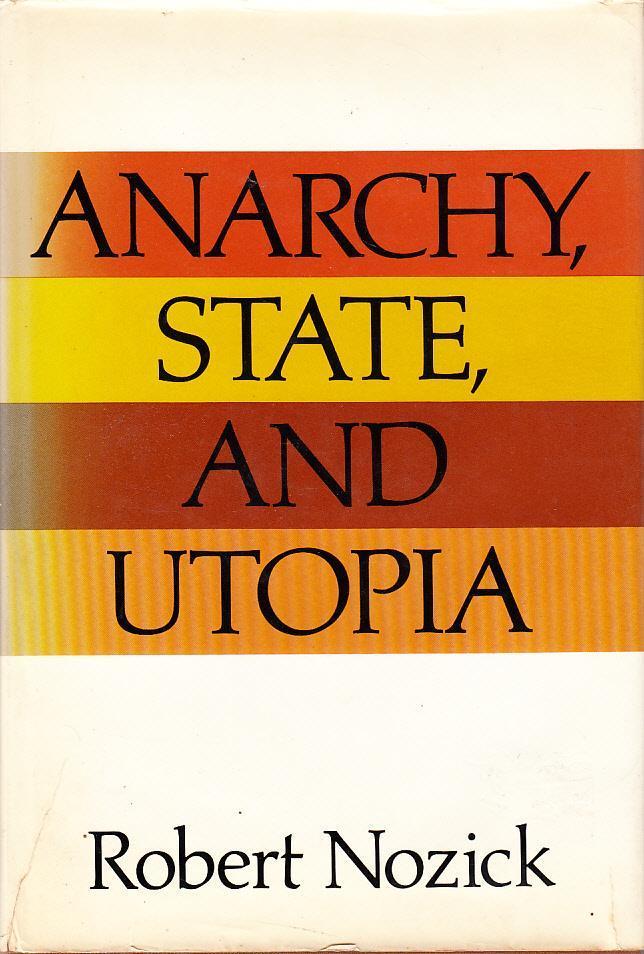
Anarchy, State, and Utopia (ASU) is a 1974 book by the American philosopher Robert Nozick. A work of analytic philosophy in the libertarian capitalist tradition, it popularised and developed the concepts of the night-watchman state, entitlement theory of property, and Lockean proviso, employing original thought experiments, such as the utility monster, experience machine, Wilt Chamberlain argument, and demoktesis, an experiment with the aim of demonstrating a progressive loss in self-ownership in democratic government.
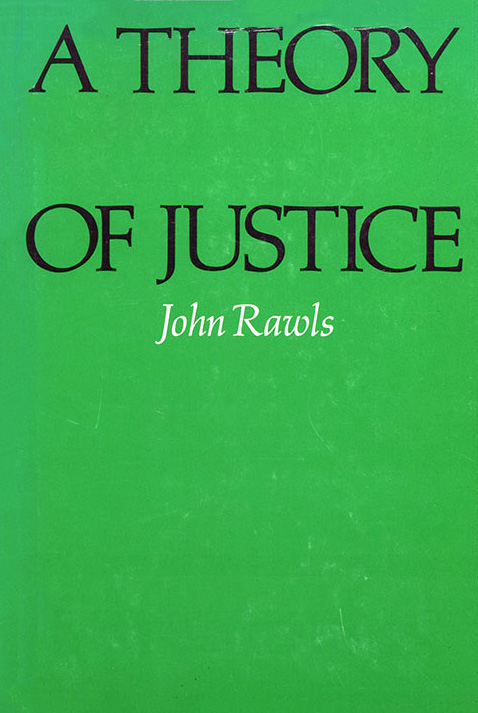
In opposition to A Theory of Justice (1971) by John Rawls, and in debate with Michael Walzer, Nozick argues in favor of a minimal state, "limited to the narrow functions of protection against force, theft, fraud, enforcement of contracts, and so on".
As a work of analytic philosophy, the work offers an original interpretation and synthesis of the Lockean state of nature, Immanuel Kant's theory of persons being and in themselves, and economic research in game theory and welfare economics. Though highly controversial, the book was acclaimed by philosophers, political theorists, and American libertarians.
Background
Anarchy, State, and Utopia came out of a semester-long course that Nozick taught with Michael Walzer at Harvard in 1971, called Capitalism and Socialism. The course was a debate between the two; Nozick's side was later detailed in Anarchy, State, and Utopia, and Walzer's side produced his Spheres of Justice (1983).
Nozick further envisioned ASU as a response to John Rawls' A Theory of Justice (1971), challenging, in particular, Rawls's second principle that "social and economic inequalities are to be arranged so that they are to be of greatest benefit to the least-advantaged members of society."
Intellectual history
In writing the book, Nozick was particularly influenced by John Locke, Immanuel Kant, and Friedrich Hayek. Nozick frames the first part of the book through John Locke's state of nature and draws on the Kantian idea that individuals are separate persons who may not simply be used for the benefit of others.
Rawls's A Theory of Justice
Nozick presents Part II of the book as an argument that no state more extensive than the minimal state can be justified. In developing his entitlement theory, he concentrates on Rawls's account of distributive justice and the difference principle.
H. L. A. Hart's fairness principle
Nozick also discusses a principle proposed by H. L. A. Hart and called the "principle of fairness" by Rawls. On this principle, participants in a just and mutually advantageous cooperative practice may require similar restraint from those who accept the practice's benefits.
Reception
Following its publication in 1974, ASU won the 1975 US National Book Award in category Philosophy and Religion, has been translated into 11 languages, and was named one of the "100 most influential books since the war" (1945–1995) by the UK Times Literary Supplement. ASU remains particularly popular among American libertarian circles as a canonical intellectual articulation of libertarianism. As such, Nozick, alongside Murray Rothbard and Ayn Rand, became regarded as the leading intellectual leaders of libertarianism, although Nozick did not publish substantive work in political philosophy after 1974.
Philosopher Jan Narveson described Nozick's book as "brilliant". In 1991, Jonathan Wolff published Robert Nozick: Property, Justice and the Minimal State, a general overview of the debate around Nozick's political philosophy.
Criticism
G. A. Cohen criticized Nozick's libertarian-style concept of property rights and the proprietary freedom view.
In the article "Social Unity and Primary Goods", republished in his Collected Papers (1999), Rawls notes that Nozick handles the liberal paradox in a manner that is similar to his own. However, the rights that Nozick takes to be fundamental and the basis for regarding them to be such are different from the equal basic liberties included in justice as fairness and Rawls conjectures that they are thus not inalienable.
In Lectures on the History of Political Philosophy (2007), Rawls notes that Nozick assumes that just transactions are "justice preserving" in much the same way that logical operations are "truth preserving". Thus, Nozick holds that repetitive applications of "justice in holdings" and "justice in transfer" preserve an initial state of justice obtained through "justice in acquisition or rectification". Rawls points out that this is simply an assumption or presupposition and requires substantiation. In reality, he maintains, small inequalities established by just transactions accumulate over time and eventually result in large inequalities and an unjust situation.
Invisible-hand arguments
Nozick begins the book laying the epistemic groundwork for his theory of state. Principally, he seeks to rely upon John Locke's social contractarian theory, particularly Locke's state of nature thought experiment, in justifying the existence of the state, by way of counterfactual, as opposed to anarchy.
In justifying his philosophic methodology, Nozick offers an original interpretation of the invisible hand concept in economics, conceiving of a broader class of "invisible hand" explanations of social phenomena, which would appear to be the product of "intelligent design", but which actually arises out of spontaneous mechanisms that naturally result in an equilibrium. Nozick distinguishes invisible hand explanations from "intelligent design" explanations, on the basis that the latter merely rely upon the intention of the designer and as such are less satisfying than the former. As an example, Nozick provides an equilibrium explanation for the adoption of fiat currencies in a hypothetical society, rebutting Locke's view that a social contract is necessary to establish the common usage of money.
In a similar vein, Nozick aims to explain the state in terms of the nonpolitical by means of a state-of-nature argument, believing that such an explanation is more "fundamental" than a political one, even if no state ever actually developed in the social contractarian way. Concretely, his attempt is to describe the appearance of the state in relation to morally permissible and impermissible actions within a non-political society, and to show how violations of those constraints by some individuals would lead to the emergence of a state.
The anarcho-capitalist economist Murray Rothbard has criticised this "invisible hand" methodology, likening it to an "immaculate conception of the state". He argues that, as no existing state has actually developed by such an 'invisible hand' process of social contract, Nozick should, by his own reasoning, simply "advocate anarchism" and then "wait for his State to develop". At the same time, Rothbard argues that the "invisible hand" process would, in fact, move society from his minimal State "back to anarchism".
Ultraminimalist statism
Applying his methodology and the division of labor concept, Nozick moves to consider the possibility of professional protective associations, where one pays a fee in exchange for protection and not having to be on call to assist another. Nozick states that in such a model, because of economic phenomena, such as the economies of scale effect, people within a given geographic area will all join the strongest association, thus creating a monopoly market, or a market with monopolistic features. This scenario, apparently, is "very much resembling a minimal state"; however, it would also appear that the protective firm does not have a true monopoly of force (following Max Weber's definition of state), nor does it protect every individual within the geographic area.
Nozick argues that such an association, although differing from the ordinary understanding of statehood, is, in fact, an ultraminimal "state". This dominant agency has a de facto and economic monopoly on force, owing to the "might" of the agency and its corresponding ability to enforce rules. Though such a monopoly does not correspond precisely with Weber's conception of the state as "the sole authorizer of violence", since some independents may conduct violence to one another without intervention, it is the sole effective judge over the permissibility of violence, and should be regarded as a "statelike entity." Nozick also claims that a society with such an entity will 'diverge greatly... from what anthropologists call a stateless society', as it shares in many of the institutional features that states have, such as 'enduring administrative structures' and 'full-time specialized personnel'.
Nozick distinguishes this association, which he calls "an ultraminimal state", which monopolizes the enforcement of rights but protects only paying clients, from a minimal state that provides protection to everyone in its territory. Nozick shows that the ultraminimalist state may justifiably become a minimal state if it gives universal protection. This involves what Nozick regards as compensation, rather than distribution, to persons who are disadvantaged and cannot pay for protection. In other words, Nozick argues the universal protection provided does not violate anybody's rights and does not redistribute wealth by making its clients pay for the protection of others, because the people who are given money or protective services at a discount had a right to this as a compensation for the disadvantages forced upon them.
Minimal statism
Adapted from the Wikipedia article Anarchy, State, and Utopia, available under CC BY-SA 4.0.