
Sanai
Hakim Abul-Majd Majdūd ibn Ādam Sanā'ī Ghaznavi (Persian: حکیم ابوالمجد مجدود بن آدم سنایی غزنوی), more commonly known as Sanai, was a renowned Iranian Sufi poet mystic from Ghazni. He is best known for his influential works The Walled Garden of Truth (Hadiqat al-Haqiqa) and The Divan.
Hakim Abul-Majd Majdūd ibn Ādam Sanā'ī Ghaznavi (Persian: حکیم ابوالمجد مجدود بن آدم سنایی غزنوی), more commonly known as Sanai, was a renowned Iranian Sufi poet mystic from Ghazni. He is best known for his influential works The Walled Garden of Truth (Hadiqat al-Haqiqa) and The Divan. He is regarded as one of the pioneers of Persian Sufi poetry and had a major influence on later Iranian poets such as Attar and Rumi.
Life
Sanai was an Iranian poet who lived in the late 11th and early 12th century and was associated with Ghazni. He was connected with the court of Bahram Shah. The details of Sanai’s personal life are not well documented, and much of his biography is based on later sources. His surviving poetry is the principal source for understanding his literary and religious ideas.
Poetic influence
Rumi acknowledged Sanai and Attar as his two great inspirations, saying, "Attar is the soul and Sanai its two eyes, I came after Sanai and Attar." The Walled Garden of Truth was also a model for Nizami's Makhzan al-Asrar (Treasury of Secrets).
Modern cultural references
Guillermo del Toro's 2017 film The Shape of Water ends with a recitation of one of Sanai's poems; Sanai is named in the closing credits.
Unable to perceive the shape of you, I find you all around me.
Your presence fills my eyes with your love.
It humbles my heart, for you are everywhere.
Quotations
Sanai's poetry stresses the possibility of an "awakening." His means for this awakening is surrender to God. His poetry has been called "the essential fragrance of the path of love." He hits out at human hypocrisy and folly:
Others are heedless,—do thou be wise, and on this path keep thy tongue silent. The condition laid on such a one is that he should receive all food and drink from the Causer, not from the causes. Go, suffer hardship, if thou wouldst be cherished; and if not, be content with the road to Hell. None ever attained his object without enduring hardship.
Adapted from the Wikipedia article Sanai, available under CC BY-SA 4.0.
Connections
You might also explore
 Ḥāfeẓmystic★Islamic1325 – 1390Poet of Shiraz whose ghazals unite love, wine and the divine; a household presence in Iran.
 Rūmī★Islamic1207 – 1273Sufi poet-mystic whose Masnavi explores love as the path to the divine.
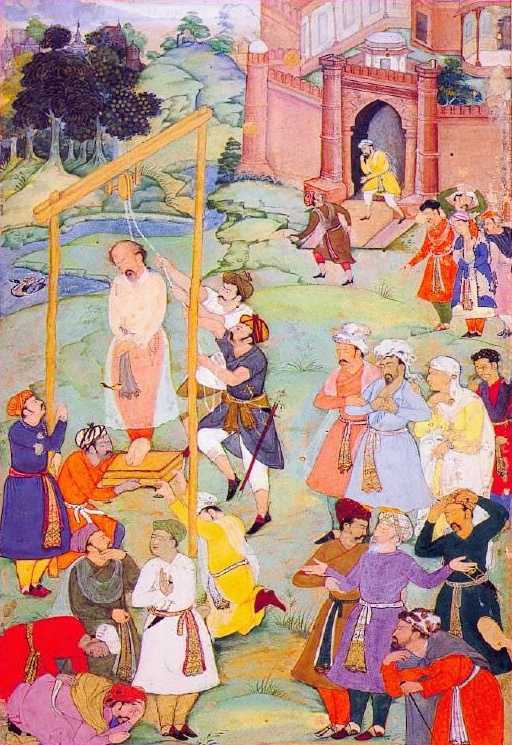 Mansur Al-HallajmysticIslamic858 – 922Mansour al-Hallaj (Arabic: ابو المغيث الحسين بن منصور الحلاج, romanized: Abū 'l-Muġīth al-Ḥusayn ibn Manṣūr al-Ḥallāj)…
 ʿAṭṭār of NishapurIslamicc. 1145 – 1221Sufi poet of The Conference of the Birds, an allegory of the soul's journey to God.
 Ibn ʿArabīIslamic1165 – 1240Sufi metaphysician of the "unity of being".Attar of NishapurIslamic1145 – 1221Faridoddin Abu Hamed Mohammad Attar Nishapuri, better known by his pen-names Faridoddin (فریدالدین) and Attar of…