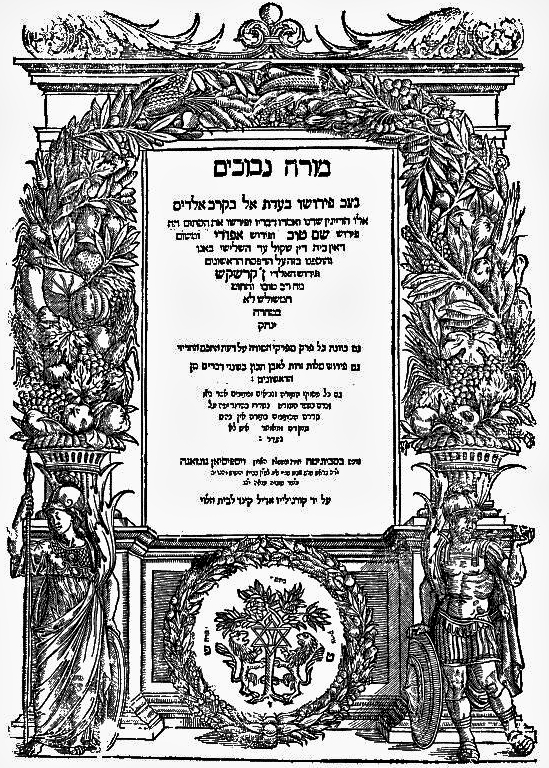
Saadia Gaon
Saʿadia ben Yosef Gaon or Said bin Yusuf al-Fayyumi was a prominent rabbi, gaon, Jewish philosopher, and exegete who was active in the Abbasid Caliphate. Saadia is the first important rabbinic figure to write extensively in Judeo-Arabic.
Saʿadia ben Yosef Gaon or Said bin Yusuf al-Fayyumi (892–942) was a prominent rabbi, gaon, Jewish philosopher, and exegete who was active in the Abbasid Caliphate.
Saadia is the first important rabbinic figure to write extensively in Judeo-Arabic. His extensive writings are one of the foundations of Judeo-Arabic literature. Known for his works on Hebrew linguistics, Halakha, and Jewish philosophy, he was a student of the philosophical school known as "Jewish Kalam". In this capacity, his philosophical work entitled The Book of Beliefs and Opinions represents the first systematic attempt to integrate Jewish theology with components of ancient Greek philosophy. Saadia was also very active in opposition to Karaite Judaism in defense of Rabbinic Judaism.
Early life
Saadia was born in Dilāẓ in the Faiyum in Middle Egypt in 892. He immigrated to the Land of Israel (in the Abbasid province of Bilad al-Sham) in 915 at the age of 23, where he studied in Tiberias under the scholar Abu Kathir Yaḥya al-Katib (known as Eli ben Yehudah ha-Nazir in Hebrew), a Jewish mutakallim or theologian also mentioned by ibn Ḥazm. In 926, Saadia settled permanently in Lower Mesopotamia, known to Jews as 'Babylonia', where he became a member of Sura Academy.
Saadia, in Sefer ha-Galui, stresses his Jewish lineage, claiming to belong to the noble family of Shelah, son of Judah, and counting among his ancestors Hanina ben Dosa, the famous ascetic of the first century. Saadia expressed this claim by calling his son Dosa; this son later served as gaon of Sura Academy from 1012–1018. Regarding Joseph, Saadia's father, a statement of the Palestinian gaon Aaron ben Meïr has been preserved saying that he was compelled to leave Egypt and died in Jaffa, probably during Saadia's prolonged residence in the Holy Land.
The usual nisba al-Fayyumi refers to Saadia's native place, the Fayyum, which is located in Middle Egypt; in Hebrew, it is often given as Pitomi, derived from a contemporary identification of Fayyum with the Biblical Pithom, an identification found in Saadia's works.
At the age of 20, Saadia began composing his first great work, the Hebrew dictionary called the Agron. At 23, he composed a polemic against the followers of Anan ben David, particularly Solomon ben Yeruham, thus beginning the activity which was to prove important in opposition to Karaite Judaism in defense of Rabbinic Judaism. In the same year, he left Egypt and moved to Palestine. There, he became acquainted with Tiberian Hebrew and studied with Abu Kathir Yahya al-Katib, a Tiberian Jew. His familiarity with Palestinian rabbinic literature distinguished him from earlier Babylonian geonim. He would subsequently introduce the Palestinian Talmud and Palestinian aggadic midrashim into Babylonian rabbinic scholarship, helping establish their use as subsidiary authorities when they did not conflict with the Babylonian Talmud.
In 921, Saadia triumphed over Gaon Aaron ben Meïr over the latter's introduction of a new triennial cycle of Torah reading that also changed the dates of Passover and Rosh Hashanah. Later, one of Saadia's chief disputants was the Karaite by the name of Abu al-Surri ben Zuṭa, who is referred to by Abraham ibn Ezra, in his commentary on Exodus 21:24 and Leviticus 23:15).
In the year 928, at the age of thirty-six (variant: forty-six), David ben Zakkai, the Exilarch or head of Babylonian Jewry, petitioned Saadia to assume the honorary title of gaon, where he was appointed that same year the Gaon of Sura Academy at Mata Mehasya, a position which he held for 14 years until his death.
After only two years of teaching, Saadia recused himself from teaching because of a dispute that had fallen out between him and the Exilarch. During Saadia's absence, his post was occupied by Joseph ben Jacob, the grandson of Natronai ben Hilai. At length, Saadia was reconciled with the Exilarch and returned to serve in his former position, although Joseph ben Jacob also remained serving in his capacity as Gaon.
Dispute with Ben Meir
In 922, six years before Saadia was appointed Gaon of Babylonia, a controversy arose concerning the Hebrew calendar, which threatened the entire Jewish community. Since Hillel II (around 359 CE), the calendar had been based on a series of rules (described more fully in Maimonides' Code) rather than on observation of the lunar phases. One of these rules required the date of Rosh Hashanah to be postponed if the calculated lunar conjunction occurred at noon or later. Rabbi Aaron ben Meïr, head of the Palestinian Gaonate (then located in Ramla), claimed a tradition according to which the cutoff point was 642/1080 of an hour (approximately 35 minutes) after noon. In that particular year, this change would result in a two-day schism with the major Jewish communities in Babylonia: according to Ben Meir the first day of Passover would be on a Sunday, while according to the generally accepted rule it would be on Tuesday.
Saadia was in Aleppo, on his way from the East, when he learned of Ben Meïr's regulation of the Jewish calendar. Saadia addressed a warning to him, and in Mesopotamia, he placed his knowledge and pen at the disposal of the exilarch David ben Zakkai and the scholars of the academies, adding his letters to those sent by them to the communities of the Jewish diaspora (922). In Babylonia, he wrote his Sefer haMo'adim, or "Book of Festivals", in which he refuted the assertions of Ben Meïr regarding the calendar and helped to avert from the Jewish community the perils of schism.
Appointment as Gaon
His dispute with Ben Meir was an important factor in his call to Sura in 928. The Exilarch David ben Zakkai insisted on appointing Saadia as Gaon ("head of the academy"). This was done despite the fact that no foreigner had ever served as Gaon before, and against the advice of the aged Nissim Nahrwani, a Resh Kallah at Sura, who feared a confrontation between the two strong-willed personalities, Exilarch David and Saadia. Nissim declared, however, that if David was determined to see Saadia in the position, then he would be ready to become the first of Saadia's followers. Another factor against Saadia's appointment was his relatively undistinguished family, compared to the familial legacies of certain rabbis and their oral traditions.
Under his leadership, the ancient academy of Sura founded by Abba Arikha entered upon a new period of brilliancy. This renaissance was cut short by a clash between Saadia and David, much as Nissim had predicted.
In a probate case, Saadia refused to sign a verdict of the exilarch, which he thought unjust, although the Gaon of Pumbedita had subscribed to it. When the son of the exilarch threatened Saadia with violence to secure his compliance and was roughly handled by Saadia's servant, open war broke out between the exilarch and the gaon. Each excommunicated the other, declaring that he deposed his opponent from office. David ben Zakkai appointed Joseph ben Jacob Gaon of Sura and Saadia conferred the exilarchate on David's brother Hasan (Josiah; 930).
Hasan was forced to flee and died in exile in Greater Khorasan, and the strife that divided Babylonian Judaism continued. Saadia was attacked by the exilarch and his chief adherent, the young but learned Aaron ibn Sargado (later Gaon of Pumbedita, 943–960), in Hebrew pamphlets. Fragments of these pamphlets show a hatred on the part of the exilarch and his partisans that did not shrink from scandal. Saadia did not fail to reply.
Influence
Saadia's influence upon the Yemenite Jews has been exceptionally great, as many of Saadia's extant works were preserved by the community and used extensively by them. The basis for the Yemenite tiklāl is founded upon the prayer format edited originally by Saadia. The Yemenite Jewish community also adopted thirteen penitential verse written by Saadia for Yom Kippur, as well as the liturgical poems composed by him for Hoshana Rabbah, the seventh day of Sukkot.
Saadia's Judeo-Arabic translation of the Pentateuch, the Tafsir, was copied by the Yemenite Jews in nearly all their handwritten codices. They originally studied Saadia's major work of philosophy, Beliefs and Opinions, in its original Judeo-Arabic, although by the early 20th century, only fragments survived.
Method of translation
As much as Saadia's Judeo-Arabic translation of the Torah (Tafsīr) has brought relief and succour to Jews living in Arabic-speaking countries, his identification of places, fauna and flora, and the stones of the priestly breastplate, has found him at variance with some scholars. Abraham ibn Ezra, in his commentary on the Torah, wrote scathing remarks about Saadia's commentary, saying: "He doesn't have an oral tradition [...] perhaps he has a vision in a dream, while he has already erred with respect to certain places [...]; therefore, we will not rely on his dreams."
However, Saadia assures his readers elsewhere that when he rendered translations for the twenty-odd unclean fowl mentioned in the Hebrew Bible, (Leviticus 11:13–19; Deuteronomy 14:12–18) his translation was based on an oral tradition received by him. Saadia's method of conveying names for the fowls based on what he had received by way of an oral tradition prompted him to add in his defense: "Every detail about them, had one of them merely come unto us [for identification], we would not have been able to identify it for certain, much less recognize their related kinds."
Adapted from the Wikipedia article Saadia Gaon, available under CC BY-SA 4.0.
Connections
Influenced
1
You might also explore
 Thomas Aquinas★Medieval Latin1225 – 1274The great scholastic synthesiser of Aristotle and Christianity, author of the Summa Theologiae and the Five Ways.
 Al-KindīIslamicc. 801 – 873"The philosopher of the Arabs", who launched Arabic philosophy in Baghdad.Abraham bar Hiyya SavasordaJewish1070 – 1136Abraham bar Ḥiyya ha-Nasi, also known as Abraham Savasorda, Abraham Albargeloni, and Abraham Judaeus, was a Catalan…
 Abraham ibn EzraJewish1089 – 1167Abraham ben Meir Ibn Ezra was one of the most distinguished Jewish biblical commentators and philosophers of the Middle…
 Abraham Isaac KookJewish1865 – 1935Abraham Isaac HaCohen Kook, known as HaRav Kook, and also known by the Hebrew-language acronym Hara'ayah (הראי״ה), was…
 Abraham Joshua HeschelJewish1907 – 1972Abraham Joshua Heschel was a Polish-born American rabbi and one of the leading Jewish theologians and philosophers of…