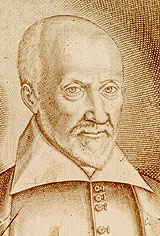
Pierre Charron
Pierre Charron was a French Catholic theologian and major contributor to the new thought of the 17th century. He is remembered for his controversial form of skepticism and his separation of ethics from religion as an independent philosophical discipline.
Pierre Charron (French pronunciation: [pjɛʁ ʃaʁɔ̃]; 1541 – 16 November 1603) was a French Catholic theologian and major contributor to the new thought of the 17th century. He is remembered for his controversial form of skepticism and his separation of ethics from religion as an independent philosophical discipline.
Biography
Pierre Charron was born in Paris, one of the twenty-five children of a bookseller. After studying law at Orléans and Bourges he practiced as an advocate, for a few years. He then entered the church and soon became a popular priest, rising to become a canon.
He moved to the southwest of France, invited by Arnaud de Pontac, Bishop of Bazas. He was appointed priest in ordinary to Marguerite de Valois, wife of Henry IV of Navarre. In about 1588, Charron decided to become a monk, but being rejected by both the Carthusians and the Celestines, he returned to his old profession. He delivered a course of sermons at Angers, and in the next year moved to Bordeaux, where he formed a famous friendship with Michel de Montaigne. On Montaigne's death, in 1592, Charron was requested in the will to bear the Montaigne arms.
From 1594, he used his own name; he spent from 1594 to 1600 under the protection of Antoine Hérbrard de Saint-Sulpice, Bishop of Cahors, who appointed him grand vicar and theological canon. His first book led to his being chosen deputy to the general assembly of the clergy, for which he became chief secretary.
Charron retired to Condom in 1600; he died suddenly of a stroke; his works were then receiving attention.
Influences
Apart from the major influence of Montaigne, Charron took from Raymond of Sabunde (Sibiuda). Another influence was neostoicism, as handled by Justus Lipsius.
Psychology
According to Charron, the soul, located in the ventricles of the brain, is affected by the temperament of the individual; the dry temperament produces acute intelligence; the moist, memory; the hot, imagination. Dividing the intelligent soul into these three faculties, he writes the branches of science corresponding with each. On the nature of the soul, he quotes opinions. The belief in its immortality, he says, is the most universal of beliefs, but the most feebly supported by reason. As to a human's power of attaining truth, he declares that none of our faculties enable us to distinguish truth from error. In comparing humans with animals, Charron insists that there are no breaks in nature. Though inferior in some respects, in others, animals are superior. Namely, humanity's essential qualities are vanity, weakness, inconstancy, and presumption.
Theology
Charron writes that all religions teach that God is to be appeased by prayers, presents, vows, but especially, and, most irrationally, by human suffering . Each religion is said by its devotees to have commenced by divine inspiration. A human is a Christian, Jew, or Muslim, before he or she knows that they are persons. Furthermore, he writes that one religion is built upon another.
While Charron declares religion to be "strange to common sense," the practical result at which he arrives is that one is not to sit in judgment on his or her faith, but to be "simple and obedient," and to submit to public authority. He writes that this is one rule of wisdom with regard to religion. Another equally important is to avoid superstition, which he defines as the belief that God is like a hard judge who, eager to find fault, narrowly examines our slightest act, that he is vengeful and hard to appease, and that, therefore, he must be flattered and won over by pain and sacrifice.
Charron states that true piety, which is the first of duties, is the knowledge of God and of one's self; the latter knowledge being necessary to the former. The belief that what God sends is all good, and that all the bad is from ourselves is the abasing of humanity and the exalting of God. It leads to spiritual worship, for external ceremony is merely for our advantage, not for his glory.
Politics
Charron declares the sovereign to be the source of law, and asserts that popular freedom is dangerous.
Adapted from the Wikipedia article Pierre Charron, available under CC BY-SA 4.0.
You might also explore
 A. J. AyerModern European1910 – 1989Sir Alfred Jules "Freddie" Ayer was an English philosopher who became professionally established through his exposition…
 Adam FergusonModern European1723 – 1816Adam Ferguson (Scottish Gaelic: Adhamh MacFhearghais), also known as Ferguson of Raith, was a Scottish philosopher and…
 Adam Smith★Modern European1723 – 1790Moral philosopher of sympathy and the impartial spectator, and father of economics.
 Adam WeishauptModern European1748 – 1830Johann Adam Weishaupt was a German philosopher, professor of civil law and later canon law, and founder of the Bavarian…Adolf ReinachModern European1883 – 1917Adolf Bernhard Philipp Reinach was a German philosopher associated with the Munich phenomenology school.
 Ágnes HellerModern European1929 – 2019Ágnes Heller was a Hungarian philosopher and lecturer. She was a core member of the Budapest School philosophical forum…