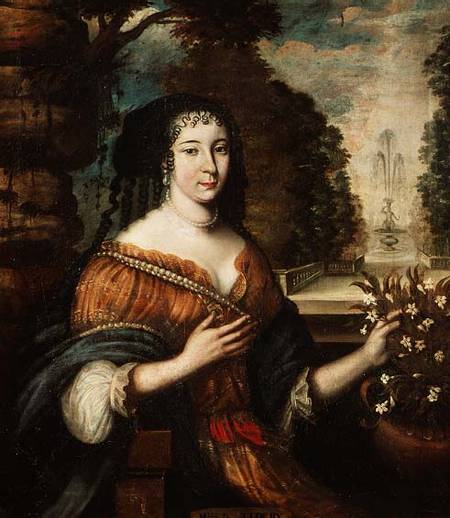
Madeleine de Scudéry
Madeleine de Scudéry, often known simply as Mademoiselle de Scudéry ([madmwazɛl də skydeʁi]), was a French writer. Her works demonstrate such comprehensive knowledge of ancient history that it is suspected she had received instruction in Greek and Latin.
Madeleine de Scudéry (French: [madlɛn də skydeʁi]; 15 November 1607 – 2 June 1701), often known simply as Mademoiselle de Scudéry ([madmwazɛl də skydeʁi]), was a French writer.
Her works demonstrate such comprehensive knowledge of ancient history that it is suspected she had received instruction in Greek and Latin. In 1637, following the death of her uncle, Scudéry established herself in Paris with her brother, Georges de Scudéry, who became a playwright. Madeleine often used her older brother's name, George, to publish her works. She was at once admitted to the Hôtel de Rambouillet coterie of préciosité, and afterwards established a salon of her own under the title of the Société du samedi (Saturday Society). For the last half of the 17th century, under the pseudonym of Sapho or her own name, she was acknowledged as the first bluestocking of France and of the world. She formed a close romantic relationship with Paul Pellisson which was only ended by his death in 1693. She never married.
Biography
Born at Le Havre, Normandy, in northern France, she was without fortune, but she was exceedingly well-educated. Her father, captain of the port in Le Havre, died in 1613 with her mother following shortly after. Madeleine and her brother Georges de Scudéry were placed in the care of an uncle who cared for them very well. He gave Madeleine an abnormally well-rounded education: she studied writing, spelling, drawing, dancing, painting, and needlework. In addition, on her own, Madeleine studied agriculture, medicine, cooking, Spanish, and Italian.
Later years
Madeleine survived her brother by more than thirty years, and in her later days published numerous volumes of conversations, to a great extent extracted from her novels, thus forming a kind of anthology of her work. Scudéry was deaf for the last 40 years of her life. She outlived her vogue to some extent, but retained a circle of friends, like Marie Dupré, to whom she was always the "incomparable Sapho."
Her Life and Correspondence was published at Paris by MM. Rathery and Boutron in 1873.
Legacy
Madeleine de Scudéry was part of a movement in the late Renaissance in England and France where women used classical rhetorical theory for their own. She revised discourse to be modeled on conversation rather than public speaking, favoring that as a means of rhetoric, the speaker in the salon built on the ideas of the speaker before them, opting for consensus rather than argument. She is one of the central figures associated with the "salon" conversation and letter writing.
Cultural references
Controversial in her own era, Mademoiselle de Scudéry was satirized by Molière in his plays Les Précieuses ridicules (1659) and Les Femmes savantes (1672) and by Antoine Furetière in his Roman Bourgeois (1666).
Arabella, the protagonist of Charlotte Lennox's 1752 novel, The Female Quixote, mistakenly believes that the romances written by Madamoiselle de Scudery are historically accurate accounts of antiquity that also reflect the realities of contemporary life. After she is visited by a clergyman towards the end of the novel, Arabella comes to the conclusion that de Scudery's works are ridiculous, frivolous and unhealthy.
The 19th century German writer E.T.A. Hoffmann wrote what is usually referred to as the first German-language detective story, featuring Scudéry as the central figure. "Das Fräulein von Scuderi" (Mademoiselle de Scudery) is still widely read today, and is the origin of the "Cardillac syndrome" in psychology.
Mademoiselle de Scudéry is also featured prominently in Madeleine: One of Love's Jansenists, a novel published in 1919 by modernist writer Hope Mirrlees. The novel is set in and around the literary circles of the 17th Century Précieuses. The protagonist, a young woman named Madeleine Troqueville, becomes enamored of Mademoiselle de Scudéry, who snubs young Madeleine. It has been suggested that the novel is a roman à clef with Natalie Clifford Barney portrayed as Mademoiselle de Scudéry.
Adapted from the Wikipedia article Madeleine de Scudéry, available under CC BY-SA 4.0.
You might also explore
 A. J. AyerModern European1910 – 1989Sir Alfred Jules "Freddie" Ayer was an English philosopher who became professionally established through his exposition…
 Adam FergusonModern European1723 – 1816Adam Ferguson (Scottish Gaelic: Adhamh MacFhearghais), also known as Ferguson of Raith, was a Scottish philosopher and…
 Adam Smith★Modern European1723 – 1790Moral philosopher of sympathy and the impartial spectator, and father of economics.
 Adam WeishauptModern European1748 – 1830Johann Adam Weishaupt was a German philosopher, professor of civil law and later canon law, and founder of the Bavarian…Adolf ReinachModern European1883 – 1917Adolf Bernhard Philipp Reinach was a German philosopher associated with the Munich phenomenology school.
 Ágnes HellerModern European1929 – 2019Ágnes Heller was a Hungarian philosopher and lecturer. She was a core member of the Budapest School philosophical forum…