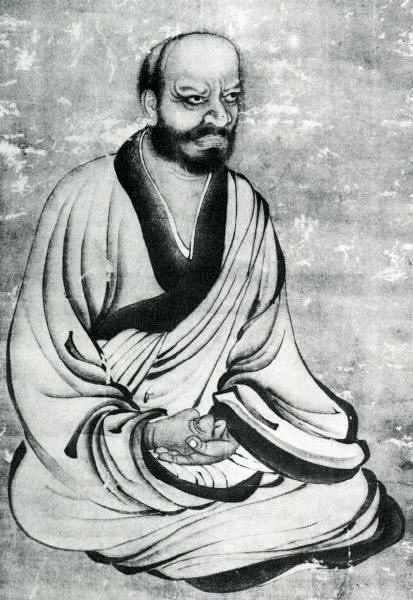
Linji Yixuan
Linji Yixuan was a Tang dynasty Chinese monk and teacher of the Hongzhou school of Chinese Chan (Zen). Linji was the leading figure of Chan Buddhism in the Tang era, and the Recorded Sayings of Linji (Linji yulu), which contains his teachings, is seen as a major Chan (Zen) text which exemplifies the iconoclastic and an
Linji Yixuan (traditional Chinese: 臨濟義玄; simplified Chinese: 临济义玄; pinyin: Línjì Yìxuán; Wade–Giles: Lin-chi I-hsüan; Japanese: 臨済義玄 Rinzai Gigen; died 866 CE) was a Tang dynasty (618-907) Chinese monk and teacher of the Hongzhou school of Chinese Chan (Zen). Linji was the leading figure of Chan Buddhism in the Tang era, and the Recorded Sayings of Linji (Linji yulu), which contains his teachings, is seen as a major Chan (Zen) text which exemplifies the iconoclastic and antinomian spirit of Chan. He is also known by the posthumous title Huizhao Chanshi (慧照禪師, "Meditation Master of Illuminating Wisdom").
Linji was a student of Huangbo Xiyun and is also considered to be the founder of the influential Linji school of Chan. This school actually developed in the Song dynasty (960-1279) among descendants of Linji, who created various mythic stories about Linji in the process of founding their new school of Zen. Today he is seen as the founder of the various Linji regional traditions, including the Japanese Rinzai school, the contemporary Korean Seon schools (all which consider themselves to be of the "Imjae" line, i.e. Linji) and the Lâm Tế school of Vietnamese Zen.
Life
According to the sources, Linji was born during the Yuanhe era (806–820) into a family named Xing (邢) living in Nanhua (南華), Cao (曹) Prefecture (modern Yanzhou 兖州 in Shandong Province). Little is known of his early life. According to the Guzunsu yulu (Recorded sayings of the ancient worthies), "After shaving his head and receiving the full precepts, he frequented the lecture halls; he mastered the vinaya and made a thorough study of the sutras and śāstras." Yanagida Seizan writes that his teachings indicate that Linji was knowledgeable in the Mahayana sutras and also "show the influence of works of the Huayan 華嚴 (Avataṃsaka) and Weishi 唯識(“Consciousness-only”; Yogācāra) schools." Seizan also mentions that he seems to have been expert in the teachings of Yogācāra, since the Zutang ji depicts Linji's first meeting with Dayu as being a discussion on the Treatise on the stages of Yogācāra practice (Yuqie lun 瑜伽論).
After this period of study however, Linji turned to meditative practice, as sermon 18 of the Record of Linji states "But later, when I realized that they were only remedies to help the world and displays of opinion, I threw them all away, and, searching for the Way, I practiced meditation." Linji then traveled to Jiangnan where he met Chan master Huangbo Xiyun (黃蘗希運), at some point between 836 and 841. He likely stayed with Huangbo at Mount Huangbo for about three years until he had a great enlightenment. According to sources like the Record of Linji, Linji questioned Huangbo three times about the central meaning of Buddhism and Huangbo struck him three times. Then Huangbo sent Linji to meet the reclusive monk Dàyú (大愚). After exchanging some words with this monk, Linji attained an awakening or (見性, jianxing). He then returned to Huangbo and told him what had occurred. Huangbo slapped Linji, saying “You lunatic, coming back here and pulling the tiger’s whiskers!” Then Linji responded with a loud shout. After this event, Linji stayed with Huangbo for some time, or he may have traveled to practice with Dayu for a time as well. The various sources differ on this issue.
In around 849 or 850 Linji, an older forty year old, left on a pilgrimage. Little is known of this pilgrimage, though the Chuandeng lu mentions that he visited Bodhidharma’s memorial tower in Henan. In about 851, Linji settled in Zhenzhou, Hebei where he led a small temple located southeast of the city of Zhenzhou. It was known as the Linji yuan (臨濟院, “Temple Overlooking the Ford”) since it was on the banks of the Hutuo River. It is the name of this temple which gave Linji his name. Linji's temple may have been supported by the Wang family patriarch Wang Yuankui 王元逵 (d. 855) or one of his sons.
Linji lived and taught in this temple for about ten years. Linji's students included Zhaozhou Congshen, Puhua, Sansheng Huiran, Baoshou Yanzhao, Xinghua Cunjiang, Mayu, Longya Judun, Dajue, and Xingshan Jianhong. In about 863 or 864, Linji left Linji temple to accept an invitation by Lord Jiang Shen, regional commissioner of Hezhong, who had his seat at Puzhou (蒲州). From Puzhou, Linji traveled to Weifu on the invitation from Grand Marshal and President of the Grand Imperial Secretariat, Lord He. At Weifu, he stayed at Jiangxi Chanyuan Temple (江西禪院), of Guanyin si (觀音寺). He stayed at this temple for a year, receiving visitors, until his death. The Linji Lu describes his death as follows:
Suddenly one day the master, although not ill, adjusted his robes, sat erect, and when his exchange with Sansheng [Sansheng Huiran] was finished, quietly passed away. It was on the tenth day of the first month in the eighth year of Xiantong [18 February 867] of the Tang dynasty.
Posthumous influence
After Linji's death, his disciples then cremated him and built a memorial pagoda for the master's remains in the capital of Daming Prefecture. The Chinese emperor decreed that Linji was to receive the posthumous title "Huizhao Chanshi" (慧照禪師, "Meditation Master of Illuminating Wisdom").
According to Yanagida Seizan, "Linji died probably in his early or mid-fifties, and thus did not reach the advanced age of many of the illustrious masters of his time. Nor did he leave a large body of notable disciples to disseminate his style of Chan."
Of Linji's small body of disciples, only Xinghua Cunjiang's line of transmission survived. Very little is known of Cunjiang's heir Nanyuan Huiyong. The three succeeding figures from Nanyuan: Fengxue Yanzhao, Shoushan Shengnian, and Fenyang Shanzhao, all remained in the Yellow river area. According to Albert Welter, "While the inspiration for the Linji Chan faction was, of course Linji Yixuan, the real founder of the movement was, as noted previously, Shoushan Shengnian (926–993), a fourth-generation descendant."
Fenyang Shanzhao's heir, Shishuang Chuyuan, transmitted the Linji lineage to Southern China. Shishuang was instrumental in promoting and expanding the influence of the Linji school. Over time, this tradition became one of the largest and most influential schools of Chan in East Asia, with branches in Japan (Rinzai), Korea and Vietnam.
Linji's students compiled and passed on his teachings in various sources, the most famous of which is the Recorded Sayings of Linji (Linji yulu).
The Record of Linji and other sources
The Linji yulu (臨濟語錄; Japanese: Rinzai-goroku, Recorded Sayings of Linji) or Línjìlù for short, is a collection of sayings and anecdotes attributed to Linji which is traditionally considered to be the main source of Linji's teachings. The full title is Zhenzhou linji huizhao chanshi yulu (鎭州臨濟慧照禪師語錄, Recorded Sayings of Chan Master Huizhao of Linji in Zhenzhou).
The standard edition of the Linji yulu (c. 1120) was not completed until two hundred fifty years after Linji's death (866). Thus parts of the text likely reflects the concerns of the Song dynasty Linji school rather than that of Linji in particular. The standard edition was first included within the massive Tiansheng guangdeng lu by the lay believer Li Zunxu (a student of Guyin Yuncong) in 1036 and it was independently printed in 1120 by Yuanjue Zongyan at Mount Gu in Fuzhou (present-day Fujian).
Yanagida Seizan writes that "we have no way of determining exactly what the earliest version of the Linji lu was like or when it was compiled." In spite of this, Yanagida Seizan still held that the main twenty two sermons in the Linji yulu "provide us with an account of the man and his teaching".
Furthermore, earlier passages from Linji's sermons can be found in texts compiled before the 12th century, such as the Zutang ji, the Zongjing lu, the Jingde Chuan-deng lu and the Tiansheng guang-denglu (Tiansheng-era Extensive record of the transmission). These passages contain minor differences with the parallel passages from Linji's sermons found in the Linji yulu according to Yanagida.
Albert Welter also notes that the earliest fragments of Linji's teachings are found in the Zutang ji, which was compiled in 952. However, regarding the contents of the Linji lu, he writes:
Ultimately, the story of the Linji lu is the story of a movement that found its voice and identity through the image and alleged teachings of Linji. What these teachings represent are not the words of one man, which are in any case irretrievable, but the combined aspirations of the movement as a whole, projected onto the persona of Linji as founder. Linji wrote nothing himself. Our knowledge of his teachings allegedly depends on notes taken by students of his sermons, lectures, dialogues, and other interactions. The names of those who originally kept such notebooks are unknown to us. Eventually, fragments of Linji's teachings were included in Chan transmission records.
The Linji yulu contains stories of Linji's interactions with teachers, contemporaries, and students. The recorded lectures are a mixture of the conventional and the iconoclastic; those who resented the iconoclastic nature of Linji discourse saw him as "one of the most infamous Chinese Chan masters who censored traditional Buddhist practices and doctrines." Despite the iconoclasm, however, the Linji yulu reflects a thorough knowledge of the sūtras. Linji's style of teaching, as recorded in that text, exemplifies Chán development in the Hongzhou school (洪州宗) of Mazu and his successors, such as Huangbo, Linji's master.
Iconoclasm
Adapted from the Wikipedia article Linji Yixuan, available under CC BY-SA 4.0.
You might also explore
 A. C. Bhaktivedanta Swami PrabhupadaIndian1896 – 1977Abhay Charanaravinda Bhaktivedanta Swami Prabhupada was an Indian spiritual, philosophical, and religious teacher who…
 Ādi ŚaṅkaraIndianc. 700 – 750The great systematiser of Advaita Vedānta: the self is Brahman, and the world of plurality is appearance.
 Ahmad SirhindimysticIndian1564 – 1624Imām Rabbānī Shāykh Aḥmad ibn 'Abd al-Ahad al-Fārūqī al-Sirhindī Mūjaddīd al-Alf al-Thanī or simply known as Ahmad…
 Akṣapāda GautamaIndianc. 200 BCE – 150 CEAuthor of the Nyāya Sūtras, foundation of Indian logic.
 Amartya SenIndianborn 1933Amartya Kumar Sen is an Indian economist and philosopher. Sen has taught and worked in England and the United States…
 ĀnandaBuddhist monkIndian600 – 500 BCEĀnanda was the primary attendant of the Buddha and one of his ten principal disciples. Among the Buddha's many…