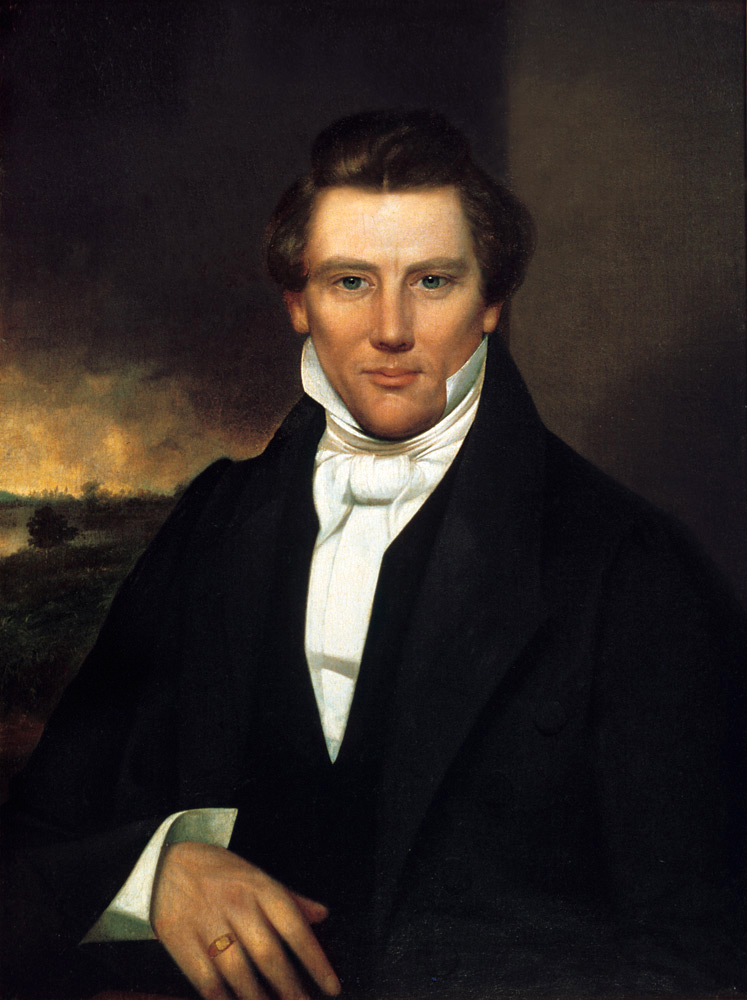
Joseph Smith
Joseph Smith Jr. was an American religious and political leader and the founder of Mormonism and the Latter Day Saint movement. Publishing the Book of Mormon at the age of 24, Smith attracted tens of thousands of followers by the time of his death fourteen years later.
Joseph Smith Jr. (December 23, 1805 – June 27, 1844) was an American religious and political leader and the founder of Mormonism and the Latter Day Saint movement. Publishing the Book of Mormon at the age of 24, Smith attracted tens of thousands of followers by the time of his death fourteen years later. The religious movement he founded is followed by millions of global adherents and several churches, the largest of which is the Church of Jesus Christ of Latter-day Saints (LDS Church).
Born in Sharon, Vermont, Smith moved with his family to Western New York by 1816. Smith reported that, in 1820, he had a vision in which he saw God the Father and Jesus Christ. In 1823, he claimed he was visited by an angel who directed him to a buried book of golden plates inscribed with a Judeo-Christian history of an ancient American civilization. In 1830, Smith published the Book of Mormon, which he described as an English translation of those plates. The same year, he organized the Church of Christ, calling it a restoration of the early Christian Church.
The next year, Smith and his followers moved to Kirtland, Ohio, and established an outpost in Independence, Missouri, planning to build a communal Zion in the American heartland. During the 1830s, Smith sent out missionaries, published revelations, and supervised construction of the Kirtland Temple. Smith and his followers left Ohio after the church-sponsored Kirtland Safety Society bank collapsed; they left Missouri after the 1838 Mormon War.
Smith and his followers established a new settlement at Nauvoo, Illinois, which grew quickly during Smith's mayoralty. In 1844, Smith ordered the destruction of the Nauvoo Expositor's printing press after it criticized Smith's power and his practice of polygamy; Smith was arrested and charged with treason, but was killed by a mob that stormed the jailhouse before he could be tried.
During his ministry, Smith published numerous documents and texts, many of which he attributed to divine inspiration. His followers accepted his teachings as prophetic and revelatory, and several of these texts were canonized by denominations of the Latter Day Saint movement, which continue to treat them as scripture. Smith's teachings discuss God's nature, cosmology, family structures, political organization, and religious community and authority.
Early years (1805–1827)
Joseph Smith was born on December 23, 1805, in Vermont to Joseph Smith Sr. and Lucy Mack Smith. One of eleven children, Smith's childhood was marked by hardship. Joseph Sr.'s drunkenness was a source of embarrassment. When seven-year-old Joseph Jr. underwent painful surgery for a leg bone infection, the boy refused alcohol. He used crutches for three years and walked with a slight limp thereafter. After Joseph Sr. fell for a swindle and then endured years of crop failures, the Smiths lost the family farm and were forced to travel 300 miles (480 km) west to frontier Western New York, where they took out a mortgage on a small farm.
From about 1819 until about 1826, the Smiths engaged in folk magic, a relatively common practice in that time and place.
On the night of September 21, 1823, Smith reported he was visited by a supernatural being who revealed the location of a nearby treasure. The Smith family believed in prophetic dreams or visions; both parents and his maternal grandfather had previously reported such dreams. Smith claimed the treasure was golden plates, with a religious history of indigenous Americans inscribed on them.
In 1825, Joseph's friend Josiah Jr. told his father Josiah Stowell about the two Smiths, and Josiah Sr. hired them to locate for a lost mine he believed might be on his property in Pennsylvania. While boarding in Pennsylvania, Smith met Emma Hale, his future wife. After about a month in Pennsylvania, the company disbanded and Smith returned to Chenango, New York where he worked for Stowell and his friend Joseph Knight Sr., along with making trips to court Emma Hale.
In New York, Smith directed further treasure digs for Knight and Stowell until March. That month, Josiah Stowell's nephew Peter Bridgeman filed a complaint against Joseph Smith, alleging he was taking advantage of the elder Stowell by engaging in "glass-looking", or using fortune-telling to attempt to find treasure. Smith was arrested and taken to trial, where Josiah Stowell testified that he believed Smith had the ability to find treasures by use of a seer stone. While the precise result of the proceeding remains unclear, Smith was freed and returned home to Palmyra.
Smith and Emma eloped and married on January 18, 1827, over the objections of her father Isaac Hale who regarded Smith as a charlatan. The couple began boarding with Smith's parents in Manchester, but after Smith promised to abandon treasure seeking, Hale offered to let the couple live on his property in Harmony and help Smith get started in business.
Josiah Stowell and Joseph Knight, Smith's patrons, travelled to Palmyra for the anticipated recovery of the treasure on September 22, 1827. Smith, with Emma, left home that night, returning with a report that treasures had been recovered, but that he had hidden them inside a hollow log for safekeeping. Days later, he returned home with a set of plates which could be hefted but not viewed. Smith explained he had been commanded not to show the plates to anyone else.
Upon hearing Smith had obtained a treasure, Smith's former treasure-seeking partners believed he had double crossed them and kept all the treasure to himself. After they ransacked places where they believed the plates might have been hidden, Smith decided to leave Palmyra.
Writing a book and founding a church (1827–1830)
In October 1827, Smith and Emma permanently moved to Pennsylvania, funded by a relatively prosperous neighbor, Martin Harris in exchange for a share in Smith's upcoming book. There, Smith began dictating a text to wife Emma until April 1828, when Martin Harris took over dictation.
The process broke down after Smith allowed Harris to take possession of the only copy of the first 116 pages of manuscript, which were subsequently lost. Smith ended the dictation process, explaining that an angel had taken away the plates as punishment for having lost the manuscript pages.
On June 15, Emma and Joseph's first child, a son, was born but died the same day. Joseph joined his wife's church, the Methodists, becoming an "exhorter" for the group. He continued as a Methodist until one of his wife's cousins objected to inclusion of a "practicing necromancer" on the Methodist class roll, and Smith left the group.
Smith's first revelation, which he and followers interpreted as a direct communication from God, announced that the material covered in the lost pages, which had been translated from the plates of Lehi, would be replaced by new translation drawn from the plates of Nephi. Smith resumed dictation of the book to Emma in September 1828, In April 1829, he was joined by Oliver Cowdery, a distant cousin from Vermont who had also dabbled in folk magic. The two worked on the manuscript, later moving into the home of Cowdery's friend Peter Whitmer, where they completed it.
Smith dictated by using the same chocolate-colored seer stone he had used previously for treasure hunting placed in a hat.
Dictation was completed about July 1, 1829. The completed work, titled the Book of Mormon, was published in Palmyra and first advertised for sale on March 26, 1830.
Less than two weeks later, on April 6, 1830, Smith and his followers formally organized the Church of Christ, and small branches were established in Manchester, Fayette, and Colesville, New York. As in 1826, he was arrested and charged with being a "disorderly person". Although he was acquitted, he was again arrested, this time transported to Broome County, where he was again acquitted by a three-judge panel. He and Cowdery fled to escape a gathering mob.
Success and schism in Ohio (1831–1838)
In 1830, church co-founder Oliver Cowdery and others had left New York on a mission to proselyte Native Americans on the then-Western boundary of the United States. Travelling through Ohio, they encountered the Campbellite minister Sidney Rigdon. Rigdon, who had long preached a Restoration of the true church, converted to the new movement, bringing along over a hundred followers. Rigdon's conversion dramatically swelled the ranks of the new organization. Rigdon visited New York, where he visited with Smith. With growing opposition in New York, Smith announced that his followers should gather at Kirtland, Ohio.
Smith moved to Kirtland in January 1831. There, many of Rigdon's followers practiced Christian communism. In 1831, Smith began to privately teach the practice of polygamy, according to a variety of sources including apostles Brigham Young, Orson Pratt, and Lyman E. Johnson. Levi Lewis, Emma's cousin who had known Smith and Harris in Harmony, accused Smith of trying to seduce local girl Eliza Winters. According to Lewis, he had heard both Smith and Harris say that "adultery is no crime". That year, Smith told twelve-year old Mary Rollins that God had commanded him to take her as a wife; she would later be recognized by the church as one of Smith's plural wives in February 1842 at the age of 23.
Converts poured into Kirtland. By the summer of 1835, there were fifteen hundred to two thousand members in the vicinity, many expecting Smith to lead them shortly to the Millennial kingdom.
Missouri settlements and Zion's Camp
In July 1831, Smith visited Independence, Jackson County, Missouri, and announced a revelation that the frontier hamlet was the "center place" of Zion. Smith visited Missouri again in early 1832 to prevent a rebellion of prominent church members who believed the church in Missouri was being neglected.
In Jackson County, existing Missouri residents resented the Latter Day Saint newcomers for both political and religious reasons. Additionally, their rapid growth aroused fears that they would soon constitute a majority in local elections, and thus "rule the county". Tension increased until July 1833, when non-Mormons forcibly evicted the Mormons and destroyed their property. Smith advised his followers to bear the violence patiently until after they had been attacked multiple times, after which they could fight back. Armed bands exchanged fire, killing one Mormon and two non-Mormons, until the old settlers forcibly expelled the Mormons from the county.
After petitions to the Missouri governor were unsuccessful, in May 1834 Smith organized and led a 200-man paramilitary expedition, called Zion's Camp, to aid church members in Jackson County, Missouri. As a military endeavor, the expedition was a failure. The men of the expedition were disorganized, a cholera outbreak killed 14, and they were severely outnumbered. By the end of June, Smith deescalated the confrontation, sought peace with Jackson County's residents, and disbanded Zion's Camp. Nevertheless, Zion's Camp transformed Latter Day Saint leadership because many future church leaders came from among the participants. After the Camp returned to Ohio, Smith drew heavily from its participants to establish various governing bodies in the church.
Temple construction and dedication
In 1835, Smith gave a revelation announcing that in order to redeem Zion, his followers would have to receive an endowment in the Kirtland Temple, which he and his followers constructed. In March 1836, at the temple's dedication, many who received the endowment reported seeing visions of angels and engaged in prophesying and speaking in tongues.
Banking failure, dissention, and flight to Missouri
In 1837, a series of internal disputes led to the demise of the Kirtland community. In 1836, church apostle Orson Hyde was sent to the Ohio legislature to request a bank charter, while Oliver Cowdery went to Philadelphia and acquired plates to print notes for the proposed bank. On January 2, Hyde returned to Kirtland empty-handed, unable to persuade any legislator to sponsor a bill for a bank charter; Smith and other bank leaders proceeded with their plans, calling their organization an 'anti-banking society' and issuing bank notes. Smith encouraged his followers to buy the notes, in which he invested heavily himself. The bank failed within a month.
As a result of the bank failure, Mormons in Kirtland suffered losses and intense pressure from debt collectors. Smith was held responsible for the failure, and there were widespread defections from the church, including many of Smith's closest advisers. Construction of the Kirtland Temple had only added to the church's debt, and Smith was hounded by creditors. Smith and Rigdon were charged with illegally operating a bank; both were found guilty and fined.
In June 1837, Smith was arrested on a charge that he had conspired to have critic Grandison Newell murdered. Solomon Denton and Orson Hyde testified for the prosecution. Smith was acquitted.
Also in 1837, Oliver Cowdery, who was then assistant president of the church, accused Smith of engaging in a sexual relationship with a teenage servant in his home, Fanny Alger. Smith, who was married to Emma at the time, said little of the relationship, but he did specifically deny being guilty of adultery. Indeed, contemporaries of Smith agree that he had likely married Alger as a polygamous wife. Cowdery was subject to excommunication proceedings for "seeking to destroy the character of President Joseph Smith, Jun., by falsely insinuating that he was guilty of adultery", but in 2014 the LDS church admitted Smith had had a marital relationship with Alger.
By 1838, Smith was facing widespread dissension from high-profile church leaders, accusing him of being a fallen prophet, as well as mounting lawsuits. That night, he and Sidney Rigdon fled Kirtland to join up with the Mormons in Far West, Missouri. Smith's critics in Kirtland took control of the temple, but many Kirtland Mormons eventually followed Smith to Missouri.
Strife and war in Far West, Missouri (1838–39)
By 1838, Smith had abandoned plans to reclaim the city of Independence and instead declared the town of Far West as the new "Zion". In Missouri, the church also took the name "Church of Jesus Christ of Latter Day Saints", and construction began on a new temple. In the weeks and months after Smith and Rigdon arrived at Far West, thousands of Latter Day Saints followed them from Kirtland. Smith encouraged the settlement of land outside Caldwell County, instituting a settlement in Adam-ondi-Ahman, in Daviess County.
Political and religious differences between old Missourians and newly arriving Latter Day Saint settlers provoked tensions between the two groups, much as they had in Jackson County. By this time, Smith's experiences with mob violence led him to believe that his faith's survival required greater militancy against anti-Mormons. Tensions between the Mormons and the native Missourians escalated quickly until, on August 6, 1838, non-Mormons in Gallatin, Missouri, tried to prevent Mormons from voting, and a brawl ensued. The election day scuffles initiated the 1838 Mormon War. Non-Mormon vigilantes raided and burned Mormon farms, while Danites and other Mormons pillaged non-Mormon towns. Eventually, Governor Lilburn Boggs ordered that the Mormons be "exterminated or driven from the state". On October 30, a party of Missourians surprised and killed seventeen Mormons in the Haun's Mill massacre.
The following day, the Mormons surrendered to 2,500 state troops and agreed to forfeit their property and leave the state. Smith was immediately brought before a military court, accused of treason, and sentenced to be executed the next morning, but Alexander Doniphan, who was Smith's former attorney and a brigadier general in the Missouri militia, refused to carry out the order. Smith was then sent to a state court for a preliminary hearing, where several of his former allies testified against him. Smith and five others, including Rigdon, were charged with treason, and transferred to the jail at Liberty, Missouri, to await trial.
During his imprisonment, Smith wrote a personal defense and an apology for the activities of his followers. Though he directed his followers to collect and publish their stories of persecution, he also urged them to moderate their antagonism toward non-Mormons. On April 6, 1839, after a grand jury hearing in Daviess County, Smith and his companions escaped custody, almost certainly with the connivance of the sheriff and guards.
Rule in Nauvoo, Illinois (1839–1844)
Many American newspapers criticized Missouri for the Haun's Mill massacre and the state's expulsion of the Mormons. Illinois then accepted Mormon refugees who gathered along the banks of the Mississippi River, where Smith purchased high-priced, swampy woodland in the hamlet of Commerce. He attempted to portray the Mormons as an oppressed minority and unsuccessfully petitioned the federal government for help in obtaining reparations.
Smith also attracted a few wealthy and influential allies, including John C. Bennett, the Illinois quartermaster general. Bennett used his connections in the Illinois state legislature to obtain an unusually liberal charter for the new city, which Smith renamed "Nauvoo". The charter granted the city virtual autonomy, authorized a university, and granted Nauvoo habeas corpus power—which allowed Smith to fend off extradition to Missouri. Though Latter Day Saint authorities controlled Nauvoo's civil government, the city guaranteed religious freedom for its residents. The charter also authorized the Nauvoo Legion, a militia whose actions were limited only by state and federal constitutions. Bennett and Smith became its commanders, and were styled Major General and Lieutenant General respectively. As such, they controlled by far the largest body of armed men in Illinois. Smith appointed Bennett as Assistant President of the Church, and Bennett was elected Nauvoo's first mayor.
The early Nauvoo years were a period of doctrinal innovation. Smith introduced baptism for the dead in 1840, and in 1841 construction began on the Nauvoo Temple as a place for recovering lost ancient knowledge. An 1841 revelation promised the restoration of the "fullness of the priesthood"; and in May 1842, Smith inaugurated a revised endowment or "first anointing". The endowment resembled the rites of Freemasonry that Smith had observed two months earlier when he had been initiated "at sight" into the Nauvoo Masonic lodge. At first, the endowment was open only to men, who were initiated into a special group called the Anointed Quorum. For women, Smith introduced the Relief Society, a service club and sorority within which Smith predicted women would receive "the keys of the kingdom". Smith also elaborated on his plan for a Millennial kingdom; no longer envisioning the building of Zion in Nauvoo, he viewed Zion as encompassing all of North and South America, with Mormon settlements being "stakes" of Zion's metaphorical tent. Zion also became less a refuge from an impending tribulation than a great building project. In the summer of 1842, Smith revealed a plan to establish the millennial Kingdom of God, which would eventually establish theocratic rule over the whole Earth.
Escalating tensions
Adapted from the Wikipedia article Joseph Smith, available under CC BY-SA 4.0.
Connections
Ideas & arguments
1
You might also explore
 Alain LeRoy LockeAmericas1885 – 1954Alain LeRoy Locke was an American writer, philosopher, and educator. Distinguished in 1907 as the first African…Alan WattsAmericas1915 – 1973British-American popularizer who interpreted Zen, Daoism and Vedānta for Western audiences with wit and clarity.
 Alasdair MacIntyreAmericas1929 – 2025Alasdair Chalmers MacIntyre was a Scottish-American philosopher who contributed to moral and political philosophy as…
 Alfonso ReyesAmericas1889 – 1959Alfonso Reyes Ochoa was a Mexican writer, philosopher and diplomat. He was nominated for the Nobel Prize in Literature…
 Alfred KorzybskiAmericas1879 – 1950Alfred Habdank Skarbek Korzybski was a Polish-American philosopher and independent scholar who developed a field called…Alfred SchützAmericas1899 – 1959Alfred Schutz was an Austrian philosopher and social phenomenologist whose work bridged sociological and…