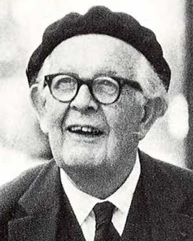
Jean Piaget
Jean William Fritz Piaget was a Swiss psychologist known for his work on child development. Piaget's theory of cognitive development and epistemological view are together called genetic epistemology.
Jean William Fritz Piaget (9 August 1896 – 16 September 1980) was a Swiss psychologist known for his work on child development. Piaget's theory of cognitive development and epistemological view are together called genetic epistemology.
Piaget placed great importance on the education of children. As the Director of the International Bureau of Education, he declared in 1934 that "only education is capable of saving our societies from possible collapse, whether violent, or gradual". His theory of child development has been studied in pre-service education programs. Nowadays, educators and theorists working in the area of early childhood education persist in incorporating constructivist-based strategies.
Piaget created the International Center for Genetic Epistemology in Geneva in 1955 while on the faculty of the University of Geneva, and directed the center until his death in 1980. The number of collaborations that its founding made possible, and their impact, ultimately led to the Center being referred to in the scholarly literature as "Piaget's factory".
According to Ernst von Glasersfeld, Piaget was "the great pioneer of the constructivist theory of knowing". His ideas were widely popularized in the 1960s. This then led to the emergence of the study of development as a major sub-discipline in psychology. By the end of the 20th century, he was second only to B. F. Skinner as the most-cited psychologist.
Early life and education
Piaget was born in 1896 in Neuchâtel, in the Francophone region of Switzerland. He was the oldest son of Arthur Piaget (Swiss), a professor of medieval literature at the University of Neuchâtel, and Rebecca Jackson (French). Rebecca Jackson came from a prominent family of French steel foundry owners. Piaget was a precocious child who developed an interest in biology and the natural world. His early interest in zoology earned him a reputation among those in the field after he had published several articles on mollusks by the age of 15.
When he was 15, his former nanny wrote to his parents to apologize for having once lied to them about fighting off a would-be kidnapper from baby Jean's pram. There never was a kidnapper. Piaget became fascinated that he had somehow formed a memory of this kidnapping incident, a memory that endured even after he understood it to be false.
He developed an interest in epistemology due to his godfather's urgings to study the fields of philosophy and logic. He was educated at the University of Neuchâtel, and studied briefly at the University of Zürich. During this time, he published two philosophical papers that showed the direction of his thinking at the time, but which he later dismissed as adolescent thought. His interest in psychoanalysis, at the time a burgeoning strain of psychology, can also be dated to this period.
Career
Piaget moved from Switzerland to Paris after his graduation and he taught at the Grange-Aux-Belles Street School for Boys. The school was run by Alfred Binet, the developer of the Binet-Simon test (later revised by Lewis Terman to become the Stanford–Binet Intelligence Scales). Piaget assisted in the marking of Binet's intelligence tests. It was while he was helping to mark some of these tests that Piaget noticed that young children consistently gave wrong answers to certain questions. Piaget did not focus so much on the fact of the children's answers being wrong, but that young children consistently made types of mistakes that older children and adults managed to avoid. This led him to the theory that young children's cognitive processes are inherently different from those of adults. Ultimately, he was to propose a global theory of cognitive developmental stages in which individuals exhibit certain common patterns of cognition in each period of development.
In 1921, Piaget returned to Switzerland as director of the Rousseau Institute in Geneva. At this time, the institute was directed by Édouard Claparède. Piaget was familiar with many of Claparède's ideas, including that of the psychological concept of groping which was closely associated with "trials and errors" observed in human mental patterns.
In 1923, he married Valentine Châtenay (7 January 1899 – 3 July 1983); the couple had three children, whom Piaget studied from infancy. From 1925 to 1929, Piaget worked as a professor of psychology, sociology, and the philosophy of science at the University of Neuchatel. In 1929, Piaget accepted the post of Director of the International Bureau of Education and remained the head of this international organization until 1968. Every year, he drafted his "Director's Speeches" for the IBE Council and for the International Conference on Public Education in which he explicitly addressed his educational credo.
Having taught at the University of Geneva, and at the University of Paris in 1964, Piaget was invited to serve as chief consultant at two conferences at Cornell University (11–13 March) and the University of California, Berkeley (16–18 March). The conferences addressed the relationship of cognitive studies and curriculum development, and strived to conceive implications of recent investigations of children's cognitive development for curricula.
Death
Piaget died on 16 September 1980, and, as he had requested, was buried with his family in an unmarked grave in the Cimetière des Rois (Cemetery of Kings) in Plainpalais district of Geneva.
Psychology
Harry Beilin described Piaget's theoretical research program as consisting of four phases:
the sociological model of development,
the biological model of intellectual development,
the elaboration of the logical model of intellectual development,
the study of figurative thought.
The resulting theoretical frameworks are sufficiently different from each other that they have been characterized as representing different "Piagets". More recently, Jeremy Burman responded to Beilin and called for the addition of a phase before his turn to psychology: "the zeroth Piaget".
Sociological model of development
Piaget first developed as a psychologist in the 1920s. He investigated the hidden side of children's minds. Piaget proposed that children moved from a position of egocentrism to sociocentrism. For this explanation he combined the use of psychological and clinical methods to create what he called a semiclinical interview. He began the interview by asking children standardized questions and depending on how they answered, he would ask them a series of standard questions. Piaget was looking for what he called "spontaneous conviction" so he often asked questions the children neither expected nor anticipated. In his studies, he noticed there was a gradual progression from intuitive to scientific and socially acceptable responses. Piaget theorized children did this because of the social interaction and the challenge to younger children's ideas by the ideas of those children who were more advanced.
This work was used by Elton Mayo as the basis for the famous Hawthorne Experiments. For Piaget, it also led to an honorary doctorate from Harvard in 1936.
Biological model of intellectual development
In this stage, Piaget believed that the process of thinking and intellectual development could be regarded as an extension of the biological process of the (adaptation) of the species, which has also two ongoing processes: assimilation and accommodation. There is assimilation when a child responds to a new event in a way that is consistent with an existing schema. There is accommodation when a child either modifies an existing schema or forms an entirely new schema to deal with a new object or event.
He argued infants were engaging in the act of assimilation when they sucked on everything in their reach. He claimed infants transform all objects into an object to be sucked. The children were assimilating the objects to conform to their own mental structures. Piaget then made the assumption that whenever one transforms the world to meet individual needs or conceptions, one is, in a way, assimilating it. Piaget also observed his children not only assimilating objects to fit their needs, but also modifying some of their mental structures to meet the demands of the environment. This is the second division of adaptation known as accommodation. To start, the infants only engaged in primarily reflex actions such as sucking, but not long after, they would pick up objects and put them in their mouths. When they do this, they modify their reflex response to accommodate the external objects into reflex actions. Because the two are often in conflict, they provide the impetus for intellectual development—the constant need to balance the two triggers intellectual growth.
To test his theory, Piaget observed the habits in his own children.
Elaboration of the logical model of intellectual development
In the model Piaget developed in stage three, he argued that intelligence develops in a series of stages that are related to age and are progressive because one stage must be accomplished before the next can occur. For each stage of development the child forms a view of reality for that age period. At the next stage, the child must keep up with earlier level of mental abilities to reconstruct concepts. Piaget conceived intellectual development as an upward expanding spiral in which children must constantly reconstruct the ideas formed at earlier levels with new, higher order concepts acquired at the next level.
It is primarily the "Third Piaget" (the logical model of intellectual development) that was debated by American psychologists when Piaget's ideas were "rediscovered" in the 1960s.
Study of figurative thought
Piaget studied areas of intelligence like perception and memory that are not entirely logical. Logical concepts are described as being completely reversible because they can always get back to the starting point, meaning that if one starts with a given premise and follows logical steps to reach a conclusion, the same steps may be done in the opposite order, starting from the conclusion to arrive at the premise. The perceptual concepts Piaget studied could not be manipulated. To describe the figurative process, Piaget uses pictures as examples. Pictures cannot be separated because contours cannot be separated from the forms they outline. Memory is the same way: it is never completely reversible; people cannot necessarily recall all the intervening events between two points. During this last period of work, Piaget and his colleague Bärbel Inhelder also published books on perception, memory, and other figurative processes such as learning.
Because Piaget's theory is based upon biological maturation and stages, the notion of readiness is important. Readiness concerns when certain information or concepts should be taught. According to Piaget's theory, children should not be taught certain concepts until they reached the appropriate stage of cognitive development. For example, young children in the preoperational stage engage in "irreversible" thought and cannot comprehend that an item that has been transformed in some way may be returned to its original state.
Theory
Piaget defined himself as a 'genetic' epistemologist, interested in the process of the qualitative development of knowledge. He considered cognitive structures' development as a differentiation of biological regulations. When his entire theory first became known – the theory in itself being based on a structuralist and a cognitivitist approach – it was an outstanding and exciting development in regards to the psychological community at that time.
There are a total of four phases in Piaget's research program that included books on certain topics of developmental psychology. In particular, during one period of research, he described himself studying his own three children, and carefully observing and interpreting their cognitive development. In one of his last books, Equilibration of Cognitive Structures: The Central Problem of Intellectual Development, he intends to explain knowledge development as a process of equilibration using two main concepts in his theory, assimilation and accommodation, as belonging not only to biological interactions but also to cognitive ones.
He stated that children are born with limited capabilities and their cognition ability develops with age.
Piaget believed answers for the epistemological questions at his time could be answered, or better proposed, if one looked to the genetic aspect of it, hence his experimentations with children and adolescents. As he says in the introduction of his book Genetic Epistemology: "What the genetic epistemology proposes is discovering the roots of the different varieties of knowledge, since its elementary forms, following to the next levels, including also the scientific knowledge."
Stages
The four development stages are described in Piaget's theory as:
Psychology of functions and correspondences
Piaget had sometimes been criticized for characterizing preoperational children in terms of the cognitive capacities they lacked, rather than their cognitive accomplishments. A late turn in the development of Piaget's theory saw the emergence of work on the accomplishments of those children within the framework of his psychology of functions and correspondences. This new phase in Piaget's work was less stage-dependent and reflected greater continuity in human development than would be expected in a stage-bound theory. This advance in his work took place toward the end of his very productive life and is sometimes absent from developmental psychology textbooks.
An example of a function can involve sets X and Y and ordered pairs of elements (x,y), in which x is an element of X and y, Y. In a function, an element of X is mapped onto exactly one element of Y (the reverse need not be true). A function therefore involves a unique mapping in one direction, or, as Piaget and his colleagues have written, functions are "univocal to the right" (Piaget et al., 1977, p. 14). When each element of X maps onto exactly one element of Y and each element of Y maps onto exactly one element of X, Piaget and colleagues indicated that the uniqueness condition holds in either direction and called the relationship between the elements of X and Y "biunivocal" or "one-to-one". They advanced the idea that the preoperational child manifests some understanding of one-way order functions.
According to Piaget's Genevan colleagues, the "semilogic" of these order functions sustains the preoperational child's ability to use of spatial extent to index and compare quantities. The child, for example, could use the length of an array to index the number of objects in the array. Thus, the child would judge the longer of two arrays as having the greater number of objects. Although imperfect, such comparisons are often fair ("semilogical") substitutes for exact quantification. Furthermore, these order functions underlie the child's rudimentary knowledge of environmental regularities. Young children are capable of constructing—this reflects the constructivist bent of Piaget's work—sequences of objects of alternating color. They also have an understanding of the pairwise exchanges of cards having pictures of different flowers.
Piaget and colleagues have examined morphisms, which to them differ from the operative transformations observed on concrete operational children. Piaget (1977) wrote that "correspondences and morphisms are essentially comparisons that do not transform objects to be compared but that extract common forms from them or analogies between them" (p. 351). He advanced the idea that this type of knowledge emerges from "primitive applications" of action schemes to objects in the environment. In one study of morphisms, Piaget and colleagues asked children to identify items in a series of movable red cutouts that could cover a pre-specified section of each of four base cards—each card had a red area and a white area. The task, in effect, asked the child to superimpose the cut-outs on a base card to make the entire card appear to be red. Although there were 12 cutouts in all, only three, which differed slightly from each other, could make an entire base card look red. The youngest children studied—they were age 5—could match, using trial and error, one cut-out to one base card. Piaget et al. called this type of morphism bijection, a term-by-term correspondence. Older children were able to do more by figuring out how to make entire card appear to be red by using three cutouts. In other words, they could perform three to one matching. Piaget et al. (1977) called a many-to-one match surjection.
Developmental process
Piaget provided no concise description of the development process as a whole. Broadly speaking it consisted of a cycle:
The child performs an action which has an effect on or organizes objects, and the child is able to note the characteristics of the action and its effects.
Through repeated actions, perhaps with variations or in different contexts or on different kinds of objects, the child is able to differentiate and integrate its elements and effects. This is the process of "reflecting abstraction" (described in detail in Piaget 2001).
At the same time, the child is able to identify the properties of objects by the way different kinds of actions affect them. This is the process of "empirical abstraction".
By repeating this process across a wide range of objects and actions, the child establishes a new level of knowledge and insight. This is the process of forming a new "cognitive stage". This dual process allows the child to construct new ways of dealing with objects and new knowledge about objects themselves.
Once the child has constructed these new kinds of knowledge, he or she starts to use them to create still more complex objects and to carry out still more complex actions. As a result, the child starts to recognize still more complex patterns and to construct still more complex objects. Thus a new stage begins, which will only be completed when all the child's activity and experience have been re-organized on this still higher level.
This process may not be wholly gradual, but new evidence shows that the passage into new stages is more gradual than once thought. Once a new level of organization, knowledge and insight proves to be effective, it will quickly be generalized to other areas if they exist. As a result, transitions between stages can seem to be rapid and radical, but oftentimes the child has grasped one aspect of the new stage of cognitive functioning but not addressed others. The bulk of the time spent in a new stage consists of refining this new cognitive level; it does not always happen quickly. For example, a child may see that two different colors of Play-Doh have been fused together to make one ball, based on the color. If sugar is mixed into water or iced tea, then the sugar "disappeared" and therefore does not exist to the child at that stage. These levels of one concept of cognitive development are not realized all at once, giving us a gradual realization of the world around us.
It is because this process takes this dialectical form, in which each new stage is created through the further differentiation, integration, and synthesis of new structures out of the old, that the sequence of cognitive stages are logically necessary rather than simply empirically correct. Each new stage emerges only because the child can take for granted the achievements of its predecessors, and yet there are still more sophisticated forms of knowledge and action that are capable of being developed.
Adapted from the Wikipedia article Jean Piaget, available under CC BY-SA 4.0.
Connections


You might also explore
 Karl Popper★Modern European1902 – 1994Philosopher of science for whom theories must be falsifiable; defender of the open society.
 Theodor AdornoModern European1903 – 1969Frankfurt School critic of the culture industry and instrumental reason.
 Friedrich Nietzsche★Modern European1844 – 1900Diagnostician of nihilism who proclaimed the death of God and called for a revaluation of all values.
 G. W. F. Hegel★Modern European1770 – 1831Systematic idealist for whom history is the dialectical self-realisation of Spirit and freedom.
 Arthur Schopenhauer★Modern European1788 – 1860Pessimist who saw the world as blind Will and found relief in art, compassion and Indian philosophy.
 Hannah Arendt★Modern European1906 – 1975Political theorist of totalitarianism, action and the "banality of evil".