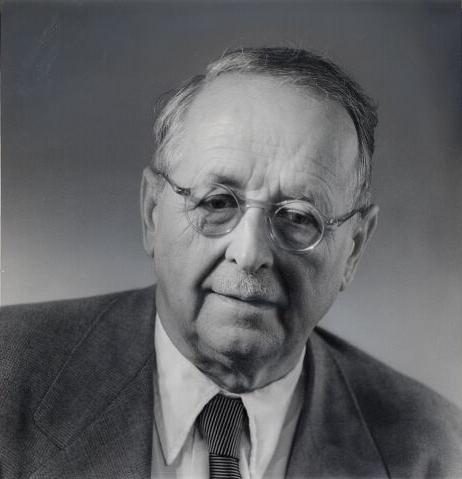
Hermann Weyl
Hermann Klaus Hugo Weyl was a German mathematician, theoretical physicist, logician, philosopher and polymath. Widely regarded as one of the most significant mathematicians of the twentieth century, he made major contributions to differential geometry, Lie group theory, representation theory, number theory, mathematica
Hermann Klaus Hugo Weyl ( VILE; German: [vaɪl]; 9 November 1885 – 8 December 1955) was a German mathematician, theoretical physicist, logician, philosopher and polymath. Widely regarded as one of the most significant mathematicians of the twentieth century, he made major contributions to differential geometry, Lie group theory, representation theory, number theory, mathematical physics and foundations of mathematics. His work was instrumental to the transition from classical mathematics, founded on the real number, to modern mathematics, founded on the notion of structure.
Weyl made significant contributions to an exceptionally wide range of intellectual fields, including mathematics, physics, philosophy and logic, with interests extending to the nature of space, time, matter and symmetry, as well as the history of mathematics. His work on Lie groups and their representations helped establish group theory as a central tool in modern mathematics and theoretical physics, particularly in the mathematical formulation of quantum mechanics. He developed a systematic theory of the invariants and representations of classical groups, bringing classical invariant theory into the framework of modern algebra, while his work on the foundations of mathematics has been regarded as the opening chapter in the development of the field of predicative mathematics. His work on group theory and symmetry also helped lay the foundations for structuralist approaches to the philosophy of science, and has been regarded as an important precursor of ontic structural realism.
Weyl introduced gauge theory, initially proposing in 1918 a theory intended to unify gravitation and electromagnetism through local scale invariance, before reformulating the principle in 1929 using local phase transformations. His gauge principle became a central framework of modern particle physics and quantum field theory and has been described as “the most fundamental cornerstone of modern theoretical physics”.
He was among the pioneers of applying group theory to quantum mechanics and made important contributions to the formulation of general relativity and quantum theory. In cosmology, he formulated the Weyl postulate, which became an important cornerstone of relativistic cosmology, and used it to theoretically derive Hubble's redshift law in 1923, several years before Hubble's observational establishment.
An important member of the Institute for Advanced Study during its early years, Weyl conceived of mathematics as an organic whole, a view informed by his philosophical outlook, and this conception shaped his work across disciplines. His intellectual and mathematical stature attracted broad recognition from his contemporaries and successors. Freeman Dyson wrote that Weyl alone bore comparison with the "last great universal mathematicians of the nineteenth century", Henri Poincaré and David Hilbert. Vladimir Arnold and Aleksei Parshin described his mathematical, philosophical, physical and literary breadth as having made him “a phenomenon of twentieth-century German culture in entirety".
Biography
Hermann Weyl was born in Elmshorn, a small town near Hamburg, in Germany, and attended the Gymnasium Christianeum in Altona. His father, Ludwig Weyl, was a banker; whereas his mother, Anna Weyl (née Dieck), came from a wealthy family.
From 1904 to 1908, he studied mathematics and physics at both the University of Göttingen and the Ludwig-Maximilians-Universität München. His doctorate was awarded at the University of Göttingen under the supervision of David Hilbert, whom he greatly admired. Although much of his later working life was spent in Zürich, Switzerland, and then Princeton, New Jersey, he is associated with the University of Göttingen tradition of mathematics, represented by Carl Friedrich Gauss, David Hilbert and Hermann Minkowski.
In 1913, Weyl married Friederike Bertha Helene Joseph, known as Helene or Hella.
Helene had studied philosophy and mathematics at the University of Göttingen, where she attended the lectures of phenomenologist Edmund Husserl. She later became a translator of Spanish and English literature into German, particularly the works of Spanish philosopher José Ortega y Gasset. Helene's studies under Husserl seem to have helped stimulate Weyl's interest in phenomenology, although Weyl had himself attended Husserl's lectures during his student years in Göttingen. Weyl and Helene had two sons, Fritz Joachim Weyl and Michael Weyl, both of whom were born in Zürich, Switzerland. Helene died in Princeton, New Jersey, on 5 September 1948. A memorial service in her honor was held in Princeton on 9 September 1948. Speakers at her memorial service included her son Fritz Joachim Weyl and mathematicians Oswald Veblen and Richard Courant. In 1950, Weyl married sculptor Ellen Bär (née Lohnstein), who was the widow of professor Richard Josef Bär of Zürich.
After taking a teaching post for a few years, Weyl left Göttingen in 1913 for Zurich to take the chair of mathematics. There he overlapped with Albert Einstein, who, together with Marcel Grossmann, was working on the mathematical formulation of general relativity. Einstein's work helped ignite Weyl's interest in physics, particularly the theory of relativity. In 1921, Weyl met Erwin Schrödinger, a theoretical physicist who at the time was a professor at the University of Zurich. They were to become close friends over time. Weyl and Schrödinger's wife, Annemarie ("Anny") Schrödinger, began a relationship that lasted for several years that Schrödinger learned of only in the early 1930s. By that time the Schrödingers were living in an open marriage, and the revelation did not damage his friendship with Weyl.
Following the start of the World War I, Weyl was drafted into the German Army on 15 May 1915 and stationed near Saarbrücken. At the request of the Swiss government, he was released from military service in 1916 and returned to his position at the ETH Zürich. The interruption had profoundly affected his mathematical work. Reflecting on the experience in a 1946 address at Princeton University, Weyl recalled: "My mathematical mind was as blank as any veteran’s and I did not know what to do. I began to study algebraic surfaces; but before I had gotten far, Einstein’s memoir came into my hands and set me afire." The memoir was Einstein’s 1916 work on general relativity, which renewed Weyl’s interest in mathematical physics..
Weyl was a Plenary Speaker of the International Congress of Mathematicians (ICM) in 1928 at Bologna and an Invited Speaker of the ICM in 1936 at Oslo. For the academic year 1928–1929, he was a visiting professor at Princeton University where he wrote a paper, "On a problem in the theory of groups arising in the foundations of infinitesimal geometry," with Howard P. Robertson.
In 1930, Weyl left the University of Zürich to succeed David Hilbert as professor of mathematics at the University of Göttingen. He remained there until 1933, when he left Germany in opposition to the Nazi regime. His decision was also influenced by the fact that his wife, Helene, was Jewish and their sons were classified as Jewish under Nazi racial laws. Abraham Flexner, the director of the newly established Institute for Advanced Study in Princeton, had first approached Weyl about joining its faculty in 1932. Although Weyl initially accepted the offer, he later declined it after the death of his mother-in-law and an outbreak of influenza in his household. As conditions in Germany deteriorated, Flexner renewed the offer in September 1933, and Weyl accepted. He joined the Institute's faculty that year and remained there until his retirement in 1951, when he became Professor Emeritus. During World War II, Weyl contributed to the Allied war effort as a civilian mathematician, conducting theoretical research on shock waves and fluid dynamics, remaining in Princeton. After retiring, he divided his time between Princeton and Zürich with his second wife Ellen Bär. He died of a heart attack in Zürich on 8 December 1955.
Weyl was cremated in Zurich on 12 December 1955. His remains were subsequently interred in a columbarium at Princeton Cemetery in 1999.
The remains of Weyl's son Michael Weyl (1917–2011) are interred right next to Hermann's ashes in the same columbarium vault.
In his 1908 doctoral curriculum vitae, Weyl identified his religion as Evangelical Lutheran. Weyl's later conception of God has been recognised as similar to the philosophy of Baruch Spinoza, particularly his understanding of God or nature.
Working Style
According to Max Newman, Weyl’s working style was characterised by a conceptual theme: he preferred arguments emerging from the central core of a problem to computational verification, and often favoured verbal formulations over symbolic ones. Nevertheless, this taste for general theories did not diminish his rigour for mathematical detail, and he regarded examples as essential to mathematical understanding. Newman described his writing as leisurely and rich in ideas. Schrödinger was astonished about how he found Weyl’s written explanations harder to follow than his speech. He attributed this to mathematical objects and conclusions being so apparent to Weyl that he sometimes omitted intermediate steps other people considered necessary. Schrödinger attributed this partly to Weyl’s aesthetic sensibility. Weyl himself expressed an aesthetic orientation in his outlook, remarking famously: "My work always tried to unite the true with the beautiful; but when I had to choose one or the other, I usually chose the beautiful."
Mathematics
Hermann Weyl's work had a foundational influence on much of mathematics. In particular, he is credited with deeply shaping several fields, including differential geometry, topological groups, Lie groups, representation theory, harmonic analysis, analytic number theory and spectral theory.
Max Newman wrote that Weyl was at the peak of his powers between 1917 and 1927, adding: "A stream of papers appeared, not only on his main themes, but on any mathematical topics that interested him—and that meant in almost all parts of mathematics."
Manifolds and Topology
Weyl's 1913 book, Die Idee der Riemannschen Fläche (The Concept of a Riemann Surface), based on his Göttingen lectures of 1911–12, provided the first precise axiomatic definition of an abstract manifold.
At the time, the theory of Riemann surfaces, pioneered by Bernhard Riemann and Felix Klein, was not a fully rigorous field and relied on intuitive geometry in large part. Weyl's work grounded this more intuitive picture with a systematic foundation. He defined the concept of a two-dimensional topological manifold abstractly by using a list of axioms which are independent of any embedding in a larger space. Holomorphic transition functions were then added between coordinate charts, creating a complex-analytic manifold, a Riemann surface in the modern sense. The work laid the axiomatic foundations for the theory of Riemann surfaces, by becoming the model for all subsequent kinds of manifolds studied in the twentieth century, such as differentiable, complex, Riemannian, and symplectic manifolds. The book also gave a new proof of the Dirichlet principle, following Hilbert, to establish the existence of global meromorphic functions on these surfaces. Mathematician Leo Sario described Weyl's 1913 publication as "undoubtedly [having] a greater influence on the development of geometric function theory than any other publication since Riemann's dissertation."
Differential Geometry
By 1915, Albert Einstein's general theory of relativity had successfully described gravity as the curvature of four-dimensional spacetime. However, electromagnetism remained a separate force, described by Maxwell's equations rather than by geometry. It was widely felt that a truly fundamental theory should not treat these as two unrelated phenomena, but should show some sort of unity; Einstein himself considered it a primary shortcoming of his theory that it did not unify gravitation and electromagnetism.
Weyl found it philosophically and mathematically unsatisfying that Riemannian geometry allowed for the direct comparison of lengths at distant points, which he saw as a "last element of geometry 'at a distance'" and an accidental remnant of its Euclidean origins. He argued that a "true infinitesimal geometry" should only permit the comparison of lengths at the same point or at infinitesimally close points. His ambition was to construct a geometry based on this purely infinitesimal principle. His insight was that in the process of fixing this perceived mathematical flaw, the resulting geometric structure would also naturally accommodate the electromagnetic field.
In 1918, Weyl introduced a generalisation of Riemannian geometry known as Weyl geometry, based on a local scale (gauge) symmetry. In it, the length of a vector is not constant when it is moved from one point to another, so its length can change depending on the path taken. This change is described by a new field, a 1-form Aμ, which mathematically acts as the electromagnetic four-potential. The gravitational field is described by the spacetime metric (as in general relativity), while the electromagnetic field is described by the new gauge field Aμ that dictates how lengths change from point to point. Both are now facets of a single, unified geometric structure. From this framework Weyl derived a tensor that exists as a Riemannian conformal object, not something that subsists only within Weyl’s full gauge geometry. This tensor, later called the Weyl tensor, is the trace-free part of the Riemann curvature tensor and is conformally invariant. The Weyl tensor became a fundamental object in differential geometry and general relativity, where it describes tidal forces and gravitational waves.
Einstein critiqued the physical aspect of Weyl’s theory, noting that if the length of a vector is path-dependent, then the rate of a clock (whose ticking is based on a physical length, such as the size of an atom) would also depend on its history. This leads to the prediction of a not yet observed effect, the so-called "second clock effect". In a space-time ruled by Weyl geometry, the existence of sharp spectral lines in the presence of an electromagnetic field would not be possible since atomic clocks would depend on their past history. Since sharp spectral lines are observed in nature, Einstein concluded that Weyl's theory could not be a correct description of physical reality. Despite this, Einstein praised the idea’s ingenuity. He wrote “Apart from agreement with reality, it is in any case a grandiose achievement of thought [...] its depth and boldness must fill every reader with admiration."
Lie groups, representation theory and invariant theory
Alongside Élie Cartan, Weyl was a major influence in establishing Lie group theory and algebraic group theory as basic fields of mathematical research. In 1925-26, he wrote four papers, described as "epochal", in representation theory of Lie groups, which solved fundamental problems and also gave birth to the subject of harmonic analysis of semisimple Lie groups. These papers drew together Schur's work on the rotation group, Cartan's classification of semisimple Lie algebras, Hilbert's theory of integral equations, and invariant theory. Weyl regarded them as his greatest mathematical work.
The papers built a general theory of finite-dimensional representations of semisimple Lie groups. The Weyl group is the subgroup generated by reflections through the hyperplanes orthogonal to the roots, and as such is a finite reflection group; the Weyl character formula describes the characters of irreducible representations in terms of their highest weights; and the Weyl dimension formula is a corollary of the character formula. Weyl proved the character formula analytically, by integration over a compact group, using Hilbert's integral equations. The unitary trick later let him pass from the compact case to the complex semisimple case, and he gave the resulting algebraic treatment in The Classical Groups (1939).
Together with Fritz Peter, he also proved the Peter–Weyl theorem in 1927, which establishes that, for a compact topological group, the finite-dimensional (almost invariant) functions form a uniformly dense set within the space of all continuous functions. The theorem provided a generalisation of Fourier analysis to non-commutative compact groups, demonstrating that their functions could be decomposed into contributions from irreducible representations. This launched what is now known as harmonic analysis on groups. This work, alongside his 1925 papers on semisimple groups, constitutes an important landmark in the history of Lie theory and mathematics more broadly. André Weil and Claude Chevalley remarked that after the discovery of Haar measure, "not a word needed to be changed" in Weyl's exposition, and "no one even thought to rewrite it, a rare occurrence in mathematics.”
In 1939 he published The Classical Groups: Their Invariants and Representations, which treated the general linear, special linear, orthogonal, and symplectic groups together. The book linked classical invariant theory with modern representation theory. It showed how to understand polynomial invariants of the general linear, orthogonal, and symplectic groups through linear representations and tensor methods. It has been widely credited with reviving interest in invariant theory. Weyl also coined the now-standard term "classical groups".
Weyl placed quantum-mechanical symmetry on a group-theoretic footing, including spinors. Together with John von Neumann’s independent Hilbert space formulation, this shaped the standard mathematical treatment of quantum mechanics that emerged in the early 1930s.
The Weyl algebra, whose relations Weyl had set out in 1927, subsequently became an important object in noncommutative algebra and the theory of differential operators, with applications to partial differential equations, D-module theory and symplectic geometry. It has been described as serving as a bridge between these disparate fields.
Integral Equations and Spectral Theory
Weyl’s 1910 paper is credited with initiating the modern study of singular Sturm–Liouville problems. It was a separation from the older regular Sturm–Liouville theory, which could only handle finite intervals and discrete spectra. Weyl’s circle method treats the eigenvalue equation for non-real values of the spectral parameter and follows the nested circles traced out by the Weyl m-function as the interval grows toward a singular endpoint. These circles either shrink to a point or tend to a limiting circle, giving the limit-point/limit-circle alternative. In the limit-circle case a boundary condition is needed for a self-adjoint realization, whereas in the limit-point case the endpoint is already essentially self-adjoint. The resulting eigenfunction expansions have both a discrete and a continuous part. Separately, Weyl’s stability theorem shows that the essential spectrum is invariant under compact perturbations and, in particular, does not change when the boundary condition is changed. The theory has remained an intensely active field of research ever since, and the paper has been described as a milestone in the development of twentieth-century mathematical analysis.
Weyl's work on integral equations began with Hilbert's program of applying spectral theory to symmetric kernels. Hilbert had shown that the method failed in singular cases. Weyl's 1908 dissertation gave sufficient conditions on the kernel K(s,t) for the associated bilinear form to remain bounded on an unbounded interval, thereby extending Hilbert's spectral theory to cases where complete continuity fails.
Adapted from the Wikipedia article Hermann Weyl, available under CC BY-SA 4.0.
Connections
Influenced by
2

Ideas & arguments
2
You might also explore
 Martin Heidegger★Modern European1889 – 1976Asked the question of the meaning of Being; analysed human existence (Dasein) as being-in-the-world and…
 Arthur Schopenhauer★Modern European1788 – 1860Pessimist who saw the world as blind Will and found relief in art, compassion and Indian philosophy.
 Michel Foucault★Modern European1926 – 1984Historian of power and knowledge — prisons, madness, sexuality and the disciplined self.
 Hannah Arendt★Modern European1906 – 1975Political theorist of totalitarianism, action and the "banality of evil".
 Johann Gottlieb FichteModern European1762 – 1814Johann Gottlieb Fichte was a German philosopher, and a founding figure of German idealism, which developed from the…
 Jürgen HabermasModern Europeanborn 1929Theorist of communicative action and deliberative democracy.