
George Henry Lewes
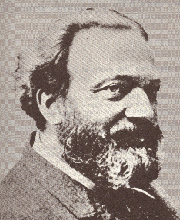
George Henry Lewes was an English philosopher and critic of literature and theatre. He was also an amateur physiologist.
George Henry Lewes ( ; 18 April 1817 – 30 November 1878) was an English philosopher and critic of literature and theatre. He was also an amateur physiologist. American feminist Margaret Fuller called Lewes a "witty, French, flippant sort of man". He became part of the mid-Victorian ferment of ideas which encouraged discussion of Darwinism, positivism, and religious skepticism. However, he is perhaps best known today for having openly lived with Mary Ann Evans, who wrote under the pen name George Eliot, as soulmates whose lives and writings were enriched by their relationship, though they never married each other.
Early life
Lewes, born in London, was the illegitimate son of the minor poet John Lee Lewes and Elizabeth Ashweek, and the grandson of comic actor Charles Lee Lewes. His mother married a retired sea captain when he was six. Frequent changes of home meant he was educated in London, Jersey, and Brittany and finally at Dr Charles Burney's school in Greenwich. Having abandoned successively a commercial and a medical career, he seriously thought of becoming an actor and appeared several times on stage between 1841 and 1850. Finally he devoted himself to literature, science and philosophy.
As early as 1836, he belonged to a club formed for the study of philosophy, and had sketched out a physiological treatment of the philosophy of the Scottish school. Two years later he went to Germany, probably with the intention of studying philosophy.
Lewes undertook studies on nutrition and physiology; he explored the question whether sugar was injurious to teeth. He conducted experiments on the reflexes and the nervous system of living animals, especially frogs, using ether and chloroform out of consideration for their pain.
He became friends with Leigh Hunt, and through him he entered London Literary Society and met John Stuart Mill, Thomas Carlyle and Charles Dickens.
Marriage to Agnes Jervis
On 18 February 1841, Lewes married 19-year-old Agnes Jervis, daughter of Swynfen Stevens Jervis, who gave written permission for the marriage and witnessed the wedding. There are several theories about how they met, such as Lewes working for Swynfen Jervis as a secretary or tutor for his sons. They may have met through Thornton Hunt's circle of friends. Jervis was young, and considered "lovely", "charming", and intelligent. She took positions as a translator to augment the family's income.
The couple lived in Kensington in the houses of Lewes's mother and others. Lewes and Agnes Jervis agreed to have an open marriage. Between 1842 and 1848, Lewes and his wife had four sons together, Charles Lee, Thornton Arnott, Herbert Arthur, and St Vincent Arthy. Agnes also had four children by Lewes's best friend (Thornton Hunt), the son of Leigh Hunt. Because Lewes was named on the birth certificate as the father of one of these children despite knowing this to be false, he was considered complicit in adultery and was not able to divorce Agnes. Lewes left his wife in 1854 to live with Mary Ann Evans.
Of his sons only one, Charles (1843–1891), survived him. He was elected as the first London County Councillor (1888) for St Pancras North. He was also much interested in the Hampstead Heath extension. Charles married Gertrude Hill, granddaughter of Thomas Southwood Smith and sister of the social reformers Miranda Hill and Octavia Hill, the latter of whom jointly founded the National Trust.
Relationship with Mary Ann Evans
Lewes met writer Mary Ann Evans, later to be famous as George Eliot, in 1851, and by 1854 they had decided to live together. As a result, the couple lived with scandal for some time and Evans's family spurned them. They lived together as husband and wife, although never married, for 25 years. Lewes died in 1878. In about two years, Evans had married John Cross and after seven months of marriage she died suddenly in December 1880. She was buried next to Lewes at Highgate Cemetery.
Death
Lewes died on 30 November 1878 and is buried on the eastern side of Highgate Cemetery, diagonally across from the grave of his common-law wife Mary Ann Evans, known best by her pen name George Eliot. She died 22 December 1880, and was buried as Mary Ann Cross, her remarried name.
Adapted from the Wikipedia article George Henry Lewes, available under CC BY-SA 4.0.
Connections
Belongs to
1You might also explore
 Auguste Comte★Modern European1798 – 1857Isidore Auguste Marie François Xavier Comte was a French philosopher and writer who formulated the doctrine of…
 Herbert Spencer★Modern European1820 – 1903Herbert Spencer was an English polymath active as a philosopher, psychologist, biologist, sociologist, and…
 Nikolay ChernyshevskyModern European1828 – 1889Nikolay Gavrilovich Chernyshevsky was a Russian literary and social critic, journalist, novelist, democrat, and…
 Leo StraussModern European1899 – 1973Leo Strauss was a German-American political philosopher and historian of philosophy whose work greatly influenced…
 Richard AvenariusModern European1843 – 1896Richard Heinrich Ludwig Avenarius was a German-Swiss philosopher, born in Paris. He formulated the radical positivist…Alexandre KoyréModern European1892 – 1964Alexandre Koyré, also anglicized as Alexander Koyre, was a French philosopher of Russian origin who wrote on the…